



Earning Passive Income with Stablecoins: The Realistic Guide to Crypto Gains
The “Snout0x” Key Takeaways
-
Yield is Risk, Not Magic: Stablecoins offer 4%–10% APY because you are taking on risk (smart contract bugs, exchange bankruptcy), not because the blockchain likes you.
-
The “Lazy Tax” is Real: Centralized exchanges (Coinbase, Kraken) skim off ~50% of the yield. To get the full return, you must use DeFi protocols like Aave directly.
-
Not Your Keys, Not Your Yield: If you lend via a centralized exchange, you are an “unsecured creditor.” If they go bankrupt (like Celsius/FTX), your “savings” are used to pay their lawyers.
-
The “De-Peg” Threat: A stablecoin is only $1.00 until it isn’t. Diversify across different issuers (USDC, DAI, PYUSD) to survive if one crashes.
-
The Tax Man is Watching: Every second of interest and every token swap is a taxable event. Do not use Excel; use automated tax software or you will go insane.
The Dream of “Sleep Money” vs. The NightmareIn recent years
“Passive Income” has become the most abused buzzword in finance. YouTube gurus promise you can retire in Bali by pressing two buttons on a sketchy website.
Here is the truth: Most “passive income” in crypto is actually just “active stress.”
But Stablecoins are the exception. They act as a bridge. They offer the stability of fiat currency (like the US Dollar) with the programmable yields of DeFi. Instead of earning 0.01% in a Wells Fargo savings account, you can realistically earn 4% to 8% on-chain.
Why isn’t everyone doing it? Because it requires technical skill, discipline, and the ability to spot a scam before it rugs you.
What Are Stablecoins? (And Why Do They Matter?)
Stablecoins are cryptocurrencies designed to hold a stable value, usually pegged 1:1 to a fiat currency like the US Dollar (USDC, USDT, DAI).
-
The Problem: Bitcoin is great, but if you need to pay rent next month, you can’t risk your portfolio dropping 20% overnight because the CEO of Bitcoin (Wait, there isn’t one) tweeted something weird.
-
The Solution: Stablecoins let you stay in the crypto ecosystem—ready to buy dips or move funds—without exposing that cash to volatility.
But here is the “Snout0x Reality Check”: A stablecoin is essentially a corporate IOU. You are trusting the issuer (Circle, Tether) to actually have the dollars in the bank.
-
Deep Dive: Read more about the government’s crackdown on these issuers in my breakdown of The CLARITY Act 2026: Why the Government Wants Your Stablecoin Yield.
Strategy 1:
The “Lazy” Method (Centralized Exchanges / CeFi)
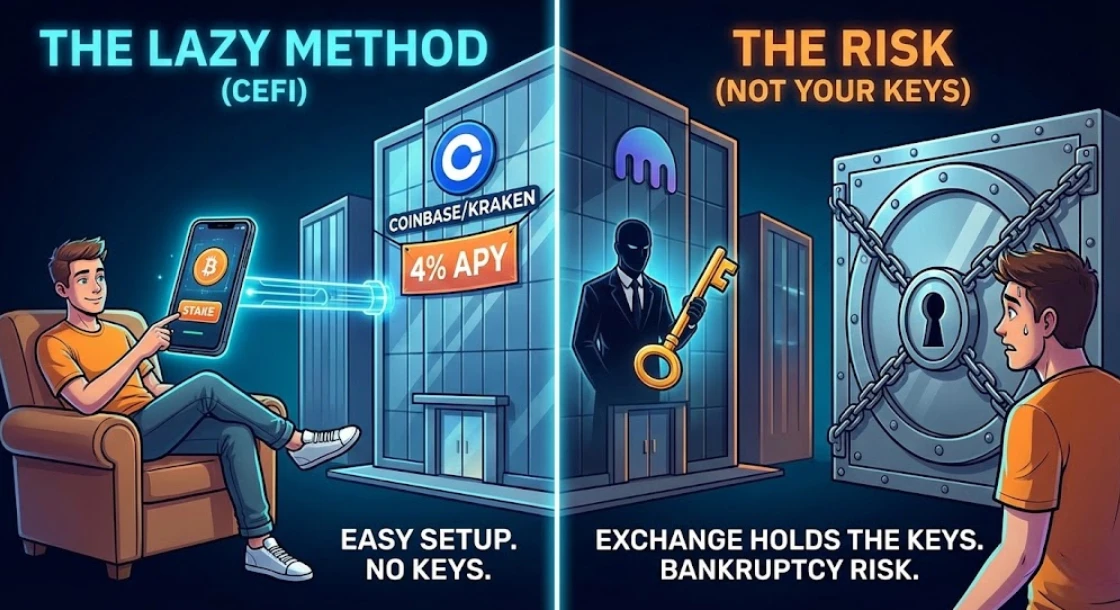
This is the easiest way to start, but it violates the golden rule of crypto: “Not your keys, not your coins.”
How it works (The Mechanics): You buy USDC on a regulated exchange like Coinbase or Kraken and opt-in to their “Rewards” or “Earn” program.
-
The Reality: You are effectively giving them an unsecured loan. They take your USDC, lend it to institutional market makers (hedge funds) who use it for trading leverage, and then they split the profit with you.
-
The “Lazy Tax”: If the hedge fund pays 8% interest, the exchange keeps 4% for “facilitating” the deal and gives you the remaining 4%. You are paying for the convenience of not managing your own keys.
Pros:
-
One-Click Setup: No Metamask, no seed phrases, no gas fees.
-
Instant Liquidity: You can usually sell or withdraw instantly (unless they pause withdrawals…).
-
Regulation (Sort of): Publicly traded companies like Coinbase are audited, meaning they are less likely to steal your funds than a random offshore site—but they are not invincible.
Cons:
-
You Are an “Unsecured Creditor”: Read the Terms of Service. If the exchange goes bankrupt (remember FTX? Celsius? BlockFi?), your funds are likely treated as company property. You stand last in line behind the lawyers.
-
No FDIC Insurance: Unlike a bank, if they lose your money, the government will not bail you out.
-
Lower Yields: You will almost always earn 2-3% less than you would using DeFi protocols directly.
Snout0x Tip: If you use this method, stick to publicly traded, audited companies (like Coinbase). Avoid “black box” offshore exchanges that promise 15% APY but won’t show you their Proof of Reserves.
Verdict: Good for keeping “dry powder” ready to buy dips, but terrible for life savings.
-
Comparison: Unsure if you should trust a company or code? Read CeFi vs DeFi Explained: Which Is Better for Earning Crypto Interest in 2026?.
Strategy 2:
The “DeFi” Standard (Lending Protocols)
This is where the real passive income lives. You use a non-custodial wallet to interact directly with a smart contract, cutting out the middleman (and the middleman’s fees).
The “Blue Chip” Protocols:
-
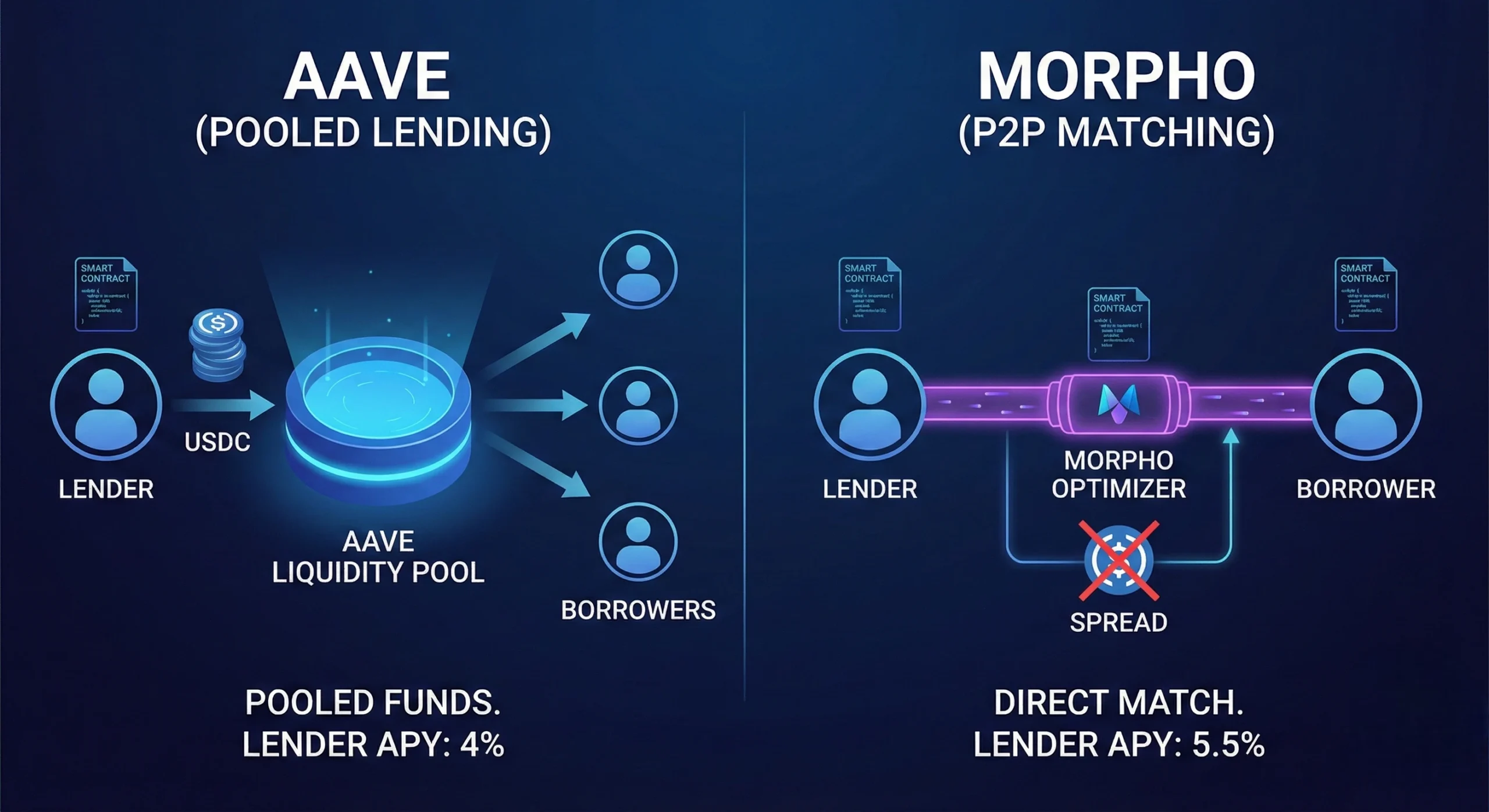
Aave (The Bank of DeFi): The largest liquidity protocol on Earth. You deposit USDC, and the code automatically lends it to borrowers who put up collateral (like ETH or WBTC). You get paid interest every second, typically 3% to 6% depending on market demand.
-
Compound: Similar to Aave, this is the grandfather of algorithmic lending. It is battle-tested, secure, and boring which is exactly what you want for your savings.
-
Morpho (The Optimizer): In 2026, smart money moved here. Morpho is a “peer-to-peer” layer built on top of Aave. It matches lenders directly with borrowers to eliminate the spread, often boosting your APY by 1-2% without taking on extra “degen” risk.
Why do this? Because it is Permissionless. No bank manager can freeze your account. No “business hours.” You interact strictly with code.
⚠️ The “Gas Fee” Warning (Critical): If you only have $500 to invest, do not use Ethereum Mainnet. The transaction fees ($5–$20) will eat your first year of profit.
-
The Fix: Use Aave on Arbitrum or Base (Layer 2 networks). The fees are pennies, but the yields are often the same or better.
💡 The “Degen” Secret (Looping): Advanced users don’t just lend; they “Loop.” They deposit USDC, borrow more USDC against it, and redeposit it.
-
Risk: This increases your yield (sometimes to 10%+), but if rates change or the peg slips, you can get liquidated (lose your funds) instantly. Do not do this unless you understand “Health Factor.”
Security Tip: To do this safely, you generally need a hardware wallet to sign the transactions. Do not keep $10,000 in a browser extension.
-
Check out my review: Ledger Nano X vs. Trezor Safe 7: Which Wins in 2026?
Strategy 3:
Liquidity Provision (The “Advanced” Play)
If Strategy 1 is a savings account and Strategy 2 is a bond, Strategy 3 is becoming the house. You provide the “fuel” (liquidity) that allows other people to swap tokens on a Decentralized Exchange (DEX) like Uniswap v3 or Curve Finance.
How it works (The Market Maker Model): When you provide liquidity to a “Stable-Pair Pool” (e.g., USDC/USDT or USDC/PYUSD), you deposit equal amounts of both coins into a smart contract.
-
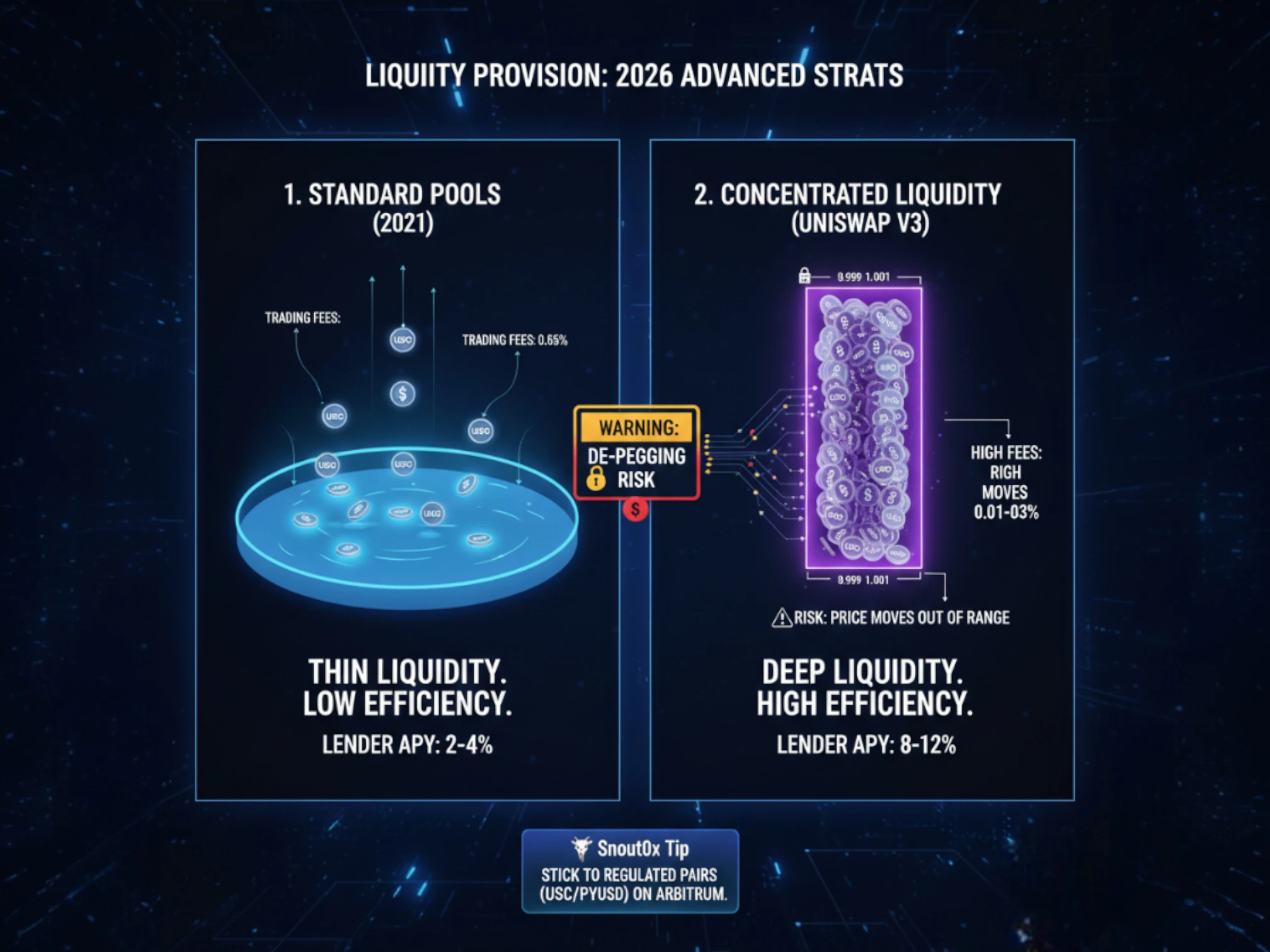
The “Fee” Engine: Every time a trader swaps between those two coins, they pay a small fee (usually 0.01% to 0.05%). Those fees are distributed directly to you based on your share of the pool.
-
Concentrated Liquidity: In 2026, the pros use “Concentrated Liquidity” (pioneered by Uniswap v3). Instead of spreading your money across all price ranges, you concentrate it in a tiny band (e.g., $0.999 to $1.001). This makes your capital 4000x more efficient, leading to those 8-12% yields even with low trading volume.
The Upside:
-
Negligible Impermanent Loss: Because you are pairing two assets that are both tied to $1.00, the “price ratio” rarely shifts, meaning you don’t lose money to the rebalancing issues that plague volatile pairs like ETH/BTC.
-
High Efficiency: On high-volume days (like when a major exchange pauses withdrawals), the fee income can spike to 20%+ APY temporarily.
The “2026” Risks (Read Carefully):
-
The “De-Peg” Trap: If one stablecoin in your pair loses its peg (e.g., a “systemic” coin like USDC vs. a “risky” algorithmic one), the pool will automatically trade your “good” coin for the “bad” one. You could wake up holding a bag of worthless tokens.
-
The Clarity Act Divide: Since the Clarity for Payment Stablecoins Act of 2026, the market has split into “Regulated Rails” (USDC, PYUSD) and “Offshore Liquidity” (USDT). Mixing these in a pool adds a layer of regulatory risk if one gets sanctioned or restricted, your liquidity could be frozen.
-
Range Risk: In concentrated liquidity, if the price moves even slightly out of your narrow $0.999–$1.001 band, you stop earning fees entirely until you manually reset your range (which costs gas).
Verdict: This is the most profitable “passive” strategy for large amounts of capital, but it requires weekly monitoring. If you “set it and forget it,” a single de-pegging event can wipe out three years of fees in three minutes.
Snout0x Tip: Stick to pools where both assets are backed 1:1 by high-quality liquid assets (HQLA) like U.S. Treasuries, as mandated by the Clarity Act. Avoid “synthetic” or algorithmic pairs unless you’re prepared to lose the principal.
The Risks: How to Not Get Wrecked
If you take nothing else from this article, memorize this section.
1. De-Pegging Risk Stablecoins are supposed to be $1.00. Sometimes they aren’t. In 2023, USDC briefly hit $0.87. In 2022, UST hit $0.00. Diversify your holdings. Don’t go “All In” on one coin.
2. Smart Contract Risk If Aave has a bug in its code, hackers could drain the pool. This is rare for “Blue Chips,” but it is a non-zero risk.
3. The Tax Man Cometh In most countries, earning crypto interest is a taxable event. Every time you claim rewards, that is income.
-
Solution: Do not try to use Excel. It is a nightmare. Use automation. Best Crypto Tax Software 2026: CoinLedger Review.
Step-by-Step: How to Start Earning Today
Get a Wallet: Do not leave funds on Binance. Set up a SafePal S1 or a Trezor Safe 7.
Buy USDC: It is generally considered the safest, most regulated stablecoin for DeFi.
Choose a Protocol: Go to a site like DefiLlama to check current yields on Aave or Compound.
Connect & Deposit: Link your wallet, approve the transaction, and deposit your funds.
Sleep: Watch the balance grow slowly.
Final Thoughts: Cynical but Realistic Empowerment
Passive income with stablecoins is boring. Good. It should be boring.
If you are looking for excitement, go gamble on memecoins (and likely lose). If you are looking to preserve purchasing power against inflation, stablecoin yield strategies are a powerful tool in 2026.
Just remember: In crypto, yield is never free. You are being paid for taking on risk. Manage it wisely.
Frequently asked questions
What exactly is a stablecoin?
A stablecoin is a cryptocurrency designed to hold a steady value, usually pegged 1:1 to a fiat currency like the US Dollar (e.g., USDC or USDT). It allows you to stay in the crypto ecosystem and earn yields without your portfolio swinging 20% in a single day.
Is earning passive income with stablecoins risk-free?
No. While the price of the coin is stable, the platforms you use might not be. Risks include “de-pegging” (where the coin drops below $1.00), smart contract bugs, or the lending platform going bankrupt. Never put your life savings into a single protocol.
What is the difference between staking and lending?
In staking, you lock tokens to support a blockchain’s security (like Ethereum). In lending, you give your tokens to a borrower (or a pool) who pays you interest. Lending often pays higher rates but carries higher risks of borrower default.
How much can I realistically earn?
In 2026, realistic “safe” yields on stablecoins typically range from 3% to 8% on major platforms. If you see someone promising 20%+ APY, run the other way—that is likely a Ponzi scheme or an extremely high-risk “degen” play.
Do I need a hardware wallet for stablecoins?
For large amounts, absolutely. Holding stablecoins on a Ledger or Trezor protects you from exchange hacks. You can still earn yield while keeping your keys secure by using hardware-compatible DeFi dashboards.
Subscribe to our newsletter
Enjoy exclusive special deals available only to our subscribers.