

Best Staking Coins 2026: Low-Risk Options for the paranoid HODLer
Disclosure & Transparency: I am not a financial advisor; I am a guy on the internet navigating the trenches just like you. I hold positions in ETH, SOL, and DOT. I am biased because I want my bags to go up. This article is for educational purposes only, never invest money you can’t afford to lose.
Key Takeaways
-
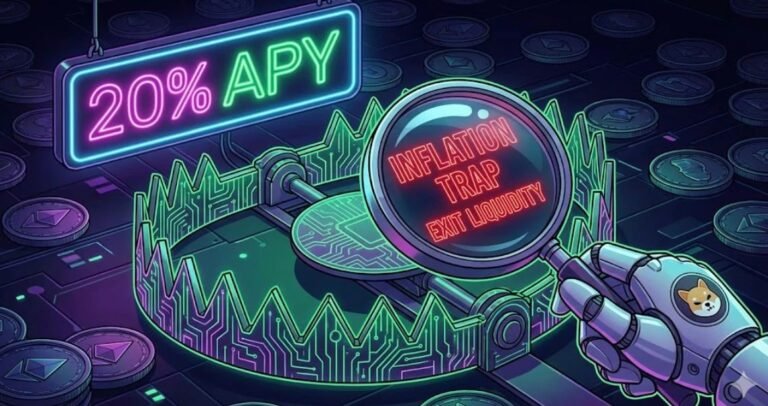
The “Real Yield” Test: In 2026, if a coin offers >15% APY, it is likely an inflationary Ponzi. Sustainable yield comes from transaction fees (Real Yield), not printing new tokens.
-
Ethereum is the “Risk-Free Rate”: Staking ETH is the digital equivalent of a US Treasury Bond. Expect 3-4% APY. For maximum safety, use decentralized liquid staking (like Rocket Pool) or a Solo Node if you have 32 ETH.
-
Solana = High Frequency: Solana is no longer just a casino; with the Firedancer upgrade, it is the “Nasdaq of Crypto.” Staking here targets ~7% APY, largely boosted by MEV (arbitrage) revenue.
-
Polkadot 2.0: The old “Parachain Auctions” are dead. The new “Agile Coretime” model burns DOT revenue directly. Use Nomination Pools to stake with as little as 1 DOT.
-
The Restaking Trap: Be very careful with “Restaking” (EigenLayer). Earning an extra 1% yield to take on massive smart contract risk is “picking up pennies in front of a steamroller.”
The “Safe Yield” Myth
Welcome to 2026. The days of “OlympusDAO forks” and algorithmic money printers are (mostly) gone. The survivors of the last bear market aren’t looking for a “moonshot” with their savings; they are looking for cash flow.
But here is the problem: “Staking” has become a buzzword used to disguise everything from actual network validation to Ponzi schemes.
In this guide, we are looking at Low-Risk Staking. What does “Low Risk” mean in crypto? It means the coin won’t go to zero while you are locked up. It means the yield comes from actual people paying to use the network, not just the protocol printing tokens out of thin air to pay you.
We are looking for the “Lindy Effect” coins that have survived multiple cycles, have billions in TVL (Total Value Locked), and are too big to fail (or at least, too big to rug overnight)
1. Ethereum (ETH) – The “Internet Bond”
-
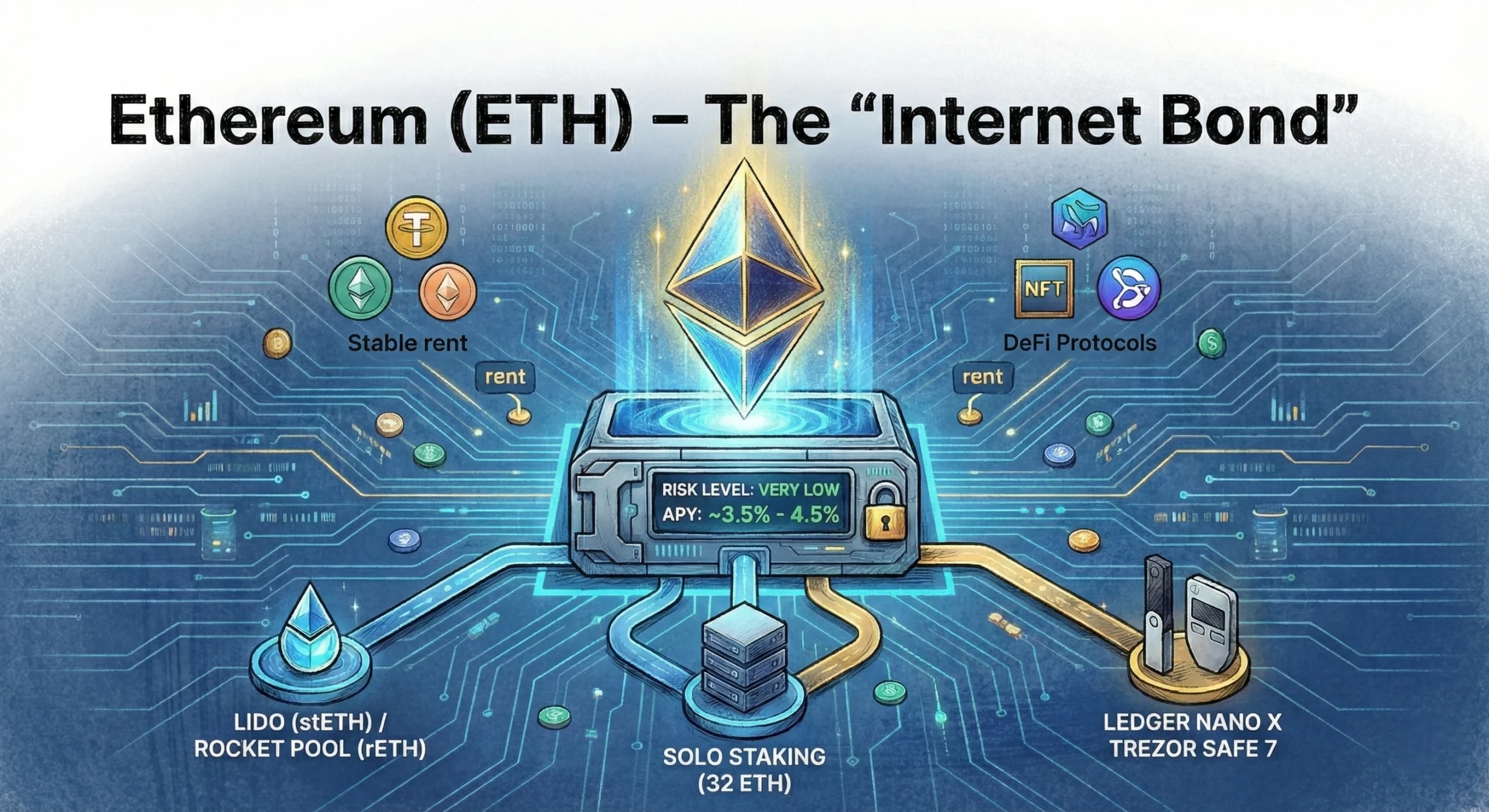
Risk Level: Very Low
-
Expected APY: ~3.5% – 4.5%
-
Lock-up Period: Dynamic (usually days to enter/exit queues)
If you want heart-stopping excitement, go leverage trade a memecoin on a sketchy DEX. If you want a digital savings account that actually beats inflation and the bank, you stake Ethereum.
Since the historic “Merge” to Proof-of-Stake, ETH has effectively become the risk-free rate of the digital economy. Think of it as the US Treasury Bond of crypto, but instead of being backed by a government’s promise to tax its citizens, it’s backed by the world’s most used decentralized computer.
Why it’s the Safest Bet in Crypto:
Ethereum is not just another coin; it is the settlement layer for the entire industry.
-
The “Rent” Economy: Every stablecoin transfer (USDC, USDT), every NFT mint, and every DeFi transaction on Ethereum pays “rent” in the form of gas fees.
-
Burn Mechanism (EIP-1559): A portion of every transaction fee is burned (destroyed forever), making ETH a deflationary asset during periods of high usage.
-
Real Yield: When you stake, you aren’t just getting printed inflation tokens. You are earning a cut of those real transaction fees plus new issuance. It’s boring, it’s slow, and it is exactly what you want for the bedrock of your portfolio.
How to Stake it Properly (Stop Being Lazy):
Leaving your ETH on a centralized exchange (CEX) like Coinbase is the path of least resistance, but it comes at a cost. They take a massive cut (often 25%+) of your rewards as a “service fee.” Stop paying the middleman tax. Here is how the pros do it:
-
Liquid Staking (The Flexible Route): This is the most popular option. You deposit your ETH into a protocol and get a receipt token back that represents your staked deposit. This receipt token grows in value over time.
-
Lido (stETH): The market leader with the deepest liquidity. It’s the easiest to use in DeFi apps to earn extra yield on top of your staking rewards.
-
Rocket Pool (rETH): A more decentralized alternative that aligns better with the crypto ethos. It’s a favorite among purists.
-
-
Solo Staking (The “Be Your Own Bank” Route): This is the gold standard. If you have 32 ETH and a dedicated computer (even a mini-PC), you can run your own validator node. You help secure the network directly, you keep 100% of the rewards, and you don’t have to trust any third-party protocol.
-
The Security Non-Negotiable: Whatever method you choose, do not keep your long-term stack on a hot wallet like MetaMask. Store your private keys offline. Use a battle-tested hardware wallet like the Ledger Nano X or the Trezor Safe 7 so you can actually sleep at night without checking your portfolio every five minutes.
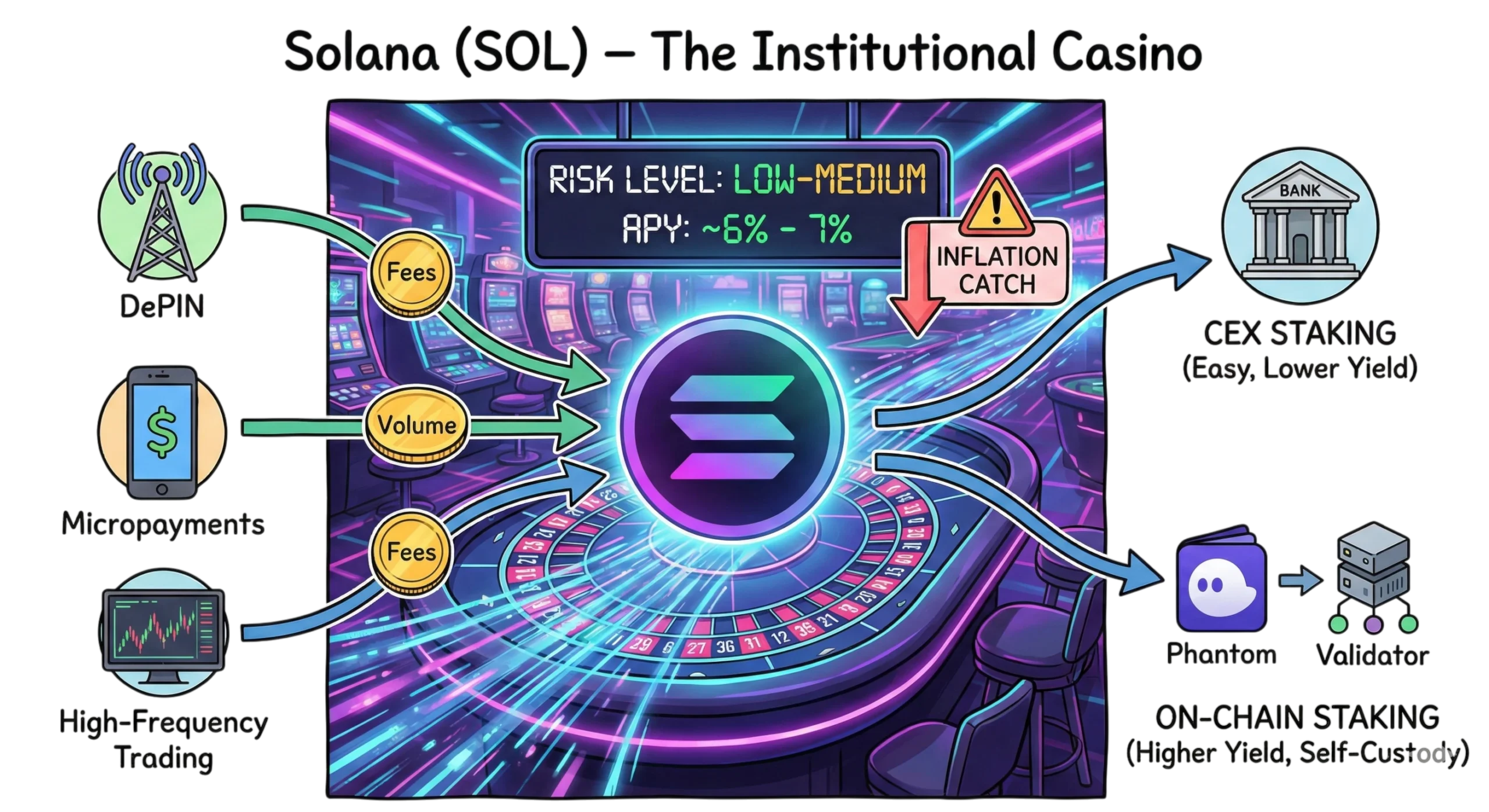
Solana (SOL) – The Institutional Casino
-
Risk Level: Low-Medium (High performance, higher centralization risk)
-
Expected APY: ~6.5% – 7.5% (Staking Rewards + MEV Boost)
-
Lock-up Period: ~2-3 Days (1 Epoch) – Fastest liquidity in the game.
Remember when Solana used to crash every other Tuesday? In 2026, those days are over. Thanks to the Firedancer validator client upgrade, Solana has cemented itself as the “high-frequency trading” chain. It is no longer just a casino; it’s the Nasdaq of crypto.
The “Real Yield” Argument (It’s Not Just Inflation Anymore):
In the early days, staking rewards were just printed tokens (inflation). Today, a massive chunk of your yield comes from Priority Fees and MEV (Maximum Extractable Value).
-
DePIN is Paying the Bills: Projects like Helium (networks), Hivemapper (mapping), and Render (GPU power) use Solana for micropayments. They pay millions in real fees that flow to stakers.
-
The Velocity of Money: Because Solana is fast (~400ms blocks), the same dollar moves 100x faster than on Ethereum. This volume generates “Real Yield” that isn’t dependent on a Ponzi scheme.
The “Pro Move” for Staking SOL:
Do NOT just click “Stake” on a vanilla validator. You are leaving free money on the table.
-
MEV-Powered Staking: Use a Liquid Staking Token (LST) like JitoSOL or mSOL. These protocols run special software that captures “MEV” (arbitrage profits from trading bots) and distributes it to you on top of the standard inflation rewards.
-
The Math: Standard Staking (~5.5%) + MEV Rewards (~1.5%) = ~7% Total APY.
The Catch (Inflation vs. Real Return):
Solana still has higher inflation than Ethereum.
-
Nominal Yield: ~7%
-
Inflation: ~4.5%
-
Real Yield: ~2.5% It beats the bank, but you aren’t retiring on the yield alone. You are staking to accumulate more SOL because you believe the asset itself is going to $1,000+.
(Note: Not sure if you should be staking via a CEX or on-chain? Read my guide on CeFi vs DeFi Explained).
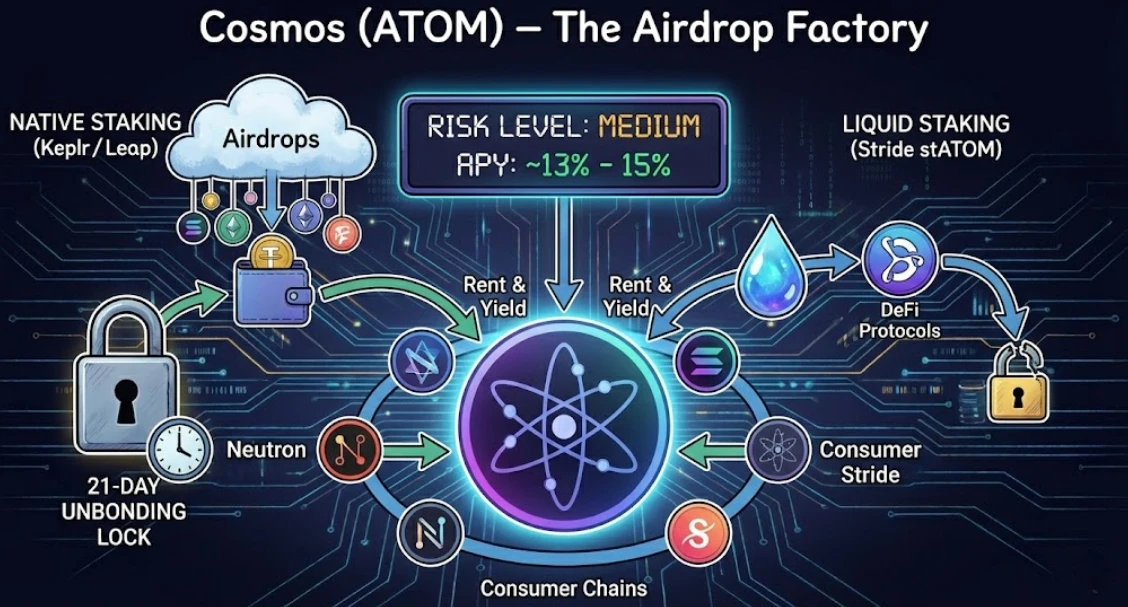
3. Cosmos (ATOM) – The Airdrop Factory
-
Risk Level: Medium (Inflationary pressure vs. Ecosystem growth)
-
Expected APY: ~13% – 15% (Staking Rewards + Consumer Chain Yield)
-
Lock-up Period: 21 Days (The “Diamond Hands” Enforcer)
Cosmos is the “Internet of Blockchains,” and the Hub is the city center. Historically, people staked ATOM just for the Airdrops. New chains launching in the ecosystem would snapshot ATOM stakers and drop free money into their wallets.
The 2026 Reality Check (No More Free Lunch):
The “stake and ignore” airdrop meta is dead. In 2026, protocols use “Activity Scoring”. They don’t just reward you for holding ATOM; they reward you for using it in governance or holding it on their specific chain.
-
The Pivot: You still stake ATOM to qualify, but now you must also cast governance votes to prove you aren’t a bot.
-
Real Yield (Interchain Security): This is the game-changer. The Cosmos Hub now provides security for other blockchains (called Consumer Chains) like Neutron and Stride. These chains pay “rent” to the Hub.
-
Result: When you stake ATOM, you aren’t just earning ATOM; you are earning a basket of tokens (NTRN, STRD, etc.) from these consumer chains.
The Strategy (Liquid vs. Locked):
-
The Purist Play: Stake natively via the Keplr or Leap wallet. This maximizes your airdrop eligibility because some protocols exclude liquid stakers.
-
The Liquid Play: Use Stride to convert your ATOM into stATOM. You get staking rewards + DeFi yield, and you can sell instantly (skipping the 21-day lock). Trade-off: You might miss some airdrops.
The “Forced HODL” Risk:
The 21-day unbonding period is brutal. If the market crashes today and you want to sell, you have to wait three weeks. By the time your tokens unlock, your portfolio might be down 40%.
-
Rule of Thumb: Only stake ATOM funds you are willing to lock away for 12+ months. If you need liquidity, use Stride.
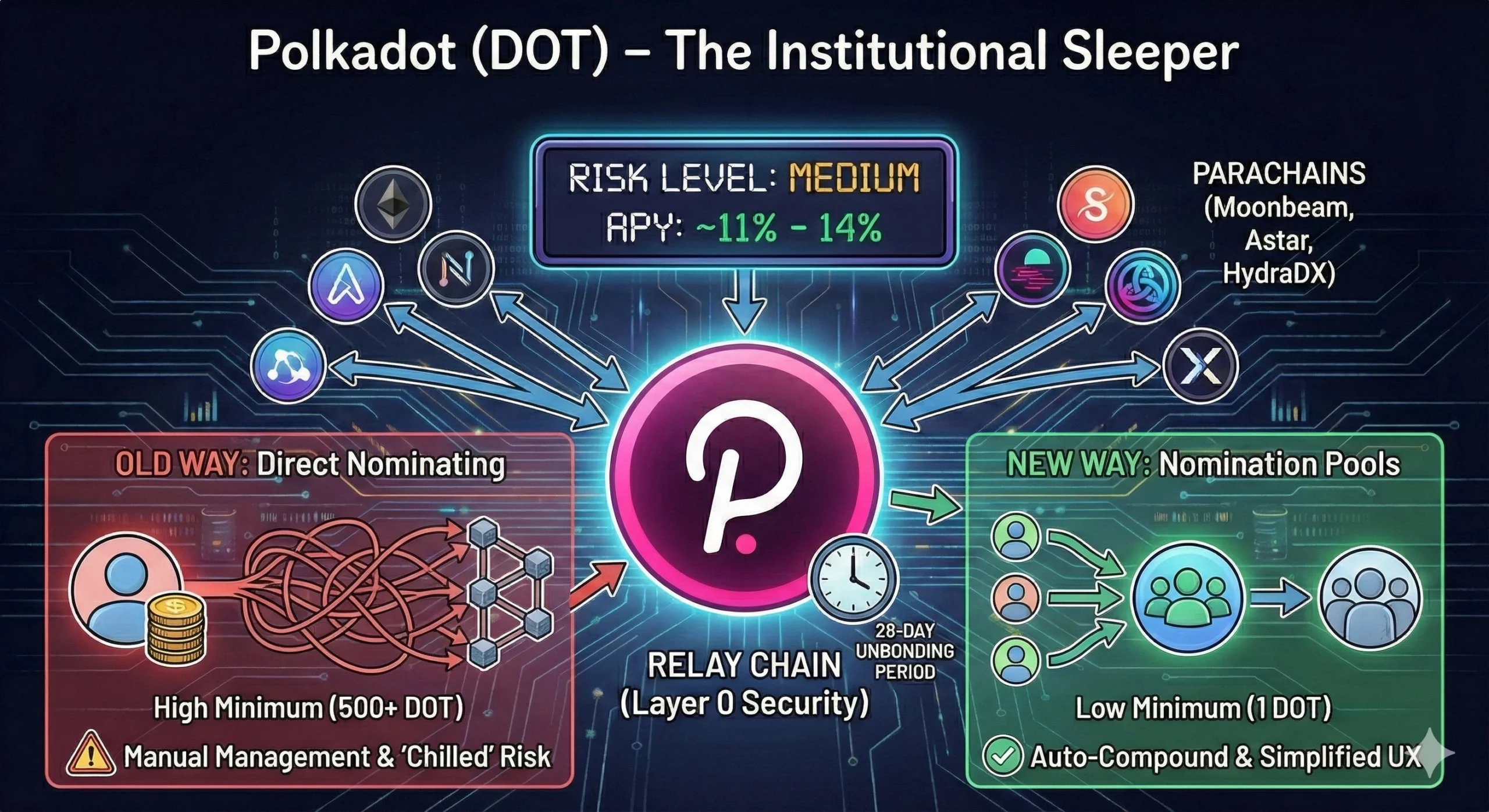
4. Polkadot (DOT) – The Institutional Sleeper
-
Risk Level: Medium (Complex tech, but battle-tested)
-
Expected APY: ~11% – 14% (High yield to combat high inflation)
-
Lock-up Period: 28 Days (The “Diamond Hands” Month)
Polkadot is the “Engineer’s Blockchain.” It wasn’t built for degens to trade cat coins; it was built for institutions to launch their own blockchains. It is complex, it is heavy, and it has one of the highest full-time developer counts in the entire industry (second only to Ethereum).
The “Ghost Chain” Myth vs. Reality:
Crypto Twitter calls DOT a ghost chain because they don’t see memecoins pumping on it. They are looking at the wrong layer.
-
The Layer 0 Thesis: DOT is the “Relay Chain.” It doesn’t run apps; it secures other blockchains (Parachains) like Moonbeam, Astar, and HydraDX.
-
Polkadot 2.0 (The Pivot): The network recently upgraded from the clunky “Parachain Auctions” (locking DOT for 2 years) to “Agile Coretime.” Think of it like AWS: apps now buy “blockspace time” on demand. This burns DOT revenue and makes the tokenomics far more sustainable.
The UX “Nightmare” (And How to Fix It):
Historically, staking DOT was miserable. You had to have a massive minimum stack (sometimes 500+ DOT) or your rewards would be cut to zero (“chilled”).
-
The Solution: Nomination Pools. In 2026, you do not need to pick 16 validators manually and pray. You simply join a Nomination Pool.
-
How it works: The pool pools everyone’s DOT together and manages the validators for you.
-
The Benefit: You can stake with as little as 1 DOT, you get auto-compounding rewards (which native staking didn’t have before), and you never have to worry about the “minimum active bond” requirement again.
-
The Verdict:
Staking DOT is a high-yield play on the thesis that Interoperability will eventually win. The 28-day unbonding period is long, so don’t stake money you might need for rent next week. This is a multi-year “accumulate and compound” strategy.
How to Build a “Passive Income” Portfolio
You don’t put all your eggs in one basket, and you definitely don’t put all your coins in one smart contract. A balanced “Low Risk” staking portfolio in 2026 looks like this:
-
50% ETH (The Anchor): Safe, reliable, low yield.
-
30% SOL (The Growth): Higher yield, higher volatility.
-
20% Stablecoins (The Cash Flow): Wait, stablecoins aren’t staking? Technically no, but lending them is a crucial part of passive income. Read my guide on Earning Passive Income with Stablecoins to see how this fits in.
The Risks No One Talks About (Slashing & Taxes)
It’s not all free money. There are two things that can wreck your staking strategy:
-
Slashing: If the validator you delegate to acts maliciously (or just has terrible uptime), the network punishes them by taking a portion of their stake and your stake. This is why you never pick the validator with 0% fees and a cartoon avatar. Pick reputable operators.
-
Taxes: Every time you receive a staking reward, it is a taxable event. If you receive 0.05 SOL every day, that is 365 taxable events per year. You need software to track this unless you want to spend your life in Excel hell. Check out my review of the Best Crypto Tax Software 2026.
Conclusion: Boring is Good
In 2026, “boring” is where the money is made. The 100x memecoins are fun, but they are gambling. Staking Blue Chip assets is investing.
Secure your network, earn your yield, and for the love of Satoshi, get your coins off the exchange.
Frequently Asked Questions
Q: Can I lose money staking crypto? A: Yes. There are two ways to lose. First, the price of the coin drops 50% (your 5% yield won’t save you). Second, “Slashing” where your validator messes up and the network penalizes your funds. Stick to big validators to avoid the second one.
Q: Is staking taxable in 2026? A: Absolutely. In most jurisdictions (US, UK, most of EU), staking rewards are taxed as “Income” at the moment you receive them. You also pay Capital Gains tax if the coin price goes up when you sell.
Q: What is the difference between Staking and Lending? A: Staking secures a blockchain (Proof-of-Stake) and is generally lower risk. Lending (Yield Farming) means giving your coins to a borrower or a smart contract to trade with. Lending pays more but carries “Smart Contract Risk” (hacks). Read What is Crypto Staking? for a deeper dive.
Q: Should I stake on Coinbase or a Ledger? A: Coinbase takes a ~25% cut of your rewards. Staking via Ledger (using a wallet like Solflare or MetaMask) gives you 100% of the rewards. It requires more effort, but it pays better.
Join the Resistance I post daily updates, sarcastic market commentary, and real-time alerts on the best yields (and the biggest rugs). 👉 Follow @Snout0x on X
Don’t Let the Banks Win, Stay Educated: If you are serious about passive income, you need to understand the tools you are using. Start here:
-
What is Crypto Staking? A Simple Guide to Passive Income & Rewards 2026 (Start here if you are new).
-
CeFi vs DeFi Explained: Which Is Better for Earning Crypto Interest in 2026? (Know the difference before you deposit).
-
Earning Passive Income with Stablecoins: The Realistic Guide (For when you want to avoid volatility).
-
Ledger Nano X Review 2026 (Secure your staked assets).
-
Best Crypto Tax Software 2026 (Don’t get audited).
Subscribe to our newsletter
Enjoy exclusive special deals available only to our subscribers.