



Key Takeaways
- The “Epstein is Satoshi” theory does not affect Bitcoin’s security or supply.
- Bitcoin is open-source and operates without admin keys or founder control.
- Even if Epstein is Satoshi (extremely unlikely), the protocol would function exactly the same.
- Bitcoin survives on consensus rules, not personality or trust.
- Founder obsession is a fiat mindset weakness, not a Bitcoin vulnerability.
Epstein Is Satoshi? Let’s Start With Reality
The “Epstein is Satoshi” theory has gone viral again.
Old emails. MIT Media Lab screenshots. Timeline speculation. Engagement farming.
It’s dramatic. It’s clickable.
But here is the uncomfortable truth:
Even if Epstein is Satoshi, Bitcoin’s security, issuance schedule, and decentralization would remain unchanged.
If that statement feels strange, you are still thinking about Bitcoin like a company with a CEO.
Bitcoin is not a company.
That distinction is everything.
Code vs. Cult of Personality
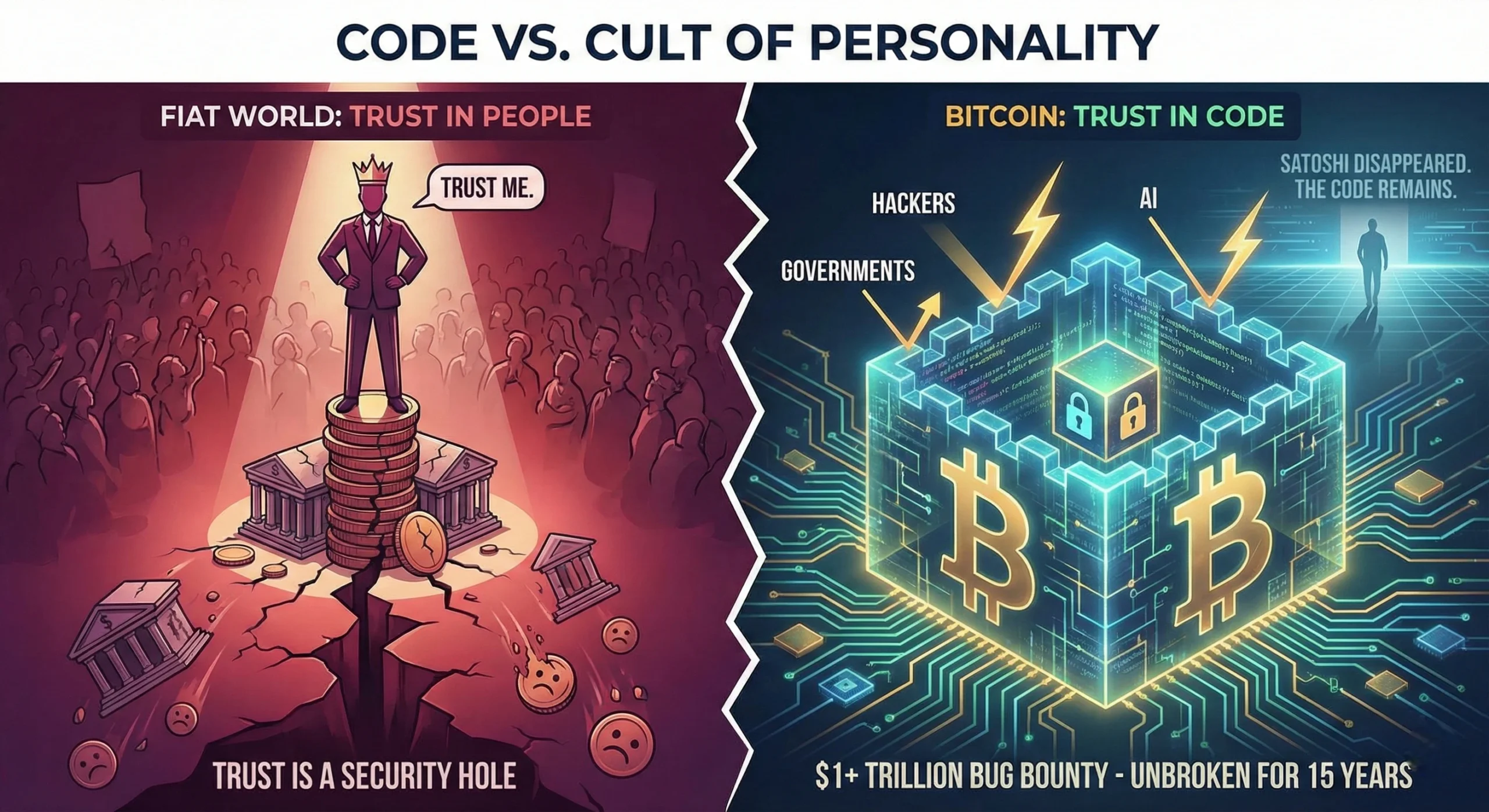
The Epstein is Satoshi narrative reveals how many people still misunderstand Bitcoin’s architecture.
Modern crypto projects rely on:
- Founders
- Dev teams
- Admin keys
- Governance councils
Those systems depend on trust.
Trust is a security hole.
Bitcoin was engineered to remove that hole.
Bitcoin is fully open-source and publicly auditable. Anyone can review the source code or run their own node. You can verify this directly by browsing the official Bitcoin Core repository on GitHub:
https://github.com/bitcoin/bitcoin
Satoshi released the code in 2009 and disappeared in 2011.
From that moment forward, the creator lost control.
If Epstein is Satoshi, he has the same authority over Bitcoin today as you do:
Zero.
No override key.
No supply switch.
No emergency pause.
The Epstein is Satoshi rumor fails because Bitcoin does not rely on founders.
It relies on consensus.
If you want a deeper explanation of how blockchain consensus works, read my full breakdown on how blockchain consensus works.
Why the “Epstein Is Satoshi” Theory Doesn’t Break Bitcoin
Let’s strip emotion out and look at mechanics.
Bitcoin has:
- A fixed 21 million supply cap
- A transparent issuance schedule
- Thousands of global nodes enforcing rules
- A difficulty adjustment mechanism
Even if Epstein is Satoshi:
Can he mint more coins?
No. Nodes would reject invalid blocks.
Can he reverse transactions?
No. That would require majority hash power.
Can he change the 21 million cap?
No. Any change would require overwhelming consensus from node operators.
The Epstein is Satoshi theory is dramatic.
Bitcoin’s design is mathematical.
Math does not care about conspiracy theories.
The “Doomsday Dump” Scenario
The usual counterargument is this:
“What if Satoshi owns 1 million BTC and dumps it?”
Fine. Let’s simulate it.
If the creator (Epstein, Satoshi, whoever) sold 1 million BTC tomorrow:
- The price would crash temporarily.
- Volatility would spike.
- Exchanges would panic.
But:
- Blocks would keep being produced.
- The 21 million cap would remain intact.
- The coins would redistribute across the market.
The blockchain would not stop.
Bitcoin relies on consensus rules, not a founder’s moral compass.
The Epstein is Satoshi narrative confuses price with protocol.
They are not the same thing.
The Stress Test: We’ve Already Seen It Survive
In 2021, China banned Bitcoin mining overnight.
At the time, more than 50% of global hash power was located there.
In a centralized system, that would be collapse.
In Bitcoin?
- Hash rate dropped
- Difficulty adjusted
- Miners relocated globally
- Blocks continued
The network never shut down.
That event was a live stress test.
The Epstein is Satoshi rumor is nothing compared to that.
Absolute Scarcity and the Difficulty Adjustment
Bitcoin’s hidden weapon is the difficulty adjustment.
Every 2,016 blocks (about two weeks), the network recalibrates how hard it is to mine.
It does not matter if computing power doubles.
It does not matter if half the miners disappear.
Issuance stays on schedule.
This is the only monetary system in history with a supply curve that is completely unresponsive to demand.
Even if Epstein is Satoshi, he cannot alter that schedule.
No individual can.
Censorship Resistance: Why Identity Doesn’t Matter
Bitcoin is neutral.
It processes transactions for:
- Individuals
- Institutions
- Governments
- Corporations
It does not ask who you are.
It enforces rules.
The Epstein is Satoshi rumor focuses on identity.
Bitcoin focuses on validation.
This founder obsession is one of the most common common Bitcoin myths investors still believe.
Bitcoin removed the need for trust in individuals.
That is the innovation.
Why Founder Obsession Is Dangerous
People want villains.
They want heroes.
They want someone to blame.
That mindset belongs to centralized finance.
Look at the last cycle:
- Sam Bankman-Fried
- Do Kwon
- Alex Mashinsky
Fully public founders.
Fully visible.
Fully trusted.
Billions were lost.
Being doxxed did not protect users.
Bitcoin’s strength is that Satoshi disappeared.
No subpoenas.
No coercion.
No ego-driven bailouts.
If Epstein is Satoshi (again, extremely unlikely), the fact that Bitcoin runs flawlessly without him proves the system matured beyond its creator.
That is a feature, not a flaw.
Signal vs. Noise
While social media debates whether Epstein is Satoshi, the Bitcoin network does one thing:
Tick.
Tock.
Next block.
Every 10 minutes, a new block is mined.
Supply issuance continues.
Halving cycles progress.
Institutional accumulation continues quietly.
If you want to understand how supply shocks actually work, read my breakdown of Bitcoin halving cycle dynamics.
The Epstein is Satoshi rumor is noise.
Bitcoin’s consensus engine is signal.
Final Thought
The Epstein is Satoshi theory reveals more about how people misunderstand Bitcoin than about Bitcoin itself.
Bitcoin is protected by:
- Cryptography
- Distributed consensus
- Incentive design
- Mathematical enforcement
Not by personality.
Don’t trust.
Verify.
And stop looking for a CEO in a protocol designed not to have one.
Frequently Asked Questions (FAQ)
Is the Epstein is Satoshi theory credible?
No. The Epstein is Satoshi claim is based on speculation and online conspiracy threads. There is no cryptographic or historical proof linking Epstein to the Satoshi Nakamoto identity.
If Epstein created Bitcoin, would that make Bitcoin unsafe?
No. Bitcoin is open-source code verified by thousands of nodes and developers worldwide. Even if Epstein is Satoshi, he has no special authority to change supply or seize funds.
Can the government shut down Bitcoin?
Governments can regulate exchanges and on-ramps, but Bitcoin runs on decentralized global nodes. There is no central server to shut off.
Does Satoshi still control Bitcoin?
No. Satoshi has no admin privileges. Bitcoin’s rules are enforced by consensus across the network.