

Last Updated on March 13, 2026 by Snout0x
A wallet derivation path is a sequence of instructions that tells a hierarchical deterministic (HD) wallet how to generate a specific address from a single seed phrase. Rather than creating addresses at random, HD wallets follow structured paths that guarantee the same address is always produced from the same seed. When two different wallet apps display different addresses from an identical recovery phrase, derivation paths are almost always the reason.
Disclaimer: This content is for educational and informational purposes only and does not constitute financial, investment, tax, or legal advice. Cryptocurrency markets are volatile and involve risk. Always conduct your own research and consult a qualified professional before making financial decisions.
Affiliate Disclosure: Some links in this article may be affiliate links. If you choose to use them, I may earn a commission at no additional cost to you.
What Is a Wallet Derivation Path
A wallet derivation path is a string that defines the exact route through a hierarchical key tree to arrive at a specific private key, and therefore a specific wallet address. Every HD wallet starts from a master seed and uses the derivation path to navigate to a precise position within that structure. The path is not arbitrary. It is a set of coordinates pointing to one address out of a practically limitless set of possibilities.
The most common path format looks like this: m/44’/0’/0’/0/0. Each segment refers to a specific level in the key hierarchy. Change any one segment and you arrive at a completely different address, even with the same seed phrase underneath.
How HD Wallets Generate Addresses from One Seed
HD wallets derive every key they use from a single master seed. That seed is what your 12 or 24-word recovery phrase represents. From the master seed, the wallet generates a master private key. From that key, it can derive an enormous tree of child keys in a structured, predictable way.
Derivation paths tell the wallet where in that tree to look. Because the tree is deterministic, the same seed combined with the same path always produces the same key. This is what makes recovery possible. It is also why one seed can control multiple separate accounts or even separate blockchains, each accessed through a different path.
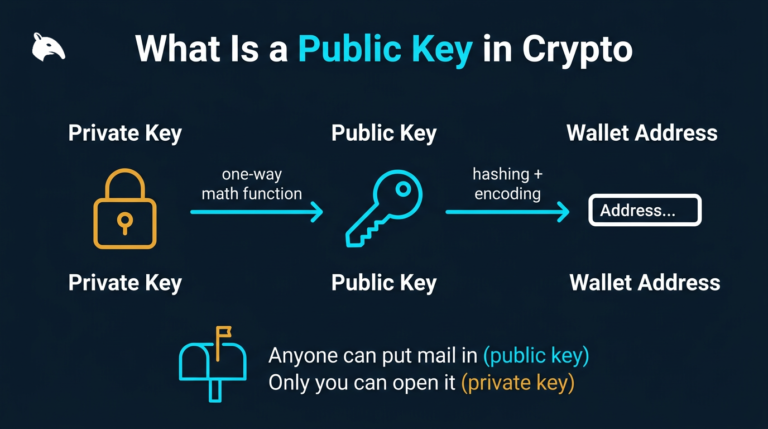
To understand how the private key eventually becomes a usable on-chain address, see how public keys become wallet addresses.
BIP32 and BIP44: The Standards Behind Derivation Paths
BIP32 introduced the concept of hierarchical deterministic wallets. It defines how a single seed can generate an entire tree of private and public keys. Before BIP32, wallets generated keys randomly, which made backup and recovery far more complicated. Every new address required a separate backup.
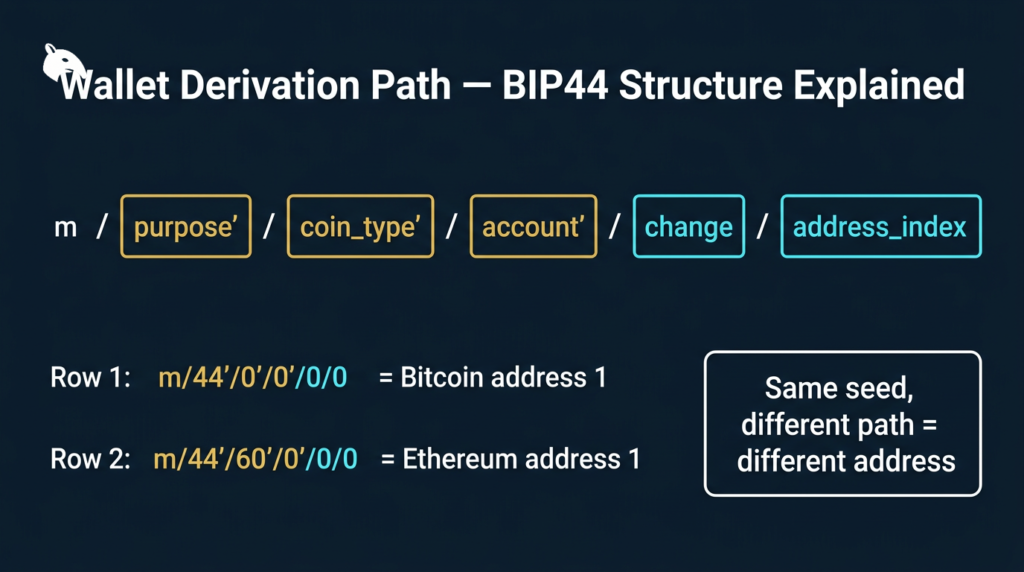
BIP44 built on BIP32 and created a standardized path structure that wallets could follow consistently. The BIP44 format is:
m / purpose’ / coin_type’ / account’ / change / address_index
Each level has a specific meaning. The purpose field in BIP44 paths is always 44, identifying the standard in use. The coin_type identifies the blockchain: 0 for Bitcoin, 60 for Ethereum, and so on across hundreds of registered chains. The account field allows wallets to separate funds into distinct buckets while still using one seed. The change field separates external receiving addresses from internal change addresses. The address_index is simply a position counter.
Later standards extended this system further. BIP49 added support for SegWit addresses on Bitcoin using a purpose of 49. BIP84 supports native SegWit with a purpose of 84. The logic at each level is the same. Only the purpose value changes to signal which address format the wallet should produce.
Why Different Apps Generate Different Addresses from the Same Seed
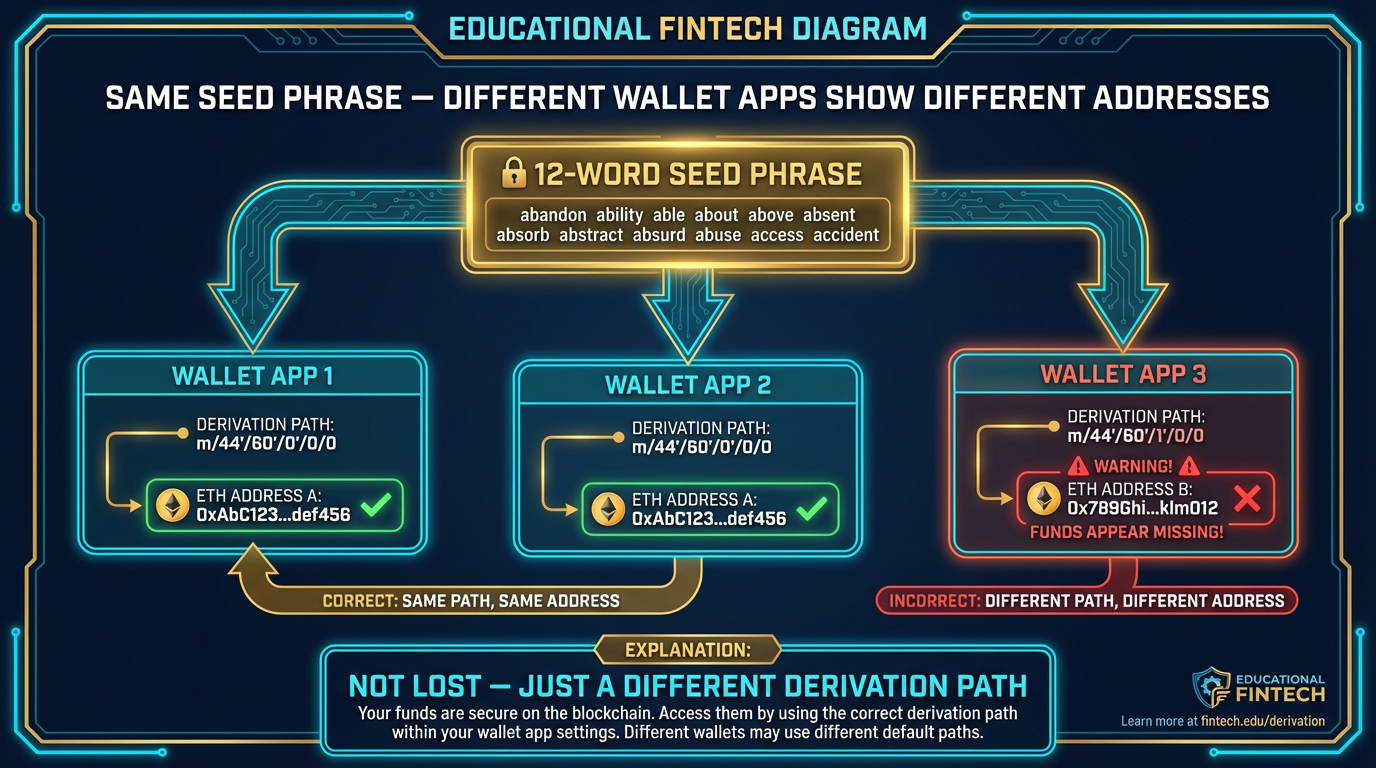
This is the most common source of confusion when switching wallets. If you restore your seed phrase into a new app and see unfamiliar addresses, the new app is almost certainly using a different default derivation path than the one your original wallet used.
As an example, MetaMask uses the Ethereum path m/44’/60’/0’/0/0 for its default account. Some older wallets or less standard implementations use m/44’/60’/0’/0 or a non-BIP44 structure. The addresses produced by these paths are entirely different, even with an identical seed underneath.
Your funds are not lost. They are still controlled by the same seed phrase. You need to either select the matching path in your new wallet or use an app that supports custom derivation path entry. Most professional hardware wallets give you this option during recovery.
Reading the Path: What Each Segment Means
Breaking down m/44’/0’/0’/0/0 segment by segment:
- m – the master key, the root of the entire key tree.
- 44′ – follows the BIP44 standard. The apostrophe marks hardened derivation.
- 0′ – coin type 0, which is Bitcoin.
- 0′ – account zero, the first account under this seed.
- 0 – external chain, used for receiving addresses visible to others.
- 0 – address index zero, the first address in the sequence.
Incrementing the last number from 0 to 1 gives you the second address in the same account. Incrementing the account index from 0 to 1 produces an entirely separate account. Both accounts remain controlled by the same seed phrase.
Hardened vs Non-Hardened Derivation
The apostrophe in a derivation path indicates hardened derivation. In a hardened step, the child key cannot be traced back to its parent even if an attacker obtains that child’s public key. This matters because non-hardened derivation allows extended public keys to generate child public keys without accessing private keys, which is useful for certain applications but introduces a risk if any child private key is leaked.
Most wallet implementations use hardened derivation at the purpose, coin type, and account levels. The address index level is often left non-hardened to support use cases like payment servers that need to generate fresh receiving addresses without exposing private keys. Understanding this distinction matters when evaluating wallet software or setting up custom paths.
What This Means When You Restore a Wallet
When you restore a wallet using a seed phrase, the derivation path determines which addresses get loaded. Many modern wallets auto-detect common paths by scanning blockchain history for addresses with transaction activity. Some do not, and they will simply load the default path for that app.
If you switch from one wallet app to another and your balance does not appear, the first thing to check is the derivation path. Ledger Live, Trezor Suite, and most hardware wallet management tools allow you to specify or change the path during wallet recovery. Writing down your derivation path alongside your private key documentation is a practical habit, especially if you use less common wallet software or multi-account setups.
A broader look at secure wallet practices is covered in the crypto wallet hygiene checklist, which addresses documentation habits alongside technical security steps.
Common Mistakes with Derivation Paths
- Assuming all wallets use the same default path. They do not. Always confirm the path a new wallet uses before migrating funds.
- Concluding funds are lost when addresses look different. Different addresses do not mean lost funds. The seed phrase is the source of truth, not the specific address.
- Not recording a non-standard derivation path. If you use a custom or non-standard path, note it somewhere safe alongside your seed. Without that record, recovery on a different wallet may require manually scanning multiple path variants.
- Confusing account index changes with separate wallets. Changing the account number in a BIP44 path creates a new account under the same seed, not a separate wallet with separate recovery requirements.
Sources
- BIP-44 Specification – Bitcoin Improvement Proposals repository
- Bitcoin Developer Documentation – developer.bitcoin.org
Frequently Asked Questions
What is a wallet derivation path in simple terms?
A derivation path is a set of instructions that tells your wallet exactly which address to generate from your seed phrase. It works like coordinates pointing to a specific location inside the wallet’s key tree. Same seed, same path, same address every time.
Why does a different app show different addresses from my seed phrase?
Different wallet apps often use different default derivation paths. Each path produces a different address even from the same seed. Your funds are still accessible if you use the original path in the new app, either by selecting it manually or using an app that auto-detects common paths.
Do I need to write down my derivation path?
If you use a standard BIP44 path, most wallets will find your funds automatically during recovery by scanning common paths. If your wallet uses a custom or non-standard path, recording it is a sensible precaution alongside your seed phrase backup.
What does the apostrophe mean in a derivation path?
The apostrophe indicates hardened derivation. It means the child key at that level cannot be traced back to its parent key even if an attacker obtains the child public key. Hardened steps add a layer of protection against certain key exposure scenarios.
Is BIP32 the same as BIP44?
No. BIP32 defined the underlying hierarchical deterministic wallet system. BIP44 created a standardized path format built on top of BIP32. Most wallets implement BIP44 paths, which depend on the tree structure that BIP32 established.