


Introduction
High crypto APY risks are often misunderstood by investors chasing double-digit yield.
In traditional finance, that kind of return would be extraordinary. In crypto, it often appears normal — especially during bullish cycles.
But yield in crypto is not created out of nowhere. It comes from somewhere. And understanding that “somewhere” is the difference between compounding responsibly and quietly eroding capital.
Disclaimer: This content is for educational and informational purposes only and does not constitute financial, investment, tax, or legal advice. Cryptocurrency markets are volatile and involve risk. Always conduct your own research and consult a qualified professional before making financial decisions.
Affiliate Disclosure: Some links in this article may be affiliate links. If you choose to use them, I may earn a commission at no additional cost to you.
This article breaks down:
- Where high APY actually comes from
- How inflation distorts perceived returns
- Why impermanent loss is frequently underestimated
- When lock-ups amplify risk
- What realistic yield ranges look like in 2026
If you are building structured income strategies, this article complements the broader guide here:
👉 https://snout0x.com/best-crypto-passive-income-2026-5-low-risk-strategies-no-ponzis/
5 Key Takeaways
-
High APY often comes from token inflation rather than real economic activity.
-
Sustainable yield is typically derived from trading fees, borrowing demand, or network revenue.
-
Impermanent loss can erase gains in high-yield liquidity pools.
-
Lock-up incentives increase liquidity risk during volatile markets.
-
Understanding high crypto APY risks is essential before allocating capital to double-digit yield platforms.
1. Where Yield Actually Comes From
There are two primary sources of crypto yield:
Revenue-Based Yield (Sustainable)
This includes:
- Trading fees paid by users
- Borrowing interest from leveraged traders
- Validator rewards tied to real network activity
When a decentralized exchange generates fees, liquidity providers earn a share.
When traders borrow stablecoins to take leveraged positions, lenders earn interest.
This is economic activity-based yield.
In 2026, sustainable revenue-based yields for major protocols typically fall within the mid-single to low-double digit range depending on market demand.
Inflation-Based Yield (Dilutive)
Some protocols pay yield by minting new tokens.
Example:
- APY: 40%
- Token supply growth: 45%
You may receive more tokens, but total supply expands faster than demand.
If price declines proportionally, your purchasing power falls despite earning rewards.
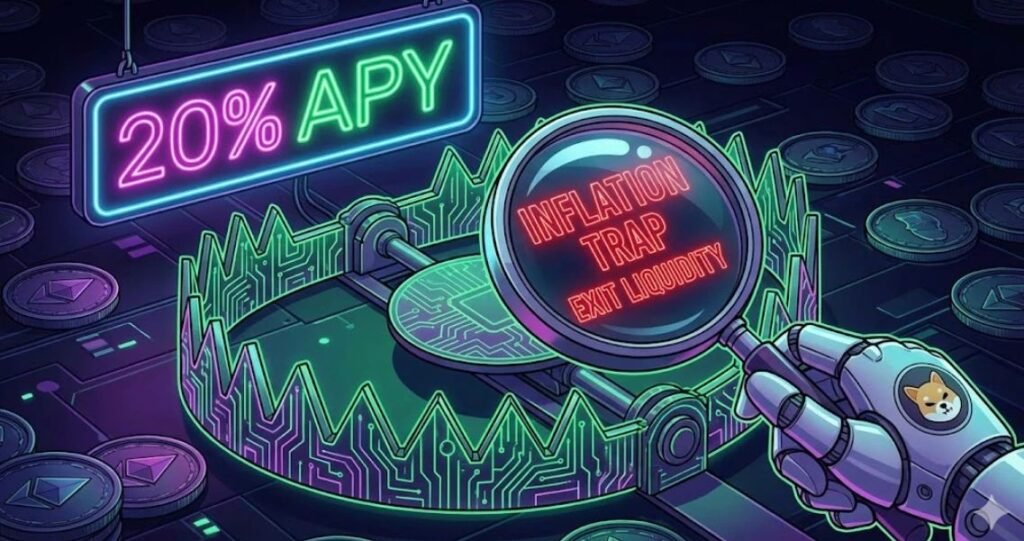
This is the inflation trap.
Nominal growth in token quantity does not guarantee real return.
Before allocating capital, ask:
- Is yield paid from revenue or emissions?
- What is the annual token inflation rate?
- Is there organic demand for the token?
High emission rates frequently distort perceived yield.
For a structured overview of realistic strategies, see:
👉 https://snout0x.com/staking-crypto-in-2026-whats-the-catch-risks-and-real-yields/
2. The Real Yield Equation
APY alone is incomplete.
A more realistic framework:
Real Yield = APY – Token Inflation – Price Drawdown
Example:
- APY: 20%
- Inflation: 12%
- Price decline: 15%
Net outcome: negative real return.
Yield does not hedge volatility.
In strong downtrends, staking rewards or lending interest often fail to offset capital losses.
Understanding this math prevents overconfidence in double-digit APY advertisements.
3. Impermanent Loss: The Hidden Cost
Liquidity pools often advertise high APY — sometimes 20–30% or more.
These returns usually combine:
- Trading fees
- Incentive token rewards
However, liquidity providers face impermanent loss (IL).
Simple Example
You deposit ETH and USDC into a pool.
ETH doubles in price.
The automated market maker rebalances by selling some of your ETH into USDC.
When you withdraw, you hold less ETH than if you had simply held it in your wallet.
If the fee income does not exceed the rebalancing difference, your net result underperforms buy-and-hold.
In trending markets, impermanent loss can significantly reduce apparent gains.
Liquidity provision may make sense for:
- Stablecoin pairs
- Correlated asset pairs
- High-volume fee-generating pools
It is riskier for:
- Highly volatile assets
- Thin liquidity environments
If evaluating stablecoin-based yield more conservatively, review:
👉 https://snout0x.com/stablecoin-passive-income-2026-the-realistic-guide-to-5-10percent-yields/
4. Lock-Ups and Liquidity Risk
High-yield protocols frequently offer:
“Lock your tokens for 90 days for boosted APY.”
Lock-ups introduce a structural constraint: you cannot exit during volatility.
This matters because:
- Crypto markets can move 20–40% within days
- Regulatory announcements can affect platforms quickly
- Liquidity can disappear during stress
If token price drops significantly during the lock period, yield may not compensate for capital decline.
Lock-ups are more appropriate when:
- You already intend long-term holding
- The asset has strong fundamentals
- Yield is revenue-based
They are riskier when applied to newly launched or speculative tokens.
Liquidity flexibility is a risk control tool. Removing it should be evaluated carefully.
5. Regulatory and Platform Risk
Yield products do not exist outside regulatory environments.
Centralized platforms offering unusually high returns often rely on:
- Lending to leveraged traders
- Institutional borrowing
- Structured credit exposure
Increased oversight in multiple jurisdictions has changed how yield products operate.
When evaluating centralized yield:
- Consider platform solvency
- Review withdrawal history
- Assess transparency of risk practices
If comparing centralized vs. on-chain structures, see:
👉 https://snout0x.com/cefi-vs-defi-explained-which-is-better-for-earning-crypto-interest-in-2026/
Platform freezes have historically erased yield advantages instantly.
Counterparty risk can outweigh APY.
6. What Is Realistic in 2026?
While conditions vary, broad patterns have emerged:
- Major proof-of-stake staking: ~3–7%
- Stablecoin lending: ~4–10% depending on demand
- Fee-based DeFi yield: variable, typically mid-single to low-double digits
Yields consistently above 15–20% generally imply:
- Elevated volatility
- Aggressive token emissions
- Lock-up structures
- Leverage exposure
- Concentration risk
High yield is not automatically fraudulent.
But it always demands deeper scrutiny.
The relevant question is not:
“Is this APY high?”
It is:
“What risk am I being paid to take?”
Risk Considerations
High APY strategies may expose investors to:
- Token dilution
- Smart contract vulnerabilities
- Liquidity risk
- Platform insolvency
- Regulatory intervention
- Market volatility
Yield is compensation for bearing one or more of these risks.
If risk is unclear, the yield is likely mispriced.
Common Mistakes
- Focusing on APY without checking inflation
- Ignoring price volatility
- Providing liquidity to highly volatile pairs
- Locking tokens during euphoric market phases
- Concentrating capital in one protocol
Avoiding these errors often matters more than maximizing percentage returns.
Frequently Asked Questions
Is 20% APY always a scam?
No. But it almost always implies elevated risk. Investors should evaluate the source of yield before allocating capital.
Can staking rewards offset price declines?
Sometimes partially, but not consistently. In strong downtrends, price movement typically dominates yield.
Is liquidity provision safer than staking?
Not necessarily. Liquidity pools introduce impermanent loss risk that staking does not.
Why do some protocols offer extremely high APY?
Often due to aggressive token emissions, bootstrapping incentives, or elevated leverage demand.
What is considered “safe” yield in crypto?
There is no risk-free yield in crypto. Lower yield typically corresponds to lower relative structural risk, but volatility remains.