

Yield farming and staking are both ways to earn returns on crypto holdings, but they operate on different mechanisms, carry different risks, and suit different user profiles.
Staking involves locking tokens to participate in blockchain consensus and earn protocol rewards. Yield farming involves depositing assets into decentralized finance (DeFi) liquidity pools and earning trading fees or token incentives.
Understanding the distinction helps you evaluate claims about returns without being misled by high numbers alone.
The decision framework is simpler than the headline APYs make it look. Choose staking when you want lower operational complexity and returns that mainly come from protocol rules.
Choose yield farming when you are deliberately taking on more moving parts, more monitoring, and more market sensitivity in exchange for the possibility of higher but less stable returns.
Key Takeaways
- Staking secures a proof-of-stake blockchain and earns protocol-level rewards.
- Yield farming provides liquidity to DeFi protocols and earns trading fees or token incentives.
- Yield farming typically offers higher headline returns but with significantly more risk.
- Both expose capital to smart contract risk if done through DeFi protocols.
- Staking rewards are more predictable; yield farming returns are variable and often unsustainable at high levels.
This content is for educational purposes only and should not be considered financial or investment advice.
This article may contain affiliate links. If you purchase through these links, Snout0x may earn a commission at no additional cost to you.
What Is Staking?
Staking is the act of depositing tokens to participate in the consensus mechanism of a proof-of-stake blockchain. Validators (and their delegators) lock up tokens as collateral. In exchange, they receive newly created protocol rewards, typically a percentage of the staked amount per year.
The reward rate varies by network. It is determined by protocol parameters, the total amount staked on the network, and validator performance. Ethereum staking rewards have historically ranged from 3 to 5 percent annually. Other networks like Cosmos-based chains or Solana operate at different rates depending on inflation schedules and staking participation.
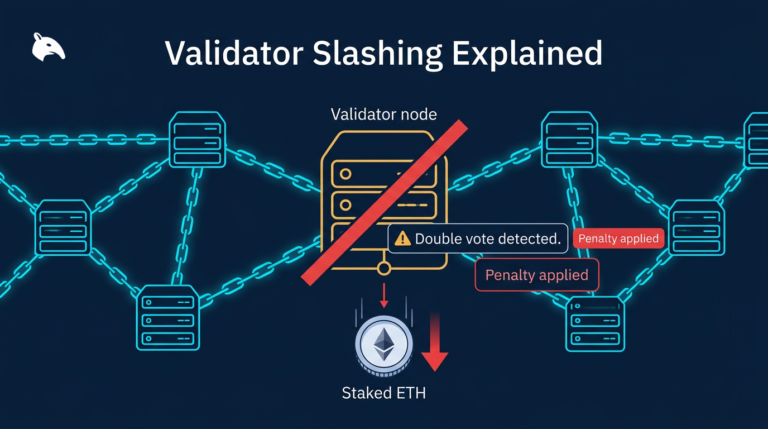
For detail on validator nodes and how staking penalties work, see the Validator Slashing Explained article.

What Is Yield Farming?
Yield farming means depositing assets into a DeFi liquidity pool to enable decentralized trading or lending. Liquidity providers earn a share of trading fees generated by the pool and, in many protocols, additional reward tokens on top of fees.
The advertised APY on yield farming positions often looks very high, particularly for new protocols that distribute their own governance tokens as incentives. The actual realized return depends on whether the reward token retains value and whether trading volume remains high enough to generate meaningful fees. High reward token emission inflates quoted APYs but the tokens often lose value quickly as more are created.
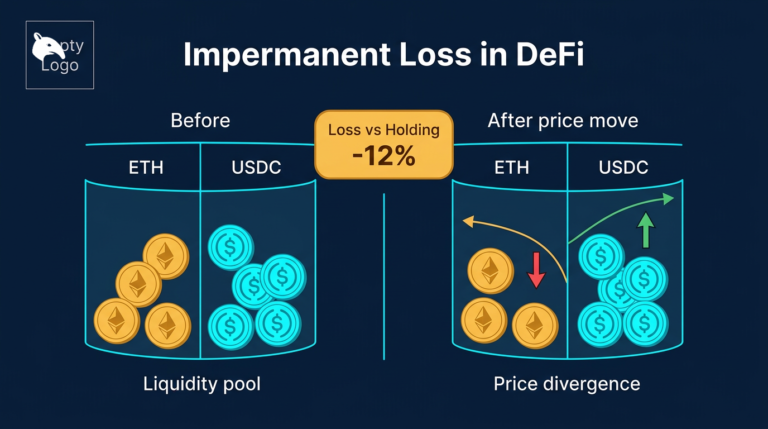
Yield farming also introduces impermanent loss, a mechanism by which providing liquidity to a pool can result in a lower value than simply holding the deposited assets if price ratios shift.

Practical Usage: Match the Strategy to Your Goal
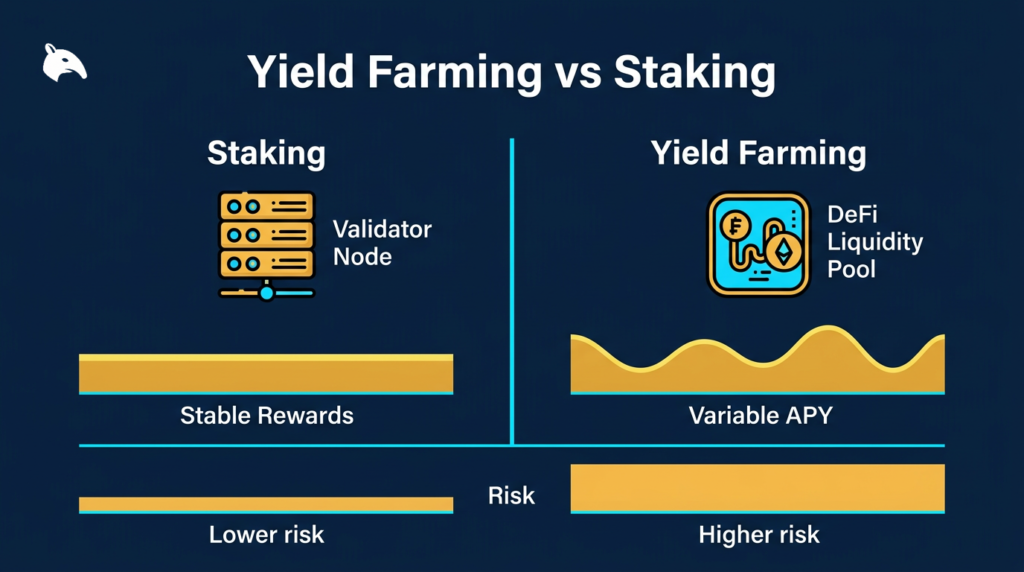
- Mechanism: Staking secures a blockchain. Yield farming provides liquidity for trading or lending.
- Reward source: Staking rewards come from protocol token issuance. Yield farming rewards come from trading fees and incentive token distribution.
- Predictability: Staking yields are relatively stable. Yield farming yields vary with volume, fees, and token prices.
- Smart contract risk: Native staking has minimal contract risk. Yield farming through DeFi protocols carries contract audit and exploit risk.
- Impermanent loss: Staking does not cause impermanent loss. Yield farming in multi-asset pools can.
- Complexity: Basic delegated staking is simple. Yield farming across multiple protocols and chains requires active management.
- Sustainability: Staking rewards are protocol-defined and relatively sustainable. Very high yield farming APYs are typically short-lived incentive programs.
The practical verdict is that staking is usually the better default for users who want yield without turning the position into a part-time job. Yield farming makes more sense when you can explain exactly where the return comes from, how temporary the incentives are, and what happens if the pool composition moves sharply against you. If the answer to those questions is vague, the headline APY is probably doing too much of the selling.
For a closely related follow-up, see Liquid Staking Risks: What Changes When You Use a Protocol.
For a closely related follow-up, see What Is a Crypto Drainer? How Wallet Drains Work.
For the direct comparison angle, see Ledger vs Keystone Security Architecture: Which Approach Is More Secure?.
Risks and Common Mistakes
Chasing the highest advertised APY is the most common mistake in yield farming. High yields on new protocols often reflect token incentive programs that are dilutive and temporary. When the rewards run out, yields drop and the reward token may have fallen in value, resulting in a net loss.
Staking risk is lower but still real. Network slashing events, smart contract bugs in liquid staking wrappers, and the lockup or unbonding period during which you cannot access funds are all factors to understand before staking.
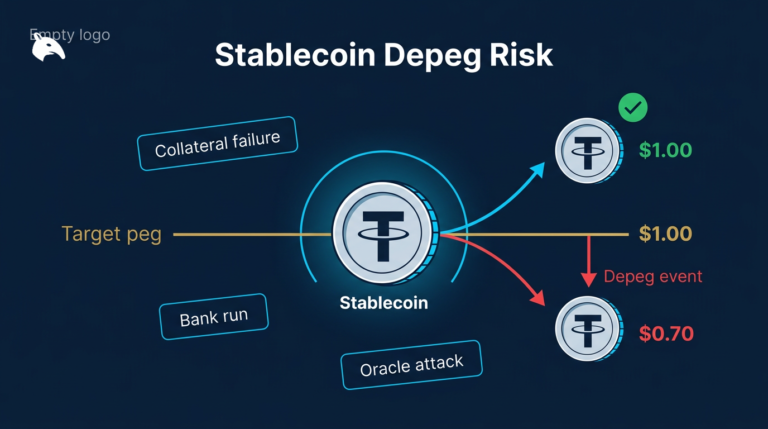
Another common mistake is comparing a relatively stable staking APR to a farming APY that depends on volatile reward tokens or shallow pool liquidity as if they were equivalent numbers. They are not. For adjacent risk context, Stablecoin Depeg Risk and Liquid Staking vs Native Staking help frame how quickly yield products can behave differently once liquidity stress appears.
Frequently Asked Questions
Which is safer: staking or yield farming?
Staking is generally considered lower risk than yield farming. Staking rewards come from protocol issuance and are more predictable. Yield farming involves smart contract exposure, impermanent loss, and reward token depreciation risk that staking typically does not.
Can you lose money staking?
Yes. Slashing events can destroy a portion of the staked amount if a validator behaves incorrectly. Liquid staking protocols add smart contract risk. And the underlying token can lose value regardless of the staking yield, resulting in a net loss in fiat terms.
Is liquidity mining the same as yield farming?
Largely yes. Liquidity mining refers specifically to earning a protocol’s governance token as a reward for providing liquidity. Yield farming is the broader practice of moving capital between protocols to maximize returns. Liquidity mining is one component of yield farming strategies.
What is the difference between APR and APY in staking?
APR (Annual Percentage Rate) shows the simple rate without compounding. APY (Annual Percentage Yield) includes compounding effects, assuming rewards are restaked periodically. When comparing staking and yield farming returns, check whether the figure is APR or APY and how often rewards compound.
Can I do both staking and yield farming at the same time?
Yes. Many users stake a portion of their assets on a proof-of-stake network and deposit a separate portion into DeFi liquidity pools. These are separate positions with separate risk profiles and can be managed independently.