

Last Updated on April 19, 2026 by Snout0x
Crypto FOMO psychology explains why rational investors abandon strategy the moment volatility accelerates. Understanding crypto FOMO psychology is the first step toward building systems that prevent emotional execution.
This content is for educational purposes only and should not be considered financial or investment advice.
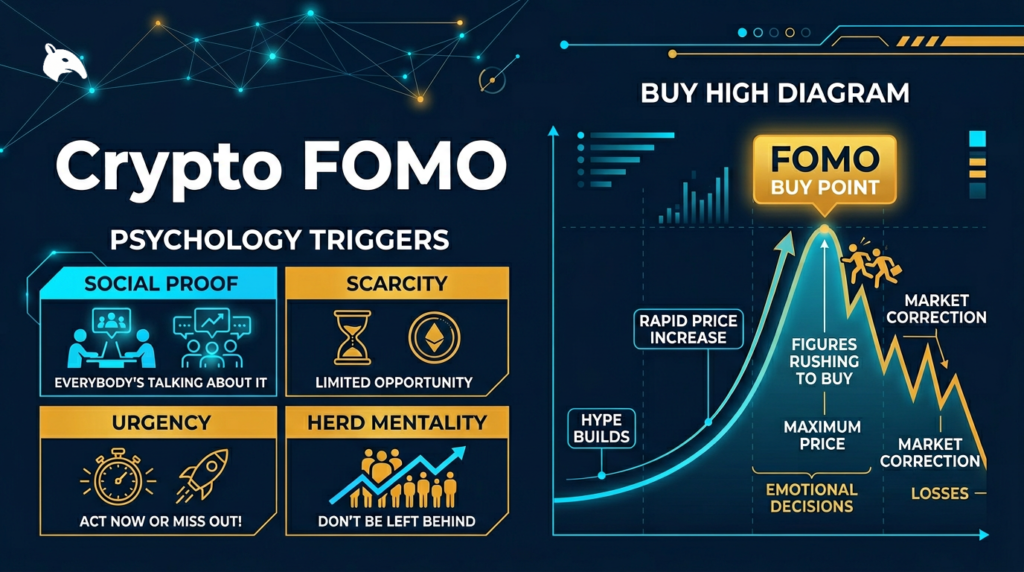
Crypto FOMO is a biological response — vertical green candles, near-misses, viral feeds, and “cheap unit” tokens all hijack the same survival circuits. Willpower does not neutralize it. The working defense is structural: add friction, enforce a waiting period, and outsource execution to rules so urgency cannot reach the buy button.
Key Takeaways
- Crypto FOMO psychology is rooted in evolutionary survival instincts.
- “Near misses” trigger dopamine spikes that fuel revenge trading.
- Unit bias makes cheap tokens look like opportunities.
- Social media creates the illusion that “everyone” is buying.
- Adding friction and automation reduces emotional execution mistakes.

What Is Crypto FOMO Psychology?
Crypto FOMO psychology is the study of how fear, scarcity signals, and social proof override rational decision-making in volatile markets.
Unlike traditional stock markets, crypto trades 24/7. There is no closing bell. No cooldown period. Volatility is constant, information spreads instantly, and social media amplifies every price move in real time.
When you see a coin pump 40% in an hour, your brain interprets that as opportunity disappearing.
That urgency is biological.
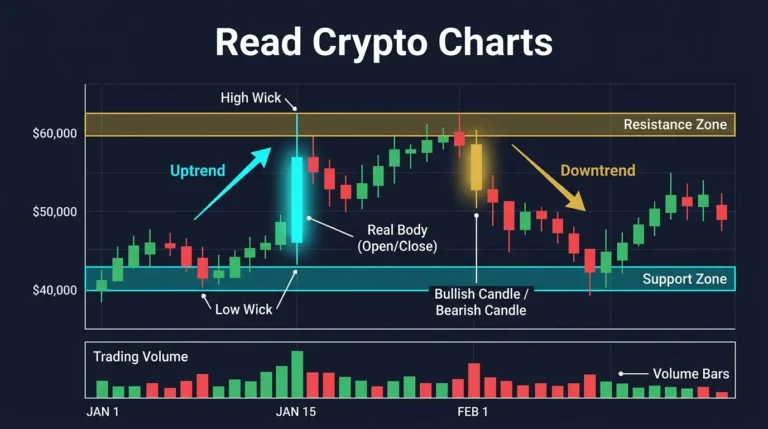
From a neurological perspective, rapid price acceleration activates the amygdala the part of your brain responsible for threat detection. A vertical green candle does not register as “potential profit.” It registers as “resource scarcity.”
At the same time, dopamine is released in anticipation of reward. This combination threat plus reward creates a powerful emotional cocktail that suppresses activity in your prefrontal cortex, the region responsible for logic, probability assessment, and long-term planning.
In simple terms:
You are chemically less rational during a pump.
Crypto FOMO psychology becomes especially dangerous because:
- Markets never pause.
- Social proof is algorithmically amplified.
- Price volatility mimics urgency signals found in survival environments.
Your brain evolved to chase food before the tribe took it.
In financial markets, that same instinct makes you buy the top.
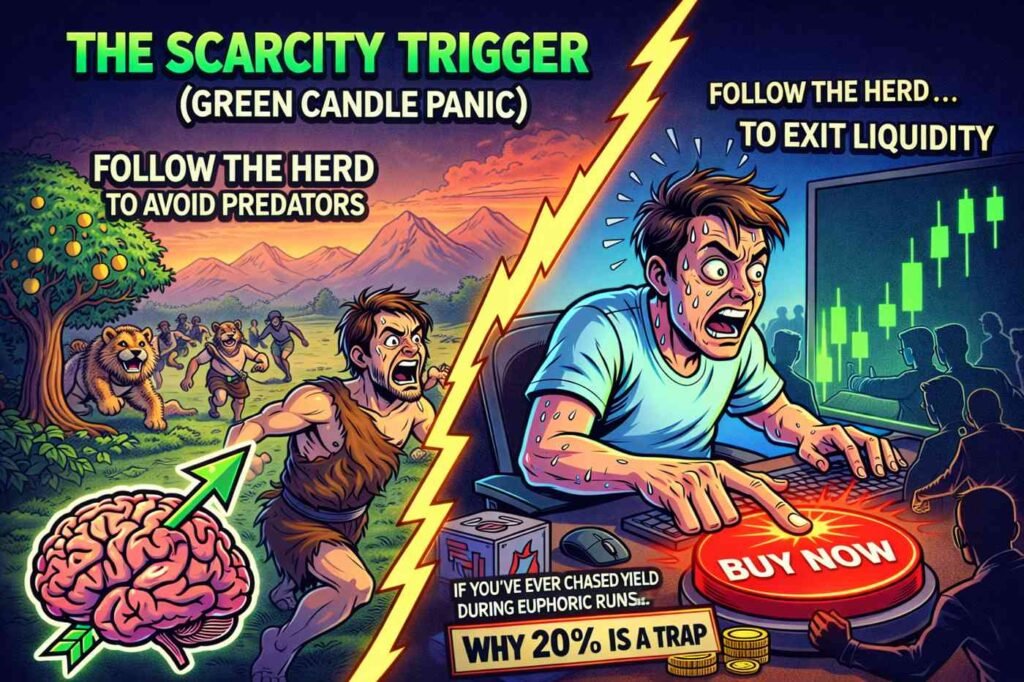
1. The Scarcity Trigger (Green Candle Panic)
Your ancestors survived by reacting quickly to scarce resources.
This is where crypto FOMO psychology begins , at the intersection of urgency and perceived scarcity.
If fruit was limited, you ate immediately.
If the herd moved, you followed.
Hesitation meant starvation.
In markets, a vertical green candle signals scarcity.
Price rising rapidly tells your brain:
“Supply is disappearing. Others are getting ahead. Act now.”
Your brain translates:
“Buy now or lose forever.”
This reaction isn’t greed. It’s evolutionary conditioning.
Behavioral economists call this “scarcity bias,” a well-documented cognitive distortion supported by research from the American Psychological Association.
Herd Behavior: From Survival to Exit Liquidity
In nature, following the herd avoids predators.
In markets, following the herd often makes you exit liquidity.
When a coin trends:
- Early buyers are already in profit.
- Influencers amplify excitement.
- Late buyers enter at peak emotional intensity.
The crowd feels like safety.
In financial markets, the crowd is often the top.
The Artificial Scarcity Illusion
Crypto amplifies this trigger because scarcity is visually exaggerated:
- Rapid candle movement
- Percentage gains displayed in bright green
- Social feeds filled with “100x” narratives
- Influencers posting unrealized gains
The environment is engineered to stimulate urgency.
Exchanges remove friction with one-click buy buttons for a reason.
Impulse execution generates fees.
Yield Euphoria & Scarcity Bias
Scarcity bias isn’t limited to price pumps.
It also appears during yield hype cycles.
When you see:
“20% APY , Limited Pool!”
Your brain reads:
“Opportunity closing. Act fast.”
The same scarcity trigger applies there.
If you’ve ever chased yield during euphoric runs, read:
👉 Why 20% APY Is a Trap
The psychology behind chasing vertical price candles is identical to chasing unsustainable yield.
The Counterintuitive Truth
The safest entries rarely feel urgent.
The most dangerous entries usually do.
If you feel physical pressure to act immediately, that’s your signal that scarcity bias is active.
Scarcity feels like opportunity.
In markets, it often signals risk.
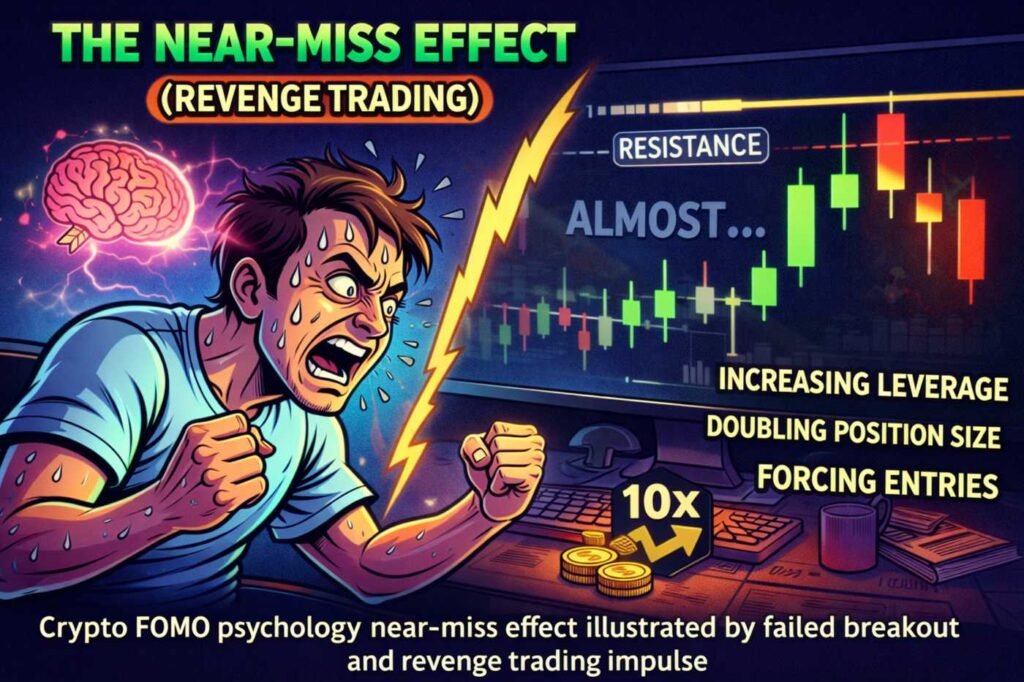
2. The Near-Miss Effect (Revenge Trading)
Research in behavioral psychology shows near misses create dopamine spikes similar to actual wins.
Slot machines are engineered around this.
Two cherries and a blank? Your brain registers it as “almost winning.”
It doesn’t feel like failure. It feels like unfinished success.
Crypto markets are a 24/7 near-miss machine.
Examples:
- “I almost bought before it pumped.”
- “I sold right before the breakout.”
- “I was one click away.”
- “If I had just held one more day…”
Your brain doesn’t process these as losses.
It processes them as evidence you were right.
That’s the dangerous part.
The near-miss effect is heavily studied in gambling psychology (see research from the National Library of Medicine).
The near-miss effect is one of the most destructive accelerants inside crypto FOMO psychology.
The Dopamine Distortion
A near miss activates the same reward pathways as a win, but without the payoff. This creates psychological tension.
You feel:
- Frustration
- Urgency
- Injustice
- A need to “correct” the outcome
This tension demands resolution.
In crypto FOMO psychology, that resolution often becomes revenge trading.
Why Crypto Makes It Worse
Traditional markets close. There is downtime.
Crypto never stops.
There is always:
- Another breakout
- Another candle
- Another “one more chance”
- Another influencer screaming “this is it”
There is no emotional cooldown period.
The cycle becomes:
Near miss → Dopamine spike → Emotional discomfort → Impulsive trade
Repeat.
Revenge Trading Behavior
Revenge trading is not about strategy.
It’s about ego repair.
Common patterns:
- Increasing leverage to “make it back faster”
- Doubling position size to recover imaginary profit
- Forcing entries without confirmation
- Ignoring risk management rules you previously respected
You are not trying to win.
You are trying to erase regret.
The market owes you nothing.
It never did.
Where This Gets Exploited
Scammers, influencers, and pump groups understand this psychology.
They amplify:
- Charts that “almost broke out”
- Narratives like “last chance”
- Artificial urgency
If you want to see how this psychological weakness gets weaponized in actual fraud mechanics, read:
👉 The Pig Butchering Scam Explained
Near misses make you emotional.
Emotional traders are predictable.
Predictable traders are profitable — for someone else.
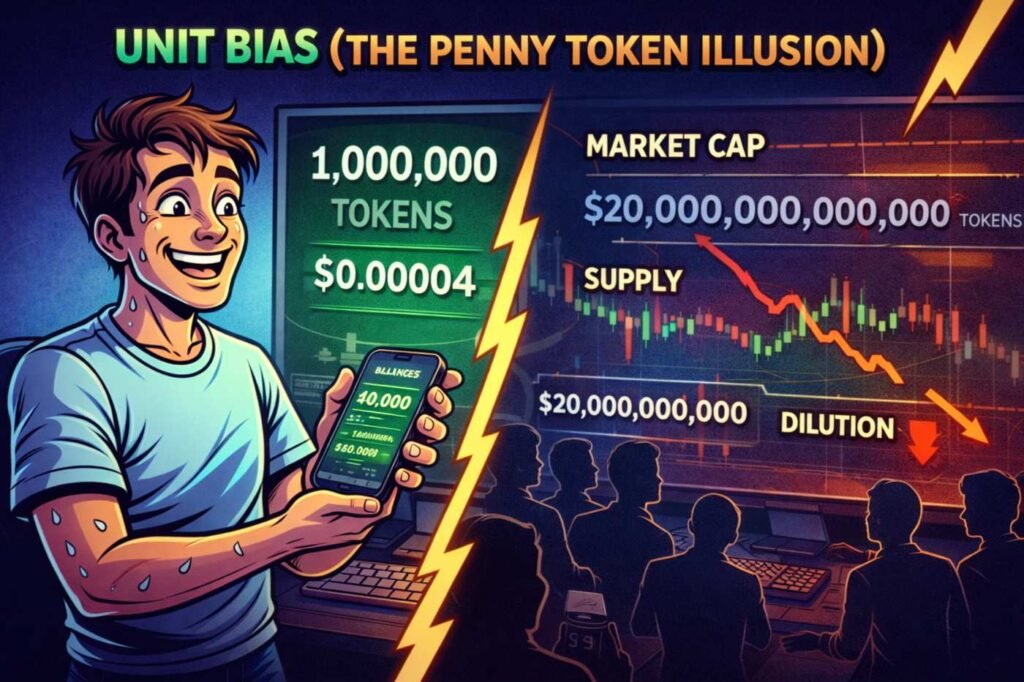
3. Unit Bias (The Penny Token Illusion)
“I can’t afford Bitcoin at $100k, but this token is only $0.00004.”
That reaction is unit bias.
Unit bias is the psychological tendency to prefer owning whole units rather than fractions. Your brain feels more satisfied holding “1,000,000 tokens” than holding “0.01 BTC,” even if the dollar value is identical.
The number of units feels like wealth.
But units are arbitrary.
Unit bias is a structural illusion that crypto FOMO psychology repeatedly exploits during euphoric market cycles, especially near local tops.
Why Your Brain Falls for It
Humans are wired to equate quantity with value.
More apples = more food.
More land = more security.
More coins = more wealth.
In crypto, this instinct becomes distorted.
Owning:
- 1,000,000 micro-tokens
feels richer than - 0.01 Bitcoin
Even if both equal $1,000.
Your brain confuses quantity with purchasing power.
The Math Most People Ignore
Price per token means nothing without:
- Total supply
- Circulating supply
- Market cap
If a token costs $0.00004 but has a supply of 500 trillion, it is not “cheap.”
It may already have a multi-billion dollar market cap.
For that token to reach $1, it would require more capital than exists in entire national economies.
But your brain doesn’t instinctively calculate market cap.
It reacts to small numbers.
$0.00004 feels “early.”
$100,000 feels “late.”
That feeling is psychological , not mathematical.
Why Scammers Love Unit Bias
High-supply tokens are not an accident.
They are designed to look cheap.
The pitch is always the same:
“If this just goes to $1…”
That statement alone reveals misunderstanding.
The question is not “Can it go to $1?”
The question is:
“How much capital would be required to move it there?”
Unit bias keeps you focused on price, not valuation.
And valuation is what actually matters.
The Emotional Trap
Unit bias also connects directly to FOMO.
If a penny token moves from $0.00004 to $0.00008, that’s a 100% gain.
It feels explosive.
But percentage gains are easier to manufacture on tiny price bases with inflated supply.
The illusion of cheapness fuels impulsive entries.
The reality of dilution destroys them.
The Brutal Truth
You are not buying something cheap.
You are buying something that feels cheap.
And markets do not reward feelings.
They reward capital efficiency.
For a deeper breakdown of the myths that keep this illusion alive:
👉 Crypto Myths People Still Believe

4. Social Proof & Algorithmic Amplification
Social media platforms are engineered to maximize engagement , not truth.
The algorithm does not ask:
“Is this accurate?”
It asks:
“Will this keep the user scrolling?”
When you interact with one bullish post, the system interprets that as preference.
You don’t just see more of it.
You see only more of it. Social proof and algorithmic amplification are core drivers of crypto FOMO psychology in modern markets.
The Illusion of Consensus
After liking one “#100x gem” post, your feed becomes:
- Charts going vertical
- Influencers posting profit screenshots
- Threads predicting “inevitable breakouts”
- Comments screaming “We’re early!”
Your brain begins constructing a dangerous narrative:
“Everyone is buying.”
They aren’t.
You are seeing a filtered slice of hyper-engaged, emotionally amplified content.
It’s a highlight reel , curated by an algorithm trained to reward outrage, excitement, and tribal energy.
Silence never trends.
Bored investors never go viral.
Why This Feels So Convincing
Humans evolved to rely on social proof for survival.
If the tribe ran , you ran.
If the tribe celebrated , you joined.
In uncertain environments, social signals override private analysis.
Crypto is maximum uncertainty.
That makes social proof extraordinarily powerful.
Now combine that with:
- 24/7 markets
- Real-time price movement
- Screenshots of “life-changing gains”
- Influencers financially incentivized to shill
You are not just fighting FOMO.
You are fighting an industrial-scale attention machine.
Algorithmic Radicalization of Belief
The more bullish content you consume, the more bearish or neutral information disappears.
You stop seeing:
- Token unlock schedules
- Liquidity risks
- Whale concentration data
- Insider allocations
Your feed becomes an echo chamber.
And echo chambers create conviction without verification.
By the time something trends on X, TikTok, or YouTube:
- Early buyers entered weeks ago
- Smart money accumulated in silence
- The hype phase has begun
At that moment, attention is being monetized.
And attention converts into liquidity.
Often, your liquidity.
The Brutal Reality
Trending ≠ Early
Viral ≠ Undervalued
High engagement ≠ High quality
By the time “everyone” is talking about it, the asymmetric opportunity is usually gone.
The algorithm didn’t show you the beginning.
It showed you the climax.
And climaxes are where distribution happens.
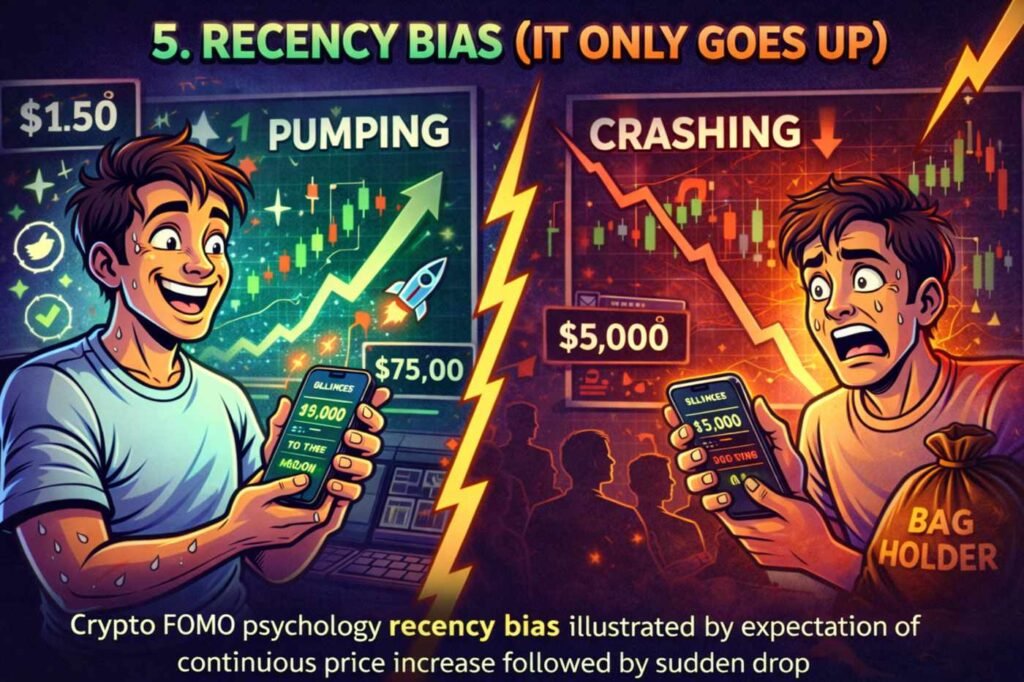
5. Recency Bias (It Only Goes Up)
If a coin pumped yesterday, your brain assumes it will pump today.
If it pumped today, your brain assumes it will pump tomorrow.
That is recency bias.
Recency bias is the tendency to overweight recent information and project it forward indefinitely. Your brain assumes the immediate past is a reliable predictor of the near future.
In crypto, this bias becomes extremely dangerous.
Recency bias completes the loop of crypto FOMO psychology by convincing you that momentum is permanent.
Why It Feels Logical
Markets reward continuation , until they don’t.
When you see:
- 3 green daily candles
- Higher highs and higher lows
- Increasing volume
Your brain forms a pattern:
“This is the new normal.”
Volatility trains you like a casino slot machine. When dips keep getting bought, you internalize the rule:
“Buying works.”
So you keep buying.
And buying.
And buying.
Until the structural regime changes.
The Turkey Problem
There’s a famous analogy in behavioral finance:
A turkey is fed every day for 1,000 days.
Every day reinforces the belief:
“The farmer brings food.”
Recency bias strengthens confidence.
On day 1,001, the farmer brings something else.
In crypto, you are the turkey.
The dip gets bought.
The dip gets bought.
The dip gets bought.
Then one day, liquidity dries up.
The macro narrative shifts.
Leverage unwinds.
Whales distribute.
And the dip doesn’t bounce.
That’s when recency bias turns into paralysis.
Why Recency Bias Fuels FOMO
Crypto FOMO psychology is amplified by this pattern:
- Fast pumps train continuation expectations
- Fast dips train bounce expectations
- Volatility conditions you to act quickly
You start believing speed equals opportunity.
When the trend flips, you don’t adapt.
You rationalize:
“It always recovers.”
“It bounced last time.”
“This is just a shakeout.”
By the time reality sets in, you are down 40%.
Now you aren’t trading.
You are hoping.
The Brutal Truth
Trends persist , until they break.
Recency bias makes you confident at the exact moment risk is rising.
The pump trains belief.
The crash tests it.
And most investors only update their beliefs after maximum damage.
That’s how bag holders are created.
This is why crypto FOMO psychology is most dangerous near cycle peaks , when continuation feels guaranteed and risk is highest.
How to Break Crypto FOMO Psychology
You cannot defeat biology with willpower. Understanding crypto FOMO psychology is useless without structural systems to neutralize it.
Breaking crypto FOMO psychology requires structural defenses, not motivational discipline.
Your brain evolved to react fast to threats and opportunities. In crypto, volatility hijacks that system.
So you don’t fight emotion.
You design around it.
You build systems that protect you from yourself.
1. Add Friction (Slow Down the Lizard Brain)
Impulse trading happens when execution is frictionless.
One-click buys.
Instant swaps.
Leverage sliders.
Modern exchanges are optimized for speed because speed increases volume , and volume increases fees.
But speed is the enemy of rational thought.
Why Friction Works
The FOMO impulse spike usually lasts 60–120 seconds.
If you interrupt that spike, logic returns.
Hardware wallets reintroduce friction:
- Physically getting up
- Finding the device
- Connecting the cable
- Entering the PIN
- Manually approving the transaction
That 2–3 minute delay often outlasts the adrenaline surge.
By the time the wallet is connected, your prefrontal cortex is back online.
You start asking better questions:
- Did I research this?
- Is this a plan or a reaction?
- Am I buying strength or chasing noise?
Security tools are not just security tools.
They are psychological circuit breakers.
Resources:
Cold storage protects your keys.
Friction protects your behavior.
2. Use the 24-Hour Rule (Interrupt the Amygdala Hijack)
If you feel:
- Heart racing
- Palms sweating
- Obsessive chart refreshing
- Urgency to “not miss it”
You are not analyzing.
You are reacting.
This is called an amygdala hijack your emotional brain overrides rational processing.
In this state, you are chemically incapable of objective decision-making.
The Protocol
- Close the exchange immediately. Removing the order ticket from screen is the single highest-leverage interrupt. Do this first, before any other reasoning.
- Write down your reason for buying. Forcing the impulse into a written sentence usually exposes whether the trade has logic or only momentum behind it.
- Set a 24-hour timer. Most FOMO impulses decay within hours when execution is denied. The timer is the constraint, not your discipline.
- Do nothing until the timer ends. If the trade still makes sense with calm reasoning the next day, it may be valid. Urgency rarely survives sleep.
The physical act of writing forces cognitive clarity.
When you revisit the note the next day, you will often discover:
“My reason was: It was going up fast.”
That’s not analysis.
That’s momentum addiction.
Most impulses decay quickly when denied immediate execution.
If you still want the position after 24 hours , with calm reasoning , it may actually be valid.
But urgency almost never survives sleep.
3. Automate the Boredom (Remove Yourself from Execution)
Excitement is expensive.
Boredom compounds.
If trading feels thrilling, you are gambling.
Professional capital allocation feels dull.
Instead of timing tops and bottoms, outsource execution to rules.
Use Dollar Cost Averaging (DCA)
Set a fixed purchase schedule.
No emotion.
No debate.
No chart watching.
Consistency beats intensity.
Use Limit Orders (Never Chase Green)
If price is pumping at $10, set a bid at $8.50.
Let volatility work for you.
If it fills great.
If not you kept your capital.
Either way, you avoided impulse execution.
Use Automation Tools
Bots do not feel FOMO.
Bots execute plans.
Humans override plans.
Automation reduces:
- Overtrading
- Emotional entries
- Revenge sizing
- Fatigue errors
Automation removes emotional execution.
And emotional execution is where most retail losses begin.
The Meta-Lesson
FOMO is not a personality flaw.
It is a biological response to volatility and social pressure.
The goal is not to suppress it.
The goal is to design a system where:
- Urgency cannot execute
- Emotion cannot size positions
- Excitement cannot override structure
The investors who survive crypto cycles are not the smartest.
They are the most structured.
And structure beats impulse every time.
The Hidden Cost: Taxes & Overtrading
Crypto FOMO psychology doesn’t just cost you entry price.
It creates:
- Excess trading fees
- Taxable events
- Administrative chaos
Swapping crypto-to-crypto is taxable in most jurisdictions.
High-frequency trading creates accounting nightmares.
If you trade actively, read:
👉 Best Crypto Tax Software 2026
Also understand exchange risk:
👉 Exchange Withdrawals Will Pause Again
Self-custody protects both access and control.

Embrace JOMO (Joy of Missing Out)
The goal isn’t catching every pump.
It’s avoiding catastrophic mistakes.
JOMO means:
- Holding conviction assets in cold storage
- Earning sustainable yield
- Ignoring hype cycles
The market transfers wealth from the impatient to the patient.
In crypto, it transfers wealth from the excited to the bored.
Be the bored one.
Mastering crypto FOMO psychology is less about predicting markets and more about controlling your own reactions to volatility.
FAQ
Is crypto FOMO psychology normal?
Yes. It’s a natural emotional response amplified by volatility and social media.
Can trading bots eliminate FOMO?
They reduce emotional execution errors but do not eliminate risk.
Why does it feel like everyone else wins?
People post gains, not losses.
What’s the fastest way to reduce FOMO?
Add friction and enforce a waiting period before buying.