

Last Updated on March 12, 2026 by Snout0x
The Real Risks Behind Crypto Staking in 2026
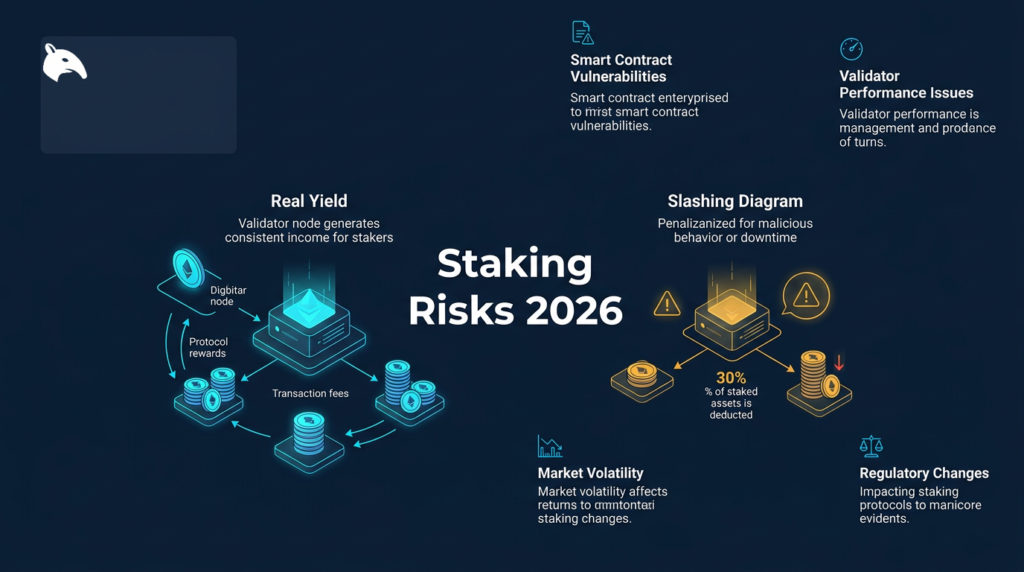
Staking crypto looks simple on a dashboard: lock tokens, earn rewards, watch the balance grow. But the number shown on-screen is not the full story. Crypto staking risks 2026 investors face are structural, not accidental. Many come directly from how Proof-of-Stake systems are designed.
The headline APY can be eroded by inflation. Your capital can be locked during a crash. A validator can be slashed. An exchange can freeze withdrawals. And in many jurisdictions, taxes are triggered before you ever sell the reward.
These are not edge cases. They are core proof-of-stake risks that every staker needs to understand before committing capital.
This guide breaks down the main staking risk categories in plain English, explains real yield versus nominal APY, and shows how to structure a staking position in 2026 without sleepwalking into avoidable losses.
Disclaimer: This content is for educational and informational purposes only and does not constitute financial, investment, tax, or legal advice. Cryptocurrency markets are volatile and involve risk. Always conduct your own research and consult a qualified professional before making financial decisions.
Affiliate Disclosure: Some links in this article may be affiliate links. If you choose to use them, I may earn a commission at no additional cost to you.
Key Takeaways: Crypto Staking Risks 2026
- The Inflation Problem: Yield usually comes from new token issuance. If the supply grows faster than you earn, you are losing purchasing power despite a rising token balance.
- The Liquidity Lock: Unbonding periods of up to 28 days mean you cannot sell during a crash. You may be forced to hold through a 40% decline simply because you staked.
- The Custody Risk: Staking on a centralized exchange means lending your crypto to a corporation. You hold an IOU. If the exchange fails, you are an unsecured creditor.
- Slashing Penalties: A slashing event can permanently burn a percentage of your principal. You are exposed to your validator’s operational quality, not just market risk.
- The Tax Trap: In most jurisdictions in 2026, staking rewards are taxable income at the moment of receipt. If the asset later crashes, you may still owe tax based on the original higher value.
1. The Inflation Catch: Real Yield vs. Nominal Yield
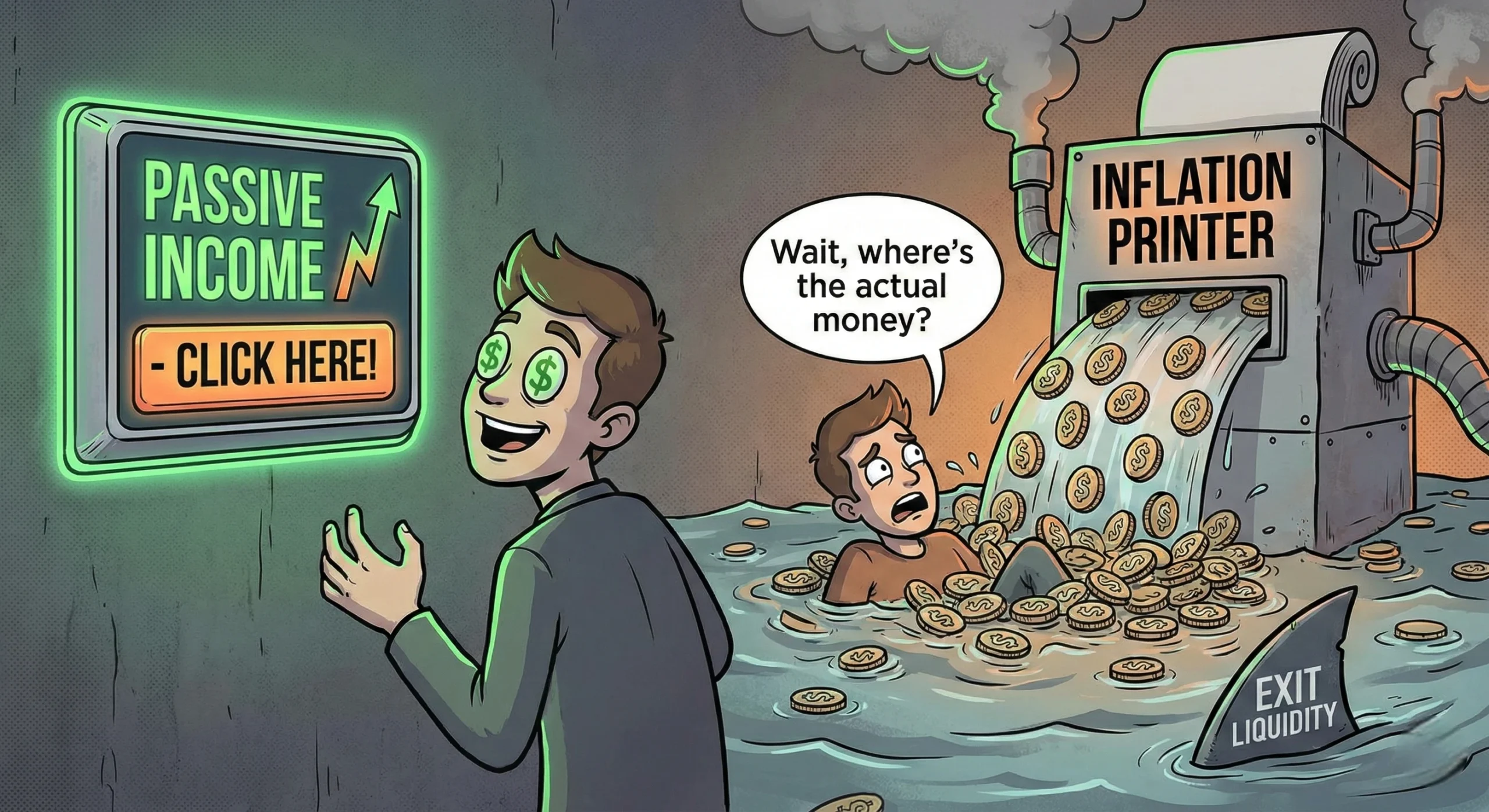
This is the most pervasive misunderstanding in crypto staking and one of the core proof of stake risks investors underestimate. It explains why many retail holders slowly lose purchasing power while their token balance increases.
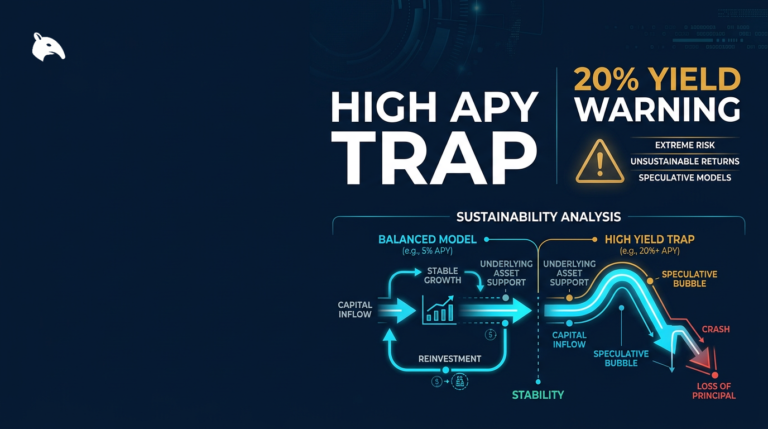
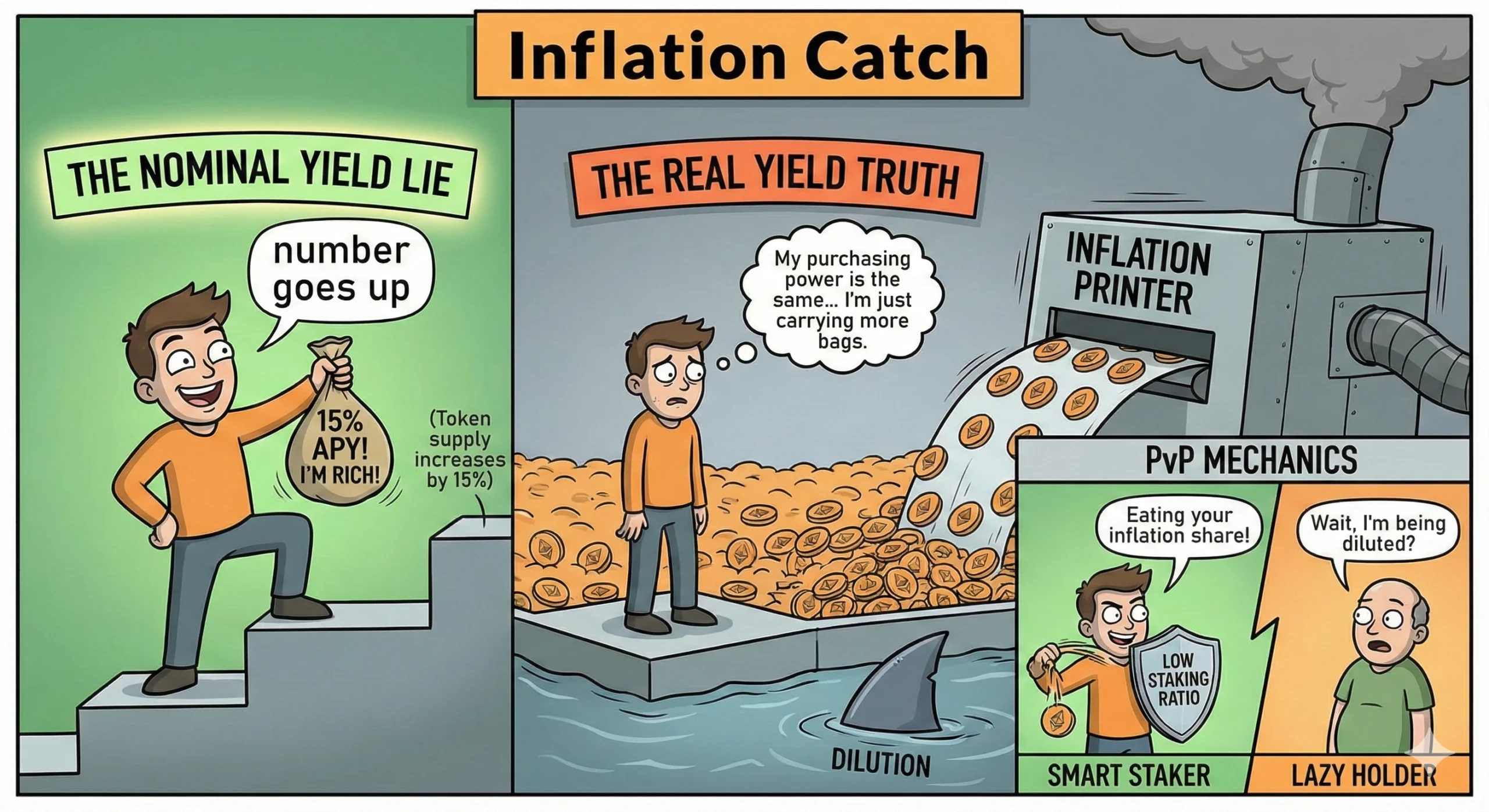
You see 15% APY on a dashboard. Your brain translates that into profit. But in most Proof-of-Stake (PoS) systems, that yield comes from new token issuance. The protocol mints tokens to pay stakers. This is the heart of staking inflation risk.
If the total supply grows by 15% and you earn 15%, your share of the network has not changed. You hold more units of a proportionally less valuable asset.
The metric that actually matters is Real Yield, not the headline APY.
Real Yield = Staking APY – (Token Inflation Rate + Dilution Events)
If the staking APY is 15% but annual token inflation is 20%, your real yield is -5%. You are losing value every block. The number of tokens in your wallet increases, but the underlying purchasing power erodes.
This is one of the most overlooked crypto staking risks 2026 participants face: confusing nominal rewards with actual economic gain.
The PvP Dynamic: Who You Are Actually Competing Against
Staking operates as a Player-vs-Player system. Your real return does not come from the protocol itself. It comes from token holders who forget to stake, choose not to stake, or leave assets parked on exchanges that stake inefficiently or not at all.
Inflation rewards are divided among active participants. If 100% of the supply is staked, every holder effectively receives the inflation rate and no one gains real value. Your edge only exists when a meaningful portion of the circulating supply remains unstaked.
The staking ratio is the key variable to watch. A low ratio can temporarily improve real yield for active participants. As the ratio climbs, that edge compresses and the inflation dynamics dominate.
Three Scenarios Worth Understanding
Understanding crypto staking risks 2026 requires thinking beyond the advertised APY. These scenarios illustrate how yield can look attractive on paper while real value quietly deteriorates.
Scenario A: The Zombie Chain
A low-activity Layer 1 advertises 18% APY. The chain has no meaningful user base, so the protocol prints 20% new supply annually to incentivize validators to stay online.
This is pure staking inflation risk.
Real yield: -2%.
The token balance grows. The USD value slowly decays. Most holders do not notice until they finally check the price chart instead of the reward counter.
High APY does not equal high return.
Scenario B: The Deflationary Model
Ethereum offers roughly 3–4% APY. Because the network burns a portion of gas fees through EIP-1559, net supply can shrink or remain flat during periods of high activity.
Your staking return is not fighting structural inflation. It is supported by real network usage.
That is real yield.
Lower number, higher quality.
This is the difference between nominal yield and economic yield — one of the key distinctions investors must understand when evaluating proof of stake risks.
Scenario C: The Hidden VC Unlock
A project shows 5% annual inflation on public dashboards. What is not highlighted: early investors unlock 10% of total supply in Q1 2026.
The effective supply shock becomes 15%.
Staking rewards are overwhelmed by insider selling pressure. The APY looks fine. The tokenomics do not. The price reflects the real supply expansion long before marketing dashboards update.
This is where dilution events compound standard staking inflation risk, and why surface-level APY comparisons are dangerous.
What to Check Before Committing Capital
- Circulating vs. total supply: If only 10% of tokens are in circulation and 90% are locked in team or VC wallets, those tokens are future selling pressure. Run a basic check on any data aggregator before staking.
- Token unlock schedules: Check token analytics platforms for upcoming cliff unlocks. If a large unlock lands within 60 days of your planned stake, the timing risk is significant.
- Where the yield originates: If yield comes from protocol fee revenue generated by real users, it is real. If it comes from minting new tokens, it is an inflation subsidy. The source changes everything about the risk profile.
For a deeper breakdown of how high APY figures are structured to mislead, see: Why 20% APY Is a Trap: A Realistic Look at 2026 Yields.
2. The Lock-Up Catch: Staking Lock-Up Period Risk and Liquidity Crisis
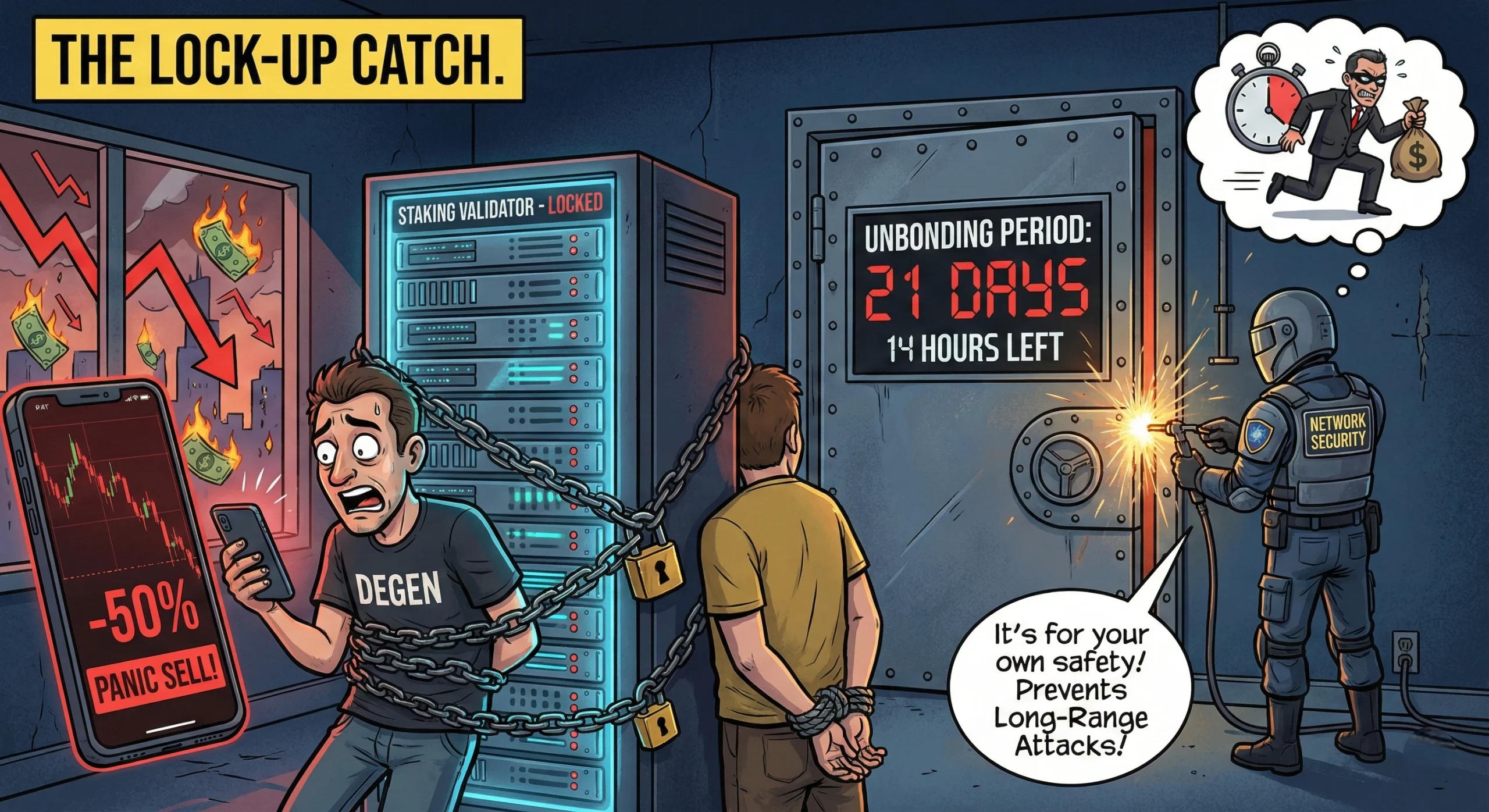
Most Proof-of-Stake networks enforce a mandatory unbonding period when you request withdrawal of staked tokens. During this window, you cannot sell, transfer, or redeploy those assets.
The staking lock-up period risk feels invisible during calm markets. In a fast-moving downturn, it becomes the dominant risk.
This is one of the most practical crypto staking risks 2026 participants underestimate: liquidity is not guaranteed when you need it most.
Common Unbonding Periods (2026)
- Cosmos (ATOM): 21 days
- Polkadot (DOT): 28 days
- Ethereum (ETH): Variable, from a few days to several weeks depending on exit queue length
- Solana (SOL): 2–3 days, epoch-dependent
In each case, once you click “unstake,” the clock starts — and your capital is frozen until it expires.
Why Unbonding Periods Exist
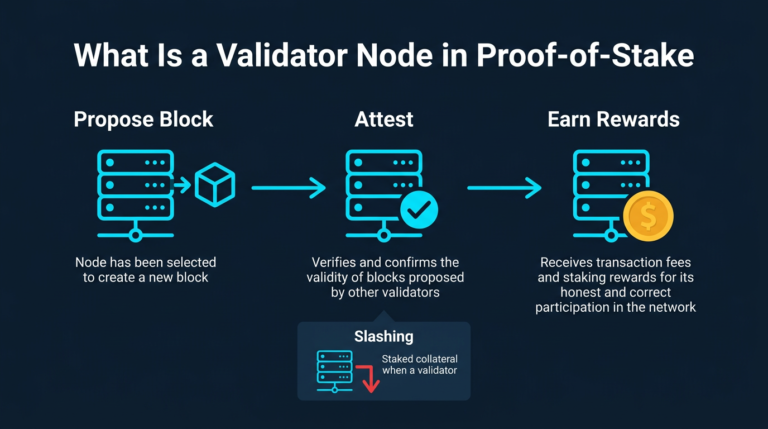
The cooling-off window is a network security mechanism. If a validator behaves maliciously, the protocol needs time to detect the violation and execute a slashing penalty before the validator can withdraw and disappear.
The lock-up is what makes slashing enforceable. Without it, Proof-of-Stake security would collapse.
You are effectively paying for network security with your liquidity.
That trade-off is reasonable if you are a long-term holder who can tolerate volatility. It becomes dangerous if you are relying on flexibility, planning to trade cycles, or managing position size actively.
This is the structural tension at the heart of proof of stake risks: stronger security requires temporary capital immobility. You understand it going in. It becomes a costly surprise if you did not account for it.
The Forced Hold Scenario
Here is a realistic sequence that plays out during major crypto drawdowns — and one of the clearest examples of staking lock-up period risk in action:
- Bitcoin drops 15% on a macro catalyst.
- Altcoins fall 40% within 48 hours.
- You decide to move your staked ATOM into stablecoins to preserve capital and wait for a better re-entry.
- You submit an unstake request. The protocol confirms it will process in 21 days.
- By the time your tokens unlock, price has fallen another 30% from your intended sell level.
You did not consciously choose to hold through that decline. The protocol held for you.
The lock-up period converted a risk management decision into an involuntary long position.
This is not a theoretical proof of stake risk. It has occurred repeatedly during every major downturn affecting ATOM, DOT, and other staked assets in recent market cycles.
Liquidity risk in staking is not about whether you can exit. It is about whether you can exit when it matters.
Liquid Staking Tokens and De-Peg Risk
Liquid staking tokens (LSTs) such as stETH or JitoSOL were designed to reduce staking lock-up period risk. You stake, receive a derivative token, and can trade that derivative at any time.
The solution is real. But it introduces a different structural risk: the de-peg.
LSTs are derivatives. Under normal conditions, they track the underlying asset closely. Under high-stress market conditions — when everyone attempts to exit simultaneously — liquidity fragments and the peg can break.
stETH has historically traded at a discount to ETH during periods of market stress. A 5–10% discount layered on top of a 40% market drop compounds losses at the worst possible moment.
Liquid staking changes the risk profile. It does not eliminate liquidity risk. It transforms direct lock-up risk into secondary market risk.
Understanding this trade-off is critical when evaluating crypto staking risks 2026 participants now face in more mature but still volatile markets.
A Practical Allocation Approach
Staking 100% of a position only makes sense if you are prepared to hold through extreme volatility on a multi-year horizon.
A more balanced framework is a split allocation:
- Keep the core long-term position staked natively for compounding.
- Maintain a liquid reserve — either unstaked or in a high-liquidity LST — for opportunistic selling or defensive positioning.
This structure reduces exposure to staking lock-up period risk while preserving the compounding benefits of Proof-of-Stake participation. The specific ratio depends on your time horizon and how actively you manage the position.
3. The Technical Catch: Slashing Penalties in Crypto
Slashing penalties in crypto represent one of the most serious and least understood proof of stake risks in modern staking systems.
When you delegate to a validator, you are not simply earning yield. You are extending trust. Your principal is now partially dependent on that validator’s operational discipline, infrastructure reliability, and security practices.
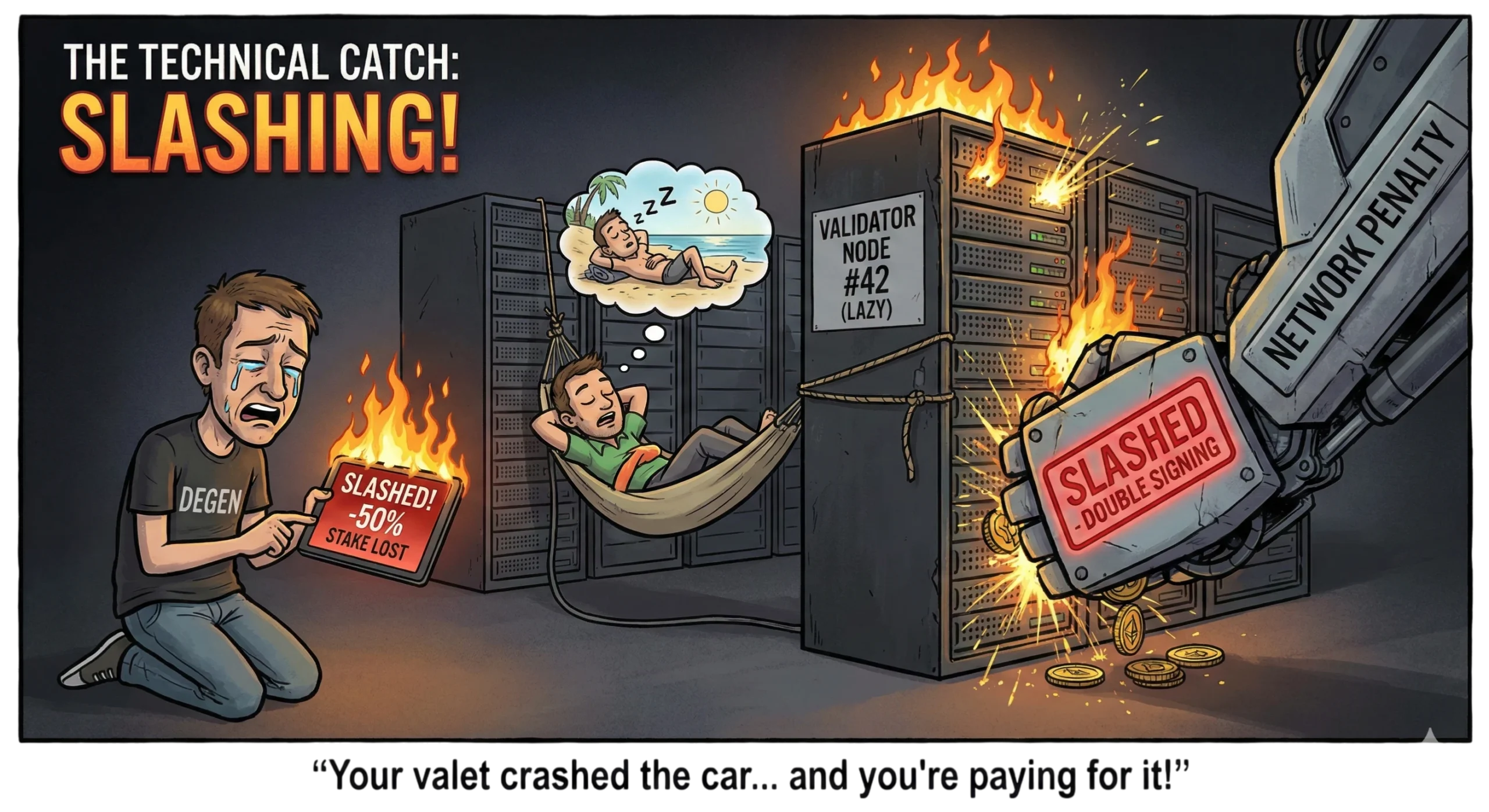
If the validator misbehaves, signs conflicting blocks, or makes critical technical errors, the protocol enforces a slashing event. The penalty is not limited to the validator’s own stake. It is applied proportionally to all delegators.
This is the structural difference between passive holding and active staking participation.
You have handed the keys to a valet. If the valet crashes the car, you pay for the damage.
Slashing transforms staking from a yield mechanism into a shared responsibility model and it is one of the core crypto staking risks 2026 investors must evaluate before delegating capital.
Two Types of Slashing Events
Understanding slashing penalties in crypto requires distinguishing between operational mistakes and protocol-level attacks.
Type 1: Downtime and Jail
The validator’s server goes offline. This could be caused by a cloud provider outage, a missed update, misconfigured infrastructure, or general operational failure.
The penalty is usually limited:
- A small percentage slash, or
- A temporary “jail” period where reward accumulation pauses
Your principal typically remains intact. This is primarily a loss of yield, not capital. Annoying, but recoverable.
Even so, repeated downtime compounds risk and signals poor validator discipline — one of the more common proof of stake risks that delegators overlook.
Type 2: Double Signing
The validator signs two conflicting blocks at the same height. The network interprets this as a direct attack or attempt to fork consensus.
Penalties are severe and immediate.
- On Ethereum, a double-sign triggers a forced validator exit and substantial principal destruction.
- On Cosmos, the slash is permanent and irreversible.
There is no appeal process. No customer support ticket. No insurance desk.
The protocol executes the penalty automatically. The coins are burned. They are gone.
This is the most extreme form of slashing risk crypto investors must account for before delegating capital.
Why Validator Selection Matters More Than Most Guides Admit
Most new participants open a staking dashboard, sort by highest voting power, and delegate to the top result — usually a major exchange or institutional operator.
This default behavior introduces several avoidable crypto staking risks 2026 investors should not ignore.
1. Concentration Risk
If the top three validators control one-third of total staked supply, a coordinated outage, regulatory action, or targeted attack could destabilize the network. Network instability directly impacts token price.
2. The Zero-Fee Trap
Large validators frequently advertise 0% commission to attract delegators. After accumulating significant stake, commissions are quietly increased. Notifications are not always obvious.
3. Institutional Target Risk
Large validators are higher-value targets for sophisticated attacks. A smaller, technically competent validator with disciplined infrastructure and transparent communication is often more resilient than a faceless corporate node.
A More Defensive Approach
A more robust strategy is diversification:
- Split stake across 3–5 validators outside the top 10
- Verify uptime above 99%
- Confirm meaningful self-bonded stake
Self-bond means the validator has their own capital at risk alongside yours. Alignment matters in Proof-of-Stake systems.
Validator selection is not a minor detail. It is one of the central proof of stake risks that determines whether staking remains a compounding strategy — or becomes a capital destruction event.
For validator research tools and staking dashboards, see: 7 Essential Crypto Tools 2026: Trading, Taxes and Security Apps.
4. The Custody Catch: Exchange Staking and the IOU Problem
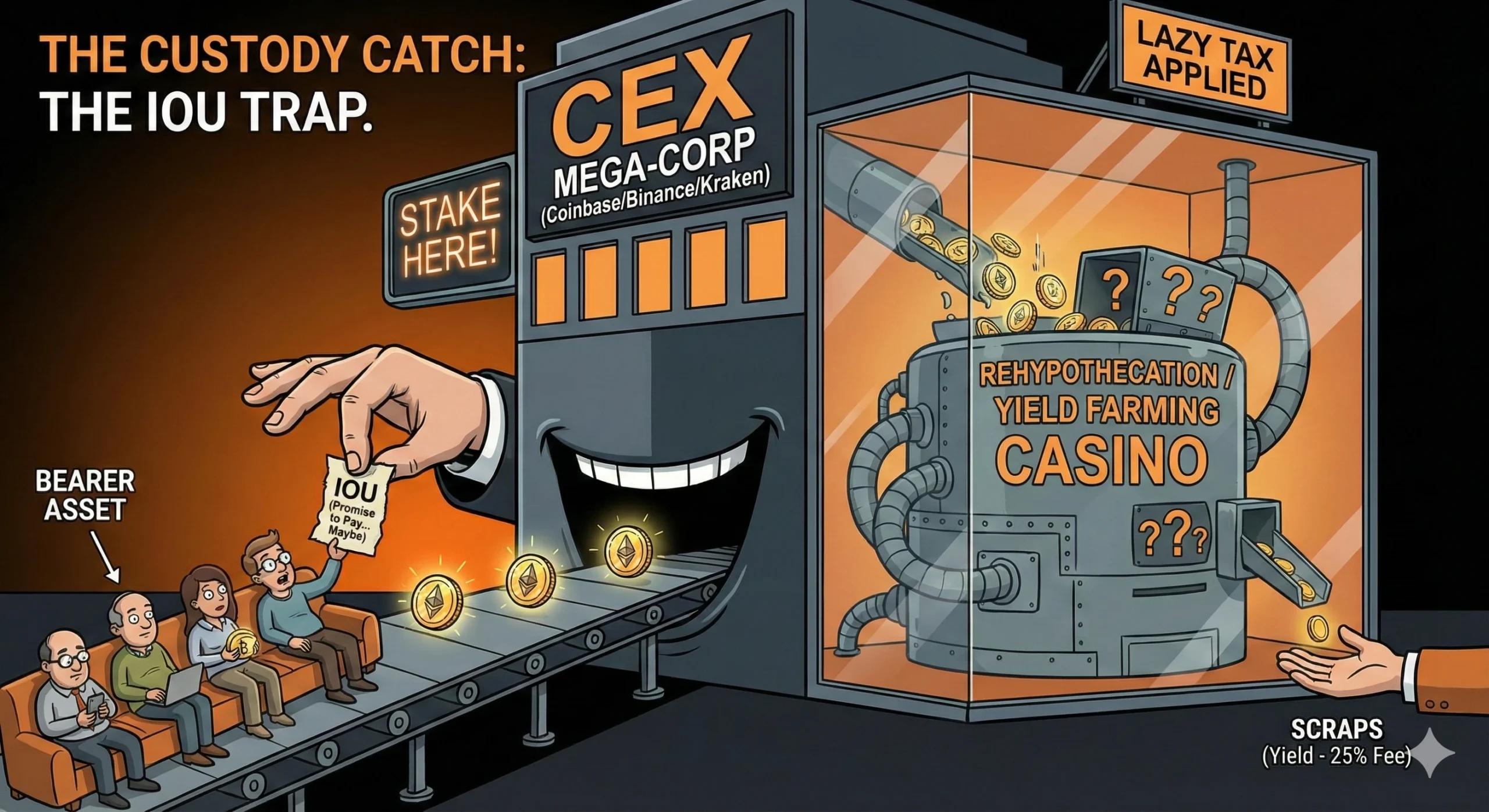
When you stake through Coinbase, Kraken, Binance, or any centralized exchange, you are not staking in the technical sense. You are lending your tokens to a corporation. They pool customer deposits, delegate to validators on your behalf, take a substantial fee cut, and return the remainder as a yield figure in your account dashboard.
You handed over a bearer asset. You received an IOU in return. That distinction matters enormously when things go wrong.
Four Risks of Exchange Staking
1. Bankruptcy exposure. If the exchange becomes insolvent, your staked balance becomes part of the estate. In bankruptcy proceedings, unsecured creditors, which is what depositors are classified as in most jurisdictions, typically recover a fraction of what they held, often years after the filing. FTX, Celsius, Voyager, and BlockFi each produced exactly this outcome. None of those platforms marketed themselves as unsafe before they failed.
2. Withdrawal freezes. During periods of high market volatility, exchanges have paused withdrawals to manage their own liquidity positions. You may want to exit your position. The exchange may not allow it. Your ability to act on your own risk management decision is conditional on the exchange’s internal situation, not yours.
3. Fee extraction. Native validator commissions typically run 5 to 10%. Exchange staking fees often run 25 to 30% of yield. If ETH staking yields 4% at the protocol level and the exchange takes 25%, you receive around 3%. That 1% difference compounds over years into a meaningful transfer of wealth from your account to the exchange’s revenue.
4. Rehypothecation risk. There is no guarantee the exchange is actually staking your tokens. In some documented cases, exchanges have lent deposited assets to counterparties seeking leverage or short-selling inventory. If that counterparty defaults, you are exposed to that counterparty’s failure on top of ordinary market risk. You accepted hedge fund counterparty risk while earning a savings account yield.
The Case for Self-Custody Staking
Self-custody staking is not technically demanding in 2026. The general process:
- Purchase a hardware wallet. This physically isolates your private keys from internet-connected devices and eliminates remote theft vectors.
- Withdraw tokens from the exchange. Move your assets to an address you control.
- Stake natively. Use the wallet’s built-in interface (Ledger Live, Trezor Suite) or connect to a chain-specific dashboard (Keplr for Cosmos, Polkadot.js for DOT) to delegate directly to a validator of your choosing.
The initial setup takes under an hour. You maintain full custody throughout. Your tokens are not part of anyone else’s balance sheet.
Hardware wallet reviews: Ledger Nano X Review 2026 or the newer Trezor Safe 7 Review 2026. Affiliate links: Ledger / SafePal.
5. The Regulatory Catch: Crypto Staking Taxes 2026
The regulatory environment for staking changed materially in 2026. The Digital Asset Market Clarity Act established a federal framework that classifies most staking and liquid staking activity as non-securities. That classification removes a major legal uncertainty that had been hanging over the industry for years. It is broadly positive for adoption and institutional participation.
The tax side of crypto staking taxes in 2026 is less forgiving.
How Staking Rewards Are Taxed: The Dominion and Control Rule
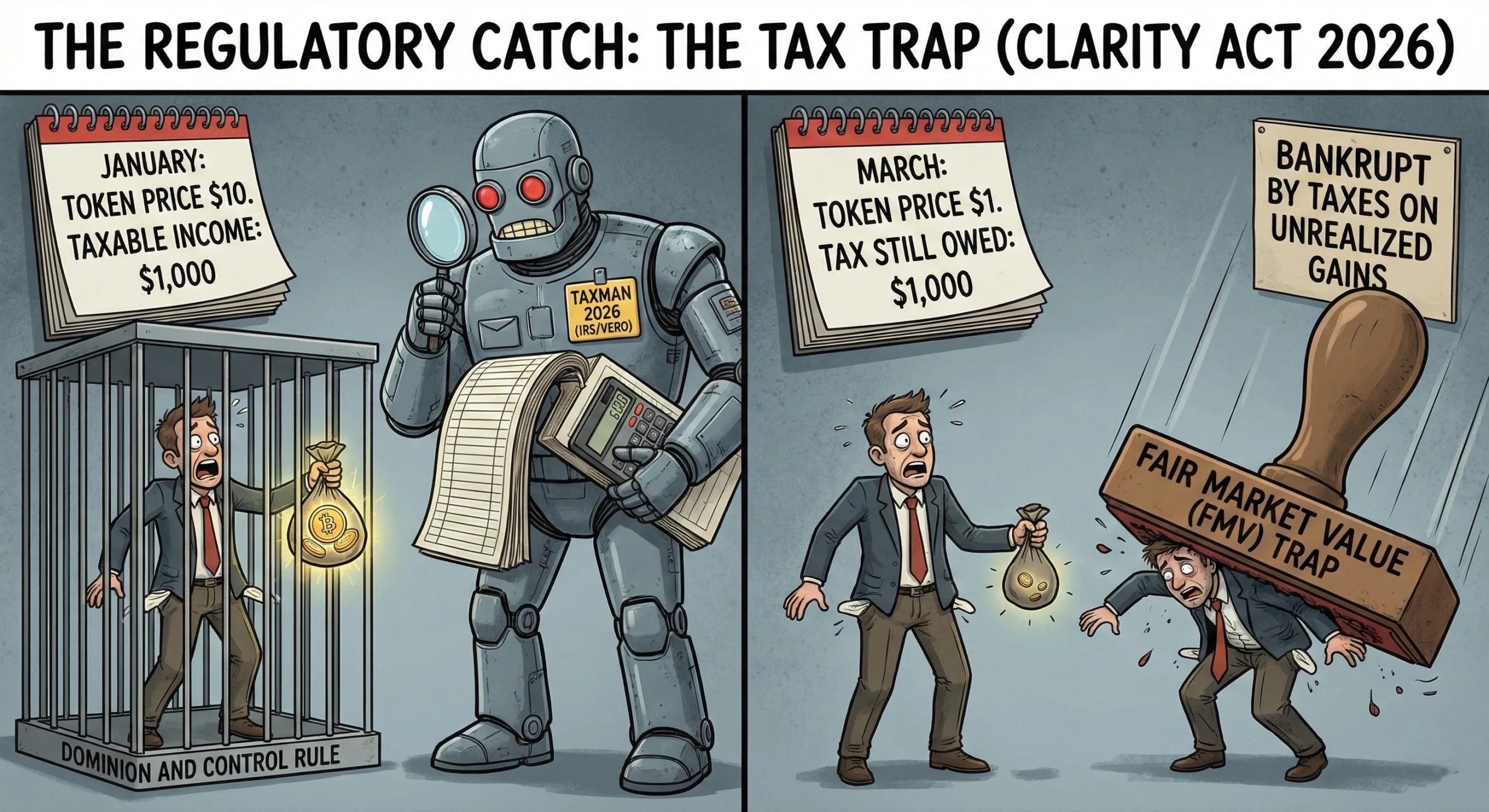
Under the current 2026 framework — consistent with IRS Revenue Ruling 2023-14 — staking rewards are taxed as ordinary income at the moment you gain dominion and control over them. That means the second a reward is claimable or deposited into your wallet, a taxable event has occurred. You do not need to sell anything. Receipt is the trigger.
The taxable amount is the Fair Market Value (FMV) at the time of receipt.
- January: You receive 100 staking reward tokens. The price is $10 each. You have $1,000 of taxable ordinary income.
- March: The market drops sharply. Your tokens are now worth $1 each.
- Tax time: You still owe income tax based on $1,000 of income. Your actual holdings are worth $100. The tax bill may exceed the value of the asset it was levied on.
This is not a fringe scenario. It has produced real financial damage for stakers who did not set aside tax provisions as they earned. When you sell the token later, you also trigger a capital gains event based on the difference between your cost basis (the FMV at receipt) and the sale price.
The 2026 Reporting Landscape: No More Flying Under the Radar
Two developments have fundamentally changed how staking income is tracked and reported.
First, the OECD’s Crypto-Asset Reporting Framework (CARF) is now operational in the US, Finland, and a growing list of jurisdictions. Exchanges are legally required to transmit your transaction data directly to tax authorities. In Finland, some tax administrations are already including crypto income data in pre-filled returns. If you do not report it, they have the data to identify the discrepancy.
Second, a draft proposal called the PARITY Act is circulating in the US. If passed, it would allow stakers to elect deferred income recognition on rewards for up to five years, potentially eliminating the crash scenario described above. As of early 2026, this is a proposal under review. It is not law. Plan around current rules, not anticipated ones.
Practical Steps for Managing Staking Tax Obligations
Do not use a spreadsheet for this. A single active staking wallet can generate hundreds of micro-reward events per day. Manual tracking breaks down quickly and creates audit risk through gaps and errors.
- Use dedicated tax software. Connect your wallets to a platform that pulls price data at the exact timestamp of every reward event and automatically calculates income recognition.
- Set aside funds for taxes as you earn. Sell a portion of staking rewards periodically for stablecoins to lock in a tax reserve. Never assume the token price will remain high enough to cover the obligation at year-end.
- Maintain full records. Keep wallet addresses, transaction timestamps, and reward amounts organized. Tax authorities in the US and Europe now run algorithmic tools specifically designed to detect missing staking income by cross-referencing on-chain data against filed returns.
For tracking staking rewards and generating tax reports: Best Crypto Tax Software 2026: CoinLedger Review.
Staking vs Lending Risks in 2026
Staking and crypto lending are often grouped together as passive income strategies, but the risk structures are different. Staking exposes you to validator risk, lock-up periods, slashing, inflation dilution, and tax complexity. Lending exposes you to borrower default, platform insolvency, collateral liquidation failures, and opaque counterparty risk.
In general, staking is more transparent because the risk comes from protocol mechanics you can study directly. Lending risk is often less visible because it depends on the solvency and behavior of third parties. That does not make staking safe. It makes staking easier to model. Lending often offers higher headline yield, but usually by introducing more hidden balance-sheet risk.
For most retail investors in 2026, staking is usually the cleaner option if the underlying asset is strong, the validator is well chosen, and the lock-up and tax consequences are acceptable. Lending may look simpler on the surface, but it often carries more catastrophic counterparty failure risk.
Is Staking Worth It in 2026? The Honest Conclusion
Yes. But only when approached as an accumulation tool, not a passive income strategy.
Staking is effective for increasing your share of a network during a holding period you already intended to commit to. It compounds exposure during bear markets and enhances positioning when conditions improve. It is not a short-term income substitute. If you are staking to fund recurring expenses, you are structurally over-leveraged regardless of the APY figure.
Understanding crypto staking risks 2026 participants face is what separates disciplined allocation from yield chasing.
The risks outlined above are not arguments against staking. They are the embedded proof of stake risks that most dashboards fail to surface. Inflation, lock-up periods, slashing penalties, custody exposure, and taxation are structural features not temporary bugs.
Understand them first. Then decide what aligns with your capital size, time horizon, and risk tolerance.
FAQ: Crypto Staking Risks 2026
Can I lose my principal investment while staking?
Yes, in two distinct ways. First, the market price of the token can fall while your assets are locked during the unbonding period, leaving you unable to exit. Second, a slashing event can result in the protocol permanently destroying a percentage of your staked tokens, which is a direct loss of principal with no recourse.
Is staking Ethereum safer than staking Solana in 2026?
They carry different risk profiles and are not directly comparable. Ethereum staking offers lower nominal APY but benefits from deflation mechanics that support real yield in periods of high network activity. Solana staking offers higher nominal yield but has historically carried more inflation-related dilution and higher ecosystem beta risk. Neither is without trade-offs. Your choice should reflect your conviction in the underlying asset, not just the yield figure.
What is the safest way to stake?
Native staking through a hardware wallet is the most secure approach. You maintain full custody of your private keys. You delegate directly to a validator without involving a third-party custodian. Liquid staking tokens offer greater flexibility but add smart contract risk and de-peg exposure. Exchange staking offers the most convenience and the least security.
Do I have to pay taxes on staking rewards I did not sell?
In most jurisdictions, including the US and most EU countries, yes. Receipt of a staking reward is a taxable income event at the Fair Market Value on the date of receipt. Selling the reward later triggers a second taxable event: capital gains or loss based on the difference between your sale price and the FMV at the time you received the reward.
Next Steps: Build the Infrastructure First
1. Understand the yield mechanics: Why 20% APY Is a Trap: A Realistic Look at 2026 Yields
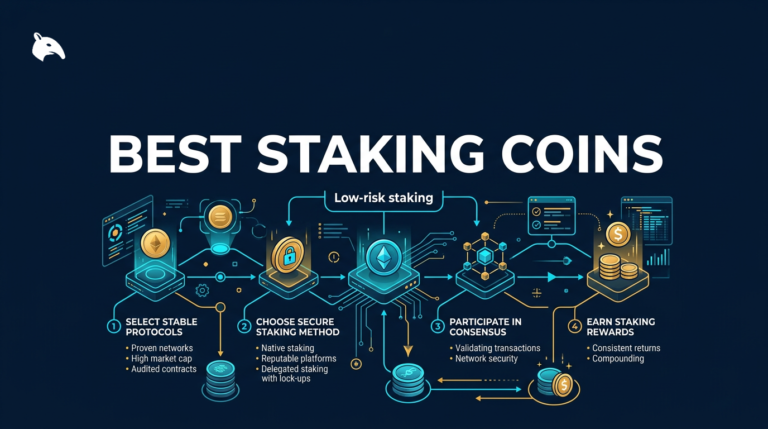
2. Choose the right assets: Best Staking Coins 2026: Low-Risk Yields That Won’t Rug You
3. Secure your keys: Exchange Withdrawals Will Pause Again: The 2026 Self-Custody Survival Guide
4. Explore low-risk alternatives: Best Low-Risk Crypto Passive Income 2026: 7 Strategies That Actually Work
5. Handle the tax side: Best Crypto Tax Software 2026: CoinLedger Review
Follow on X: @Snout0x