

Last Updated on April 20, 2026 by Snout0x
The Trezor Safe 7 is the first consumer hardware wallet built on a dual-chip architecture where both an open-source secure element and a certified tamper-resistant chip must agree before any operation proceeds. Add a 2.5-inch OLED touchscreen, Bluetooth with a physical kill switch, Shamir backup, and post-quantum firmware verification, and you get the most complete specification sheet in the 2026 hardware wallet market. The question is whether that specification justifies a $249 price when the Trezor Safe 5 exists at $169 and the Ledger Nano X at $149.
This content is for educational purposes only and should not be considered financial or investment advice.
This article may contain affiliate links. Snout0x may earn a commission at no additional cost to you.
Two independent chips mean one exploit gives an attacker nothing.
Best for: Experienced holders with portfolios above $10K who want open-source firmware, on-device transaction verification, and mobile signing via Bluetooth.
Price: $249 — premium tier, justified by dual-chip architecture and features no competitor combines.
Trade-off: Expensive relative to the Safe 5 at $169, which shares open-source firmware and Shamir backup but lacks Bluetooth and the second security chip.
Key Takeaways
- Dual-chip security: the open-source TROPIC01 secure element and EAL6+ Optiga Trust M must both authorize wallet access. Compromising one chip alone yields nothing.
- The 2.5-inch OLED touchscreen at 700 nits shows complete wallet addresses before confirmation, eliminating the truncation risk that address-swapping malware exploits.
- Bluetooth uses AES-256 encrypted BLE with a physical kill switch that cuts antenna power at the circuit level.
- Shamir backup (SLIP-39) replaces the single seed phrase with configurable threshold recovery across multiple shares.
- Post-quantum firmware verification (SLH-DSA) protects against future quantum attacks on the bootloader.
Design, Display, and Controls
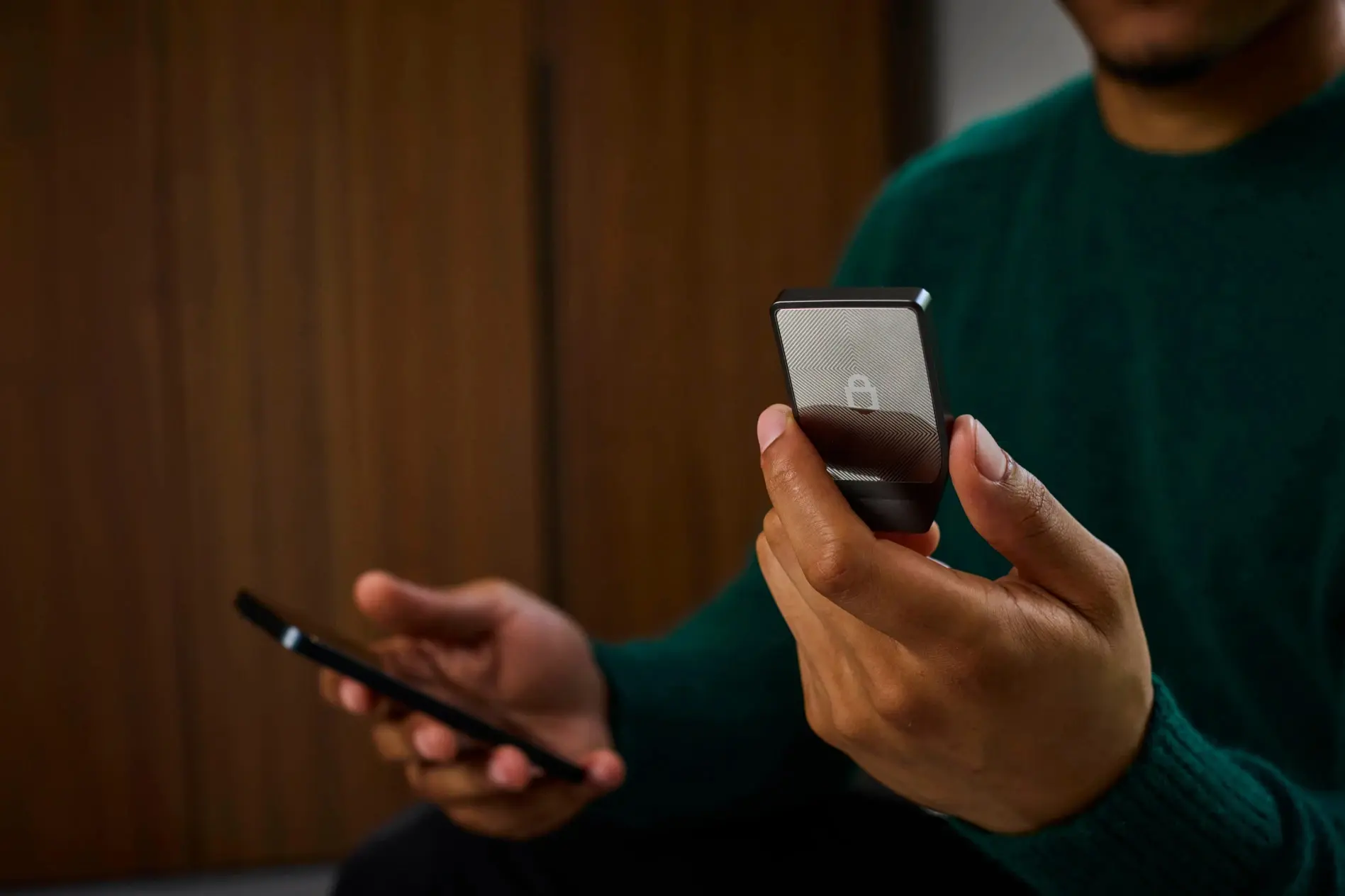
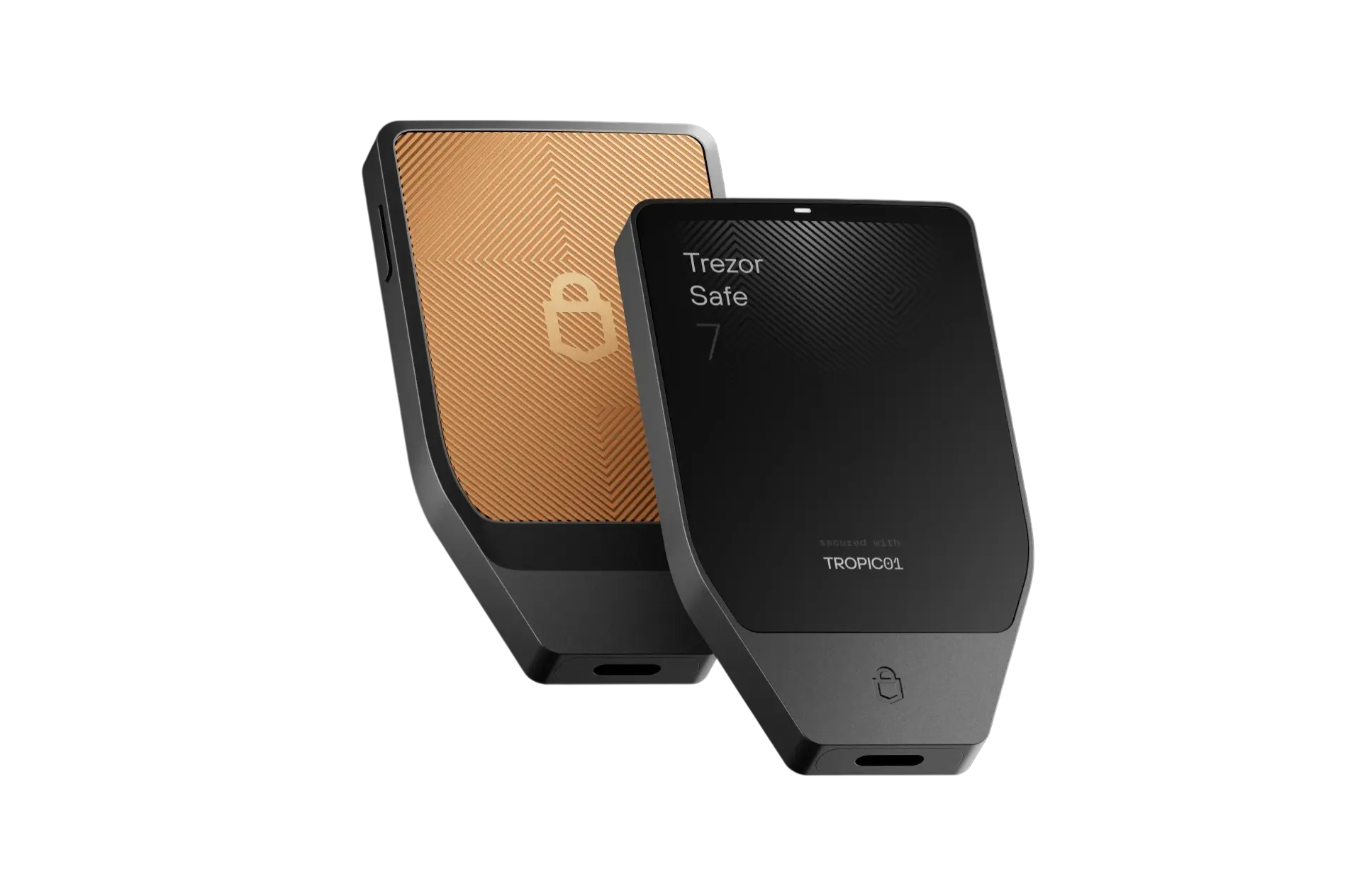
The Trezor Safe 7 moves away from the plastic feel of earlier models. The unibody aerospace-grade aluminum chassis is heavier, more rigid, and clearly built for long-term use. When a device protects serious capital, build quality matters. This feels like a security tool designed to sit in cold storage for years.
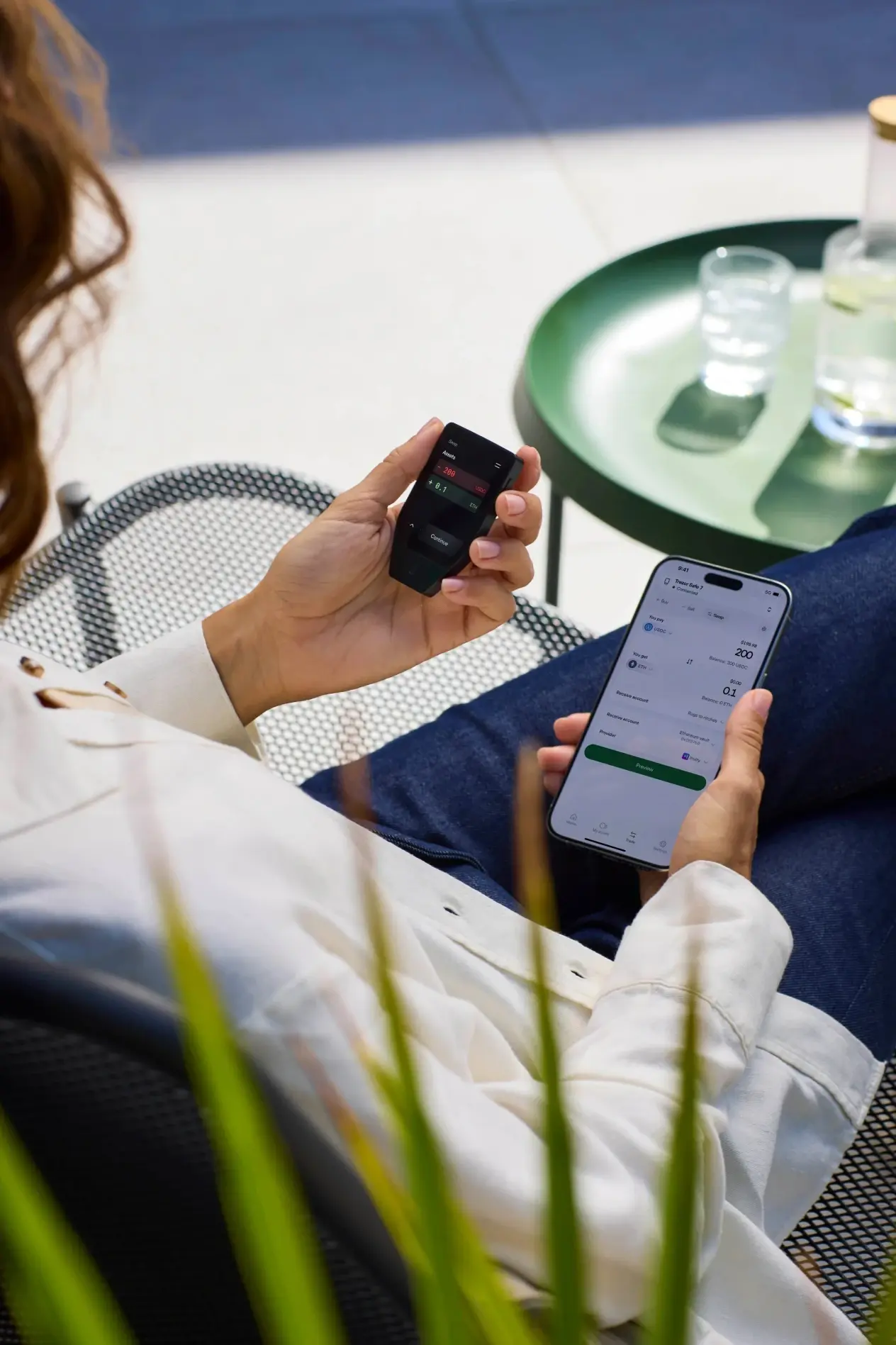
The 2.5-inch OLED touchscreen at 700 nits, protected by Gorilla Glass Victus, remains readable in direct sunlight. The larger display shows a full wallet address or smart contract destination in a single view. No scrolling through truncated characters. Address-swapping malware relies on that truncation limitation; the Safe 7 removes it by displaying the complete address before confirmation.
On-device passphrase entry, historically a weak point for Trezor, improves significantly. The larger keyboard layout paired with subtle haptic feedback removes uncertainty about whether a tap registered. Entering a long passphrase feels deliberate and secure.
Trezor Safe 7 Security: Dual-Chip Architecture
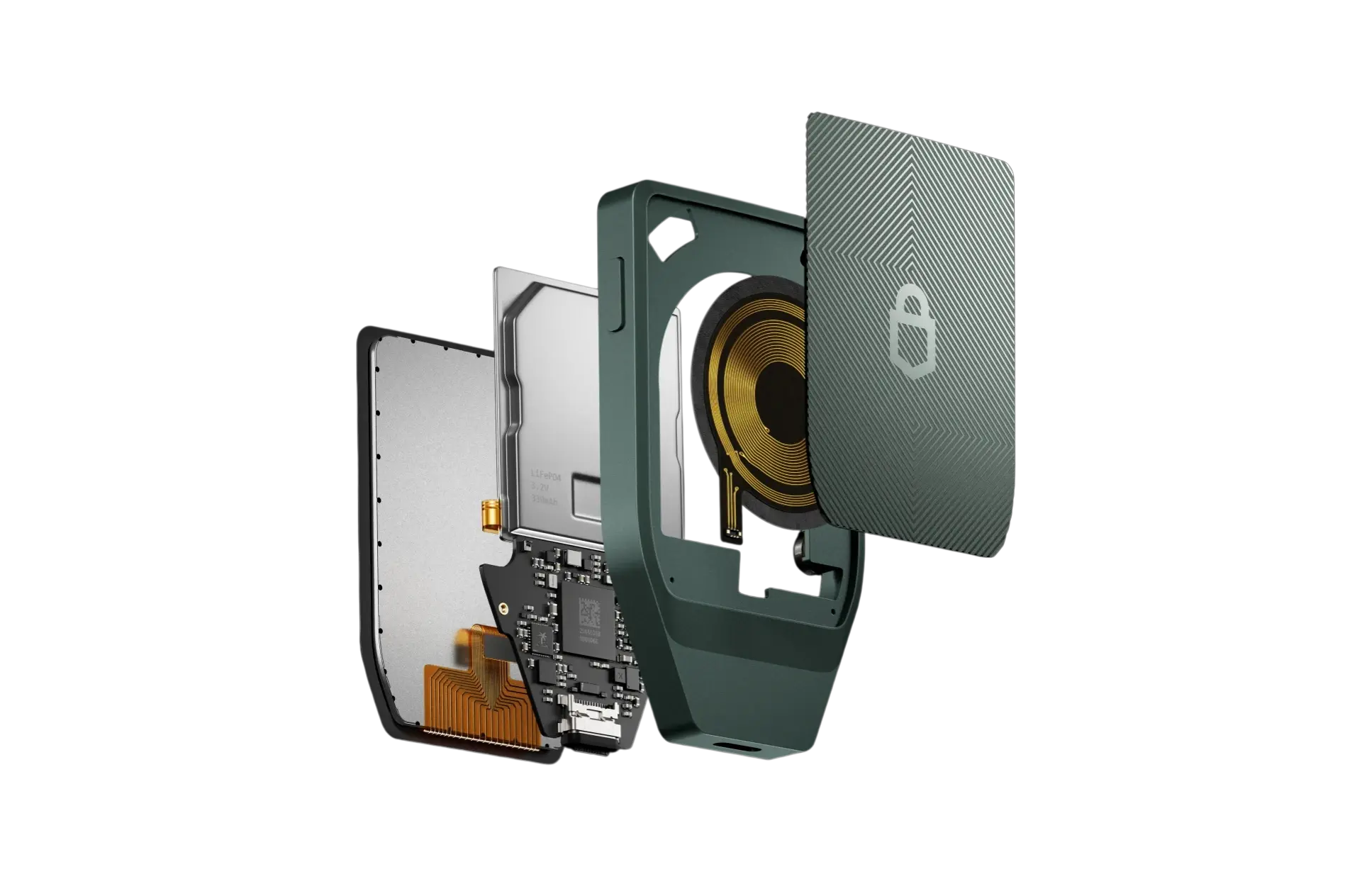
The most important feature in this Trezor Safe 7 review is the dual-chip security architecture.
Hardware wallet security has historically forced a trade-off. Ledger relied on proprietary secure elements with strong physical tamper resistance but closed firmware. Trezor focused on open-source firmware running on general-purpose chips, prioritizing transparency but offering less resistance against laboratory-grade hardware attacks. The Safe 7 removes that trade-off by combining both models.
TROPIC01: Open-Source Secure Element
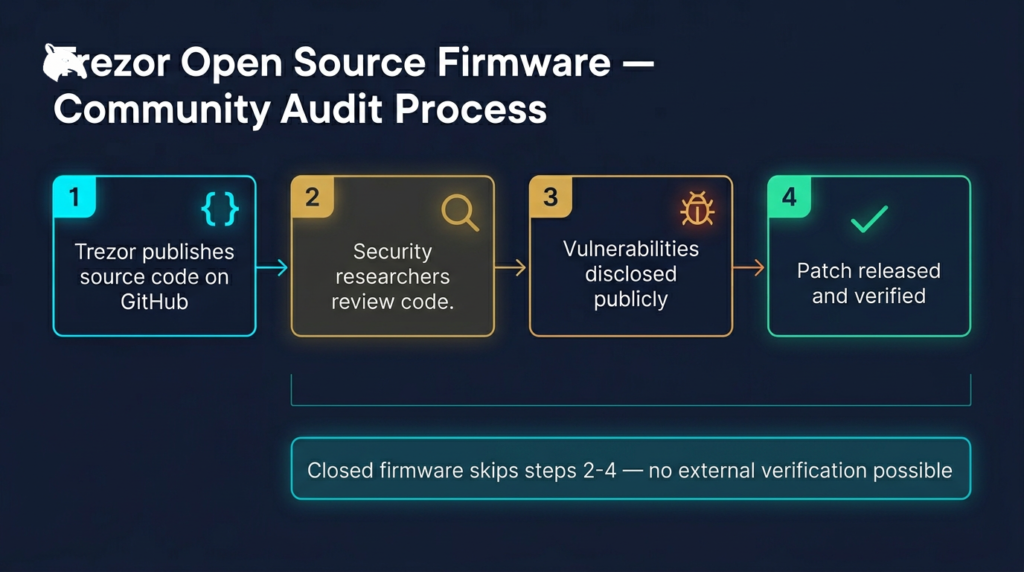
The TROPIC01, developed by Tropic Square (a SatoshiLabs subsidiary), is the first fully open-source secure element in a consumer hardware wallet. Design files, including transistor-level logic, are publicly available for independent security audits. Closed secure elements require blind trust. With TROPIC01, private key generation and cryptographic signing run on auditable code. Researchers can inspect how the chip works instead of relying on marketing claims.
Optiga Trust M: Physical Tamper Resistance
The Optiga Trust M carries EAL6+ certification, one of the highest commercial hardware security standards. Its role is protecting the TROPIC01 from physical attack vectors: voltage glitching, laser fault injection, and side-channel analysis. The chip detects abnormal electrical behavior and locks the circuit. By pairing an auditable secure element with certified physical protection, the Safe 7 delivers transparency and tamper resistance in one device.
2-of-2 Authorization
The Safe 7 splits sensitive wallet data, including PIN material and seed derivation logic, across both chips. Unlocking requires a validated handshake from each. If an attacker discovers a vulnerability in one component, the second chip still blocks access. No single point of failure at the hardware level. Compromising this device would require exploiting two independent chips built on different architectures and security models.
Post-Quantum Firmware Protection
Most hardware wallets secure firmware updates using Elliptic Curve Cryptography (ECC). A sufficiently powerful quantum computer could theoretically reverse ECC mathematics and forge malicious firmware updates. The Safe 7 implements SLH-DSA (Stateless Hash-Based Digital Signature Algorithm) at the bootloader level. Instead of relying on elliptic curves, SLH-DSA verifies firmware authenticity using large trees of cryptographic hashes that remain resistant to known quantum algorithms.
No publicly known quantum computer can break ECC at practical key sizes today. The value is long-term durability: firmware security is difficult to redesign once devices are widely deployed. By integrating post-quantum protection now, the Safe 7 extends its security horizon across the full lifecycle of the device.
Bluetooth Security and Kill Switch
Adding a radio to a key-signing device introduces a potential attack surface. The difference lies in how that surface is managed.
How Bluetooth Works on the Safe 7
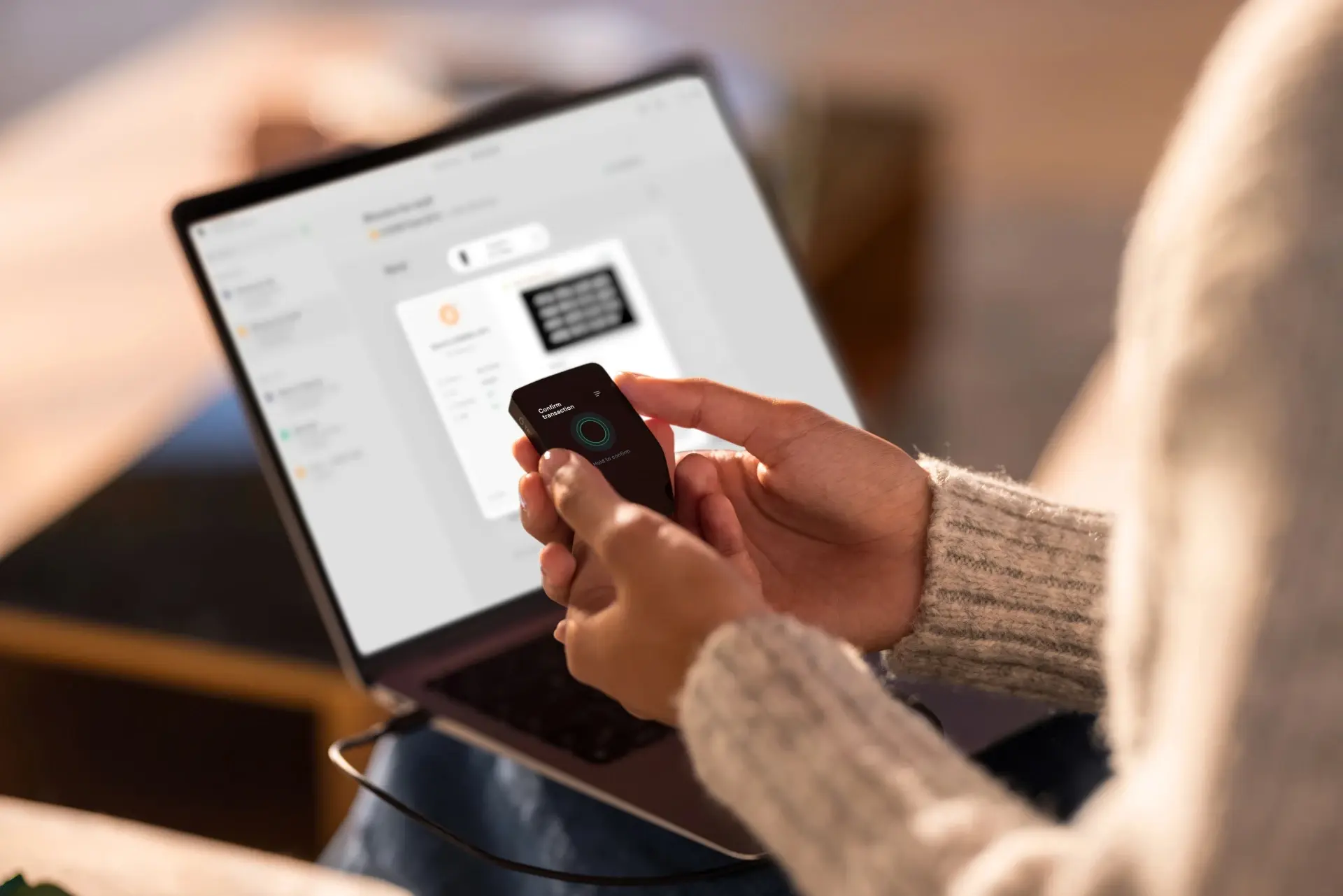
The device uses AES-256 encrypted BLE. The companion phone app acts strictly as a relay: it sends an unsigned transaction to the wallet, the Safe 7 signs internally, and returns only the signed output. Private key material never enters the Bluetooth transmission layer.
All critical actions require physical confirmation on the touchscreen. The phone cannot authorize anything independently. Even if someone intercepted the Bluetooth signal, they would see only encrypted traffic with no usable key data.
Physical Hardware Kill Switch
A physical toggle cuts power to the Bluetooth antenna at the hardware level. This is not a software setting. A compromised app cannot re-enable it remotely. The electrical path is physically disconnected.
For long-term cold storage, the device operates in a fully air-gapped mode over USB-C with zero power supplied to the Bluetooth module.
Passphrase and Shamir Backup
Remote exploits are only one risk category. Physical threats require a different defense model.
Passphrase as a Hidden Wallet
The Safe 7 supports BIP39 passphrases, creating separate hidden wallets from the same seed. A wallet accessed without a passphrase, or with a designated decoy passphrase, is independent from the wallet unlocked with the real passphrase. The device does not label one as primary and the other as hidden. It opens whichever wallet matches the credentials entered.
In a coercion scenario, a decoy passphrase reveals a wallet with a visible balance while actual holdings remain inaccessible. For this strategy to work, the decoy wallet should contain some funds. An empty wallet signals deception immediately. A modest balance creates a more convincing narrative while protecting long-term holdings.
Shamir Backup (SLIP-39)
Traditional 24-word seed phrases are a single point of failure. If discovered, access is compromised. If destroyed, the wallet is unrecoverable.
The Safe 7’s Shamir backup replaces that model using Shamir’s Secret Sharing (SLIP-39). Instead of one recovery phrase, the device creates multiple unique shares. You define how many are required for reconstruction. A common configuration is 3-of-5, where five shares exist and any three recover the wallet.
Theft resistance: A single stolen share provides zero access. Additional shares stored in separate locations are required.
Disaster recovery: Losing one or two shares to fire or flood does not prevent recovery from the remaining threshold.
Flexible distribution: Shares can be stored in different physical locations such as a home safe, a bank deposit box, or with trusted family members. The strategy adapts to your risk tolerance and geography.
Trezor Suite 2026 Software
Hardware specs are half the equation. The 2026 Trezor Suite Mobile update closes several gaps that previously required third-party integrations.
Solana (SOL), Cardano (ADA), and Avalanche (AVAX) are now supported natively inside Trezor Suite, eliminating the need for browser extensions or interfaces like Exodus. Staking for ETH, SOL, and DOT is available directly through the mobile app. Funds remain secured on the hardware wallet throughout the process. Rewards compound while private keys stay isolated inside the device.
The update also removes the need for bridge wallets in most common use cases. Previously, certain chains required the hardware wallet to act as a signer for a separate software interface. By reducing external dependencies, the signing process has fewer touchpoints and fewer opportunities for compromise.
Who Should Buy the Trezor Safe 7 (and Who Should Not)
The Safe 7 fits a specific buyer profile. If most of these apply, it is the right device:
- Your portfolio exceeds $10,000 and justifies premium hardware security.
- You want fully open-source firmware you can verify independently — not a trust-the-vendor model.
- You need mobile signing via Bluetooth without sacrificing on-device transaction verification.
- You want Shamir backup (SLIP-39) to distribute recovery across multiple locations instead of a single seed phrase.
- You plan to hold the device for years and care about long-term battery chemistry and post-quantum durability.
The Safe 7 is not the right choice if:
- Your holdings are under $5,000. The Trezor Safe 3 at $79 delivers open-source cold storage fundamentals at a fraction of the cost.
- You do not need Bluetooth or mobile signing. The Trezor Safe 5 at $169 shares open-source firmware, Shamir backup, and a color touchscreen — but without Bluetooth, dual-chip architecture, or post-quantum firmware. If USB-C-only is acceptable, the Safe 5 saves $80.
- You want the simplest possible self-custody with no seed phrase management. A seedless wallet like Tangem removes that complexity entirely at a lower price.
- Budget is your primary constraint. The premium features justify the premium price only if your portfolio and threat model demand them.
- Dual-chip architecture — first open-source secure element + EAL6+ tamper resistance
- Fully open-source firmware — independently auditable, not trust-based
- 2.5-inch OLED shows full addresses — eliminates truncation attack vector
- Physical Bluetooth kill switch — hardware circuit break, not software toggle
- Shamir backup + post-quantum firmware verification
- $249 — most expensive mainstream hardware wallet
- Bluetooth adds an attack surface, even with the kill switch
- Overkill for small portfolios or simple hold-only strategies
- Safe 5 covers most features at $80 less without Bluetooth
Trezor Safe 7 vs Ledger Nano X
The Ledger Nano X is the primary competitor in the premium Bluetooth hardware wallet segment. For a detailed side-by-side breakdown, see our Ledger Nano X vs Trezor Safe 7 comparison.
| Feature | Trezor Safe 7 | Ledger Nano X |
|---|---|---|
| Price | $249 | $149 |
| Screen | 2.5″ OLED touchscreen (700 nits) | Small color screen |
| Security Architecture | Dual-chip (TROPIC01 + Optiga EAL6+) | Single SE (EAL5+) |
| Firmware | Fully open-source | Partially open-source |
| Bluetooth Kill Switch | Physical hardware interrupt | Software toggle only |
| Battery Type | LiFePO4 (slow long-term degradation) | Lithium-ion (faster degradation) |
| Wireless Charging | Qi2 | None |
| Post-Quantum Firmware | Yes (SLH-DSA bootloader) | No |
| Shamir Backup | Yes (SLIP-39, configurable threshold) | No |
| Native SOL / ADA Support | Yes (Trezor Suite 2026) | Via Ledger Live |
The Ledger Nano X remains capable with roughly a $100 price advantage. The 2023 Ledger Recover controversy raised questions for users who require clarity around key custody: the opt-in service involved transmitting encrypted, sharded seed data to third-party custodians.
With the Safe 7’s open-source architecture, firmware and signing logic can be independently verified. The security model does not rely on trusting closed firmware or undisclosed silicon.
At $249, the Safe 7 sits at the premium end of the market. Hardware wallet cost should be viewed as a fixed security expense: spending $249 to protect $50,000 in long-term holdings is negligible relative to the risk reduction. The dual-chip architecture, physical Bluetooth kill switch, Shamir backup, and post-quantum bootloader are architectural differences that cheaper devices do not replicate in combination.
Trezor Safe 7 Review: The Verdict
The Safe 7 delivers the most complete hardware wallet specification available in 2026. The dual-chip design combines auditable open-source logic with EAL6+ physical tamper resistance — a combination no competitor matches. The SLH-DSA bootloader, physical Bluetooth kill switch, Shamir backup, and expanded native chain support address more threat vectors than any other single device on the market.
The cost of that completeness is price. At $249, the Safe 7 is the most expensive mainstream hardware wallet. The Trezor Safe 5 covers open-source firmware and Shamir backup at $169 without Bluetooth or the second chip. The Ledger Nano X offers Bluetooth at $149 but with closed firmware and no Shamir backup. The Safe 7’s premium is justified only if your portfolio and threat model demand what the alternatives cannot deliver: dual-chip verification, open-source auditability, and mobile signing with a hardware-level radio kill switch.
The 9.5 reflects the strongest combination of open-source transparency, hardware tamper resistance, and mobile connectivity in any 2026 hardware wallet. It loses half a point for price — $249 is a real barrier, and the Safe 5 at $169 delivers most of the same firmware and backup features without Bluetooth or the second chip. For portfolios above $10K with active signing needs, this is the device. For USB-C-only cold storage, the Safe 5 is the smarter buy.
Check Price at TrezorFor a broader comparison including air-gapped options and budget alternatives, see the full hardware wallet comparison.
Sources
Frequently Asked Questions
Is the Trezor Safe 7 safer than the Ledger Nano X?
For most threat models, yes. The Safe 7 uses a dual-chip architecture: the open-source TROPIC01 secure element paired with the EAL6+ certified Optiga Trust M. Both chips must authorize wallet access, so a single-chip compromise does not unlock the device. The Ledger Nano X uses a single EAL5+ closed-source secure element, which requires trust in proprietary firmware. The Safe 7 replaces that assumption with independent verification.
Does the Trezor Safe 7 support Solana and Cardano?
Yes. The 2026 Trezor Suite Mobile update adds native support for Solana (SOL), Cardano (ADA), and Avalanche (AVAX). Third-party wallet interfaces like Exodus or MetaMask are no longer required.
Is Bluetooth safe to use on the Trezor Safe 7?
Yes. Bluetooth uses AES-256 encrypted BLE. Private keys never enter the wireless data path. The phone sends an unsigned transaction, the device signs it internally, and returns only the signed output. All confirmations must happen on the device screen. A physical kill switch cuts power to the Bluetooth antenna at the circuit level and cannot be re-enabled by software.
How long does the Trezor Safe 7 battery last?
The Safe 7 uses a LiFePO4 battery with standby life measured in weeks and better long-term capacity retention than lithium-ion cells. It supports Qi2 wireless charging. For cold storage devices that sit unused for months, LiFePO4 chemistry is more reliable over multi-year periods.
Should I upgrade from the Trezor Model T?
If you use your wallet regularly, yes. The Model T’s smaller screen made address verification difficult, a usability gap that address-swapping malware exploits. The Safe 7’s 2.5-inch display, haptic feedback, and improved keyboard layout make daily use safer. The dual-chip security and post-quantum firmware are also meaningful architectural upgrades over the Model T’s single-chip design.