

Stop Being the Exit: Dissecting the $6B Rug Pull Playbook of 2025
Key Takeaways
-
The “Industrialized” Rug: 2025 changed the game from “bad devs” to “automated theft.” With 98.7% of tokens on Solana (Pump.fun) failing, you aren’t trading against a person; you are trading against a bot that snipes and rugs in the same block.
-
TVL is a Vanity Metric: The $6B Mantra Network collapse proved that high “Total Value Locked” does not mean safety. Insiders used “circular liquidity” to fake stability while slowly draining the pool via TWAP (Time-Weighted Average Price) selling.
-
The “Session Hijack” Threat: Your hardware wallet cannot protect you if you download a “beta game” or file from a Discord friend. Hackers are now using Info-Stealers to hijack your active browser session, bypassing passwords and 2FA entirely.
-
Forensics or Poverty: In 2026, transparency tools are mandatory. If you aren’t using Bubblemaps to spot wallet clusters (insider cabals) or RugCheck to detect honeypots, you are flying blind.
-
The Liquidity Lock Nuance: A “Liquidity Lock” is worthless if the Mint Authority is still active. Scammers will lock the pool to gain trust, then simply print 1 trillion new tokens to drain the funds anyway.
The Scene of the Crime: 2025 in Review
If you thought 2024 was bad, 2025 was a massacre. We didn’t just see “bad projects”; we saw the industrialization of theft.
According to the data, 86% of all crypto project failures since 2021 happened in 2025. Let that sink in. The barriers to entry dropped to zero. Any teenager with an internet connection and a “dev wallet” generator could launch a coin, hype it on TikTok, and drain the liquidity pool before their mom called them for dinner.
The “October 10 Liquidation Cascade” was the final nail in the coffin for millions of “zombie tokens” that had been slowly bleeding out. But the real story isn’t the market crash it’s the mechanism of the theft.
Case Study A:
The “Whale” Trap (Mantra Network Incident)
Status: Alleged Rug / Catastrophic Failure Losses: ~$6 Billion (Estimated)
In April 2025, Mantra Network a project that looked “too big to fail” and draped itself in the respectable robes of RWA (Real World Assets) became the poster child for the Soft Rug. While a Hard Rug is a mugging in a dark alley, a Soft Rug is a polite dinner where the host slips out the back door with your watch while you’re still complimenting the wine.
The Setup: The “Institutional” Trap
Mantra wasn’t some Pepe-derivative launched by a dev in his basement. It had “Utility.” It had a “Roadmap.” It had “Regulatory Compliance.” It checked every box the mid-curve YouTube influencers told you to look for.
-
The TVL Illusion: The Total Value Locked (TVL) was massive. In reality, much of this was likely circular liquidity insider capital used to manufacture a facade of stability.
-
The Narrative: They promised to bridge the gap between TradFi and DeFi. It turns out they just bridged retail capital into insider bank accounts.
The Mechanism: The Liquidity Exodus
Unlike a Hard Rug where the dev mints a billion tokens and crashes the pool in one block, this was a coordinated extraction.
-
The Artificial Pump: In mid-April, transaction volume spiked. The “news” was bullish. The price ripped, and the FOMO was palpable.
-
The “Vampire” Sell: Behind the scenes, early “insider” wallets dormant for months woke up. They didn’t dump all at once (that would kill the price too fast). They used TWAP (Time-Weighted Average Price) selling to bleed the pool dry while retail “bought the dip.”
-
The Gaslighting Phase: As the price crumbled, communication from the team turned into a word salad of “infrastructure upgrades” and “strategic pivots.” Withdrawal halts were blamed on “RPC issues.”
-
The Ghosting: By the time the “patience” of the HODLers wore off, the liquidity pool was drained by 95%. The project didn’t die; it just became a ghost ship.
The Real Talk: Why You Got Exit-Liquidity’d
If you’re sitting there wondering how a “safe” project turned into a wasteland, look at the math. In crypto, transparency is only useful if you actually look at the data.
-
The Concentration Risk: If the top 10 wallets hold 40% of the supply and aren’t locked in a verifiable smart contract, you aren’t an investor; you are a contingency plan.
-
TVL is a Vanity Metric: TVL tells you how much money is there, but Liquidity tells you how much money can actually leave. Mantra had high TVL but thin liquidity a “Hotel California” trade where you can check in, but you can never sell.
The Lesson: High TVL isn’t a safety net; it’s a bigger bounty. In a world of “regulated” narratives and “institutional” partnerships, the only thing that doesn’t lie is the on-chain distribution. If the dev’s “patience” is shorter than yours, you’re the one paying for their yacht.
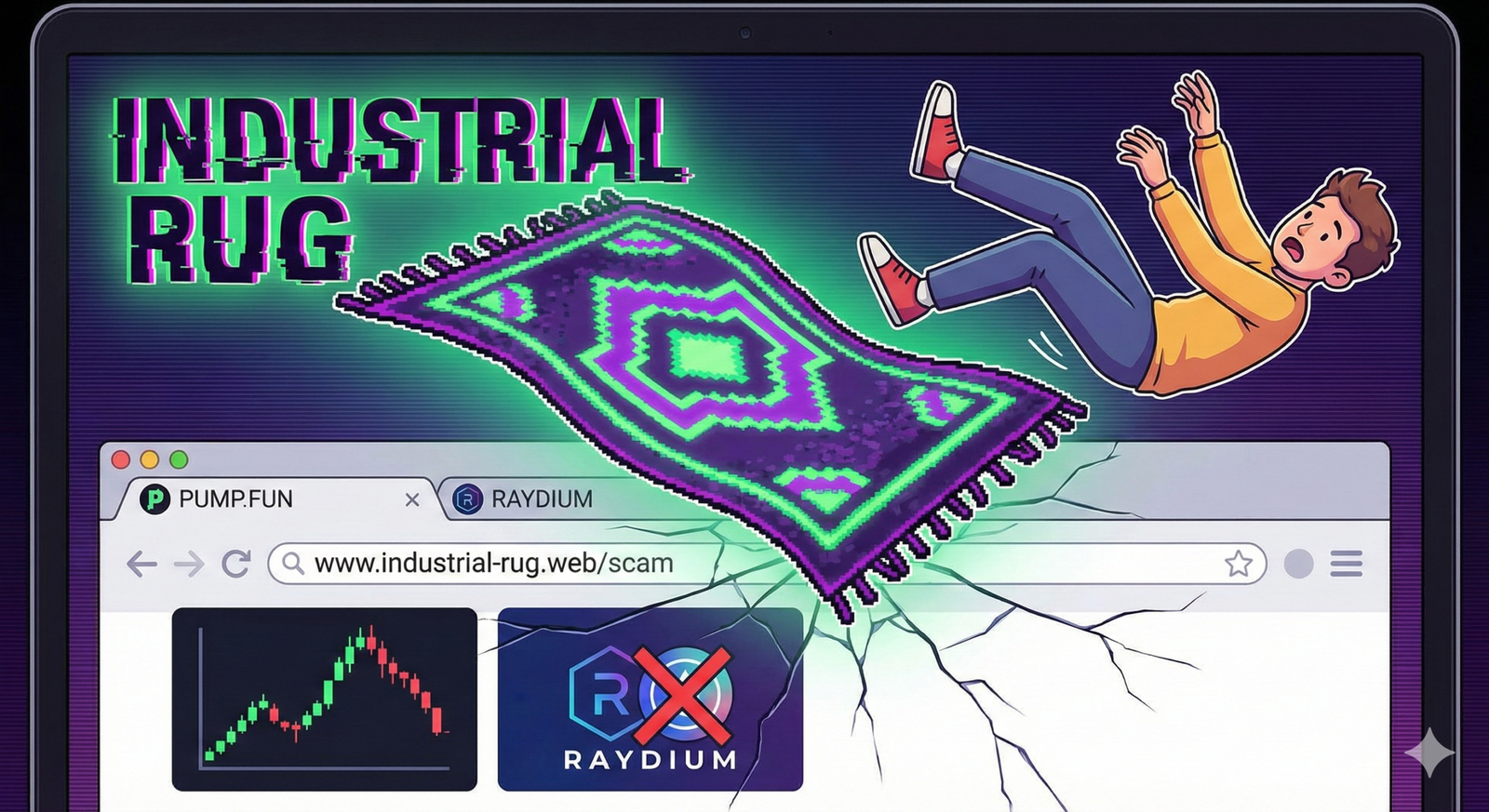
Case Study B: The “Industrial” Rug (Pump.fun & Raydium)
Status: The “99% Failure Rate” Factory
Losses: Millions in “Micro-Rugs” per hour.
Vibe: Solana isn’t just the “Vegas of Scams” it’s a casino where the house has a literal aimbot.
The Stats: A Statistical Slaughterhouse
Research from Solidus Labs and CoinGecko in late 2025 confirmed what the trenches already felt: 98.7% of tokens on Pump.fun are effectively dead on arrival. * In Q4 2025 alone, 7.7 million tokens ceased active trading.
-
Most “launches” don’t even make it past the 15-minute mark.
-
You aren’t “early” to a project; you are just the next entry in a database of victims.
The Mechanism: “High-Frequency Rugging”
This isn’t a guy in a hoodie making a mistake; it’s a server rack in a data center executing a script. This is Industrialized Fraud.
-
The Bot Factory: A dev uses a script to launch 50–100 tokens a day. They don’t need a “hit”; they just need 10 people to buy into each one.
-
The Atomic Bundle: Using Jito Bundles and LUTs (Look-Up Tables), the dev buys 20–30% of the supply across 20+ wallets in the same block the token is created. To the untrained eye (and your basic scanner), it looks like “organic distribution.” To a pro, it’s a “Bubble Map” minefield.
-
The Profile Sybil: These aren’t just empty wallets. Advanced scripts now generate fake profiles complete with bios, profile pictures, and diversified holdings to bypass “trust scores.”
-
The Sniper Execution: As soon as retail volume pushes the market cap to a modest $15k (the “sweet spot”), the bot executes a “Dump All” command. All 20 wallets sell in one atomic transaction.
-
The Result: The chart goes from a vertical green line to a flat grey line before your “Buy” transaction even confirms on Solscan.
The Lesson: You Can’t Outrun the Machine
“Stop trying to ‘snipe’ launches manually. You are fighting algorithms that use gRPC streams and private block engines to rug you faster than your human brain can process a dopamine hit.”
-
The Reality Check: If you aren’t using a high-end terminal (like Trojan or BullX) and paying for Jito tips to bypass public mempools, you are playing a game of poker where the other guy can see your cards and change the rules of the deck mid-hand.
-
The “99%” Rule: On Solana, “Community-driven” is usually code for “I haven’t sold my bundled wallets yet.”
The “Trench Checklist”
-
Check the Holders: If 15+ wallets bought at the exact same millisecond (Block 0), it’s a bundle. Run.
-
Check the “Dev” History: If the dev has launched 40 tokens today and they all have the same “dog in a hat” image, it’s an industrial rug.
-
Liquidity-to-Cap: If the market cap is $50k but the liquidity is only $4k, any single whale (or the dev’s 20 wallets) can send the price to zero instantly.
Case Study C:
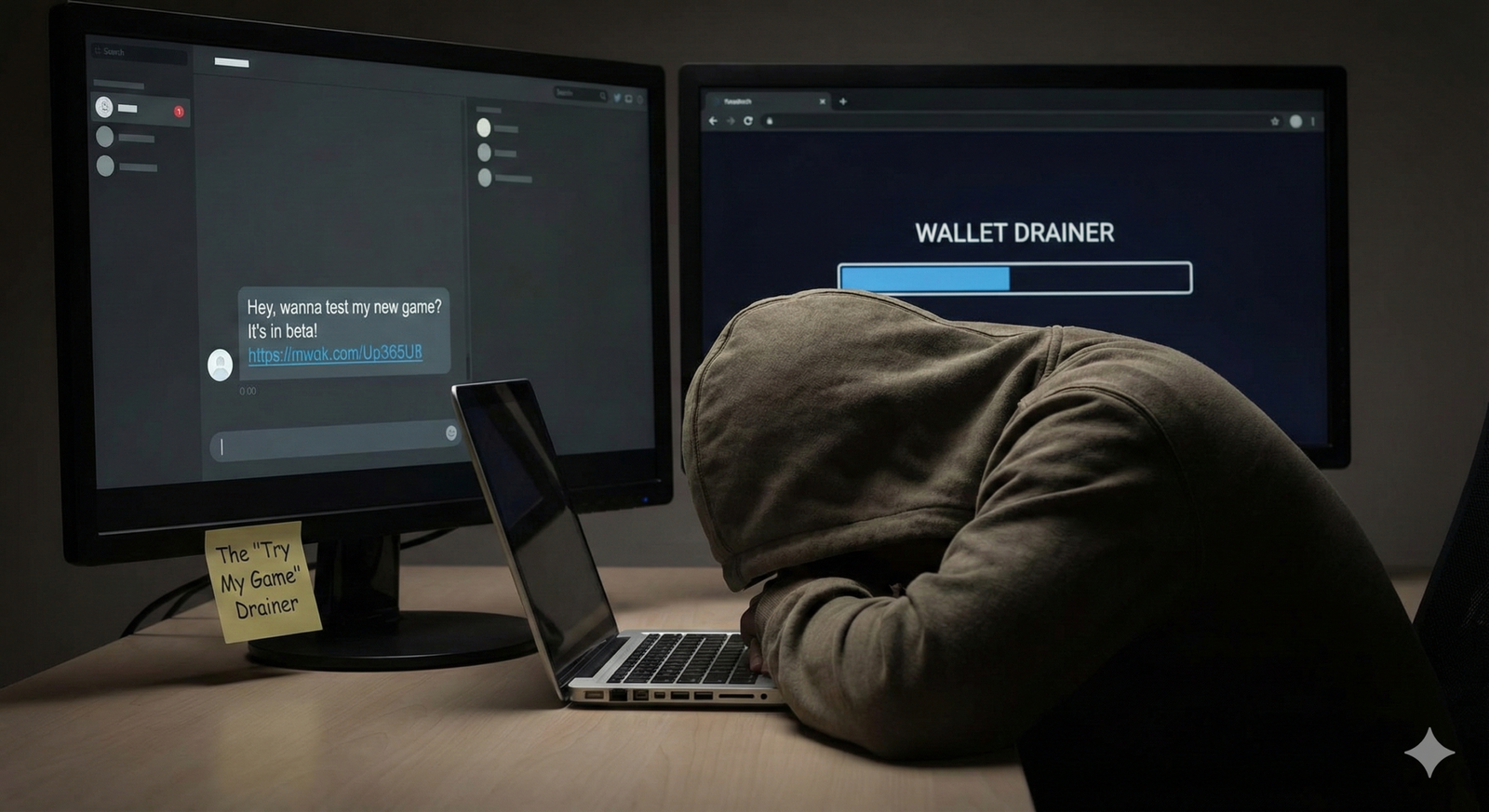
The “Social Engineer” (The ‘Try My Game’ Drainer)
Status: The “High-Value” Long Con
Target: NFT Whales, DAOs, and High-Net-Worth Wallets
Vibe: This isn’t about bad code; it’s about weaponized trust.
The Setup: The “Grooming” Phase
You’re in a Discord or a private Telegram group. You’ve been chatting with “CryptoChad99” for two weeks. He’s funny, posts the same bearish memes as you, and seems like a genuine peer. He isn’t shilling a coin; he’s building a bond.
Then comes the “ask.” It’s never “send me money.” It’s “Hey, I’m building a project/beta-testing a game. It’s listed on a legit-looking portal. Can you give me some feedback?”
The Mechanism: Session Hijacking (The “Invisible” Drain)
This is why your 2FA and hardware wallet won’t always save you.
-
The Trojan Horse: You download an executable (.exe or .dmg) disguised as a game, a “meeting tool,” or a PDF whitepaper.
-
The Info-Stealer (Lumma / Stealka): While you’re looking at a loading screen, a script scans your browser for Session Cookies and Auth Tokens.
-
The Bypass: The hacker doesn’t need your password or your Seed Phrase. By stealing your active “session,” they become you in the eyes of your browser. They can access your Discord, your Twitter, and even your “Hot” wallets (like MetaMask or Phantom) if they are currently unlocked.
-
The Remote Takeover: In advanced 2026 variants, the malware uses DLL side-loading to hide within legitimate system processes. They don’t just drain your wallet; they use your hijacked X account to tweet a “stealth drop” link, rugging your entire following before you even realize your PC is compromised.
The Lesson: Friendship is an Attack Vector
“In the trenches, a ‘friend’ who sends you a file is just a hacker who hasn’t finished the job yet.”
-
The Golden Rule: Never, under any circumstances, download an executable from someone you met online. “I’m a dev” is the new “I’m a Nigerian Prince.”
-
Hardware Isolation: If you have more than $10k in assets, you need a “Clean Room” machine. One laptop for gaming/Discord/browsing, and a completely separate, air-gapped (or strictly limited) device for signing transactions.
-
The “Cookie” Reality: Clear your browser cookies daily. If you leave your wallet “logged in” for weeks, you are leaving the vault door wide open for any info-stealer that happens to graze your system.
The Forensics Toolkit: How to Spot the Body Before It’s Cold
You want to survive 2026? You need to play Coroner before you buy.
The “Bubblemaps” Test
Go to Bubblemaps.io and plug in the token address.
-
What you see: A visual web of wallets.
-
The Red Flag: If you see a giant “cluster” of 20 wallets that are all connected (sending funds to each other) and they collectively own 30% of the supply… RUN. That is the “Cabal.” They are waiting for you to buy so they can dump on you.
The Liquidity Lock Check
Don’t just look for “Locked.” Look for “Vesting.”
-
Bad Lock: “Liquidity locked for 7 days.” (They will rug you next Tuesday).
-
Good Lock: “Liquidity locked for 1 year” on a reputable locker like Team Finance or UNCX.
-
The Trap: “Burnt Liquidity” is good, but check the Mint Authority. If liquidity is burnt but the dev can still “Mint” new tokens, they can print 1 trillion coins and drain the pool anyway.
The “Honeypot” Scan
Use RugCheck.xyz or TokenSniffer.
-
The Test: Can you sell? A “Honeypot” is a token where the code allows buying but disables selling for everyone except the dev.
-
The Error: If you see “Sell Tax: 99%” or “Transfer Error,” you are already dead.
Stay Alive in the Trenches
I track these wallets so you don’t have to. Follow @Snout0x on X for real-time alerts on which “Gem” is actually a “Germ.”
Get Smart or Get Rekt:
Frequently asked questions
Q: What was the biggest crypto rug pull of 2025?
A: The Mantra Network incident is widely cited as the largest loss event of early 2025. Alleged losses are estimated near $6 billion. Unlike a traditional “hard rug” where the website disappears, this was a massive “liquidity exodus” combined with insider selling that drained the pool while retail investors were stuck holding the bag.
Q: How do I spot a crypto rug pull before buying?
A: You need to run a 3-step forensic check:
-
Wallet Clustering: Use Bubblemaps to see if the top 10 holders are actually one person (a “cabal”) splitting funds to hide their control.
-
Mint Authority: Use RugCheck.xyz. If the developer can still “mint” new tokens, the liquidity lock is useless—they will just print more tokens and drain the pool.
-
Liquidity Locks: Verify liquidity is locked for 6–12 months on a reputable locker like UNCX or Team Finance, not just a random generic lock contract.
Q: What is the ‘Pump.fun‘ scam rate?
A: It is effectively an industrial slaughterhouse. Research from 2025 indicates that approximately 98.7% of tokens launched on platforms like Pump.fun exhibit characteristics of rug pulls, pump-and-dump schemes, or fail to ever reach a decentralized exchange (Raydium). If you are trading there, you are gambling against bots, not investing.
Subscribe to our newsletter
Enjoy exclusive special deals available only to our subscribers.