

Last Updated on March 20, 2026 by Snout0x
Validator rewards are the payments distributed to network participants who lock up cryptocurrency to secure a proof-of-stake blockchain.
These rewards are not a fixed return or a guaranteed income. They emerge from a combination of protocol-level token issuance and transaction fee distribution, and the actual yield any individual validator earns depends on how many other validators are competing for the same pool.
As participation rates change, so does the yield. Understanding how this economic system functions is essential for anyone evaluating staking as a yield strategy.
This article may contain affiliate links. If you purchase through these links, Snout0x may earn a commission at no additional cost to you.
This content is for educational purposes only and should not be considered financial or investment advice.
Key Takeaways
- Validator rewards come from two sources: newly issued tokens (protocol inflation) and transaction fees paid by users.
- The reward rate per validator decreases as more validators join the network, because the same pool is divided among more participants.
- Slashing penalties reduce a validator’s staked principal, which directly lowers the base earning future rewards.
- Nominal staking yield and real yield diverge when token inflation exceeds the reward rate, reducing actual purchasing power.
- Different proof-of-stake blockchains use distinct issuance models, each with different inflation mechanics and penalty structures.
The Two Sources of Validator Rewards
Before examining how individual yields are calculated, it helps to understand where validator rewards actually originate. Every proof-of-stake blockchain must answer the same question: where does the money come from?
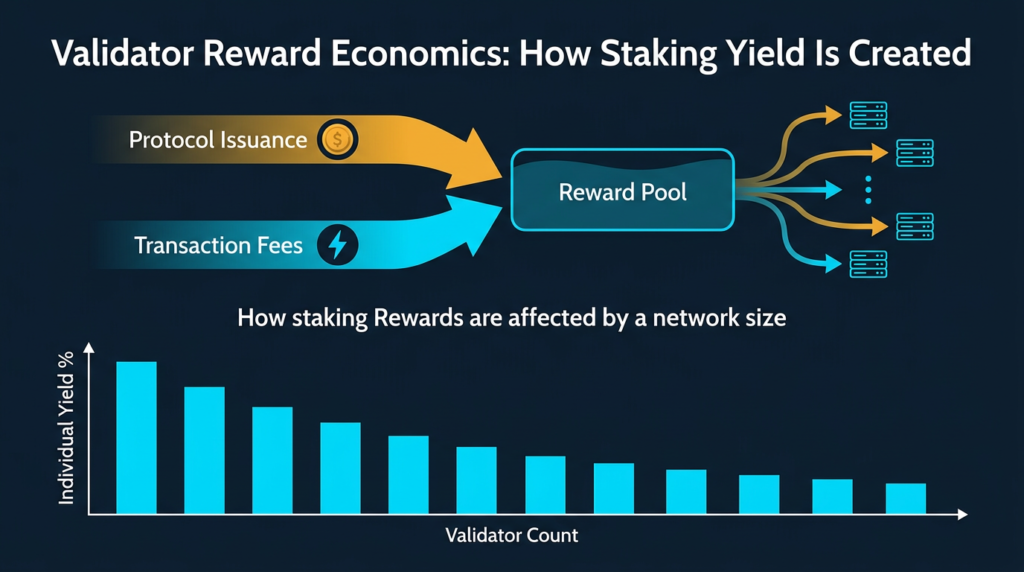
Most networks fund validator rewards through two distinct channels. The first is protocol-level token issuance. The blockchain mints new tokens and distributes them to validators as compensation for their work securing the network. This is an inflationary mechanism. It expands the total token supply, which affects the purchasing power of all token holders whether or not they are staking.
The second source is transaction fees. When users submit transactions, they pay fees denominated in the network’s native token. Validators receive some or all of these fees depending on the protocol’s design.
Ethereum introduced a significant change to fee handling with EIP-1559. Under this model, a base fee is burned (permanently removed from circulation) rather than paid to validators. Validators receive only a priority fee, sometimes called a tip, paid by users who want faster processing. This burn mechanism means that during periods of high network activity, fee burning can exceed new token issuance, making the network net deflationary. During quiet periods, issuance dominates and the network is mildly inflationary.
The combination of issuance and fee revenue determines the gross reward pool available to validators before any competitive dilution or penalties are applied.
How Participation Rate Shapes Individual Yield
Once the total reward pool is established by the protocol, it must be distributed among all active validators. This is where participation rate becomes the dominant factor in determining individual yield.
The dilution effect works like this: when more validators join a network, the same annual reward pool is split among more participants. Each validator’s proportional share decreases. This is not a flaw in the system. It is an intentional economic design that creates equilibrium. As yields compress, fewer new validators find it economically worthwhile to join, which naturally stabilizes participation levels.
A simplified example illustrates the mechanic. Suppose a network distributes 1,000 tokens per year in validator rewards and there are 100 validators each staking an equal amount. Each earns approximately 10 tokens annually. If the validator count doubles to 200, each earns approximately 5 tokens, assuming equal stake distribution. The network has not changed its reward budget. The per-validator yield has simply compressed.
In real networks the relationship is more nuanced because:
- Total staked supply (not just validator count) is the variable the issuance formula responds to.
- Stake is distributed unequally across validators.
- Some networks cap maximum stake per validator to limit centralization.
- Delegation pools charge commission that reduces delegator yields further.
Staking dashboards typically display a current APY calculated from present conditions. That figure does not predict future yield if total staked supply continues to grow. Reviewing the historical trend of staked supply on a given network provides more insight into how yields have compressed over time and where they may head. Understanding why high APY figures in crypto often signal elevated risk is essential before committing capital to any staking strategy, especially if you are weighing solo staking against delegated staking.
Reward Rate Formulas Across Networks
Different proof-of-stake blockchains handle the mechanics of reward issuance through distinct architectural choices, and those differences directly affect how yield behaves over time.
Ethereum
On Ethereum, the annualized reward rate is an inverse function of the total ETH staked across the network. When total staked ETH is low, validators earn a higher rate. As more ETH enters the staking contract, the per-validator rate decreases. The formula uses the square root of total staked ETH as a key variable. This means doubling the staked supply does not halve individual rewards outright. Instead, rewards decline at a diminishing rate mathematically calibrated to keep the network secure across varying participation levels.
Ethereum validators also earn execution layer rewards. These include priority fees from the transaction fee market and, for validators participating in MEV-boost, additional income from block value extraction. Execution layer rewards introduce variance: they are higher during periods of intense on-chain activity and lower when the network is quiet.
Solana
Solana uses a predetermined disinflation schedule. The protocol starts at a fixed initial inflation rate that decreases by a defined percentage each year until it reaches a long-term floor. This schedule is publicly documented and allows for more predictable nominal yield modeling compared to networks with variable issuance.
Validators on Solana earn rewards by voting on the network. Credits are earned per vote, and reward distribution is proportional to credits accumulated during each epoch. Validators that miss votes lose credits and earn reduced rewards. Commission rates set by operators are deducted before delegator rewards are calculated.
Cardano
Cardano distributes rewards through epochs, each lasting five days. Rewards come from two sources: transaction fees collected during the epoch and releases from a fixed reserve pool. The reserve is designed to deplete slowly over a long time horizon, with the system gradually transitioning toward fee-funded rewards.
Each stake pool declares a pledge (the amount committed by the operator) and a margin (the commission percentage). Reward calculations factor in pledge size, giving operators with higher pledges slightly better returns. This design is intended to encourage decentralization by rewarding operator commitment. For a broader comparison of staking opportunities across networks, the best staking coins guide for 2026 covers current risk-adjusted options.
MEV and Non-Standard Reward Sources
Beyond base issuance and standard transaction fees, some validators access a third income stream that meaningfully affects yield distributions across the network.
Maximal extractable value (MEV) refers to value that block proposers can capture by controlling the ordering, inclusion, or exclusion of transactions within a block. On Ethereum, this has given rise to a specialized infrastructure called MEV-boost, where validators connect to external relays that supply optimized block payloads in exchange for sharing MEV revenue with the validator.
MEV income is highly variable. During periods of high DeFi activity, arbitrage opportunities, and liquidation events, MEV income can substantially increase a validator’s total rewards above the base issuance rate. During quiet market periods, MEV revenue falls to near zero.
This creates a meaningful difference in expected returns between validators who participate in MEV extraction and those who do not. It also introduces a layer of complexity for anyone modeling staking yield because the MEV component is neither predictable nor evenly distributed across validators.
Delegators using liquid staking platforms or staking pools may or may not receive MEV income depending on whether the pool operator participates in MEV-boost and how they distribute that revenue. This information is typically disclosed in a protocol’s documentation but is worth verifying before choosing a staking provider. If the provider wraps your position in a liquid token, also review Liquid Staking Risks.
How Slashing and Penalties Reduce Net Returns
Reward calculations assume a validator remains active and honest. Penalties applied by the protocol change that calculation materially, and their effect compounds over time.
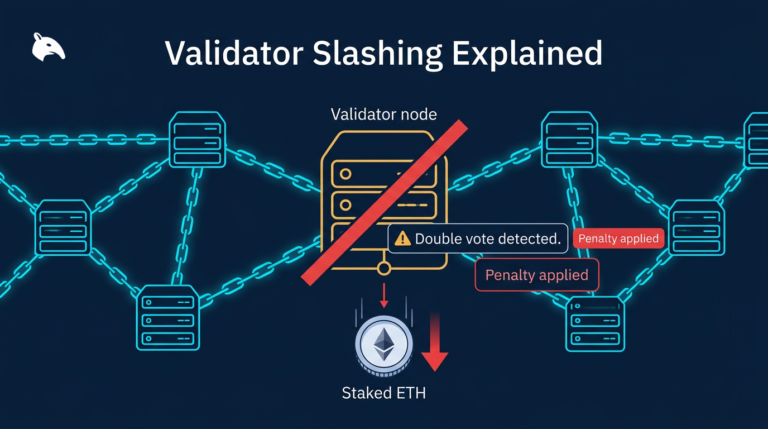
Slashing is a protocol-enforced penalty for specific provable offenses. On Ethereum, the primary slashable offenses are equivocation events: signing two different blocks for the same slot, or making conflicting attestations. When a slash occurs, a portion of the validator’s staked principal is immediately burned. The slashed validator is placed in a forced exit queue and continues losing stake gradually until the exit is processed. For a dedicated breakdown of the mechanics, see Validator Slashing Explained.
The critical distinction is that slashing attacks the principal, not just future rewards. A validator that held 32 ETH and is slashed may exit with significantly less. The reduced principal then earns lower rewards in any future staking period, and the compounding effect on long-term returns is disproportionately negative compared to simply missing a few attestations.
Ethereum also applies a correlation penalty when many validators are slashed simultaneously. If a large percentage of the network’s validators are slashed within a short window, the penalty per validator escalates sharply. This design penalizes infrastructure centralization. Validators sharing the same cloud provider, client software, or configuration introduce correlated failure risk that can trigger elevated penalties during outages.
Separate from slashing, validators face inactivity leaks during periods when the network fails to finalize blocks. If the network falls below the finalization threshold, validators that are also offline during this period lose stake gradually. The mechanic is designed to eventually restore the network to a finalizing state even if large numbers of validators remain offline.
For yield analysis, penalties must be treated as negative return events. A validator earning 4% annually for two years and then suffering a slashing event may see total multi-year returns fall well below the displayed nominal rate. For a broader look at the gap between published APY and actual staking returns, see staking in 2026: risks and real yields.
Nominal Yield vs Real Yield
Understanding protocol issuance mechanics leads to a distinction that many staking participants overlook when evaluating returns.
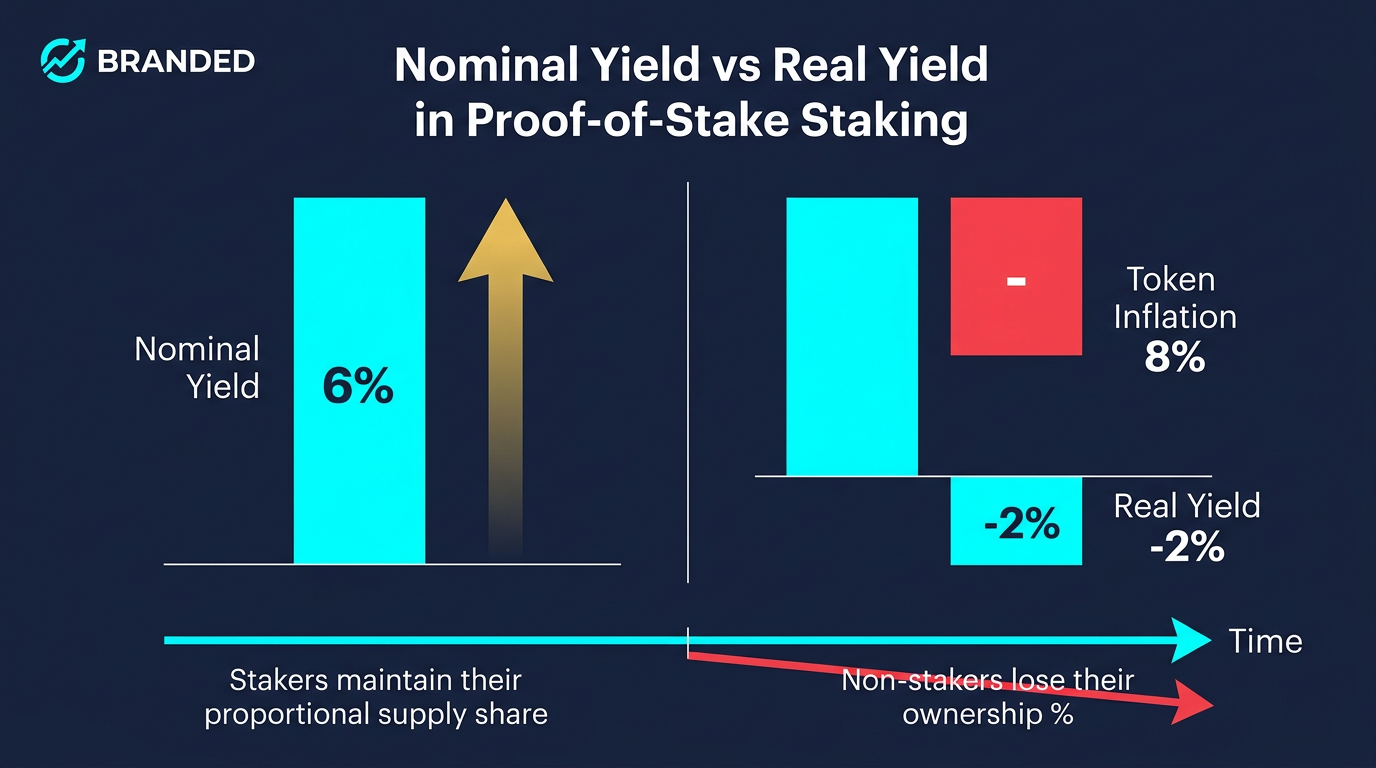
Nominal yield is the percentage return displayed on staking dashboards and protocol documentation. It represents the gross amount of new tokens a validator receives as a share of its staked balance, expressed as an annualized rate. This figure does not account for token inflation.
Real yield adjusts nominal yield for the effects of inflation. When a network mints new tokens to fund validator rewards, it expands the total token supply. If the total supply grows faster than an individual’s reward rate, the staker’s percentage share of total supply decreases even while they receive nominally more tokens.
A validator earning 6% annually on a network with 8% token inflation is experiencing a negative real yield in terms of proportional ownership. The tokens received as rewards do not fully offset the dilutionary effect of new issuance distributed across all participants.
This framing clarifies what staking actually accomplishes in inflationary environments. Rather than generating wealth in isolation, staking primarily protects against dilution. A token holder who does not stake sees their ownership percentage of total supply shrink each year as new tokens are issued to active validators. A token holder who does stake approximately maintains their proportional share, depending on how efficiently they accumulate rewards relative to total issuance.
Ethereum’s fee burn mechanism complicates this picture. When burned fees exceed new issuance, the net supply contracts and real yields improve for stakers. This has occurred during periods of heavy on-chain activity. Whether it continues depends on future network usage, which is not predictable. Solana’s predetermined disinflation schedule is publicly documented and allows for more structured real yield modeling over defined time horizons.
Risks and Common Mistakes in Validator Reward Analysis
Evaluating validator rewards requires more than reading the APY displayed on a staking platform. Several systematic errors affect how participants model expected returns.
Treating Current APY as a Forward Projection
Staking APY changes continuously as total staked supply shifts. A displayed figure accurate today may be materially lower six months later if participation grows. Participants should examine the trend of total staked supply on the network rather than relying on a single snapshot yield figure. Most major networks publish this data through official dashboards or public block explorers.
Ignoring Commission and Protocol Fees
Validators operating for delegators charge a commission on rewards. This percentage varies widely across operators. Liquid staking platforms add protocol fees on top of individual validator commissions. Comparing yield across providers requires stripping out fee layers to arrive at a comparable gross rate before making decisions.
Not Accounting for Lockup Periods
Some networks require unstaking periods of days to weeks. On Ethereum, validators entering or exiting the network pass through an activation and exit queue that can extend significantly during high-demand periods. Capital committed to staking is not immediately liquid. Risk-adjusted yield analysis must account for lockup duration alongside nominal rate.
Ignoring Operational Costs for Solo Validators
Running a validator requires server infrastructure, monitoring software, and ongoing maintenance. These costs reduce net yield and are absent from displayed APY calculations, which reflect gross protocol returns only. Delegation to a pool absorbs these costs but transfers a commission percentage to the pool operator instead. If you run your own setup, key storage becomes part of the yield equation too, so how to store crypto safely is relevant operational reading. The best crypto passive income strategies guide covers how to evaluate staking alongside other yield approaches with realistic cost considerations included.
Sources
- Ethereum Staking Documentation (ethereum.org)
- Solana Developer Documentation (docs.solana.com)
- Cardano Documentation (docs.cardano.org)
Frequently Asked Questions
Why do validator rewards decrease over time?
Validator rewards decrease as more participants stake their tokens. The protocol distributes a fixed or formula-determined reward pool, and that pool is divided among all active validators proportional to their stake. More validators mean each receives a smaller share. This compression is an intentional design feature that creates economic equilibrium rather than a malfunction.
What is the difference between nominal staking yield and real yield?
Nominal yield is the annualized percentage of new tokens received relative to staked balance. Real yield adjusts for token inflation. If a network mints tokens at a rate higher than the staking reward rate, stakers may gain tokens numerically but lose proportional ownership of total supply. Real yield is nominal yield minus the effective inflation rate for that network.
How does slashing affect long-term staking returns?
Slashing reduces the staked principal rather than just future rewards. A validator that is slashed exits with less capital than it committed. The reduced principal earns lower rewards in any subsequent staking period, creating a compounding negative effect on total returns over time. Proper validator infrastructure and key management are the primary defenses against slashing events.
Do all proof-of-stake networks issue validator rewards the same way?
No. Ethereum uses a variable issuance formula based on total staked ETH. Solana uses a predetermined disinflation schedule with annual decreases toward a long-term floor. Cardano releases rewards from a reserve pool combined with transaction fees, distributed through five-day epochs. Each model creates different nominal yield profiles and inflation dynamics for participants.
What is MEV and how does it affect validator income?
Maximal extractable value (MEV) is additional income available to block proposers who control transaction ordering within a block to capture value from arbitrage, liquidations, or other on-chain opportunities. On Ethereum, validators can access MEV through MEV-boost relays. MEV income is variable and not evenly distributed, meaning validators participating in MEV infrastructure may earn meaningfully more during active market periods than base issuance alone would provide.