

Last Updated on April 16, 2026 by Snout0x
UTXO stands for Unspent Transaction Output. It is the fundamental mechanism Bitcoin uses to record ownership and process payments on the blockchain. Rather than maintaining running account balances, Bitcoin tracks value as discrete, unspent outputs that move between addresses through transactions.
This content is for educational purposes only and should not be considered financial or investment advice.
A UTXO (Unspent Transaction Output) is a discrete chunk of bitcoin on the blockchain that has not been spent yet. When you receive bitcoin, you receive one or more UTXOs. When you spend bitcoin, your wallet consumes those UTXOs and creates new ones as change.
Simple Definition
A UTXO is a discrete unit of bitcoin value created by a transaction and not yet consumed by a subsequent one. When someone receives bitcoin, the transaction produces one or more outputs. Each output specifies an amount and is locked to a particular address.
That output remains unspent until the recipient references it as an input in a future transaction. At that point it is consumed, and the new transaction creates fresh outputs in its place.
The acronym breaks down directly:
- Unspent: the output has not been used as a transaction input
- Transaction: the on-chain event that produced it
- Output: the specific value unit directed to a recipient address
Bitcoin has no concept of a stored account balance at the protocol level. What exists on the blockchain is a collection of outputs, each holding a specific amount and each locked to an address. Your wallet balance is the sum of all UTXOs locked to addresses you control.
Why It Matters
The UTXO model shapes how Bitcoin handles ownership, fee calculation, and privacy in ways that differ from most other financial systems.
Every wallet calculates your balance by scanning the blockchain for outputs locked to your addresses and summing their values. Nothing on the blockchain holds a total figure directly. Wallet software performs this calculation each time it displays your balance.
The model has several practical consequences:
- A UTXO cannot be partially spent. The entire output must be consumed as an input.
- If a UTXO exceeds the payment amount, the transaction creates a change output returning the remainder to an address you control.
- Transactions that combine many small UTXOs as inputs require more block space, which increases the fee.
- The complete set of all unspent outputs is called the UTXO set. It represents the entire spendable state of the Bitcoin network at any given moment.
Understanding this model explains behavior that surprises new users: change outputs appearing as separate line items, fees that vary by wallet state rather than payment amount alone, and why consolidating small amounts sometimes costs more in fees than expected.
How It Works
Transaction Inputs and Outputs
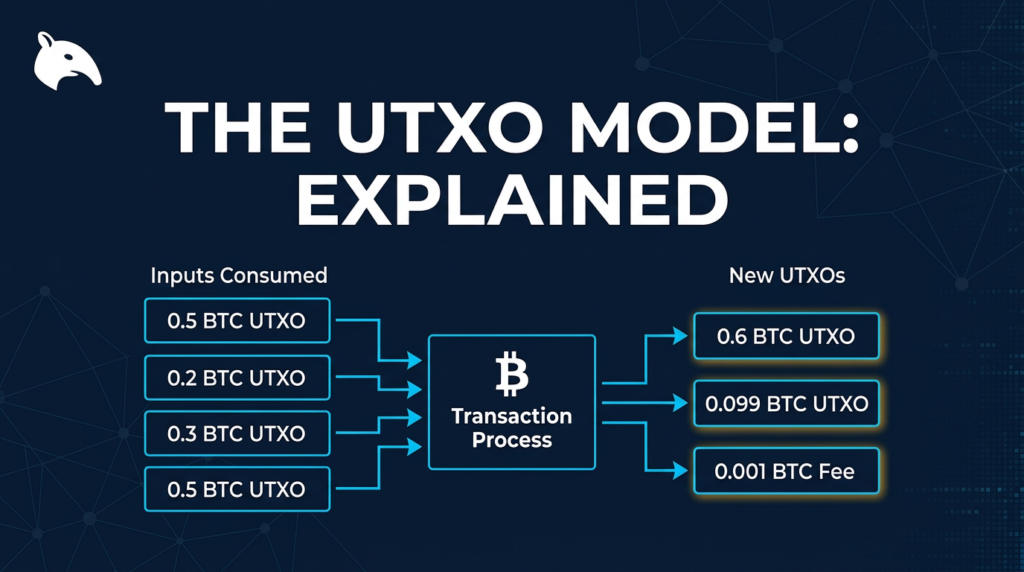
A Bitcoin transaction consumes existing UTXOs as inputs and creates new UTXOs as outputs. The inputs prove ownership of the prior outputs using cryptographic signatures derived from the private key controlling each address. The outputs define new amounts and the addresses that can spend them.
A concrete example: you hold a UTXO worth 0.05 BTC and want to send 0.03 BTC to someone.
- Input: the 0.05 BTC UTXO (fully consumed)
- Output 1: 0.03 BTC locked to the recipient’s address
- Output 2: approximately 0.0195 BTC returned to your change address (the remainder minus the mining fee)
After this transaction confirms, the original 0.05 BTC UTXO no longer exists. Two new UTXOs have replaced it. The old output is permanently removed from the UTXO set.
The UTXO Set
The UTXO set is the complete collection of all unspent transaction outputs across the Bitcoin network. Every full node maintains a local copy of this set because it is the only information required to validate new transactions.
When a new transaction arrives, nodes verify three things:
- Each referenced input exists in the current UTXO set
- The ownership proof (the cryptographic signature) is valid for that output
- The total input value is greater than or equal to the total output value
If all checks pass, the transaction is valid. The referenced inputs are removed from the UTXO set and the new outputs are added. This process is what “spending” means at the protocol level.
The UTXO set grows when transactions produce more outputs than they consume. It shrinks when users consolidate many small UTXOs into fewer larger ones through consolidation transactions.
Account-Based Models vs the UTXO Model
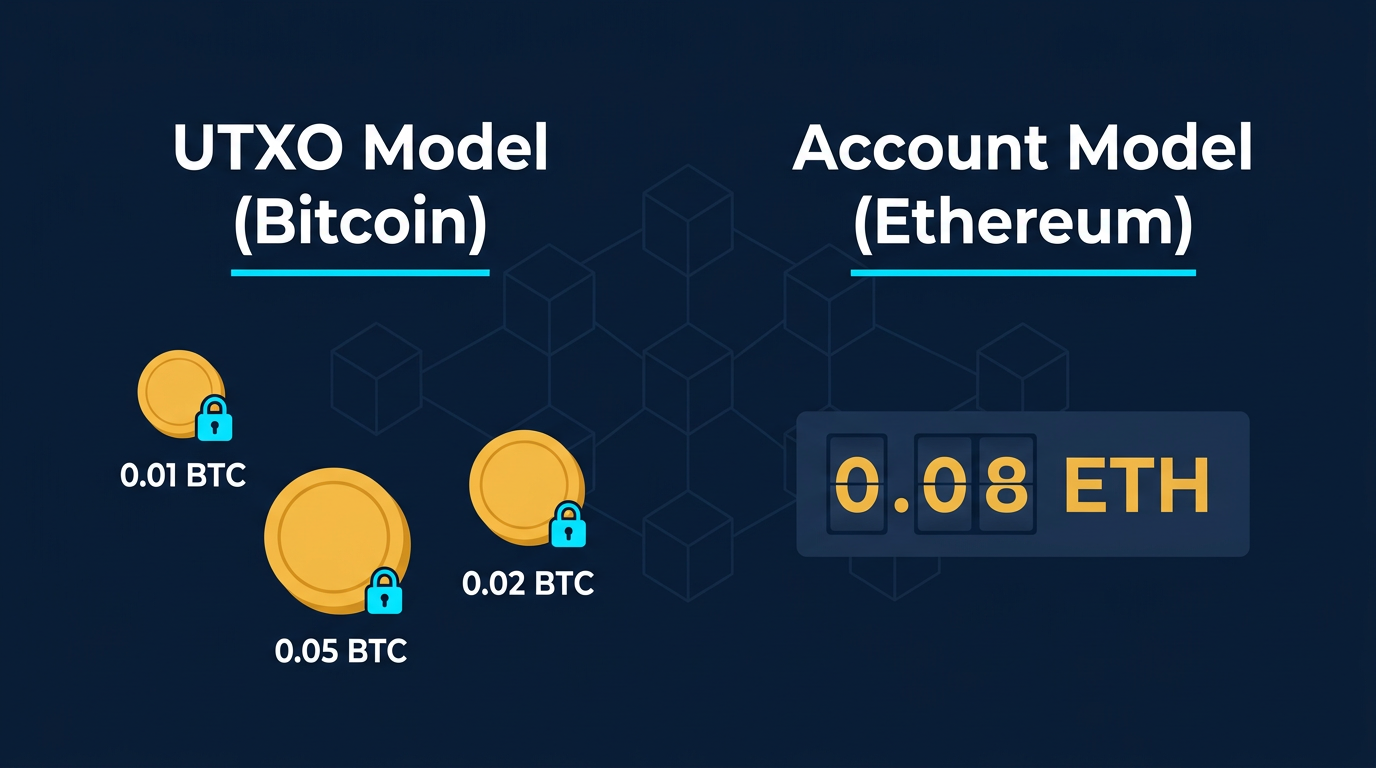
Ethereum uses an account model. Each address holds a stored balance that is updated directly when a transaction occurs. Sending 1 ETH from address A to address B increments B’s balance and decrements A’s. The change is applied to a running figure.
Bitcoin’s UTXO model works differently. There is no address balance stored anywhere on the blockchain. Value exists only as discrete outputs, and spending requires consuming entire outputs and producing new ones in their place.
| Property | UTXO Model (Bitcoin) | Account Model (Ethereum) |
|---|---|---|
| Balance storage | Sum of unspent outputs | Stored per address |
| Transaction logic | Consume inputs, create outputs | Debit sender, credit receiver |
| Partial spending | Not possible; change output required | Supported directly |
| Parallel validation | Supported (independent UTXOs) | Sequential per account nonce |
| Privacy default | Output-level traceability | Address-level traceability |
Neither model is strictly superior. The UTXO model enables independent parallel validation of transactions that reference separate outputs, and it supports certain privacy techniques that the account model does not accommodate as naturally.
Common Mistakes
The UTXO model differs enough from conventional banking that several misunderstandings appear repeatedly among new users.
Misreading Change Outputs
When a UTXO is larger than the payment amount, the excess returns to an address your wallet controls as a change output. This appears in the transaction as a second outgoing output, which some users interpret as funds sent to an unknown party.
Wallet software that does not clearly label change addresses amplifies this confusion. The funds have not been misdirected. They are sitting in your wallet at a new address generated during the transaction.
UTXO Fragmentation
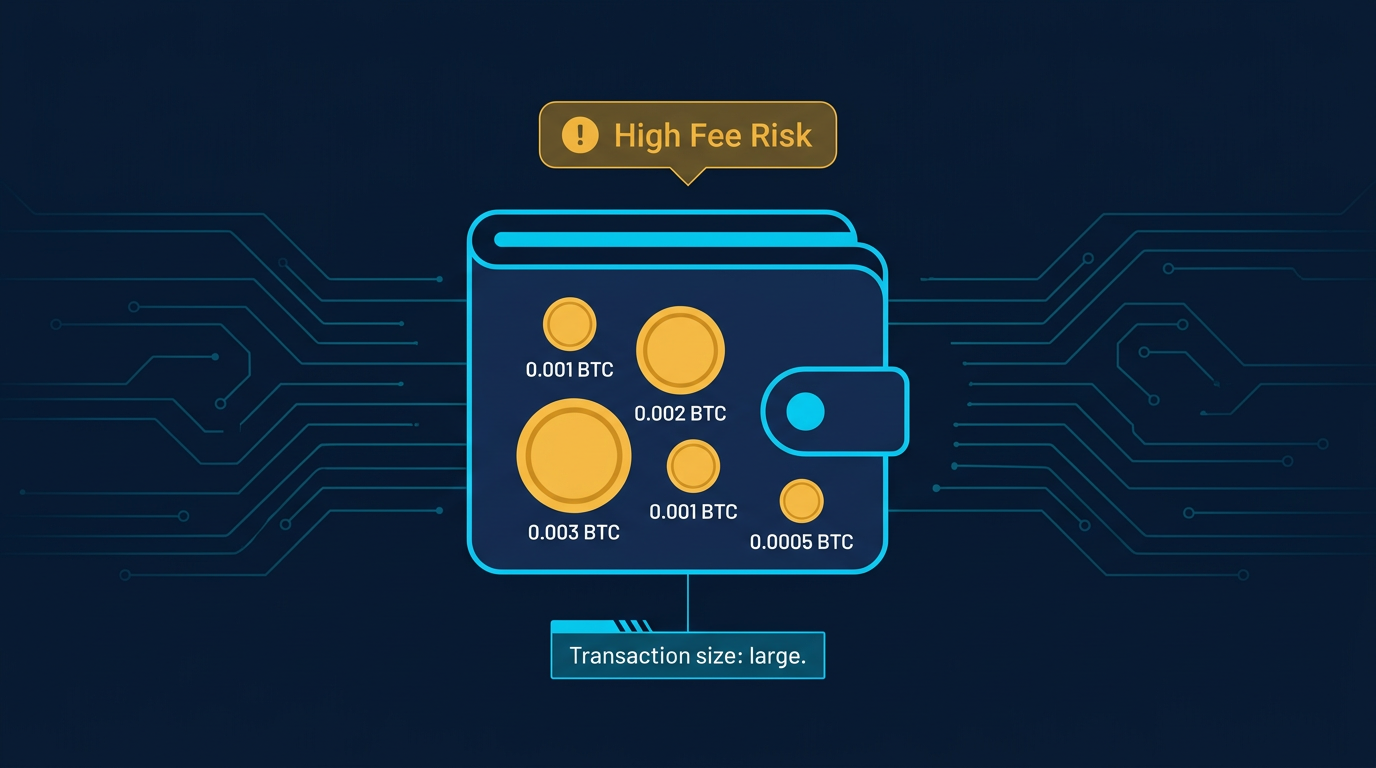
Receiving many small payments over time accumulates a large number of small UTXOs. This is called UTXO fragmentation. Fragmented wallets face higher fees because each UTXO included as a transaction input adds bytes to the transaction, and larger transactions require higher fees to confirm.
In periods of high network congestion, some small UTXOs become “uneconomical outputs,” meaning the fee required to spend them exceeds their value. Periodically consolidating UTXOs during low-fee periods reduces this problem, though consolidation transactions themselves carry privacy trade-offs.
Assuming a Balance Exists On-Chain
Some users assume the blockchain stores a balance figure for each address. It does not. The balance displayed by wallet software is calculated from UTXOs at query time. A wallet that has not fully synchronized with the chain may show an incomplete or inaccurate balance until the sync completes.
Security and Risk Considerations
Because Bitcoin ownership is defined entirely by control over UTXOs, the security properties of the UTXO model have direct implications for how self-custody should be managed.
Address Reuse and UTXO Linkability
Each UTXO is locked to an address. If you reuse the same address for multiple incoming transactions, all resulting UTXOs are visibly linked on the blockchain. Anyone analyzing on-chain data can determine those outputs belong to the same entity.
Bitcoin wallets using BIP 44 or BIP 84 derivation generate a fresh address for each incoming transaction automatically. This limits the linkability of UTXOs across different payments and is why most modern wallets should not be set to reuse addresses.
Coin Control and Transaction Privacy
Advanced wallets support manual coin control: selecting which specific UTXOs to include as inputs when constructing a transaction. This matters when certain UTXOs carry transaction history you prefer not to associate with a particular payment.
Without coin control, wallet software selects UTXOs automatically. It sometimes combines outputs from unrelated sources into a single transaction, inadvertently linking separate transaction histories on-chain. For users managing larger holdings under self-custody, understanding coin control is a meaningful part of operational security.
Dust Attacks
A dust attack sends very small amounts of bitcoin (called “dust”) to known addresses. The objective is to induce wallet software to include the dust UTXO as an input in a future transaction, linking the target address to other addresses controlled by the same wallet.
Most modern wallets flag dust inputs and give users the option to exclude them. Leaving dust unspent is usually the safest response when the source is unknown.
Key Control Is Output Control
Since every UTXO is locked to an address, and addresses are derived from private keys, the security of bitcoin holdings reduces entirely to key control. Whoever holds the private keys controls the outputs. There is no account recovery process, no password reset, and no institution that can restore access to a lost key.
For a broader overview of how Bitcoin fits into the larger blockchain architecture, the What Is Blockchain guide explains the underlying system that makes the UTXO model possible. The Crypto Starter Guide covers how these fundamentals apply to managing crypto assets securely.
Frequently Asked Questions
Is a UTXO the same as a bitcoin?
Not exactly. Bitcoin is the currency unit. A UTXO is the structural container holding a specific amount of bitcoin locked to an address. A single UTXO could hold any quantity, from a fraction of a satoshi to thousands of bitcoin.
Why does my wallet sometimes show a change transaction going back to me?
When a UTXO is larger than the amount being sent, the excess is returned as a change output directed to an address your wallet controls. This is normal protocol behavior, not an error. The funds remain fully under your control.
What is UTXO fragmentation and why does it increase fees?
Fragmentation occurs when a wallet accumulates many small UTXOs over time. Each UTXO included as a transaction input adds data to the transaction. Larger transactions require higher fees to be included in a block. Consolidating UTXOs during low-fee periods reduces this overhead.
Does Ethereum use UTXOs?
No. Ethereum uses an account model where each address maintains a stored balance updated directly with each transaction. The UTXO model is associated primarily with Bitcoin and other blockchains derived from Bitcoin’s original architecture.
Can I choose which UTXOs to spend?
Yes, if your wallet supports coin control. This feature lets you manually select which UTXOs to include as inputs. It is available in Bitcoin Core, Electrum, and several hardware wallet companion applications. Using it gives you greater control over which transaction histories get linked together on-chain.