

Last Updated on March 30, 2026 by Snout0x
Slashing is a penalty mechanism built into proof-of-stake blockchains. When a validator node behaves in ways that could undermine the integrity of the network, some or all of their staked funds are destroyed and they are forcibly removed from the validator set. Slashing is not a minor fee. It is a permanent, irreversible loss of the staked capital.
For a closely related follow-up, see UTXO Consolidation Explained: What It Is and When to Do It.
A simple way to think about slashing is as the validator’s security deposit. The network asks validators to put up capital to prove they will follow the rules. If they sign conflicting messages or behave in ways that threaten consensus, part of that deposit is burned. That mental model makes it easier to see why slashing has to be severe enough to matter.
This content is for educational purposes only and should not be considered financial or investment advice.
Why Slashing Exists
Proof-of-stake networks rely on validators to propose and attest to blocks. To participate, validators lock up (stake) a significant amount of capital. This stake is the economic mechanism that aligns validator behavior with honest network operation. If validators could attack the network with no financial consequence, attacks would be cheap.
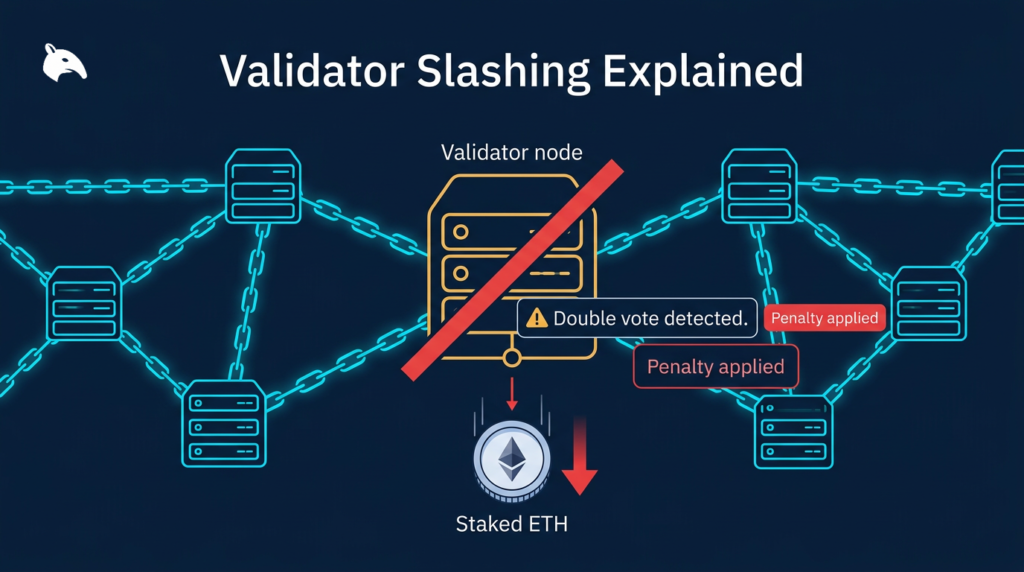
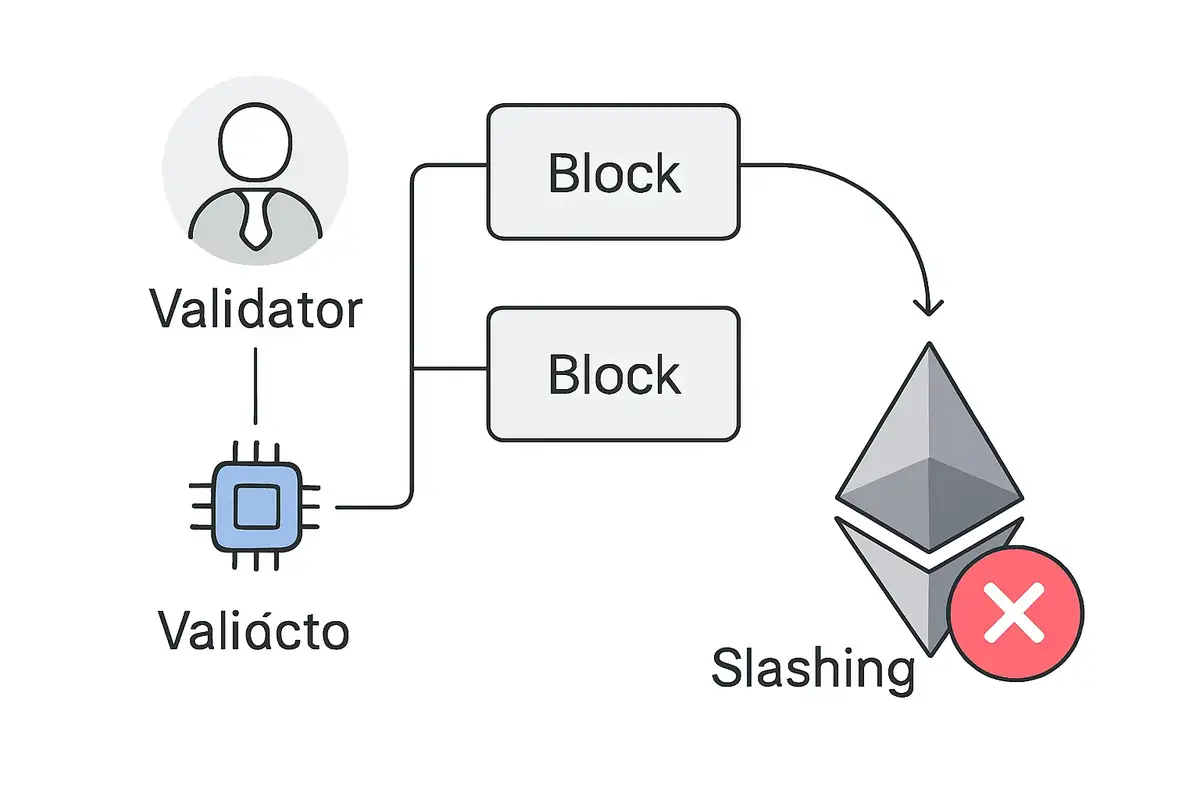
Slashing makes dishonest behavior costly. If a validator signs contradictory messages to try to manipulate consensus (a double-vote) or proposes conflicting block versions, the network detects this and destroys a portion of their staked funds. The loss must be large enough to outweigh any potential gain from the attack, which is what makes the punishment economically effective.
What Triggers Slashing on Ethereum
On Ethereum, two specific behaviors trigger slashing:
- Double voting (equivocation). A validator signs two different attestations for the same slot, or proposes two different blocks for the same slot. This can happen accidentally through misconfigured redundant validator setups running simultaneously.
- Surround voting. A validator submits attestations that contradict each other in a way that could support a chain reorganization attack. This is a more specific and less common trigger.
Both of these behaviors are forms of equivocation: presenting conflicting views of the chain to undermine consensus. The network detects these by comparing validator signatures across different messages.
How Much Stake Is Lost When Slashed
On Ethereum, the slashing penalty has two components. The first is an immediate penalty at the time of the slashing event: the validator loses 1/32 of their effective balance (approximately 1 ETH on a full 32 ETH stake). The second is a correlation penalty calculated over the following 36 days, based on how many other validators were slashed around the same time.
The correlation penalty is the more significant component. Its severity scales with the fraction of validators slashed in a similar window. If a single validator is slashed in isolation, the correlation penalty is small and total losses might be a few percent of stake. If a large coordinated attack slashes many validators simultaneously, the correlation penalty can reach 100%, destroying the entire stake of every slashed validator.
This design is intentional. Accidental misconfigurations by individual validators are penalized mildly. Coordinated attacks that slash many validators are penalized maximally, making large-scale attacks prohibitively expensive.
Slashing vs Inactivity Penalties
Slashing is often confused with inactivity penalties, but they are different. Inactivity penalties are applied to validators that go offline and stop attesting. These are minor, gradual deductions designed to slowly reduce the stake of non-participating validators. They are not slashing and do not involve any accusation of dishonest behavior. A validator that goes offline for a short period will lose a small amount of stake but can return to normal operation and earn rewards again.
Slashing, by contrast, is triggered by provably dishonest or equivocating behavior, involves a more severe penalty, and results in immediate forced exit from the validator set. A slashed validator is permanently removed. They cannot re-enter the validator set with the same credentials.
The intuitive difference is that downtime is treated like poor service, while slashing is treated like signing contradictory legal documents with the same identity. One is a performance problem. The other is a consensus-integrity problem. That is why the penalties are so different.
Practical Usage: Avoid Duplicate Validator Setup
The majority of real-world slashing events on Ethereum are not attacks. They are accidental double-signing caused by running the same validator key on more than one machine simultaneously.
For the risk side of this topic, see Wallet Address Reuse Risks: What It Exposes On-Chain.
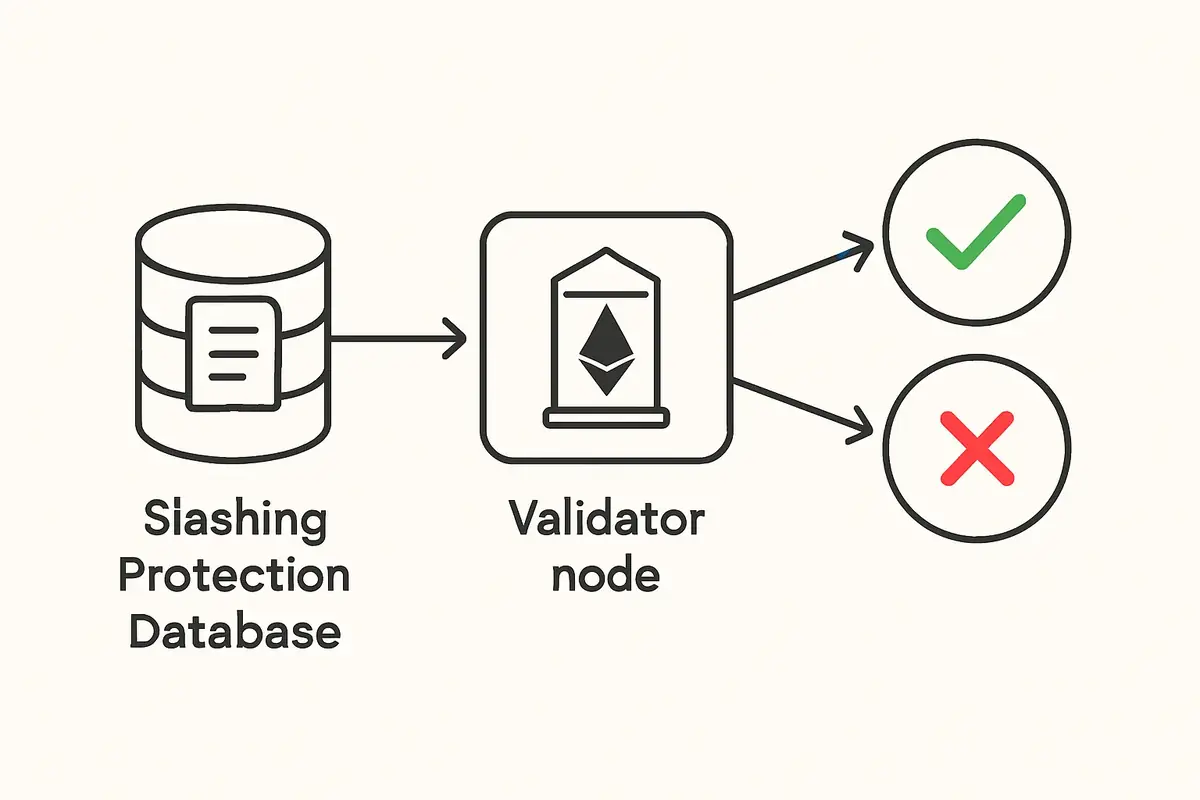
Solo stakers sometimes set up a backup validator to ensure continuity during hardware failures. If both the primary and backup are online at the same time, both may sign attestations for the same slot, triggering double voting and slashing. The solution is to ensure only one instance of a validator client is running at any time, with safeguards (slashing protection databases) that prevent a client from signing messages it has already signed with a given key.
Most modern validator clients include a slashing protection database that records all signed messages and refuses to sign conflicting ones, even if the same key is imported twice. Understanding this protection matters for anyone considering solo staking, which is covered in depth in Solo Staking vs Delegated Staking.
This is why migrations and failover procedures matter more than many new stakers expect. The danger usually is not “being hacked into slashing.” It is accidentally creating two active signers for the same validator identity during maintenance, cloud failover, or hardware replacement.
How Slashing Affects Liquid Staking Token Holders
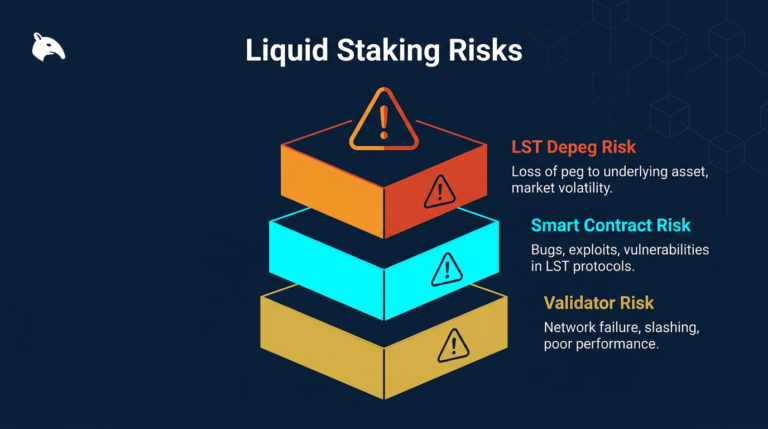
If you hold a liquid staking token (LST) such as stETH or rETH, your funds are staked through a set of validators operated by the protocol. A slashing event on one of those validators affects the entire protocol pool: the penalty is socialized across all token holders proportionally, meaning the exchange rate of your LST to ETH decreases slightly.
Historically, liquid staking protocols have maintained slashing insurance funds or reserve pools to cover individual slashing events without affecting the LST price. Whether this coverage is sufficient for large coordinated slashing events is an open question and represents a real risk for LST holders. For more on this, see Liquid Staking Risks.
Risks and Common Mistakes
The most common operational mistake is trying to build redundancy by running the same validator key on two machines at once. That feels safer during migrations or failover testing, but it can create the exact double-signing event the protocol punishes. The consequence is not just a warning or a missed reward. The validator is slashed, forcibly exited, and loses part of the stake immediately.
For a closely related follow-up, see Liquid Staking vs Native Staking: Mechanics, Trade-Offs, and When to Use Each.
Another mistake is assuming liquid staking removes slashing exposure entirely. It spreads the loss across a pool, but does not eliminate it. If a protocol operator is slashed or a cluster of validators fails under the same operator setup, the LST exchange rate can drift lower and users absorb that loss indirectly through the token price.
Frequently Asked Questions
Can slashing happen on accident?
Yes. The most common cause of slashing on Ethereum is accidental double-signing from running two instances of the same validator key simultaneously. This often happens during migration between machines or when testing a backup setup. Slashing protection databases and careful operational procedures prevent this.
What happens to a slashed validator?
The validator is immediately flagged and queued for forced exit. They lose a portion of their stake immediately and additional stake over a 36-day correlation penalty period. After exit, the remaining balance is returned, but the validator is permanently removed and cannot re-register with the same credentials.
Does delegated staking protect me from slashing?
Partially. When you delegate through a liquid staking protocol, the slashing risk is spread across many validators and the protocol may have insurance coverage for individual events. However, you are not completely protected from slashing risk; you are exposed to it proportionally as a pool participant. The protocol’s slashing history and insurance fund are worth reviewing before choosing a provider.
Is slashing the same as losing your stake entirely?
Not in most single-validator slashing events. A typical accidental slashing loses a few percent of the 32 ETH stake. Full stake destruction (100% correlation penalty) requires being slashed as part of a large coordinated group of validators. This has not occurred on Ethereum mainnet in practice.
Do other proof-of-stake blockchains have slashing?
Many do, though the specific rules vary. Cosmos-based chains use slashing for double signing and prolonged downtime. Polkadot has an “offences pallet” that handles various validator misbehaviors with graduated penalties. The specific triggers, penalty magnitudes, and recovery paths differ by protocol. Always research the slashing rules of any chain you stake on.