

Last Updated on April 14, 2026 by Snout0x
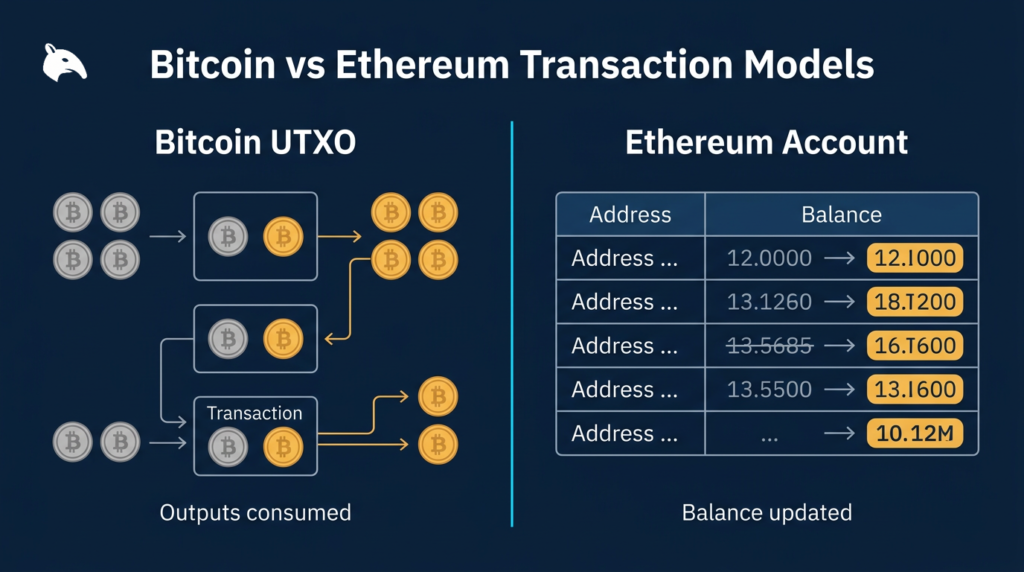
Bitcoin and Ethereum are both public blockchains that record value transfers permanently. But the underlying model they use to track who owns what is fundamentally different. Bitcoin uses the UTXO (Unspent Transaction Output) model. Ethereum uses the account model. These architectures lead to different tradeoffs in privacy, efficiency, programmability, and complexity. Understanding both illuminates why they are designed the way they are, and why neither approach is simply “better” in all cases.
For the broader overview around this topic, see What Is Blockchain?.
The practical decision lens is simple: Bitcoin’s model is stronger when you value discrete coin control, UTXO-based accounting, and better privacy potential. Ethereum’s model is stronger when you value persistent state, easier smart-contract execution, and account-style user experience. They solve different design goals, which is why the right model depends on what the chain is trying to optimize.
This content is for educational purposes only and should not be considered financial or investment advice.
Key Takeaways
- Bitcoin’s UTXO model tracks discrete coins as outputs; every transaction consumes old UTXOs and creates new ones.
- Ethereum’s account model tracks persistent balances at each address, updated with each transaction like a ledger entry.
- UTXO offers stronger privacy (each spend can use a new address) and is more complex to manage.
- The account model enables simpler smart contracts and DeFi but is more prone to replay attacks without careful nonce management.
- Fee structures differ: Bitcoin fees are based on transaction byte size; Ethereum fees are based on computational cost (gas).
How Bitcoin’s UTXO Model Works
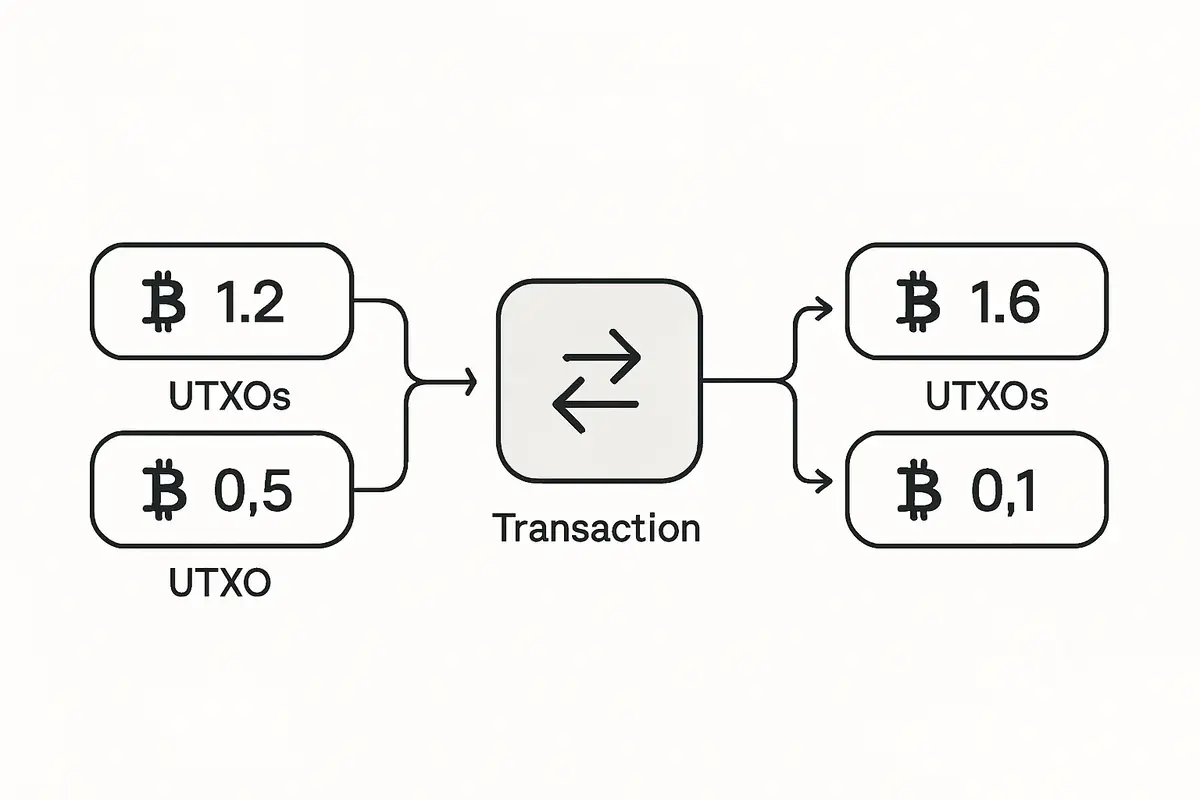
In Bitcoin, there is no such thing as an “account balance” in the blockchain state. What exists is a set of Unspent Transaction Outputs (UTXOs): discrete coins that have been created by previous transactions and not yet spent. When you “have” 0.5 BTC, it means there is one or more UTXOs locked to your addresses that together sum to 0.5 BTC.
To send 0.1 BTC to someone, you do not subtract from a balance. You consume one or more existing UTXOs as inputs and create new outputs: 0.1 BTC output to the recipient’s address, a “change” output back to yourself for the remainder (minus the transaction fee). The original UTXOs are destroyed and new ones take their place.
This is analogous to physical cash. If you have a 50 euro note and spend 10 euros, you hand over the note, the cashier returns 40 euros in change, and the original note is gone. Bitcoin works the same way, but all UTXOs are tracked on the public blockchain rather than in physical hands.
For a detailed look at the UTXO model and its practical implications, see What Is UTXO.
How Ethereum’s Account Model Works
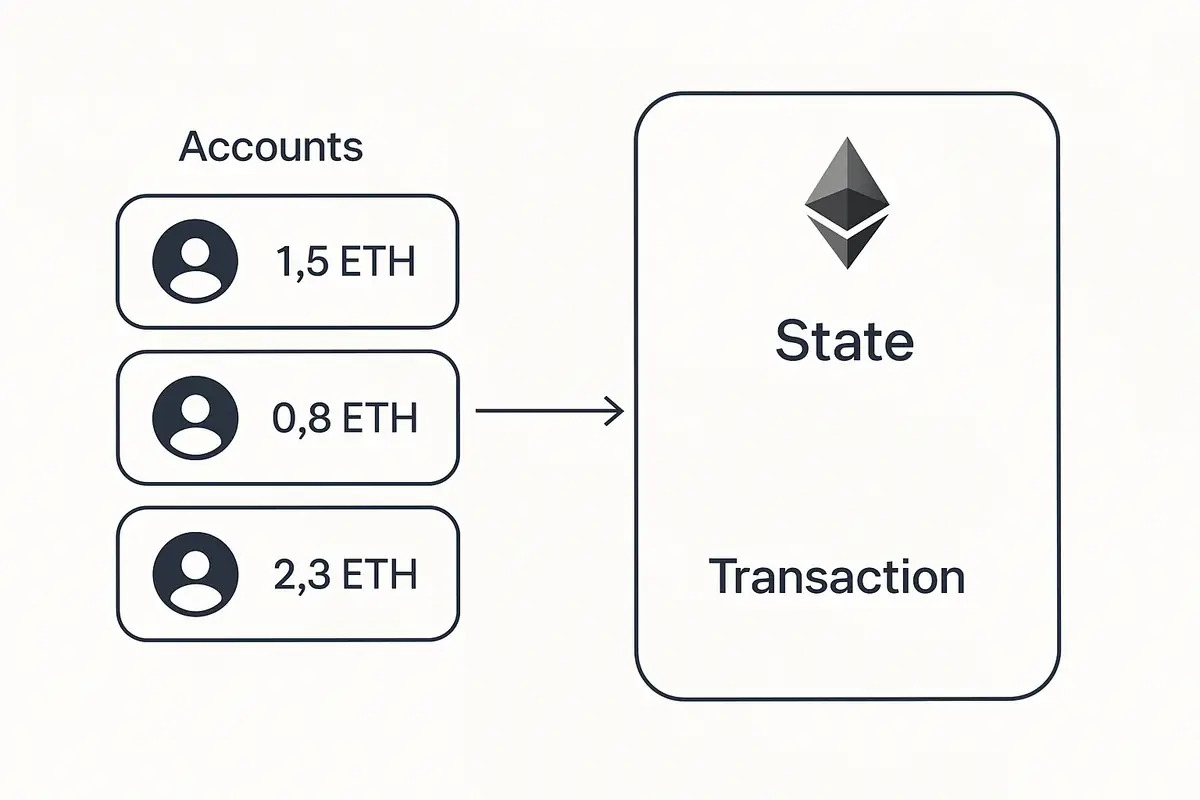
Ethereum tracks state differently. Every address on Ethereum has a persistent balance stored in the global state. Sending ETH is an update operation: deduct from sender balance, add to recipient balance. There are no coins to consume. The blockchain state simply records the current balance of each account after each transaction.
Think of it like a bank ledger. Your account has a balance field. When you send money, the bank decrements your balance and increments the recipient’s. No physical coins move; only the numbers in the ledger change. Ethereum’s account model works the same way, except the “bank” is a decentralized blockchain with no central operator.
There are two types of accounts in Ethereum. Externally Owned Accounts (EOAs) are controlled by private keys and hold ETH balances. Contract Accounts are controlled by deployed smart contract code. Contract accounts can hold balances, store data, and execute logic when called. This is fundamentally different from Bitcoin, where there is no concept of a programmable account in the base layer.
Privacy Differences
The UTXO model offers a meaningful privacy advantage when used correctly. Because each transaction creates new outputs to new addresses, a sophisticated user can receive every transaction at a fresh address. This makes it harder to link all of a user’s transactions to a single identity by tracing an address. A blockchain observer sees many addresses that have never interacted with each other, rather than a single account with a complete transaction history.
For a closely related follow-up, see Wallet Address Reuse Risks: What It Exposes On-Chain.
In practice, most Bitcoin wallets reuse addresses, and UTXO clustering analysis (identifying inputs from the same wallet by their co-spending patterns) is a well-developed technique used by blockchain analytics firms. The privacy advantage of the UTXO model exists but is not automatic; it requires deliberate use of new addresses for every receive.
Ethereum’s account model is worse for privacy by default. Your address is persistent and accumulates a full history of every transaction. Anyone who knows your Ethereum address can see every interaction you have had with every DeFi protocol, every NFT you have minted, and every approval you have granted. This is a meaningful privacy trade-off relative to UTXO, though both models are public ledgers and neither is private by default.
Fee Structures
Bitcoin fees are priced in satoshis per virtual byte (sat/vB). The fee depends on the data size of the transaction. More inputs and outputs mean a larger transaction and higher fees at a given fee rate. A simple transaction (one input, two outputs) is cheaper than a complex one (many inputs). This structure incentivizes UTXO consolidation during low-fee periods to keep future transactions small and cheap. For more on managing UTXO count, see UTXO Consolidation Explained.
Ethereum fees are priced in gas, which is a unit of computational work. Every operation the Ethereum Virtual Machine performs has a gas cost. A simple ETH transfer costs 21,000 gas. A complex DeFi interaction involving multiple contract calls might cost 300,000 or more. The total fee is gas used multiplied by the gas price, denominated in Gwei (10 to the power of negative 9 ETH). Since EIP-1559, Ethereum fees include a base fee (burned) and a priority fee (to the validator). The relationship between gas and fees is more abstract than Bitcoin’s byte-based model but follows similar supply-demand dynamics during network congestion.
Smart Contract Implications
Ethereum’s account model was designed with smart contracts in mind. Contract accounts can receive ETH, hold state, execute logic, and interact with other contracts in composable ways. The persistent balance and state model makes it straightforward to build financial protocols: a lending contract can track how much each address has deposited and owed, because balances are just numbers in a storage mapping.
Bitcoin’s UTXO model makes complex smart contracts harder. UTXOs are stateless from the perspective of the coin: each UTXO is either spent or unspent, and carrying state between transactions requires specific scripting techniques. Bitcoin Script is deliberately limited to prevent complex programs from running indefinitely and consuming excessive node resources. This simplicity is a security feature, but it limits the programmability available at the base layer.
Some Bitcoin Layer 2 solutions and sidechains have explored ways to enable more complex contract behavior on top of Bitcoin’s base layer, but the base layer itself is intentionally constrained by design.
Nonce Management and Replay Attacks
Ethereum’s account model introduces a requirement Bitcoin does not have: nonce management. Every Ethereum transaction includes a nonce, a sequential counter that must increment by exactly one for each transaction from a given address. This prevents a transaction from being replayed (resubmitted) and ensures transactions from the same address are processed in order.
If a transaction with nonce 5 fails or is stuck, transactions with nonces 6 and above cannot be confirmed until nonce 5 is resolved. This is different from Bitcoin, where transactions are independent and there is no ordering dependency between different transactions from the same wallet (unless they share UTXO inputs).
The nonce system is generally handled automatically by wallets, but it becomes a practical concern during high-congestion periods when transactions get stuck, requiring careful management to avoid blocking the entire transaction queue from an address.
Wallet Address Reuse Implications
In Bitcoin, best practice is to use a new receiving address for each transaction. Wallets derived from a single seed phrase generate a fresh address automatically for each receive. This is facilitated by the hierarchical deterministic derivation standard (HD wallets).
In Ethereum, the same address is generally used for everything. Generating new Ethereum addresses is possible but rarely done for standard use because the persistent account model means there is no particular benefit to using fresh addresses for privacy (your transaction history is linked at the contract interaction level regardless). Most Ethereum users maintain a single primary address for all their DeFi, NFT, and token activity.
Practical Usage
The model matters most when you are planning real transactions. In Bitcoin, check how many UTXOs your wallet will spend before sending, because many small inputs make the transaction larger and more expensive. If your wallet is full of small outputs, consolidating them during a low-fee period can reduce future costs. In Ethereum, the practical check is different: confirm the nonce state, available ETH for gas, and whether the transaction is a simple transfer or a contract interaction, because a stuck nonce or underfunded gas balance can block later transactions from the same address.
If you want the foundational definition behind this concept, read Bitcoin Mempool Explained: How the Transaction Queue Works.
For a closely related follow-up, see Bitcoin Mempool Congestion: Why Fees Spike and Transactions Stall.
That difference also produces a useful verdict for users. Bitcoin is usually the better fit if you want simpler base-layer money movement with stronger coin-level accounting and better privacy habits. Ethereum is usually the better fit if you need contracts, DeFi, and application state that persists across many interactions.
For wallet behavior, the local follow-ups that fit best are UTXO Consolidation Explained for Bitcoin-side transaction planning and Wallet Address Reuse Risks for the privacy consequences of persistent addresses.
If you care most about programmability, Ethereum’s account model has the clearer advantage. If you care most about discrete transaction accounting and minimizing unnecessary state complexity, Bitcoin’s UTXO model has the cleaner design. The trade-off is not old versus new. It is specialized money design versus specialized application design.
A simple real-world rule is to treat Bitcoin wallets like coin-selection tools and Ethereum wallets like state-management tools. For Bitcoin, focus on address reuse and input count before sending. For Ethereum, focus on which address is being used, what approvals or contracts it has already touched, and whether you want that activity linked to the same on-chain identity going forward.
Risks and Common Mistakes
Bitcoin: the most common mistake related to the UTXO model is accumulating too many small UTXOs (called “dust”), which increases the byte size and cost of future transactions. Consolidating UTXOs during low-fee periods keeps your wallet efficient. On the other end, large UTXO sets can complicate privacy analysis.
Ethereum: the persistent account model means your entire on-chain history is permanently associated with your address. Using the same address for DeFi, NFT purchases, and long-term storage creates a single, fully auditable profile. Privacy-conscious users maintain separate wallets for different purposes and avoid sending from cold storage directly to active DeFi addresses.
Sources
- Bitcoin Developer Reference: Transactions
- Ethereum Documentation: Accounts
- Ethereum Documentation: Transactions
Frequently Asked Questions
Can Bitcoin support smart contracts?
Bitcoin Script allows for limited conditional spending logic, multisignature setups, time locks, and atomic swaps. Full Turing-complete smart contracts like Ethereum’s are not supported at the base layer by design. Layer 2 solutions are exploring expanded programmability without changing base layer rules.
Which model is more private?
UTXO offers better baseline privacy potential when fresh addresses are used for each receive. However, neither Bitcoin nor Ethereum provides strong anonymity by default. Both are public ledgers. Technologies like CoinJoin (Bitcoin) and privacy protocols on Ethereum (Tornado Cash, etc.) can improve privacy but introduce their own trade-offs and risks.
Why does Ethereum not use UTXO?
Ethereum was designed for programmability from the start. The account model is simpler to reason about for smart contract developers and is more natural for financial applications that need to track user balances across many contract interactions. Vitalik Buterin and the Ethereum team considered UTXO but chose the account model for these reasons.
Is one model more efficient than the other?
The account model has better space efficiency for simple balance tracking: updating a balance is a small state change. UTXO has better parallelism for transaction validation: non-overlapping UTXOs can be validated simultaneously without ordering constraints, which is valuable for scaling. Both trade-offs have been studied in the context of blockchain scaling research.
Can Ethereum transactions be reversed?
No. Confirmed Ethereum transactions are final and irreversible, the same as Bitcoin. The account model’s balance updates are permanent once a transaction is included in a finalized block. The only scenario where a “reversal” could theoretically occur is a blockchain reorganization, which on Ethereum post-merge is extremely unlikely after finality is reached (two epochs, roughly 12.8 minutes).