

Last Updated on April 14, 2026 by Snout0x
Disclaimer: This content is for educational and informational purposes only and does not constitute financial, investment, tax, or legal advice. Cryptocurrency markets are volatile and involve risk. Always conduct your own research and consult a qualified professional before making financial decisions.
This content is for educational purposes only and should not be considered financial or investment advice.
Affiliate Disclosure: Some links in this article may be affiliate links. If you choose to use them, I may earn a commission at no additional cost to you.
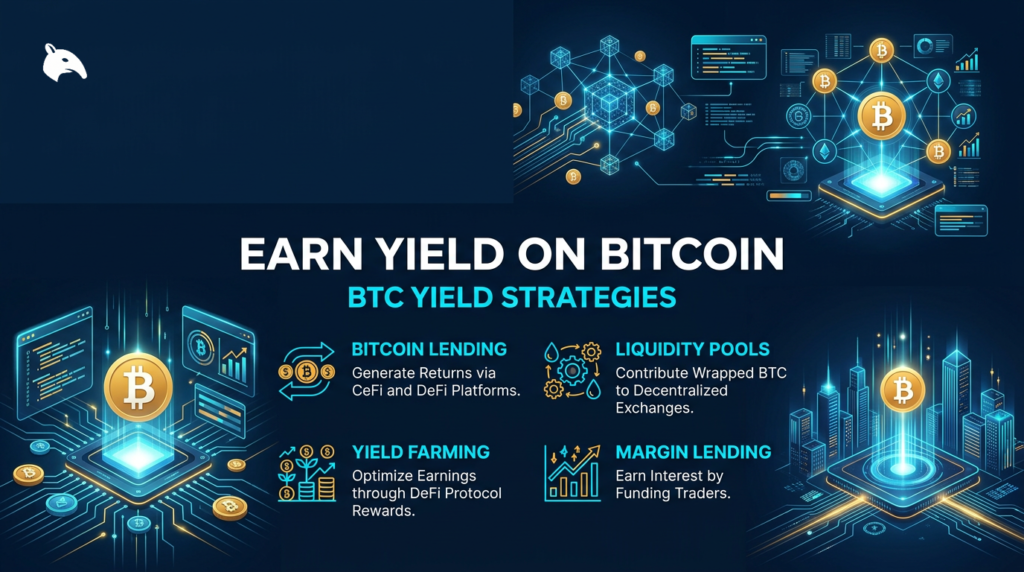
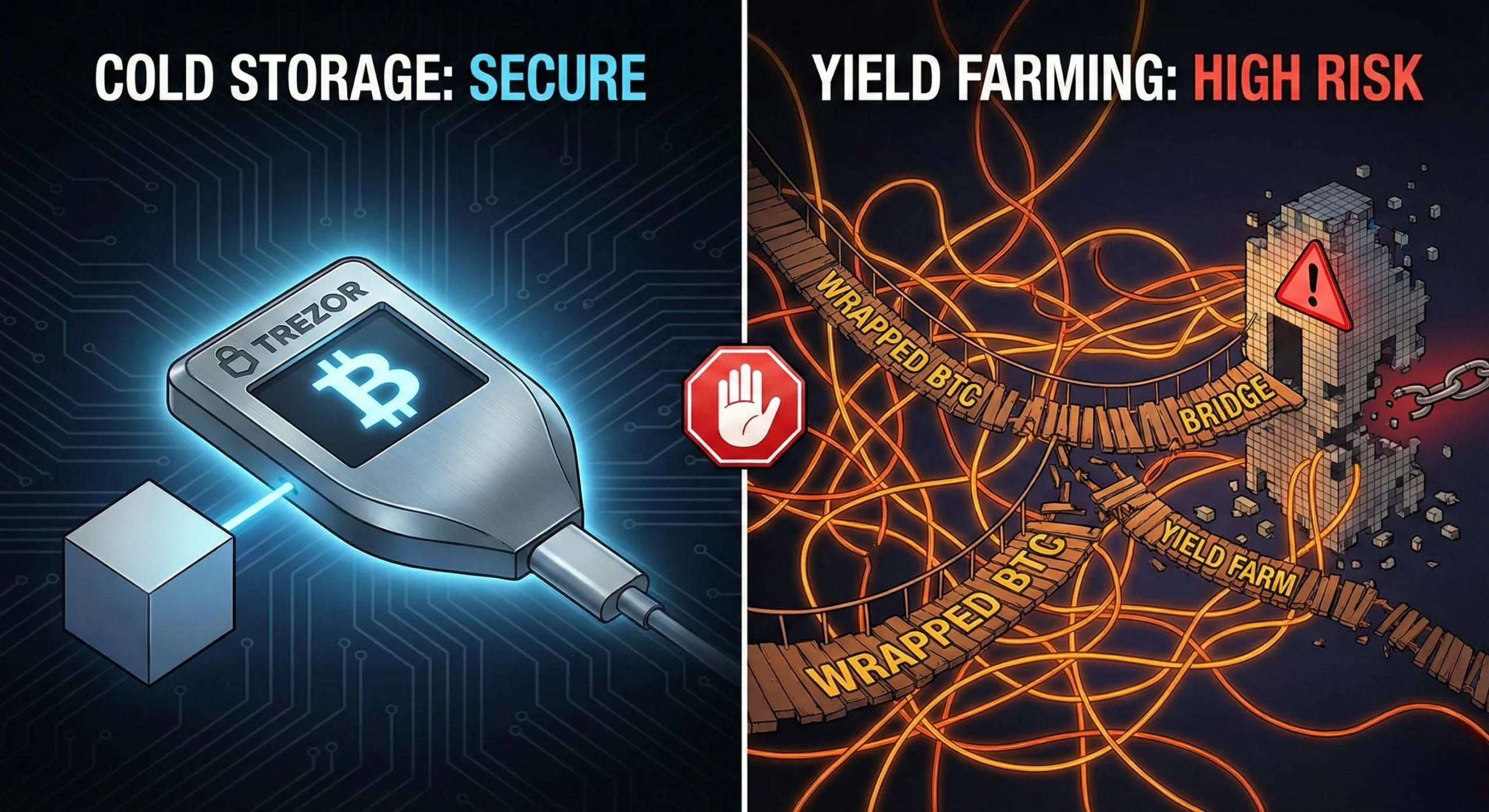
Bitcoin has no native yield. Every BTC return requires surrendering custody or adding counterparty risk.
Key Takeaways
- Bitcoin Has No Native Yield: To earn yield on Bitcoin, you typically have to wrap it, bridge it, or lend it to a third party. That adds significant custodial and technical risk. For most long-term holders, cold storage is the more defensible position.
- The 10% Rule: If the Fed rate sits around 5% and a protocol offers 20% on stablecoins, ask where the extra 15% is coming from. If there is no clear answer, you are likely the source of that yield.
- Stake Blue Chips, Not Everything: Staking Ethereum or Solana is legitimate network participation backed by real economics. Staking random low-liquidity tokens is usually just locking your assets while the price falls.
- DePIN Is Work, Not Passive Magic: Decentralized Physical Infrastructure networks pay you for actual utility , storage, compute, connectivity. Without hardware to contribute, the returns are not meaningful.
- Capital Preservation Is the 2026 Priority: Most investors lose money chasing extra yield on platforms that carry outsized risk. Ending the year with your stack intact is the goal.
Why It Is Hard to Earn Yield on Bitcoin Safely
If you want to earn yield on Bitcoin, it helps to understand what that actually requires. Unlike Ethereum or Solana, Bitcoin uses Proof of Work , miners, not token holders, secure the network. There is no native staking layer. There is no protocol-level mechanism for BTC holders to earn yield simply by holding.
That means whenever a platform claims you can earn yield on Bitcoin, the yield is not coming from Bitcoin itself. It is coming from lending, wrapping, or rehypothecating your BTC in ways that introduce additional layers of risk.
To generate any kind of return on BTC, you generally have to do one of three things: lend it to a centralized platform, wrap it into a tokenized form (such as WBTC) and deploy it in DeFi, or bridge it to another chain. Every option adds exposure on top of your existing Bitcoin position , custodial risk, smart contract risk, or bridge vulnerability.
After Celsius, BlockFi, and multiple bridge exploits, a 2% APY on wrapped BTC rarely compensates for risking 100% of your stack.
Bitcoin’s defensible thesis is long-term purchasing power appreciation, not active yield. This guide focuses on ETH staking, stablecoins, and DePIN, where risks are more transparent.
The 2026 Yield Landscape: What Changed and Why
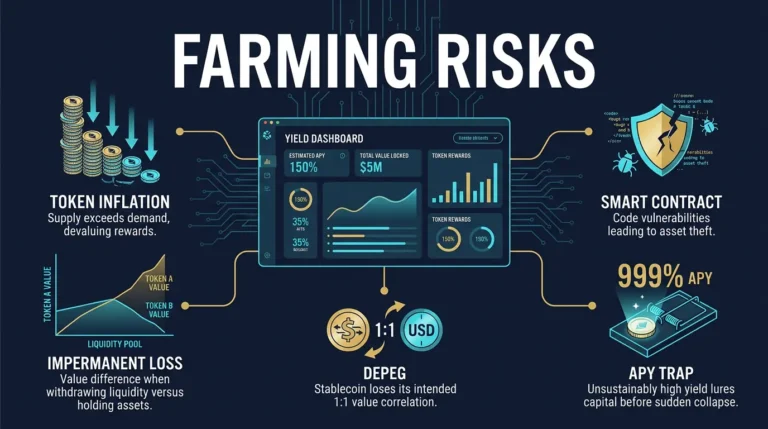
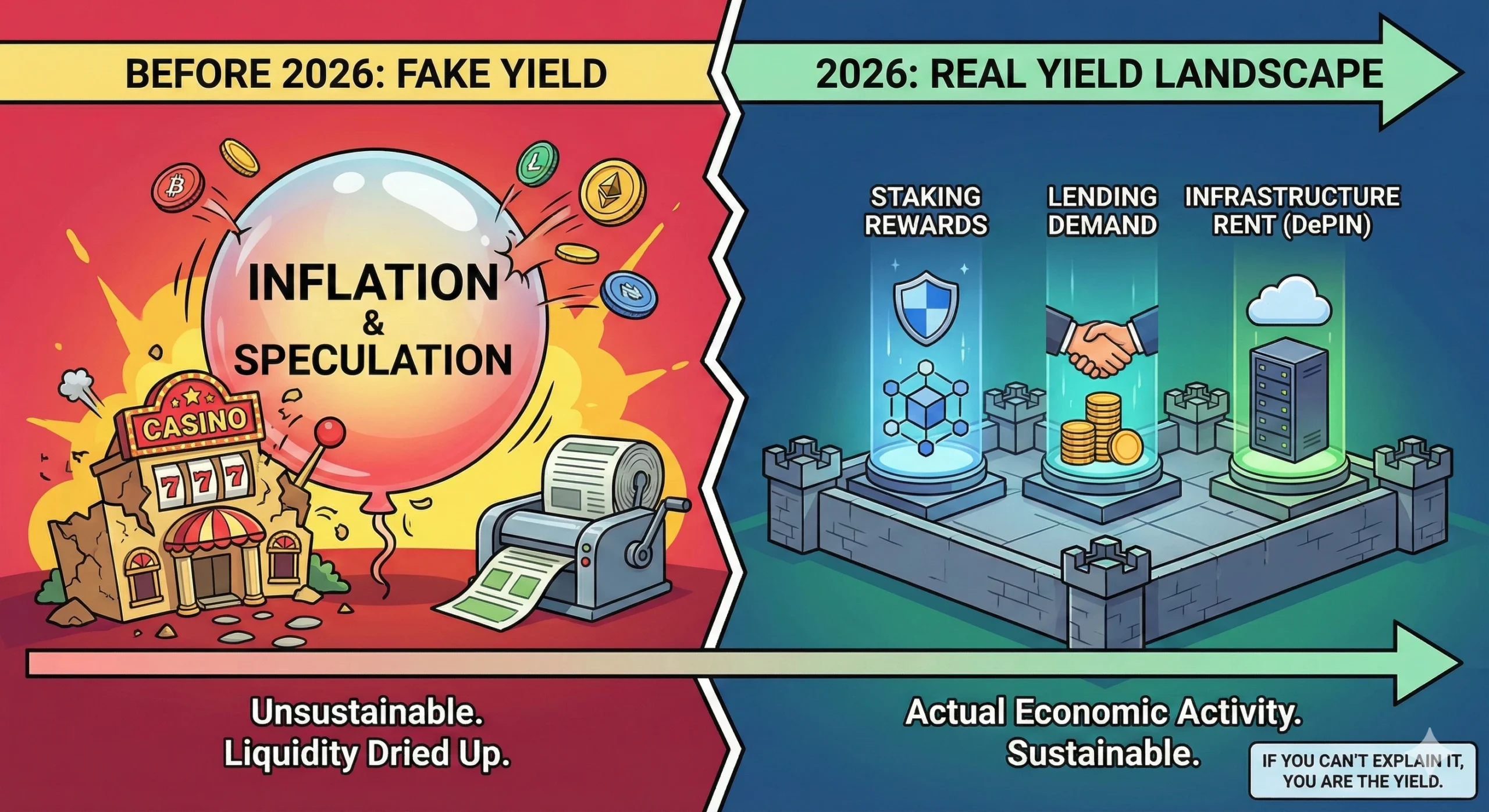
For years, yield in crypto came from token inflation and speculation. Neither was sustainable. As frameworks like MiCA took effect, the “fake yield” dried up.
In 2026, the market has moved closer to Real Yield, income generated by actual economic activity. The three legitimate sources are:
Staking Rewards: Payment for helping secure a Proof of Stake blockchain network , funded by transaction fees and controlled new token issuance.
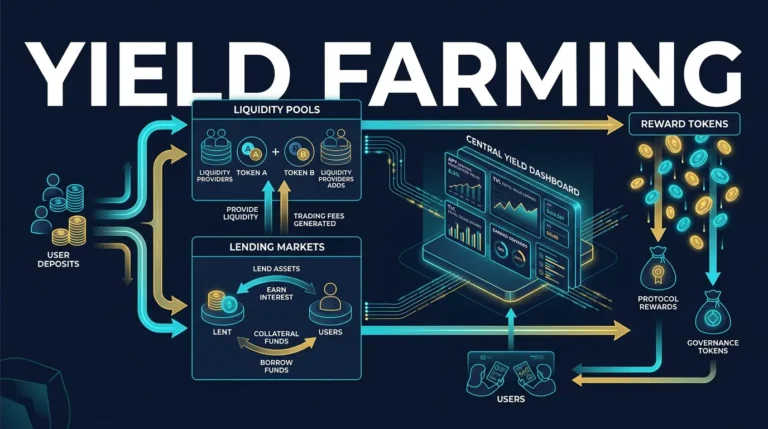
Lending Demand: Interest paid by borrowers who need liquidity and are willing to pay for access to it.
Infrastructure Rent (DePIN): Payment for providing real-world resources , storage, compute power, bandwidth , to decentralized networks.
If a protocol cannot explain where its yield comes from in one clear sentence, treat it with caution. See Why 20% APY Is Usually a Trap in Crypto for a detailed breakdown.
Strategy 1: Staking Blue-Chip Assets
If you hold ETH or SOL long-term and are not staking, you are accepting the same price exposure as a staker while earning nothing. Staking on major Proof of Stake networks is the closest thing crypto has to a baseline yield strategy in 2026 , the income comes from network economics, not speculation. For a broader comparison of which assets are worth staking this year, see Best Staking Coins 2026: Low-Risk Yields That Won’t Rug You.
Ethereum (ETH): The Institutional Standard
Post-Fusaka upgrade, Ethereum has stabilized as the dominant smart contract platform with a multi-year security track record. Yield comes from validator rewards: new ETH issuance and priority fees.
There are two practical approaches to staking ETH:
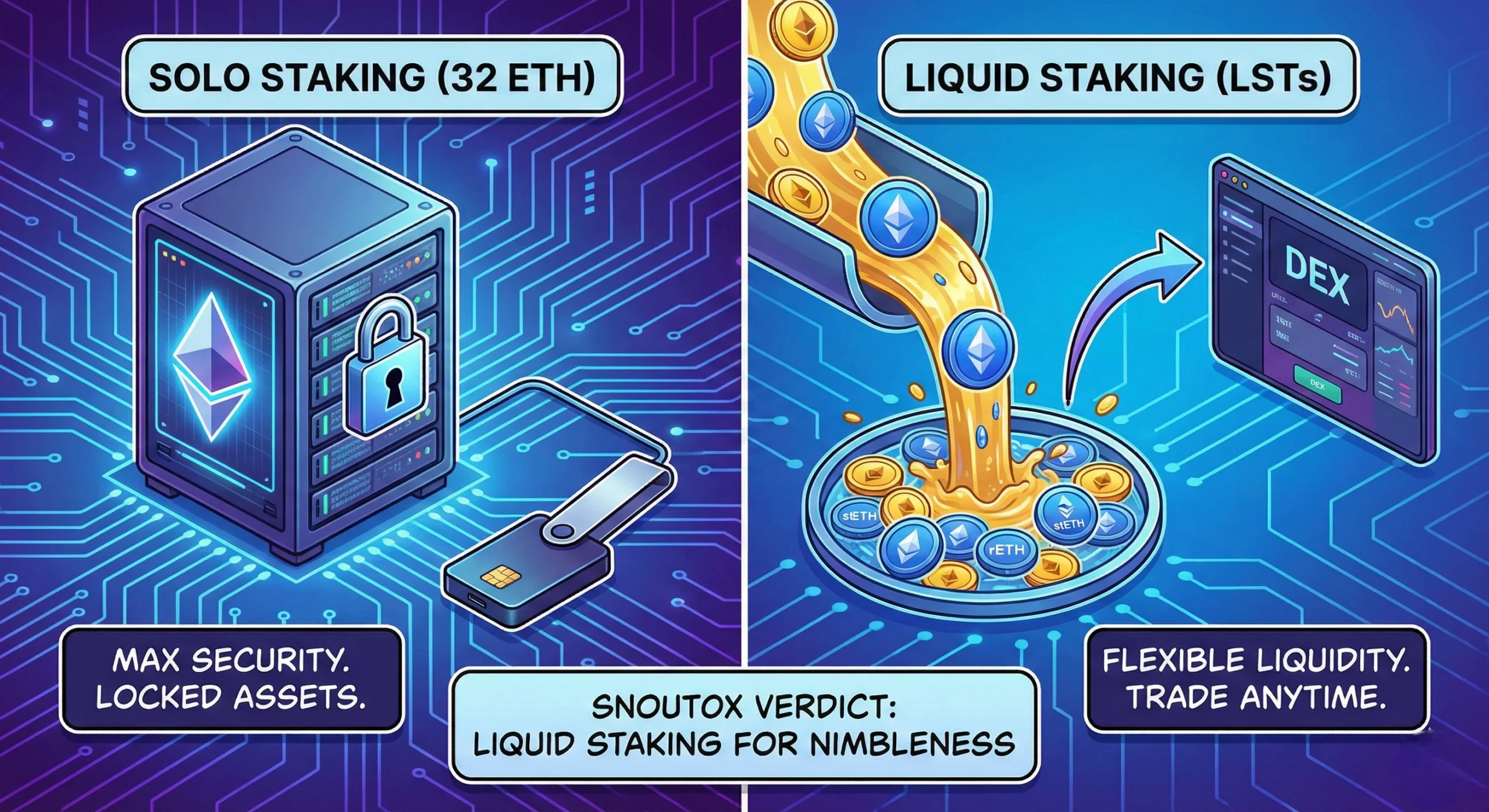
- Solo Staking (32 ETH minimum): You run your own validator node, hold your own keys, and earn full rewards. This is the most secure and decentralized method, but it requires 32 ETH, reliable hardware, consistent uptime, and technical knowledge. The official Ethereum staking documentation is the best reference for setting this up correctly. Validators that go offline incur small inactivity penalties; major protocol violations (like double-signing) result in slashing.
- Liquid Staking Tokens (LSTs): Protocols like Lido (stETH) or Rocket Pool (rETH) pool funds from many participants. You deposit any amount of ETH, receive a liquid receipt token that accrues staking rewards, and can sell or use that token on a DEX at any time. The trade-off is smart contract risk , a vulnerability in the protocol code could result in loss of funds.
Expected APY for ETH staking is approximately 3–4%, varying with network activity.
Solana (SOL): The Retail-Native Option
Solana has established itself as the primary retail-facing chain for high-speed activity. Its staking mechanism is straightforward and accessible , you delegate your SOL to a validator without it ever leaving your wallet’s custody. The validator earns block rewards on your behalf and shares a portion back to you.
The recommended approach is to stake directly from a hardware wallet (Ledger or Trezor) through a wallet interface like Phantom or Solflare. Before moving funds, follow hardware wallet setup best practices. The process is simple:
- Connect your hardware wallet to Phantom or Solflare.
- Navigate to the staking section and select “Start Earning.”
- Choose a validator. Look for 0% commission, high uptime, and a validator outside the top “Superminority” to support network decentralization.
Avoid staking SOL on centralized exchanges. The exchange controls the keys, not you. Expected APY is approximately 6–7%, though real yield after SOL inflation is meaningfully lower.
For a full breakdown of validator selection, slashing risk, and exit mechanics, see Staking Crypto in 2026: What’s the Catch? Risks and Real Yields.
Strategy 2: Yield-Bearing Stablecoins
The stablecoin market has shifted from static dollar-pegged tokens that sit idle to yield-bearing instruments with transparent underlying mechanics. For anyone who does not want price exposure to BTC or ETH, this is the most accessible entry point for crypto yield in 2026. For a comprehensive breakdown of this space, see Stablecoin Passive Income 2026: The Realistic Guide to 5–10% Yields.
The RWA Treasury Play
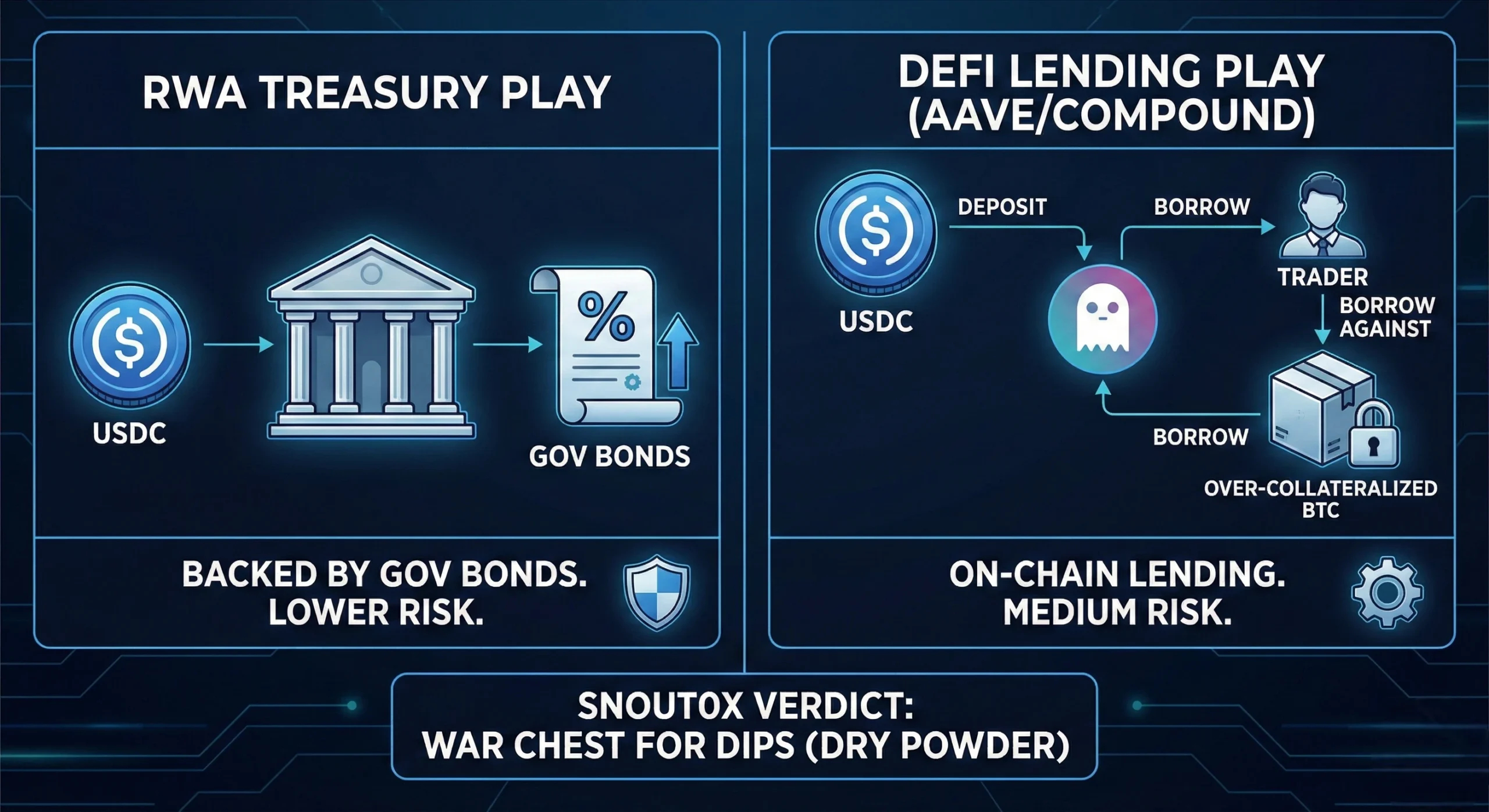
Several stablecoins available in 2026 are backed by Real World Assets (RWA) specifically short-term US Treasury Bills. The mechanics are straightforward: you hold the token, the issuer invests the underlying dollars in government bonds, and the interest is passed back to holders.
The primary risks are issuer counterparty risk and regulatory risk. Always verify the issuer is audited and reserves are independently attested.
DeFi Lending: Aave and Compound
For on-chain stablecoin yield, Aave remains the most established option. The mechanism: you deposit USDC or another stablecoin. Traders borrow that USDC , typically to leverage other positions , and pay you interest. Aave is over-collateralized: a borrower must lock up more value in collateral than they borrow. If collateral value falls below the threshold, the protocol automatically liquidates it to repay lenders before losses occur.
Expected APY on stablecoin deposits at Aave typically ranges from 5–8%, varying with market activity and borrowing demand. This makes it a useful “dry powder” position , earning modest yield during quiet periods while remaining instantly withdrawable when buying opportunities arise.
The main risk is smart contract vulnerability. No protocol is permanently immune. Only deposit what you can afford to have at risk.
Strategy 3: DePIN (Decentralized Physical Infrastructure)
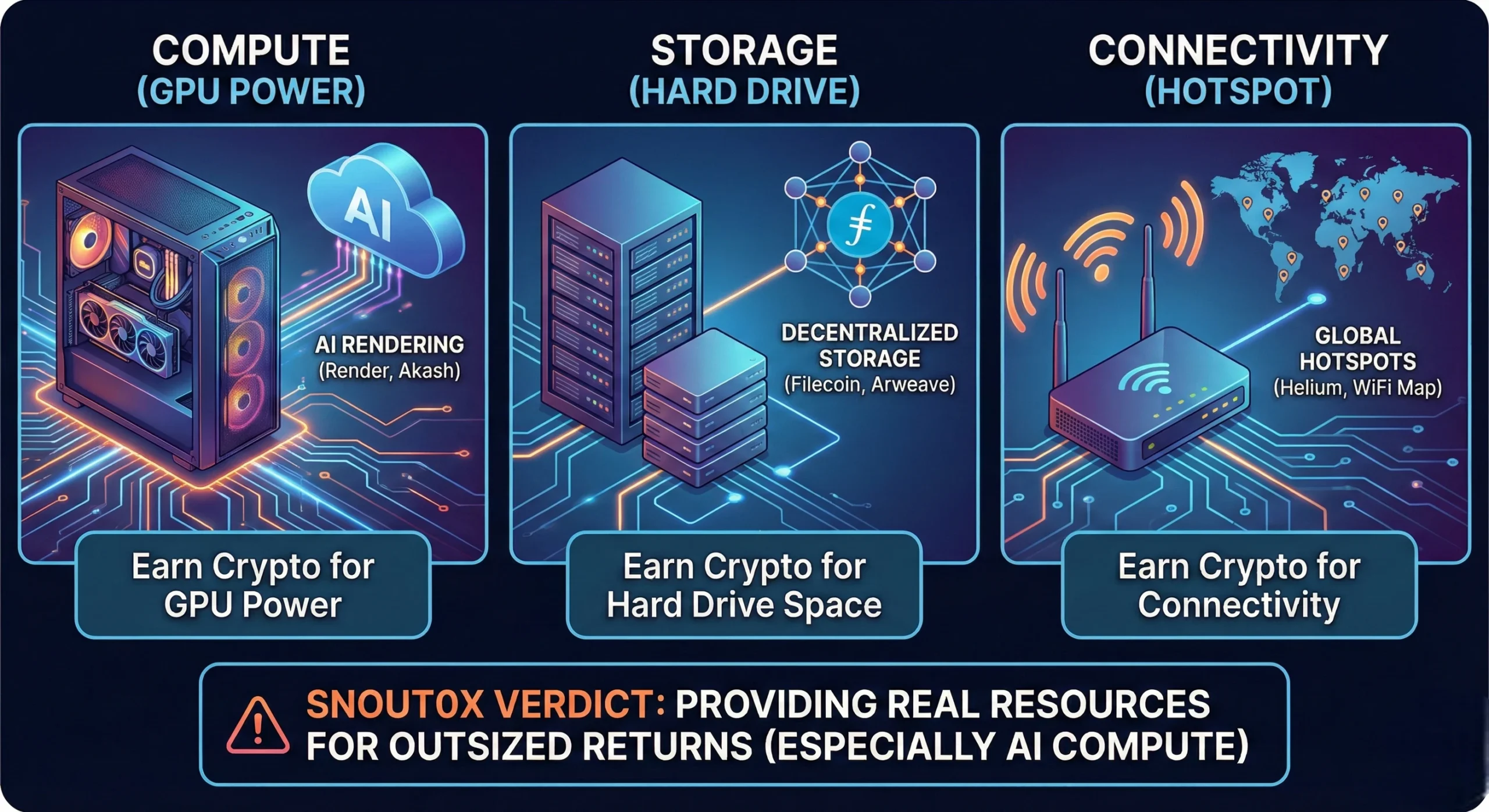
DePIN is the most discussed emerging category in 2026. Strip away the hype, and the core idea is simple: earn crypto by providing real-world resources to decentralized networks. The income is not passive in the traditional sense , it is paid for the utility you actually deliver.
Compute: Render and Akash
If you have a modern GPU that sits idle for significant portions of the day, networks like Render and Akash pay you to contribute that compute for AI rendering and inference workloads. Demand is real , AI companies and developers need GPU capacity, and decentralized options are often more cost-effective than major cloud providers. Earnings depend on hardware quality (VRAM, generation), uptime consistency, and current network demand.
Storage: Filecoin and Arweave
Filecoin requires regular cryptographic proofs that stored data remains intact; missing proofs result in penalties. Arweave uses a one-time payment model for permanent storage. Both require dedicated hardware and reliable uptime.
Connectivity: Helium and WiFi Map
Helium and similar networks pay you to run wireless hotspots that extend coverage. Earnings are heavily location-dependent , dense urban areas with existing coverage gaps earn more than rural areas or places already saturated with hotspots. Check coverage maps before committing to hardware. The payback period on hotspot equipment varies widely based on location and token price.
The common thread across all DePIN strategies: do not buy hardware speculatively based on current token prices. Run the numbers on electricity costs, hardware depreciation, and realistic earning rates at current network conditions before committing capital. If you already own qualifying hardware sitting idle, the economics look entirely different.
A Simple 2026 Portfolio Approach
The following is not financial advice. It is one way to think about allocation that balances yield generation with risk management. Adjust based on your own situation, risk tolerance, and tax jurisdiction.
- Bitcoin goes into cold storage. Do not wrap it, bridge it, or lend it. The defensible thesis for Bitcoin is long-term purchasing power appreciation. A 2% APY on wrapped BTC does not compensate for the counterparty and bridge risks involved.
- ETH earns yield through staking. Liquid staking through Rocket Pool or a comparable decentralized protocol is the practical choice for most holders. Accept the small smart contract risk in exchange for ETH being productive rather than idle.
- Keep a stablecoin allocation for opportunity. A portion of a portfolio in yield-bearing stablecoins on Aave serves two purposes: earning a modest return during quiet periods, and remaining instantly deployable when market conditions create buying opportunities.
- Apply the 10% rule to everything. If a protocol offers more than 10% APY on a stablecoin, treat it as high-risk until you can verify the yield source clearly. The risk-free rate is set by government bond markets. Any significant spread above that reflects either real risk or unsustainable tokenomics.
For a broader passive income framework covering additional strategies, see Best Crypto Passive Income (2026): 5 Low-Risk Strategies (No Ponzis).
Common Mistakes to Avoid
- Chasing the highest advertised APY: Platforms compete on headline rates to attract deposits. The highest number is not the safest option. Evaluate the source of yield before the rate.
- Leaving staked assets on centralized exchanges: Exchange staking is convenient, but you do not hold your keys. Exchange insolvency, withdrawal freezes, and regulatory actions are documented historical risks , not theoretical ones.
- Overexposure to newly launched protocols: Battle-tested protocols with years of operation carry meaningfully less smart contract risk than something launched last month.
- Ignoring token inflation when evaluating staking yield: A 7% nominal staking yield on a token inflating at 8% per year is a negative real yield. Always factor in the underlying token’s issuance rate when evaluating whether staking actually preserves purchasing power.
- Buying DePIN hardware based on token price projections: Token prices are volatile. Hardware costs and electricity bills are fixed. The math can deteriorate quickly if the token depreciates after you have committed to the equipment.
Risks to Understand Before You Start
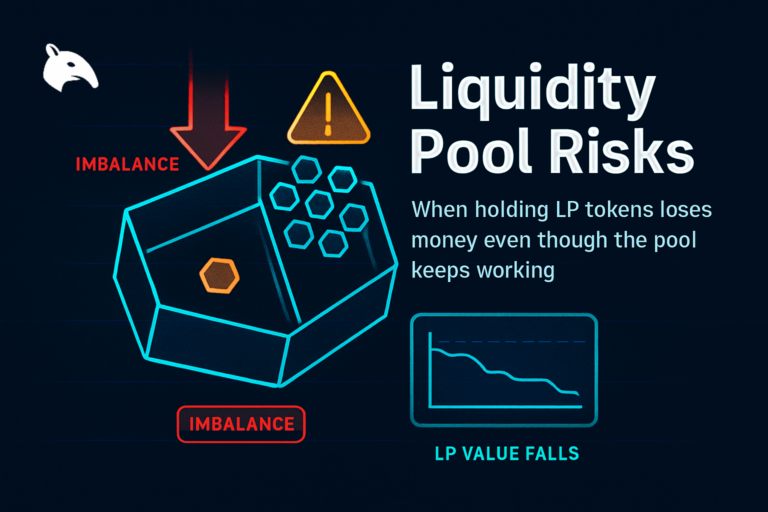
- Smart Contract Risk: All DeFi protocols carry smart contract risk. Code bugs, oracle manipulation, and governance exploits have caused losses on audited, established platforms before. Only deploy capital you can afford to lose in full.
- Validator Slashing: In Ethereum and Solana staking, validators that behave incorrectly , such as double-signing blocks , can have a portion of delegated assets destroyed. Choosing established validators with long track records reduces but does not eliminate this risk.
- Regulatory Uncertainty: Regulation of crypto yield products is still evolving in most jurisdictions. Protocol access may be restricted, tax treatment of staking rewards may change, and some yield instruments may face a new classification. Staying current on regulatory developments is part of managing this risk. For a focused look, see The CLARITY Act 2026: Why the Government Wants Your Stablecoin Yield.
- Liquidity and Exit Risk: Some staking positions and yield vaults have lock-up periods or exit queues. Ethereum validator exit queues can be lengthy during periods of high withdrawal demand. Understand the withdrawal timeline for any position before committing funds you may need on short notice.
- Token Price Risk: A staking yield paid in a depreciating token still results in a net loss. Account for price volatility when evaluating real returns.
Final Thoughts
The goal for 2026 is not to find the highest-yielding protocol on the internet. It is to keep your capital intact while letting productive assets , ETH, stablecoins, and potentially DePIN hardware , work for you in a transparent and defensible way.
Stick with what you can understand, keep your keys where possible, and discount any protocol that cannot explain its yield source in plain language.

What is your safest play this year? Find me on X at @Snout0x.
Sources
- Ethereum.org: Staking documentation and validator requirements
- Bitcoin.org: Bitcoin network fundamentals and Proof of Work design
- Solana Documentation: Staking mechanics and validator delegation
Frequently Asked Questions
Is crypto staking safe in 2026? It is more mature than in earlier years, but not risk-free. Solo staking , running your own validator hardware , is the most secure method because you retain full key custody. Liquid staking through protocols like Lido or Rocket Pool introduces smart contract risk: if the protocol code has a vulnerability, funds could be affected. Balance convenience with your risk tolerance and only use protocols with long track records and multiple security audits.
What is the difference between APR and APY? APR (Annual Percentage Rate) is the simple interest rate without compounding. APY (Annual Percentage Yield) includes compounding , reinvesting earnings back into the principal. APY will always appear higher than APR for the same underlying rate. Pay attention to which figure a platform is advertising, particularly when comparing rates across different products.
Can I lose my Bitcoin while staking? True Bitcoin cannot be staked on the Bitcoin network , there is no native staking layer. If a platform offers “Bitcoin staking,” you are either lending your BTC to a custodian or wrapping it in tokenized form on another chain. Both introduce counterparty and smart contract risk. If the platform collapses, your BTC may be unrecoverable. Keep Bitcoin in cold storage.
What is DePIN and is it worth participating in? DePIN stands for Decentralized Physical Infrastructure Networks. Participants earn tokens by providing real resources , GPU compute, hard drive storage, wireless bandwidth , to decentralized networks. It is worth considering if you already own qualifying hardware and have factored in electricity costs and token price volatility. Buying expensive equipment speculatively, based on current token prices, is a high-risk approach.
Why are stablecoin yields lower now than in 2021? In 2021, high yields were largely subsidized by token inflation , platforms printing new tokens to attract deposits. That was not sustainable. In 2026, stablecoin yield primarily comes from real borrowing demand: traders paying interest to borrow liquidity for leveraged positions. When market activity is lower, borrowing demand falls and yields compress. If a platform still offers 20% on stablecoins when the market rate is around 5%, examine the source carefully before depositing.