


Last Updated on April 12, 2026 by Snout0x
This content is for educational purposes only and should not be considered financial or investment advice.
The CLARITY Act crypto provisions are drawing significant attention in 2026. Section 404 directly targets stablecoin yield programs offered by centralized exchanges. This article breaks down what Section 404 says, why the banking industry is backing it, the likely outcomes if it passes, and what crypto holders should do now.
Disclaimer: This content is for educational and informational purposes only and does not constitute financial, investment, tax, or legal advice. Cryptocurrency markets are volatile and involve risk. Always conduct your own research and consult a qualified professional before making financial decisions.
Affiliate Disclosure: Some links in this article may be affiliate links. If you choose to use them, I may earn a commission at no additional cost to you.
Section 404 does not ban stablecoins; it bans the yield that made them competitive with banks.
Key Takeaways
- The “Solely for Holding” Ban: Section 404 prohibits exchanges from paying interest to users purely for holding payment stablecoins. Passive yield programs on US centralized platforms would end if this passes as written.
- Banking Industry Pressure: The American Bankers Association (ABA) has flagged a potential $6.6 trillion deposit flight risk if stablecoin yield continues unchecked, making this a competitive dispute as much as a safety argument.
- An Activity-Based Loophole Remains: The bill exempts “activity-based rewards,” meaning yield tied to trading volume, card spending, or network participation would still be allowed under the exemption in Section 404(c).
- DeFi Could See Increased Inflows: If centralized exchanges lose their yield products, on-chain protocols like Aave and Compound may absorb displaced capital. Smart contracts are harder to reach under this bill’s current scope.
- The Bill Is Not Final: As of early 2026, the Senate Banking Committee postponed its markup session. The language may change substantially before any floor vote.
Background: The GENIUS Act and the Loophole It Created
To understand the CLARITY Act, you need to know what preceded it. The GENIUS Act, passed in mid-2025, gave payment stablecoins legal standing in the United States for the first time. It established clear rules for issuers like Circle (USDC) and Paxos: their stablecoins could operate legally, provided they maintained appropriate reserves and met disclosure requirements. One firm restriction came with that framework. Issuers could not pay interest to holders.
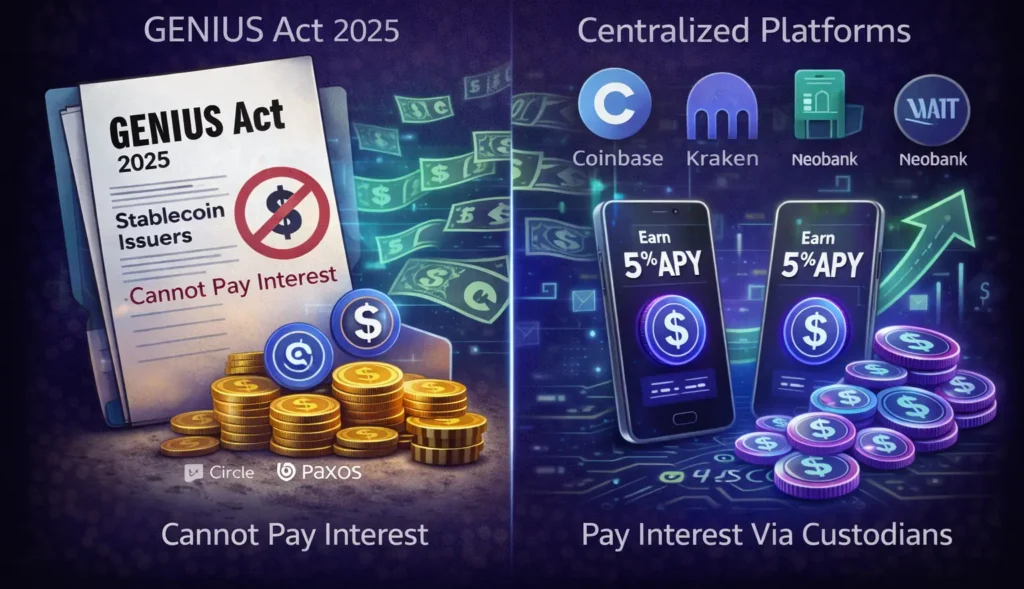
Taking deposits and paying interest is a regulated banking activity. The GENIUS Act drew that line at the issuer level.
That restriction created an opening. Exchanges recognized the GENIUS Act applied to issuers, not intermediaries. Within months, Coinbase, Kraken, and neobank platforms launched “Earn” programs paying 4–5% APY on USDC balances, framed as marketing partnerships or custodial yield products.
This worked because the GENIUS Act had a gap. The CLARITY Act is the legislative attempt to close it. Section 404 shifts the restriction from issuers to all digital asset service providers, which captures exchanges and fintech platforms in a way that the GENIUS Act did not.
Understanding Section 404 of the CLARITY Act
Most of the CLARITY Act addresses CFTC/SEC jurisdiction and disclosure standards. Section 404 is different. It sits in Title IV and targets yield payments directly.
What Section 404 Prohibits
Section 404 prohibits “digital asset service providers” from paying any form of interest, yield, or return to a user “solely in connection with the holding of a payment stablecoin.” The phrase “solely for holding” is the operative language in the bill. It distinguishes between passive income (holding a balance and receiving a return) and active income (earning a reward through specific behavior).
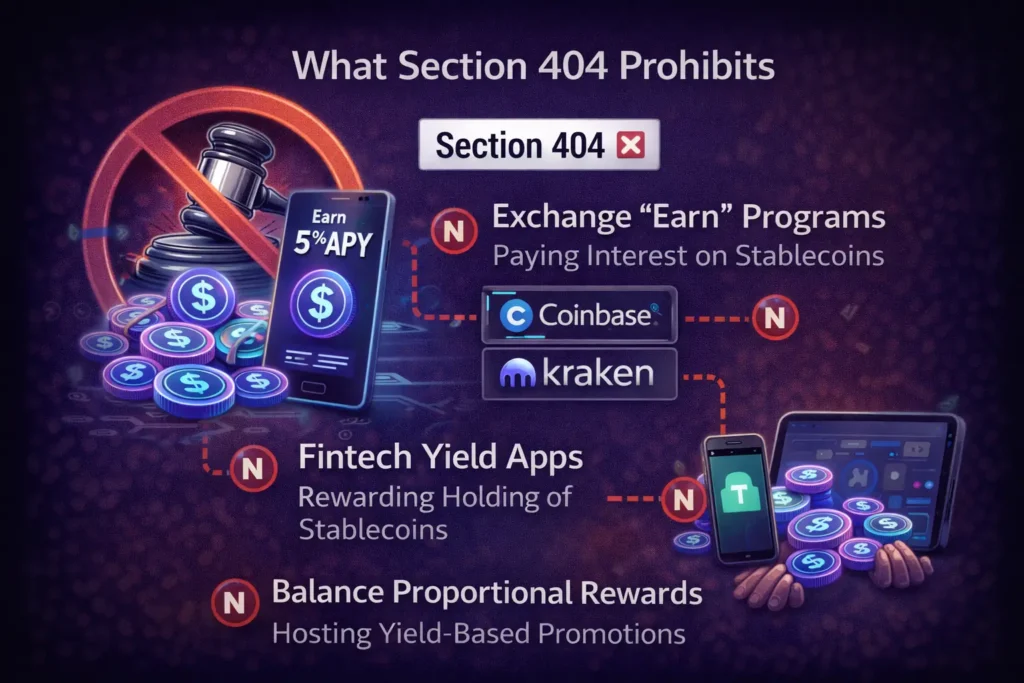
Under this language, if the bill passes without amendment:
- Exchange “Earn” programs paying APY on stablecoin balances would be prohibited for US-regulated platforms.
- Fintech apps offering percentage-based returns on idle stablecoin holdings would need to shut those programs down.
- Balance-proportional reward distributions structured as “marketing” programs would also be captured if they functionally operate as yield payments on a held balance.
The restriction applies to regulated US entities. This covers the exchanges and platforms that most retail US investors currently use for their primary trading and savings activity.
The Activity-Based Rewards Exemption
Section 404(c) preserves what the bill calls “activity-based rewards.” These are payments tied to specific user actions rather than the simple presence of a balance. Under this exemption, platforms can legally offer trading volume rebates, cashback rewards on debit card spending, and true on-chain staking rewards for validating a network.
What the exemption does not cover is a flat return credited simply because a stablecoin balance exists. The practical result is that passive, savings-style yield disappears from centralized platforms, while rewards tied to engagement or activity remain available.
If Section 404 passes, the 4% APY earned for holding USDC may become a “trading loyalty bonus” requiring a monthly trade. Whether effective yield survives in restructured form depends on how regulators interpret the exemption’s boundaries.
How This Differs From the GENIUS Act Restriction
The GENIUS Act stopped issuers from paying yield. Section 404 stops everyone from paying yield on a held stablecoin balance. The scope is much wider. A third-party exchange, a neobank app, or a fintech reward program run by a company that never issued a stablecoin would all fall within the new restriction. The bill effectively eliminates the intermediary workaround that made yield possible after the GENIUS Act.
Why the Banking Lobby Is Behind This Bill
Section 404 has a clear political origin. Earlier this year, the American Bankers Association Community Bankers Council submitted a letter to the Senate Banking Committee with a state-by-state analysis attached. Their central argument: allowing stablecoin platforms to pay 4% to 5% APY creates conditions for a $6.6 trillion deposit flight from community banks across the United States.
The ABA’s formal position frames this as a consumer safety concern. But the underlying problem is competitive. Banks are structured in a way that makes it extremely difficult for them to match the yield that stablecoin platforms can offer, and the gap is not small.
The Deposit Competition Problem
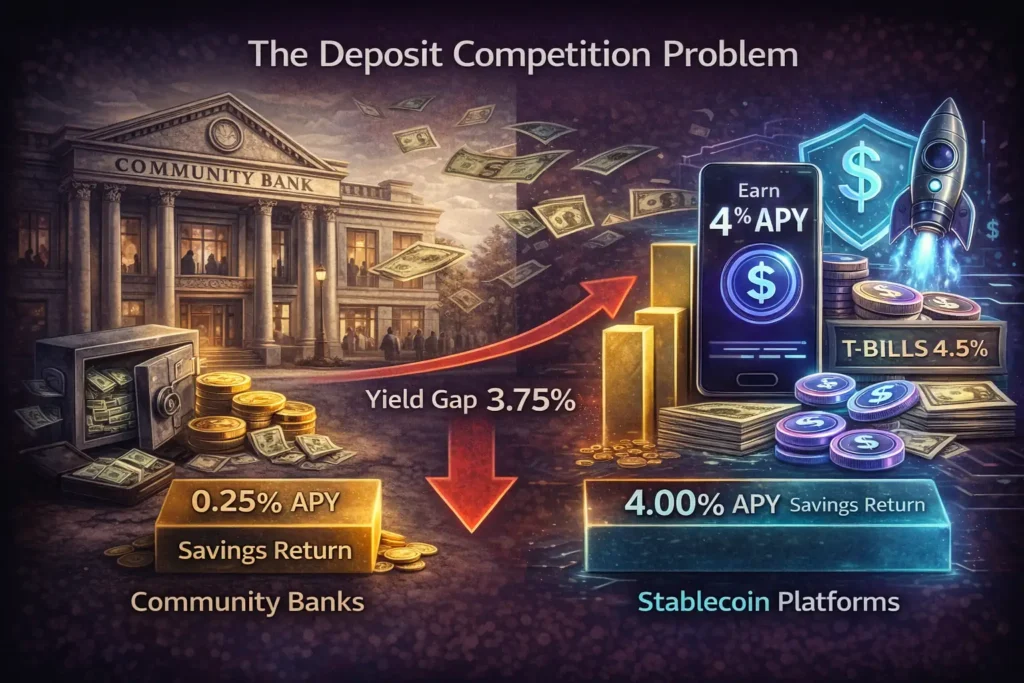
A typical community bank pays depositors between 0.01% and 0.50% on savings accounts. The bank collects those deposits, invests in Treasury securities or makes commercial loans, and earns the spread between what it pays depositors and what it earns on assets. That spread funds operations, staff, branch infrastructure, and compliance overhead. It is the core of the banking business model.
Stablecoin platforms using a Treasury-backed reserve model can compress that spread sharply. By holding short-term T-Bills at 4.5% and returning 4.0% to users, a stablecoin platform offers a yield that traditional banks structurally cannot match. Banks carry fixed costs that code-based platforms do not: physical locations, legacy infrastructure, thousands of employees, and regulatory capital requirements. The yield gap between a bank savings account and a stablecoin “Earn” program can be 3.5 to 4 percentage points.
In 2026, moving money between a bank account and a crypto platform takes minutes. At scale, that yield differential represents a credible threat to the deposit base that community banks depend on to fund their loan books. The ABA’s concern about deposit flight is not manufactured. The math is real.
The Shadow Banking Argument
The public justification the ABA offers focuses on consumer protection rather than competitive positioning. They argue that stablecoin yield platforms are effectively “shadow banks,” operating outside the FDIC insurance framework and federal bank supervision. Retail investors, they contend, do not fully understand the risks when they move funds to these platforms in search of higher returns.
Stablecoin issuers like Circle hold short-duration T-Bills as reserves, with duration and credit risk lower than the commercial loan books at many regional banks. The absence of FDIC insurance is a meaningful distinction, but presenting stablecoin reserves as uniquely dangerous involves selective framing.
For a deeper look at how the structural differences between centralized and decentralized yield work in practice, the CeFi vs DeFi comparison guide covers the mechanics and trade-offs in detail.
Winners and Losers if Section 404 Passes
If the CLARITY Act passes with Section 404 intact, the outcomes will not be uniform across the market. Some participants benefit directly. Others lose a product they have come to rely on.

Who Gets Hurt
- Retail savers on US platforms: The lowest-friction option for stablecoin passive income disappears from regulated US exchanges. Users are pushed toward accepting 0% yield on their stablecoin holdings or taking on more complexity to access returns elsewhere.
- Centralized exchanges: Coinbase, Kraken, Gemini, and similar platforms lose one of their strongest customer retention tools. Without yield products, holding stablecoins on a CEX has significantly less value compared to alternatives.
- US Treasury demand at the margin: Stablecoin issuers have become substantial buyers of short-term US government debt. Making stablecoins less attractive to hold reduces demand for the T-Bills that back them. This is a macro consequence that the bill’s proponents have not addressed publicly.
Who Benefits
- Traditional banks: The immediate competitive pressure from stablecoin yield platforms diminishes. Banks can maintain their low-interest savings account pricing without losing depositors to a structurally superior yield product.
- DeFi protocols: This is the most significant unintended consequence. Section 404 targets intermediaries. Smart contracts deployed on Ethereum or other chains are not “digital asset service providers” in the traditional legal sense. Protocols like Aave, Compound, and Morpho sit outside the bill’s current scope. If CEX yield disappears, users who still want a return on their stablecoin holdings have limited regulated options, and on-chain DeFi is the primary alternative.
- Non-US platforms: Offshore exchanges operating under different regulatory frameworks will continue offering stablecoin yield. US residents who seek alternatives abroad will face jurisdictional complications, but the capital flows will go somewhere.
What CLARITY Act Crypto Changes Mean for Your Strategy
The bill has not passed. The Senate markup was postponed and final language will likely change. That said, preparing for a scenario where passive stablecoin yield disappears from centralized US platforms is reasonable. Regulatory direction tends to persist.
Adapt to Activity-Based Yield
If exchanges restructure around the Section 404(c) activity exemption, expect changes: a monthly trade requirement, a spending threshold on a linked card, or a minimum activity level to unlock rewards. The effective yield may persist in restructured form, but it will require more active management.
Consider Self-Custody and On-Chain Alternatives
If you have not yet moved any assets to a self-custody wallet, now is a practical time to learn the process. Moving stablecoins to a non-custodial wallet and interacting with an on-chain lending protocol is more involved than using a CEX “Earn” tab, but it keeps your yield activity outside the reach of Section 404 as currently written. If that shift is new to you, read What Is Self-Custody in Crypto? first.
The risks in DeFi differ from CEX yield programs. Smart contract vulnerabilities, oracle manipulation, and interface phishing are real considerations. The risks associated with high crypto APY rates are worth reviewing before allocating to less-audited protocols.
For those newer to self-custody, the self-custody survival guide covers how to move funds off centralized exchanges safely and avoid the mistakes that cost people their assets during rushed withdrawals.
The Longer-Term Perspective
At 4–5% APY, the real gain after inflation and taxes is modest. Section 404 is a reminder that yield structures available today may not exist in the same form a year from now.
Bitcoin does not pay yield. It is a fixed-supply asset not subject to yield policy decisions. If regulatory pressure continues compressing dollar-based yield, the case for holding harder assets becomes more relevant. Consider how dependent your portfolio is on structures that require regulatory tolerance to function.
Risks to Consider
- DeFi is not a safe default alternative: Moving yield-seeking activity on-chain introduces smart contract risk, liquidation risk, and phishing risk that do not exist in a CEX yield program. These are real risks and should be assessed before making the move.
- Offshore platforms add legal and tax exposure: Using non-US platforms to access yield unavailable domestically may create compliance complications depending on how your jurisdiction treats foreign financial platform income.
- Activity-based yield may produce lower effective returns: If earning a reward requires maintaining a qualifying activity threshold, users with smaller balances or lower activity levels may find that the restructured program produces a significantly lower effective APY than the current passive rate.
- The final bill language is unknown: Legislative provisions change during committee markup and floor amendment. A version of Section 404 narrower in scope is possible. So is a broader one. Acting on current bill text as if it is final is premature.
- Tax treatment of restructured rewards may differ: If exchanges move from APY programs to trading rebates or cashback structures, the tax classification of those rewards could differ from current treatment. Consult a qualified tax professional before assuming a new yield structure improves your after-tax position.
Common Mistakes to Avoid
- Restructuring your strategy before the bill passes: The Senate markup was postponed. Making major portfolio changes based on bill text that may still change is premature. Track the markup process and wait for final language before acting.
- Treating DeFi as a permanent regulatory gap: Regulators have on-chain protocols in scope for future rulemaking. The current gap between DeFi and Section 404’s reach may not be permanent. Do not build a strategy that depends on DeFi being unregulated indefinitely.
- Chasing higher yields to compensate for lost CEX income: If regulated stablecoin yield drops to 0% on centralized platforms, seeking higher yields in less-audited protocols to maintain the same income involves proportionally higher risk. Be explicit about the trade-off before making the move.
- Assuming the activity exemption is easy to access: Users who preferred passive yield may not be well-served by an activity-based alternative. Evaluate whether the restructured product fits your use case.
Sources
- American Bankers Association (ABA): Policy positions on stablecoin legislation
- Congress.gov: Digital Asset Market Clarity Act bill tracking
- Federal Reserve: Research on financial stability and deposit competition
Frequently Asked Questions
What is the CLARITY Act of 2026?
The Digital Asset Market Clarity Act (CLARITY Act) is US legislation designed to establish a regulatory structure for digital asset markets. Its primary stated purpose is to clarify whether tokens are classified as commodities under CFTC jurisdiction or securities under SEC jurisdiction. Section 404, a separate provision in Title IV, restricts stablecoin yield programs offered by centralized exchanges and digital asset service providers.
How does the CLARITY Act differ from the GENIUS Act of 2025?
The GENIUS Act legalized payment stablecoins and prohibited issuers such as Circle or Paxos from paying interest directly to holders. The CLARITY Act targets the workaround that emerged afterward, where third-party exchanges paid yield to users without being the issuer. Section 404 applies the yield restriction to all digital asset service providers, not just issuers, closing the intermediary gap.
Will Section 404 ban crypto staking rewards?
Not directly. Section 404 targets yield paid “solely for holding” a payment stablecoin. True on-chain staking rewards for participating in network consensus, such as Ethereum or Solana validation, and activity-based rewards are currently exempt from the prohibition. The legal interpretation around staking products offered by centralized platforms is less clear and could be affected depending on how regulators apply the final language.
Is it currently illegal to earn interest on USDC in the United States?
No. As of early 2026, earning yield on USDC through centralized exchange programs is legal in the United States. The CLARITY Act has not passed. If it passes with Section 404 intact, US-regulated platforms would be prohibited from offering passive stablecoin yield, but holding USDC itself would remain legal.
Why do banks want to restrict stablecoin yield?
The American Bankers Association has argued that stablecoin platforms offering 4% to 5% APY create conditions for large-scale deposit movement out of community banks, which typically pay far lower savings rates. Their published analysis estimated up to $6.6 trillion in potential deposit flight. The banks frame their position as a consumer safety argument, citing the absence of FDIC insurance on stablecoin platforms, but the competitive pressure from the yield gap is the structural driver.
Stay Informed on Crypto Regulation
Whether or not Section 404 passes in its current form, the direction toward tighter oversight of crypto income products is unlikely to reverse.
For a broader look at yield strategies that account for regulatory risk across different asset types, see the full guide to best crypto passive income strategies for 2026.
Follow @Snout0x on X for ongoing coverage of digital asset regulation and market developments.