

Last Updated on April 20, 2026 by Snout0x
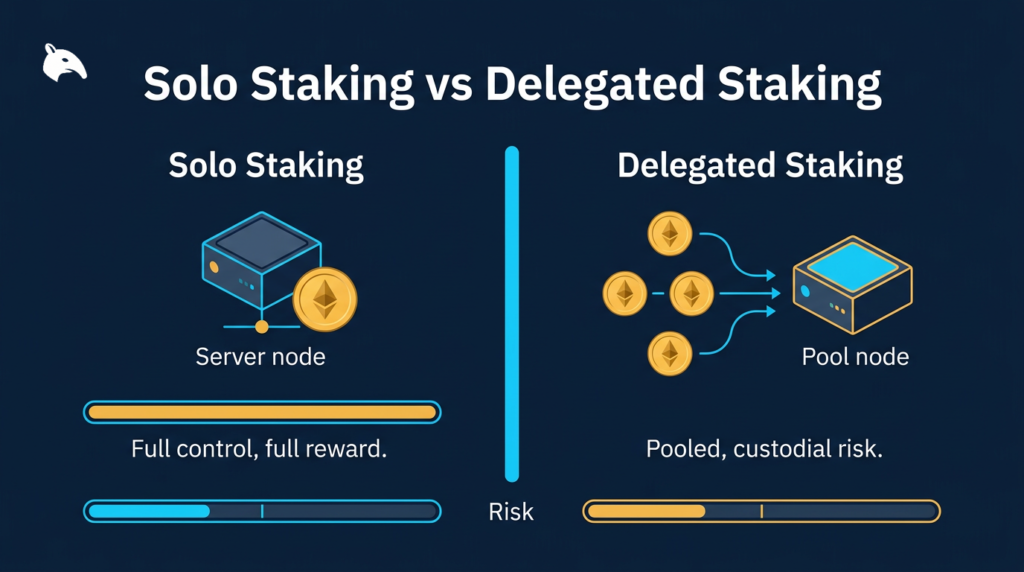
Solo staking and delegated staking are two fundamentally different ways to participate in proof-of-stake consensus. Solo staking means running your own validator node and accepting full responsibility for uptime and performance. Delegated staking means assigning your stake to an existing validator and receiving a share of their rewards without running any infrastructure yourself. The right choice depends on your technical capability, capital, and tolerance for counter-party exposure.
This article may contain affiliate links. If you purchase through these links, Snout0x may earn a commission at no additional cost to you.
This content is for educational purposes only and should not be considered financial or investment advice.
Delegation removes the hardware burden but not the slashing exposure.
Key Takeaways
- Solo staking gives full control of the validator but requires dedicated hardware and consistent uptime.
- Delegated staking is simpler but introduces counter-party risk from the chosen validator.
- Ethereum solo staking requires 32 ETH as the minimum validator deposit.
- Both models carry slashing risk if the validator double-signs or goes offline at a critical moment.
- Delegated yield is typically lower than solo yield because the validator takes a commission.
What Is Solo Staking?
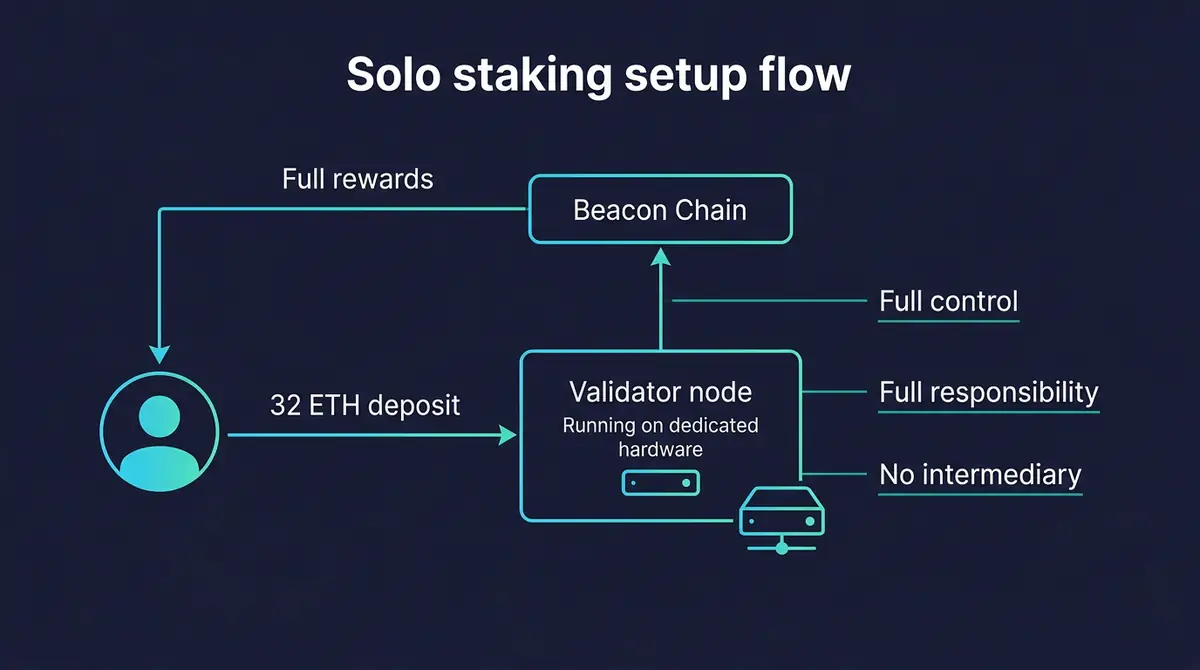
Solo staking means running a validator node yourself. You deposit the required minimum stake (32 ETH for Ethereum), install validator software, run it on dedicated hardware with a stable internet connection, and take full responsibility for the node’s availability and correct behavior.
Your rewards depend entirely on your validator’s performance. You receive the full staking yield with no commission taken by a third party. The trade-off is that downtime or misconfiguration results in penalties, and serious violations (such as double-signing) trigger slashing, which destroys a portion of the staked funds. For a detailed explanation of this penalty mechanism, see Validator Slashing Explained.
What Is Delegated Staking?
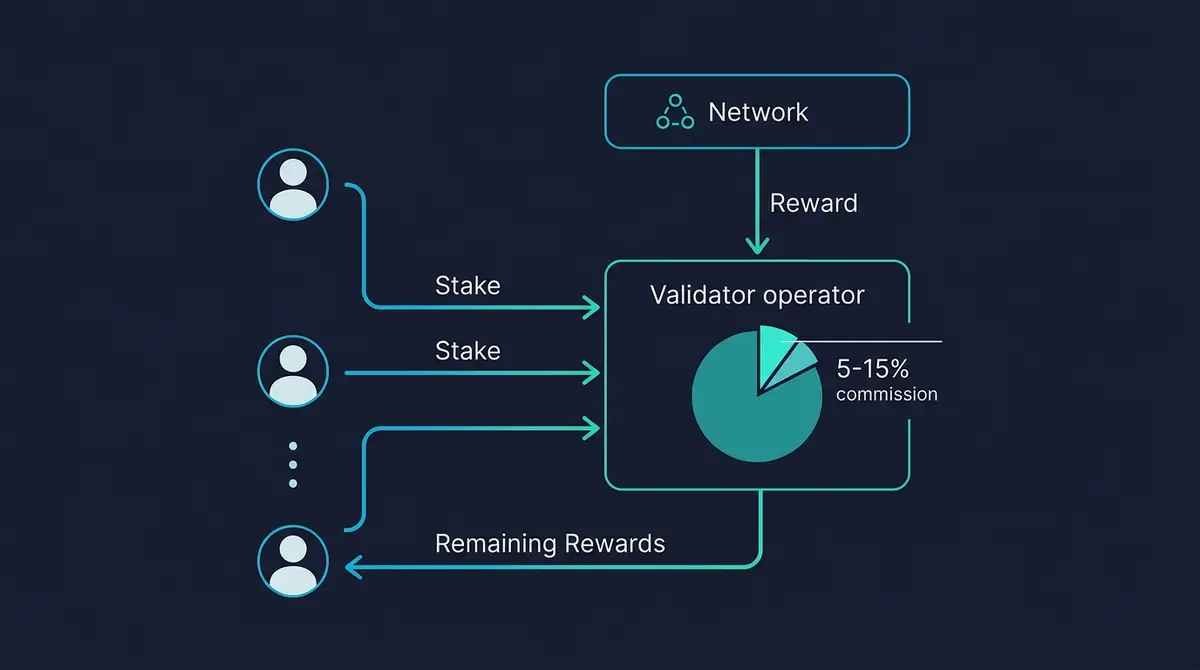
Delegated staking lets you assign your stake to a validator operated by someone else. The validator runs the node, maintains uptime, and handles all technical requirements. You receive rewards proportional to your stake, minus the validator’s commission fee (typically 5 to 20 percent, depending on the network and operator).
In many networks, delegated staking does not require a minimum as large as solo staking. Cosmos-based chains, for example, allow delegation of any amount. Ethereum does not have native delegation at the protocol level, so Ethereum users who cannot meet the 32 ETH minimum often use liquid staking protocols as an alternative, which carry their own risk profile.
Solo Staking vs Delegated Staking: Side-by-Side Comparison
- Control: Solo staking gives you full control. Delegated staking means trusting a third-party operator.
- Technical barrier: Solo staking requires Linux/hardware knowledge and consistent uptime management. Delegation requires only selecting a validator and sending a transaction.
- Minimum stake: Solo staking on Ethereum requires 32 ETH. Delegation minimums vary by network and are often much lower.
- Yield: Solo stakers receive full protocol rewards. Delegators receive rewards minus the validator’s commission.
- Slashing exposure: Both carry slashing risk, but solo stakers control the conditions. Delegators inherit the validator’s operational risk.
- Counter-party risk: Solo staking has none. Delegated staking depends on the validator’s honest and reliable operation.
Economics: Yield, Costs, and Break-Even
Solo staking on Ethereum earns the full protocol reward, including issuance, priority fees, and MEV, with no commission deducted. As of early 2026, effective solo validator yields range from roughly 3 to 5 percent APR depending on MEV-boost configuration and network activity. The cost side is hardware (a dedicated machine or VPS averaging $30–80 per month), electricity, and the time spent monitoring and updating client software. For most operators, break-even requires staking the full 32 ETH and keeping uptime above approximately 95 percent; below that, inactivity penalties erode the yield advantage over delegation.
Delegated staking yield is the protocol reward minus the validator’s commission, typically 5 to 15 percent of earned rewards. On a Cosmos-based chain paying 8 percent APR with a 10 percent commission, a delegator nets roughly 7.2 percent. The hidden cost is opportunity cost and trust: you pay nothing in infrastructure but accept whatever uptime and MEV strategy the operator runs. Commission changes, validator jailing, and sudden unbonding policies are risks that have no equivalent in solo staking.
Network-Specific Considerations
On Ethereum, the 32 ETH minimum makes solo staking capital-intensive. Ethereum does not support native delegation at the protocol level, so users with less than 32 ETH use liquid staking or staking pools. Cosmos SDK chains (Atom, Osmosis, Celestia) have native delegation built into the protocol; any amount qualifies, and redelegation is supported with a 21-day unbonding period. Solana allows delegation natively with no minimum and a shorter warm-up period, but validator economics depend on vote-cost subsidies and MEV extraction strategies that vary widely between operators. Avalanche requires 2,000 AVAX to run a validator and 25 AVAX to delegate, with a 14-day minimum lockup for both.
These differences matter because the solo-vs-delegated trade-off shifts by chain. On Cosmos chains the delegation experience is native and well-supported; on Ethereum, the gap between running your own validator and delegating is wider because delegation requires a third-party protocol rather than a protocol-level feature.
Risks and Common Mistakes
Solo staking mistakes include running validator keys on the same machine as consensus software without proper redundancy, failing to update software after network upgrades, or running two validator instances simultaneously (which triggers slashing). The technical demands are real and should not be underestimated.
Delegated staking mistakes include choosing a validator purely by highest commission or lowest fee without checking their track record. A validator with frequent downtime or a history of slashing events directly reduces your returns. Delegating to a very large validator also concentrates network stake, which is unhealthy for decentralization.
For broader context on staking risks across multiple models, see Staking Crypto in 2026: Risks and Real Yields.
Sources
- Ethereum Staking Documentation – official staking mechanics, validator requirements, and withdrawal flow
- Cosmos SDK Staking Module – native delegation, unbonding, and redelegation mechanics
- Ethereum Rewards and Penalties – slashing conditions, inactivity leak, and reward calculation
Frequently Asked Questions
Can I switch validators after delegating?
On most networks, yes. Redelegation or unbonding and re-staking is possible, though there may be an unbonding period during which your funds are locked and earn no rewards. Check the specific rules for the network you are using.
Is delegated staking custody?
In most proof-of-stake protocols, delegation does not transfer custody of your tokens. You assign voting power, not ownership. However, check the specific mechanics of the protocol, as some liquid staking implementations do require token deposits into smart contracts.
What is a staking commission?
A commission is the percentage of rewards the validator retains before distributing the rest to delegators. A 10% commission on a 5% APY means delegators effectively receive roughly 4.5% APY. Higher commission rates reduce delegator yield; lower rates increase it but may indicate an unsustainable operation.
Does solo staking require 32 ETH everywhere?
The 32 ETH minimum is specific to Ethereum. Other networks have different minimums. Cosmos-based chains, Solana, Avalanche, and others have their own validator requirements that may be higher or lower depending on network design.
Can a solo staker also get slashed?
Yes. Slashing is a protocol-level penalty that applies to any validator, solo or otherwise. The main triggers are proposing conflicting blocks or attesting to conflicting chain states. Solo stakers who run a single instance correctly have a very low slashing risk, but it is not zero.
Last reviewed: April 2026.