

Last Updated on April 14, 2026 by Snout0x
Getting into crypto can feel exciting, but it can also be one of the fastest ways for beginners to lose money. Most losses do not happen because blockchain technology fails. They happen because new investors move too quickly, trust the wrong platform, misunderstand wallets, or chase hype before they understand the risks.
If you want to know how to start crypto safely, the goal is not to become an expert overnight. The goal is to build a simple, secure foundation first: understand what you are buying, where you are buying it, how you will store it, and how to avoid the mistakes that trap beginners early.
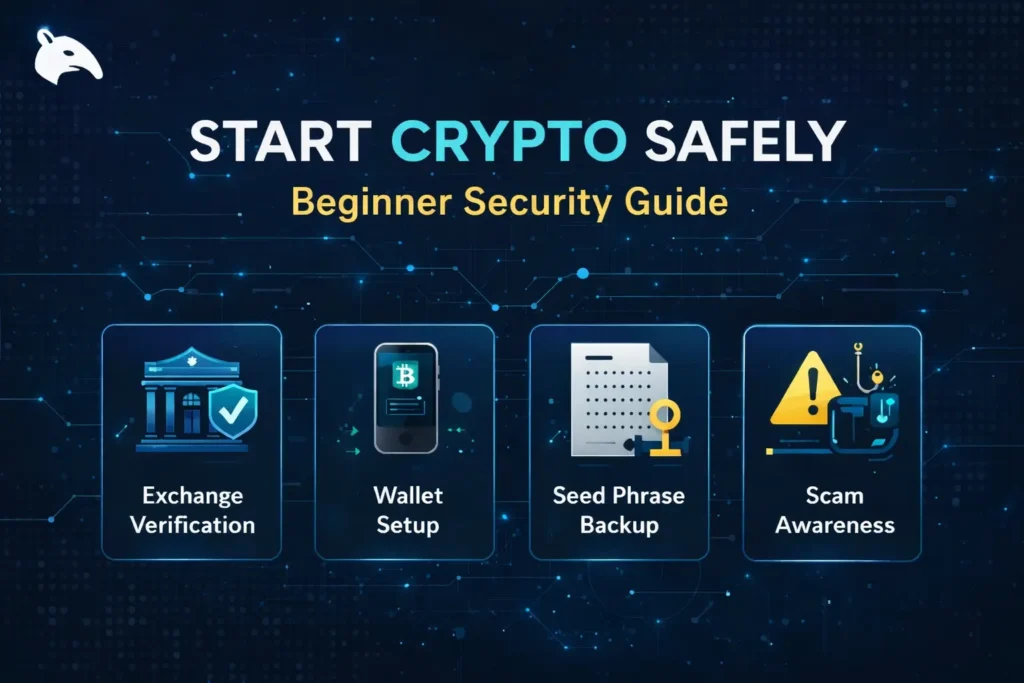
This guide explains the safest way to enter crypto step by step, focusing on security, verification, and risk awareness instead of hype or shortcuts.
This article is the first part of the Snout0x Beginner Safety Series, a step-by-step roadmap designed to help beginners understand cryptocurrency safely. Each guide in the series covers one essential concept, from wallets and self-custody to scams, risk management, and market basics.
Disclaimer: This content is for educational and informational purposes only and does not constitute financial, investment, tax, or legal advice. Cryptocurrency markets are volatile and involve risk. Always conduct your own research and consult a qualified professional before making financial decisions.
Affiliate Disclosure: Some links in this article may be affiliate links. If you use them, Snout0x may earn a commission at no extra cost to you. This does not affect editorial standards, and products should always be evaluated based on your own needs and risk tolerance.
Snout0x Beginner Safety Series
This guide is part of a structured beginner roadmap built to help new investors enter crypto more safely and avoid the mistakes that cause the most early losses.
Key Takeaways
- The safest way to start crypto is slowly, with small amounts and a strong focus on security.
- Beginners should understand exchanges, wallets, seed phrases, and scam risks before taking larger positions.
- Leaving all funds on an exchange may be convenient, but it adds counterparty and custody risk.
- Most beginner losses come from rushing, trusting hype, or failing to secure recovery information properly.
- Safe crypto investing starts with process, verification, and disciplined risk management, not excitement.
What Starting Crypto Safely Actually Means
Starting crypto safely means understanding custody, security, and risk before investing meaningful money. Beginners who focus on wallets, verification, and scam awareness usually avoid the mistakes that cause most early losses.
For beginners, crypto safety is not just about avoiding hacks. It is about reducing avoidable mistakes across the entire process. That includes choosing a reputable platform, understanding what a wallet does, protecting recovery information, and recognizing that crypto transactions usually cannot be reversed once confirmed.
A good beginner crypto guide should help you answer a few basic questions before you do anything serious.
- What am I buying?
- Where am I buying it?
- How am I storing it?
- What could go wrong?
- How much risk am I actually taking?
If you cannot answer those clearly, the safest move is to slow down. Crypto punishes confusion more aggressively than many traditional financial systems. That is why safe crypto investing begins with process, not excitement.
Before You Buy Any Crypto, Understand These Basics
- Which platform or exchange are you using
- whether you are leaving assets on an exchange or moving to a wallet
- How seed phrases and recovery work
- What common scams look like
- How much money can you afford to risk
This checklist sounds simple, but skipping it is how many beginners create problems before they even realize what they are doing.
Step 1: Learn the Basic Crypto Infrastructure First
Before buying anything, understand the basic parts of the system. You do not need deep technical knowledge, but you do need working knowledge of the tools and risks involved.
At a minimum, beginners should understand:
- Exchanges: platforms where you buy, sell, and sometimes hold crypto.
- Wallets: tools that help you control access to your funds.
- Private keys and seed phrases: the critical credentials that control recovery and access.
- Blockchain transactions: transfers that are usually irreversible once confirmed.
If you are new, start with the fundamentals before worrying about advanced topics like staking, DeFi, leverage, or speculative altcoin narratives. A beginner who understands custody and security is in a much stronger position than someone who only understands price charts.
For a fuller wallet introduction, read Your First Crypto Wallet Explained. If you want the mindset behind long-term protection, The First Rule of Crypto Security is one of the most important beginner reads on the site.
Step 2: Use a Reputable Exchange and Verify Everything
Most beginners enter crypto through a centralized exchange. That is normal, and for a small first purchase, it is often the easiest route. The key is not using the first platform that appears in a social media ad, search ad, or random message.
When evaluating an exchange, look for:
- clear identity and regulatory presence in your region
- a long operating history
- clear fee disclosures
- strong account security features such as two-factor authentication
- a reputation built on real usage, not influencer hype
Always verify the website URL manually. Fake exchange websites and phishing pages are one of the easiest ways to steal from new users. Bookmark the correct site once you verify it, and do not trust links from comments, DMs, or fake support accounts.
If your next step is making a first purchase, continue with How to Buy Bitcoin Safely for the First Time, which goes deeper into exchange selection, purchase flow, and early security checks.
Step 3: Start Small and Treat the First Purchase as Training
One of the smartest ways to start crypto safely is to treat your first buy as training, not as a life-changing position. Beginners often make the mistake of committing too much money before they have tested deposits, purchases, withdrawals, or wallet setup.
A small first transaction helps you learn:
- how funding the account works
- how fees affect the final amount you receive
- how market or limit orders behave
- how withdrawals work
- how stressful it feels to move value on-chain for the first time
This reduces the chance that your first real lesson in crypto comes from a large, expensive mistake. There is no prize for moving fast. In practice, cautious beginners often outperform impulsive ones simply by avoiding preventable damage.
If you are unsure how much exposure makes sense at the beginning, that question deserves its own framework around risk tolerance, portfolio size, and loss tolerance. Start small enough that mistakes remain educational rather than painful.
Step 4: Understand the Difference Between an Exchange and a Wallet
This is where many beginners get confused. Buying crypto on an exchange does not automatically mean you are storing it in the safest way. In many cases, the exchange is holding custody on your behalf. That may be convenient, but it also means you depend on a third party to stay solvent, operational, and accessible.
A wallet is not just an app that shows your balance. It is part of your access and recovery setup. The real issue is custody: who ultimately controls the keys, the recovery path, and the ability to move funds?
If you are deciding between wallet types, read Hot Wallet vs Cold Wallet (Beginner Explanation). If you want the bigger reason self-custody matters, read Why Self-Custody Matters for Crypto Investors.
Beginners do not need to move into advanced self-custody on day one. But they do need to understand that convenience and security are not the same thing, and leaving everything on an exchange is a decision with real trade-offs. For a deeper look at those trade-offs, see Should You Leave Crypto on Exchanges.
Step 5: Learn Seed Phrase and Recovery Basics Before You Need Them
A lot of new users think wallet security begins only when they own a large amount of crypto. That is backwards. Security should begin before the amount becomes meaningful, because bad habits form early.
If you use a self-custody wallet, your recovery setup matters immediately. In many wallet systems, the seed phrase is what allows recovery if a device is lost, damaged, or replaced. If someone else gets that phrase, they may be able to take your funds. If you lose it and have no reliable backup, you may permanently lose access to it yourself.
This is why beginners should read How Seed Phrases Protect Your Crypto early, not later. Seed phrase mistakes are one of the cleanest examples of avoidable crypto loss.
Do not store critical recovery information casually in screenshots, notes apps, chat messages, or cloud documents without understanding the trade-offs. Convenience-based storage often creates silent security problems.
Step 6: Assume Scammers Target Beginners Constantly
New users are attractive targets because they are still learning what normal behavior looks like. That makes it easier for scammers to imitate support teams, fake exchanges, giveaways, wallet tools, and investment communities.
Common red flags include:
- urgent messages telling you to act immediately
- people promising guaranteed returns
- fake support accounts asking for seed phrases
- account verification links sent through DMs
- websites that imitate major exchange or wallet brands
If someone asks for your seed phrase, private key, or remote access to your device, that is not support. It is an attack.
For the threat model behind this, read Why Crypto Scams Target Beginners and Fake Crypto Support Scams Explained.
Step 7: Build a Basic Risk Management Mindset Early
Safe crypto investing is not only about storage and scam prevention. It is also about position sizing, emotional control, and realistic expectations. Beginners often lose money not because they picked the wrong asset once, but because they combine poor security with poor risk management.
At a beginner level, risk management usually means:
- not investing money you cannot afford to lose
- not concentrating too heavily on one idea
- not panic-buying because of hype or social pressure
- not panic-selling because of volatility
- understanding that higher promised returns usually come with higher risk
The people who survive in crypto long enough to learn usually build discipline before they build complexity. You do not need to become a trader to benefit from a slower, more deliberate approach.
If you want to understand the mindset behind this more deeply, The Biggest Crypto Mistakes Beginners Make is a useful companion article because it shows how poor risk discipline and weak security often reinforce each other.
Risks and Common Mistakes
The most common beginner mistakes are not exotic. They are basic, repeated errors that show up again and again in crypto losses.
- buying too much before understanding custody
- trusting influencers or social media threads more than primary information
- keeping all funds on one platform without understanding the risk
- failing to secure two-factor authentication properly
- clicking phishing links or speaking with fake support accounts
- Treating the seed phrase casually
- chasing quick gains instead of building a repeatable process
A beginner does not need a perfect setup. But they do need a setup that is harder to break than their emotions on a volatile day. Most early damage in crypto comes from a weak process, not from a lack of intelligence.
Best Practices for Beginners
- Use a reputable exchange and verify the correct domain manually.
- Enable strong two-factor authentication and protect the device tied to it.
- Start with a small amount while learning the process.
- Learn wallet basics before moving larger funds.
- Understand the role of seed phrases, backups, and recovery.
- Assume unsolicited messages are suspicious until proven otherwise.
- Keep your first goal simple: safe participation, not maximum returns.
If you want a more detailed practical framework, see the Crypto Wallet Security Checklist for a broader security setup that builds on the habits introduced here.
Conclusion
If you are wondering how to start crypto safely, the answer is not to find the fastest coin, the loudest influencer, or the highest yield. The safest path is slower and less exciting than that. It starts with understanding custody, using trusted platforms carefully, learning wallet security, and avoiding the traps that catch beginners over and over again.
A strong beginner setup does not require perfection. It requires caution, verification, and a willingness to learn the boring parts before taking bigger risks. That is how you build a real foundation in crypto, and it is also how you stay in the game long enough to keep learning.
The best next steps from here are learning how to buy carefully, understanding your first wallet, and studying the common scam patterns that target new users most aggressively.
Part of the Snout0x Beginner Safety Series: a structured roadmap designed to help beginners understand cryptocurrency safely. Continue with How to Buy Bitcoin Safely for the First Time.
Frequently Asked Questions
What is the safest way to start investing in crypto?
The safest way is to begin with education, use a reputable exchange, start with a small amount, and learn wallet and recovery basics before increasing exposure.
Do beginners need a crypto wallet immediately?
Not always on day one, but beginners should understand wallets early. If their holdings become meaningful, learning self-custody and backup practices becomes increasingly important.
Is it safe to leave crypto on an exchange?
It can be convenient, but it adds counterparty risk. Exchanges can fail, freeze access, or become attack targets, which is why many users eventually explore stronger self-custody practices.
What is the biggest mistake crypto beginners make?
The biggest mistake is moving too fast without understanding custody, scams, and recovery. Most beginner damage comes from rushing, not from lacking advanced knowledge.
Can I start crypto safely with a small amount of money?
Yes. Starting small is often the safest approach because it lets you learn deposits, buying, withdrawals, and wallet basics with less financial risk while you build confidence.