

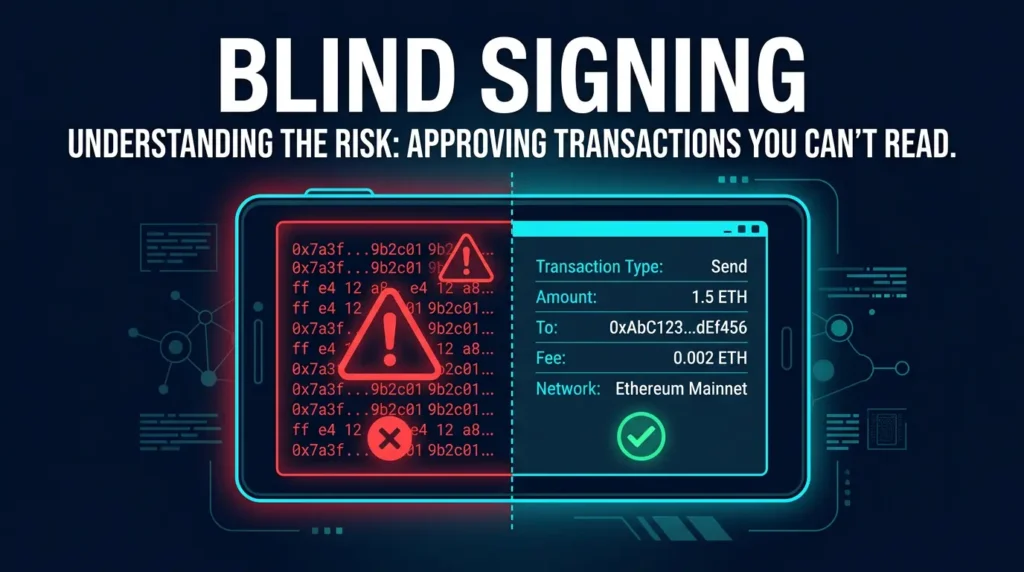
Blind signing in crypto means approving a transaction or message without being able to read and verify what it actually does. In practice, this usually happens when a wallet cannot decode the transaction into human-readable details and instead shows raw hex data, a vague warning, or only partial information. If you confirm anyway, you are trusting that the action is safe without seeing enough to judge it safely.
For a closely related follow-up, see How to Choose a Crypto Wallet: A Practical Security Framework.
This matters because wallets do not judge whether an action is wise. They only check whether you authorized it. If the contract call is malicious, the approval is still valid on-chain if you sign it. That is why blind signing is not a minor UX issue. It is a real security risk, especially in DeFi workflows where approvals, swaps, and contract interactions can be complex.
This content is for educational purposes only and should not be considered financial or investment advice.
Quick Answer
Blind signing is the act of approving a crypto transaction without a readable explanation of what you are signing. If a wallet shows only raw data, an “unverified contract” warning, or incomplete transaction details and you confirm anyway, you are signing blind.
Key Takeaways
- Blind signing means unreadable signing: You confirm an action without seeing enough detail to verify it properly.
- It often appears in DeFi interactions: Complex contract calls are harder for wallets to decode clearly.
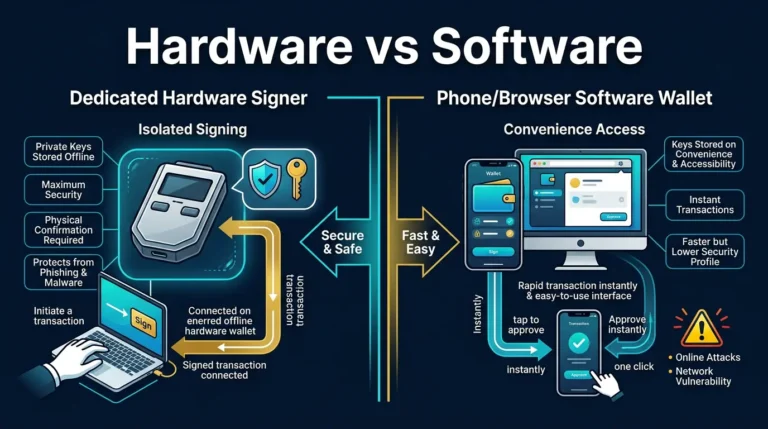
- Hardware wallets do not solve this automatically: They protect keys, but a poor screen or undecoded prompt can still leave you guessing.
- Approval scams often rely on this weakness: If you cannot read the spender, amount, or contract action, you can still authorize a bad transaction.
- The safest default is refusal: If the wallet cannot show what the transaction does in a meaningful way, do not sign it.
What Blind Signing Actually Means
When you sign normally, the wallet should show enough trusted information for you to verify what is about to happen. That may include the destination address, token amount, contract name, approval amount, network, and other relevant fields. Blind signing happens when that verification layer breaks down. The wallet still asks for confirmation, but it cannot explain the action clearly enough for a human to judge it.
The best local background for the base mechanism is What Is Transaction Signing in Crypto?. Signing itself is normal. The problem is signing without meaningful visibility into the content being approved.
Why It Happens
Blind signing usually happens because the transaction is too complex for the wallet to parse or display cleanly. This is common with smart-contract interactions, token approvals, DeFi routing flows, NFT mints, and message-signing requests that are not simple coin transfers. The wallet may receive data it technically can sign, but not data it can translate into plain language on the device or interface you trust.
One common example is a hardware wallet showing an “unverified contract” warning followed by raw hexadecimal data. Another is a browser wallet showing a long contract request where the user only sees a vague prompt like “Set approval for all” or “Data” without clear context around the spender, limits, or actual consequence.
Why Blind Signing Is Dangerous
Blind signing is dangerous because blockchains do not ask whether you understood the action. They ask only whether the action was signed correctly. If you approve a malicious token allowance, sign a dangerous contract call, or authorize a fake claim flow, the chain treats that approval as valid even if the prompt was unreadable to you.
Real-world example: a fake airdrop site asks you to connect a wallet and approve a token action that looks routine. Your wallet cannot display the full spender context clearly, but you click through because it seems like a normal step. In reality, you may have just approved a malicious contract that can pull tokens later. That is why blind signing connects directly to Crypto Approval Scams and other drainer-style attacks.
Blind Signing vs Normal Verified Signing
- Verified signing: The wallet shows readable transaction details such as amount, destination, spender, or contract purpose.
- Blind signing: The wallet shows raw data, incomplete context, or a warning that the action cannot be verified meaningfully.
- Verified signing lets you compare intention to reality: You can decide whether the on-screen details match what you meant to do.
- Blind signing replaces verification with hope: You are relying on the site, interface, or habit instead of on readable confirmation.
Why Hardware Wallets Still Need Readable Screens
A hardware wallet protects your private keys by isolating the signing operation, but key isolation is not enough if the device cannot show what it is signing in a readable form. If the trusted screen only shows fragments, warnings, or raw blobs, you may still approve something harmful. The secure boundary matters only if the human at that boundary can understand the prompt.
If you want the foundational definition behind this concept, read What Is a Hardware Wallet? Key Storage Explained.
That is why Hardware Wallet Screen Security is such an important companion page. A screen is not just a convenience feature. It is the part of the signing workflow that tells you whether the device is asking you to approve the action you intended.
Where Users Most Commonly Encounter It
- Token approvals: The spender and allowance details may be unclear or easy to ignore.
- Complex DeFi interactions: Multi-step swaps, bridges, vaults, and routing flows often generate harder-to-read prompts.
- NFT or claim sites: Fake mint or airdrop flows may disguise dangerous actions inside routine-looking wallet prompts.
- Message signing requests: Some signatures are not on-chain transactions at all, but they can still authorize risky behavior depending on the app flow.
For the wallet-connection side of this behavior, DeFi Wallet Connection: How It Works is the most useful local follow-up.
Practical Usage: How to Avoid Signing Blind
- Refuse unreadable prompts: If the wallet cannot explain the action clearly, stop.
- Verify on the trusted display: Use the device screen or the clearest trusted wallet prompt, not just the app website.
- Watch for spender and approval scope: For token approvals, the spender and limit matter more than the marketing text on the site.
- Use wallets with strong transaction parsing: Better decoding and clearer screens reduce guesswork.
- Slow down when the action is unfamiliar: Urgency is often what turns a suspicious prompt into a signed mistake.
A practical rule is this: if you cannot explain what the wallet prompt will do after you sign it, you are not ready to sign it yet.
Risks and Common Mistakes
- Assuming hardware wallets remove all signing risk: They isolate keys, but they do not make unreadable prompts safe.
- Treating warnings like normal friction: “Unverified contract” or raw-data prompts are not routine confirmations.
- Clicking through because a site looks legitimate: A polished frontend can still trigger a harmful approval or contract call.
- Ignoring approval details: Unlimited allowances to the wrong spender can drain tokens later, not just immediately.
- Confusing familiarity with safety: A common-looking DeFi workflow can still hide a malicious or misconfigured action.
Sources
- Ledger Support: Enable Blind Signing in the Ethereum App
- MetaMask Support: What Is a Token Approval?
- Ethereum.org: Smart Contract Security
Frequently Asked Questions
What is blind signing in simple terms?
It means approving a crypto transaction or message without being able to read clearly what it will do.
Is blind signing only a hardware wallet problem?
No. Hardware wallets make the issue more visible, but any wallet can create a blind-signing situation if the prompt is vague, incomplete, or unreadable.
Why is blind signing dangerous in DeFi?
DeFi interactions often involve complex contract calls and token approvals. If you cannot see the spender, amount, or action clearly, you can still authorize a harmful transaction.
Should I ever approve an unverified contract warning?
The safest default is no. If the wallet cannot explain the transaction in a meaningful way, refusing to sign is the safer choice.
What is the best defense against blind signing?
The best defense is to use wallets that show readable transaction details and to refuse any prompt you do not fully understand.