


Last Updated on April 14, 2026 by Snout0x
Liquid staking and native staking both let you earn rewards by participating in proof-of-stake consensus, but they differ in how your tokens are locked, how you receive rewards, and what risks you take on. Native staking means you (or a validator you delegate to) bond tokens directly to the chain; those tokens are locked until you unstake. Liquid staking protocols take your deposit, stake it on your behalf, and give you a derivative token that represents your stake and can be traded or used elsewhere while still earning staking yield. Choosing between them depends on whether you need liquidity, how you weigh smart contract and slashing risk, and how you want to use your capital.
The decision framework is straightforward. Choose native staking if your priority is the simplest trust model and you do not need to reuse the capital while it is staked. Choose liquid staking if the liquidity itself is part of the strategy and you are comfortable accepting protocol risk, derivative pricing risk, and more complicated exits in return.
This content is for educational purposes only and should not be considered financial or investment advice.
This article may contain affiliate links. If you purchase through these links, Snout0x may earn a commission at no additional cost to you.
Every derivative layer added for liquidity is another failure surface.
Key Takeaways
- Native staking locks tokens directly with the chain or a validator; rewards and slashing apply to your bonded balance.
- Liquid staking mints a derivative token (e.g. stETH) that tracks your stake and stays liquid while the protocol stakes behind the scenes.
- Liquid staking adds smart contract and protocol risk on top of normal staking and slashing risk.
- Choose native staking when you do not need liquidity and want minimal protocol dependency; choose liquid staking when you want to use staked capital in DeFi or avoid lockups.
- Both approaches are exposed to validator slashing if the operator misbehaves; liquid staking adds the risk that the derivative can trade below the underlying asset.
Native Staking: Direct Bond and Consensus Participation
In native staking, you lock tokens as part of the blockchain’s consensus design. On Ethereum, that means depositing ETH into the official staking contract and either running a validator node yourself or delegating to a validator. The protocol treats your deposit as bonded collateral: it is used to secure the chain and is subject to slashing if the validator violates consensus rules. Your balance does not leave the chain’s staking system; there is no intermediary token. Rewards are credited to your stake (or your validator’s pool) according to protocol rules,typically a combination of issuance and transaction fees,and are only available when you exit the stake after the network’s unbonding period.
Unbonding periods exist so the chain can apply slashing after misbehavior is detected. On Ethereum, exiting a validator involves a queue and then a delay before ETH is withdrawable. During that time your funds are still at slashing risk if evidence of a past violation is submitted. This design trades liquidity for protocol security: the lockup discourages short-term speculation and ensures validators have skin in the game. In practice, native staking suits holders who do not need to sell or redeploy their stake quickly and who prefer to interact only with the base protocol rather than a third-party liquid staking provider.
How Native Staking Rewards and Slashing Work
Staking rewards in proof-of-stake networks come from two main sources: new token issuance (inflation) and transaction fees or tips. The protocol distributes these to validators in proportion to their stake and uptime; validators then share rewards with delegators according to their fee and commission structure. Rates vary by network: Ethereum’s nominal yield depends on total ETH staked and network activity, often in the low single digits. The exact amount you earn depends on which validator you use, their commission, and whether they are slashed. Validator reward economics determine how much goes to the operator versus delegators.
For the operator side of this comparison, the important distinction is that native staking mostly asks you to judge validator quality and lockup terms, while liquid staking asks you to judge a protocol, a derivative token, and the exit market at the same time. That extra flexibility is real, but so is the extra analysis burden.
Slashing is the protocol’s penalty for consensus failures,double-signing, going offline in critical ways, or other rule violations. When a validator is slashed, a portion of their bonded stake (and thus their delegators’ stake) is destroyed or locked. That reduces the effective yield and can create a permanent loss of principal. Native staking does not remove this risk; it is inherent to the consensus design. The trade-off is that you are only exposed to protocol and validator risk, not to a separate smart contract or derivative-protocol layer. For a detailed treatment of when and how slashing occurs, see Validator Slashing Explained.
Liquid Staking: Derivative Tokens and Unlocked Liquidity
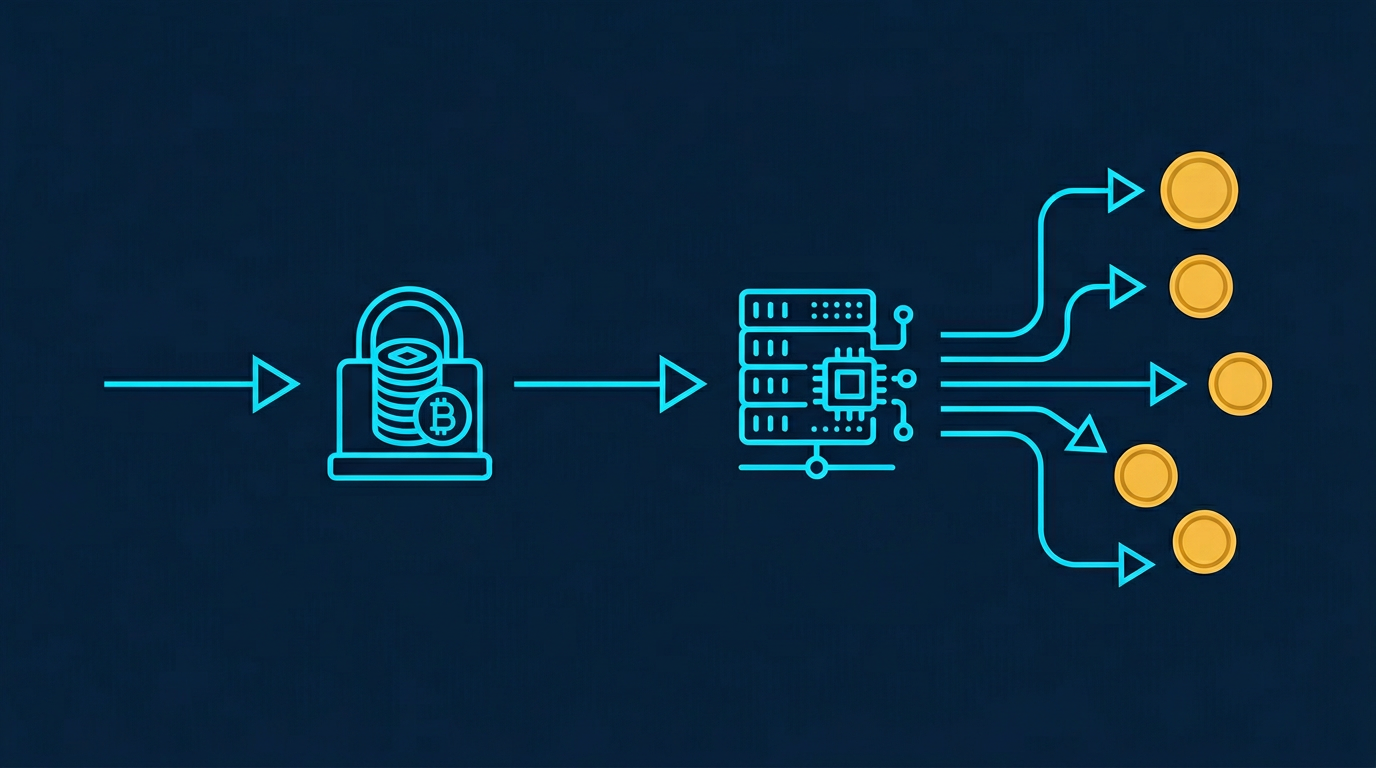
Liquid staking protocols sit between you and the chain. You deposit the native asset (e.g. ETH); the protocol stakes it in the network’s official staking system and mints you a 1:1-backed derivative token (e.g. stETH, rETH). That derivative accrues staking yield over time,either by increasing in balance per token or by rebasing. You can hold it, sell it, or use it as collateral in DeFi while the underlying ETH remains staked. The protocol handles validator selection, key management, and unbonding; you get liquidity and yield in one instrument.
The trade-off is dependency on the liquid staking protocol’s smart contracts and operations. If the protocol is exploited, misconfigured, or the derivative token loses parity with the underlying asset (e.g. during stress or liquidity crunches), you can lose value even if the base chain is fine. Liquid staking also concentrates stake in a few large operators from the protocol’s point of view, which can raise governance and centralization concerns. For a focused look at these risks, see Liquid Staking Risks.
Liquid Staking Protocol Mechanics: Mint, Delegate, Redeem
When you use a liquid staking service, your deposit is pooled with others. The protocol’s smart contracts send the pooled assets to the chain’s staking contract and run or delegate to validators. In return, you receive derivative tokens that are meant to track the value of your stake plus accrued rewards. Some derivatives use a rebase mechanism (your token balance increases); others are non-rebasing (each token increases in value relative to the underlying asset). When you want to exit, you either swap the derivative on the market or redeem it with the protocol. Redemption may involve a queue if the protocol needs to unstake first, so in practice many users sell the derivative instead, which can trade at a premium or discount to the underlying asset.
Validator selection and slashing are critical. Liquid staking providers typically run or partner with many validators and may spread stake to limit slashing impact. If a validator used by the protocol is slashed, the loss is usually socialized across all derivative holders, so your share of the pool decreases. The protocol’s design (e.g. whether it uses a set of curated validators or a permissionless set) affects both security and decentralization. Understanding this flow helps you see why derivative tokens can temporarily trade below 1:1 with the underlying asset,for example during high redemption demand or when the market prices in slashing or smart contract risk.

Liquidity vs Custody and Slashing Risk
Native staking maximizes direct control and minimizes trust in intermediaries: you (or your chosen validator) interact only with the chain. The cost is lockup and unbonding delay. Liquid staking maximizes liquidity and composability: you can use the derivative in DeFi, sell it, or move it across chains in some designs. The cost is smart contract risk, protocol dependency, and the possibility that the derivative trades below the underlying asset. Both paths remain exposed to validator slashing; liquid staking adds the risk that the protocol or its validators fail, and that the derivative’s market price diverges from the redemption value.
In failure scenarios, native staking can still result in loss, for example through slashing or key-management errors, but the number of moving parts is smaller. With liquid staking, a bug in the protocol, a compromised validator set, or a bank-run-style redemption wave can impair the derivative’s value or redeemability. There is no free lunch: the liquidity benefit of liquid staking comes with additional risk layers that the dedicated risk breakdown linked above covers in detail.
Practical Usage: When to Choose Native vs Liquid Staking
Choose native staking when you are comfortable with a lockup and unbonding period, want to minimize reliance on third-party protocols, and prefer to pick a specific validator or run your own. It fits long-term holders who do not need to use staked capital in DeFi or trade it quickly. Choose liquid staking when you want to keep capital liquid,to trade, use as collateral, or move across ecosystems,while still earning staking yield. It fits users who accept the extra smart contract and protocol risk in exchange for flexibility.
Your choice may also depend on the chain. On Ethereum, both solo/direct staking and liquid staking (e.g. Lido, Rocket Pool) are widely used; the former has a 32 ETH minimum for running a validator, while liquid staking allows smaller amounts. Comparing solo staking vs delegated staking clarifies the validator side; comparing native vs liquid clarifies liquidity and protocol risk. If you are evaluating other yield strategies, see Yield Farming vs Staking for how staking differs from liquidity provision and incentive-based farming.
The clearest verdict is by use case. Native staking is usually the better answer for long-term holders who mainly want protocol yield with fewer moving parts. Liquid staking is usually the better answer for users who deliberately want composable collateral or an easier exit path than a full unbonding period. If you will not use the derivative token for anything specific, native staking often wins on simplicity. If capital efficiency is the point, liquid staking has the stronger argument.
Risks and Common Mistakes
Confusing liquid staking with “risk-free” staking is a common mistake. Both native and liquid staking carry slashing risk; liquid staking adds smart contract and derivative risk. Another error is ignoring the derivative’s market price: if you need to sell in a hurry, the liquid token might trade below 1:1. Assuming all liquid staking protocols are equivalent is also risky,validator set, audits, and redemption mechanics differ. On the native side, delegating to a single low-fee validator without checking their slashing history or infrastructure can concentrate risk. Always verify you are using the official staking contract or the genuine liquid staking protocol (e.g. correct contract addresses) to avoid phishing or fake staking sites.
Sources
- Ethereum Staking Documentation – official staking mechanics and withdrawal flow
- Lido Documentation – reference material for liquid staking mechanics and redemptions
- Rocket Pool Documentation – protocol documentation for liquid staking design and validator structure
FAQ
What is the main difference between liquid staking and native staking?
In native staking you lock tokens directly with the chain or a validator; they are illiquid until you unstake and wait out the unbonding period. In liquid staking you deposit tokens with a protocol that stakes them and gives you a derivative token (e.g. stETH) that you can hold, trade, or use in DeFi while still earning staking yield.
Is liquid staking riskier than native staking?
Liquid staking adds smart contract and protocol risk on top of the slashing and validator risk that both approaches share. The derivative token can also trade below the underlying asset. So overall, liquid staking typically carries more risk layers than native staking, in exchange for liquidity.
Can I lose money with native staking?
Yes. Validator slashing can reduce your bonded balance. You can also lose access if you lose keys or delegate to a validator that is slashed or exits poorly. Native staking is not risk-free; it avoids the extra protocol and derivative risk of liquid staking.
When should I use liquid staking?
Use liquid staking when you want to earn staking yield but keep the option to sell, use the asset as collateral, or deploy it in DeFi without waiting for an unbonding period. Only do so if you accept the additional smart contract and protocol risk.
Does liquid staking pay the same yield as native staking?
Roughly. The underlying stake earns the same protocol rewards. Liquid staking protocols usually take a fee, so net yield may be slightly lower than solo or direct delegation. The derivative’s yield (from rebase or price appreciation) should track the underlying stake minus fees.