

Last Updated on April 14, 2026 by Snout0x
Bitcoin difficulty is the parameter that makes sure new blocks do not arrive too quickly or too slowly, even when miners add or remove huge amounts of hash rate. Instead of trusting miners to behave nicely, the protocol measures how fast blocks have arrived, then automatically adjusts difficulty so the average block time moves back toward ten minutes.
For the broader overview around this topic, see What Is Blockchain?.
A simple way to think about difficulty is as Bitcoin’s timing dial. If miners start finding blocks too quickly, the dial tightens and makes the winning hash target smaller. If blocks arrive too slowly, the dial loosens. The goal is not to reward or punish miners emotionally. It is to keep block production near the network’s intended rhythm.
This article explains how the Bitcoin retarget rule works, how the adjustment algorithm measures time and hash power, what happens during bull-market hash rate spikes or miner shutdowns, and why the system matters for both security and everyday users. We will stay close to protocol mechanics, not price predictions.
This content is for educational purposes only and should not be considered financial or investment advice.
What Bitcoin Mining Difficulty Actually Is
Bitcoin does not directly ask miners to solve “hard” or “easy” puzzles; instead it sets a difficulty target, which is a very small threshold that a valid block header hash must be below. Difficulty is a way of expressing how small that target is, relative to an easy reference target from the early days. The smaller the target, the fewer hashes will pass, and the harder it becomes to find a valid block.
For miners, difficulty is the environment they are forced to work in. Given a specific difficulty and their hash rate, they can estimate how many hashes they must perform on average to find a block. For full nodes and regular users, difficulty is a key part of the consensus rules used to verify blocks and reject any header that does not produce a low-enough hash value. If the hash is above the target, the block is invalid regardless of who mined it.
Conceptually, you can think of difficulty as narrowing a lottery’s winning number range. At low difficulty, many different ticket numbers are accepted as winning blocks, so miners expect to win quickly. At high difficulty, only a tiny portion of the total number space wins, so miners must burn far more electricity and time to stumble onto a valid hash. This automatic tightening and loosening of the target is what keeps block timing stable across wildly changing hash rates.
How Bitcoin Chooses a Difficulty Target
The protocol stores the difficulty target for each block inside the header as a compact field called nBits. Every full node takes that value, expands it into the full 256-bit target, and compares the block header hash to ensure it is below the threshold. Nodes do not care how “expensive” it was to produce the block; they only care that the hash meets or beats the published target value.
Under the hood, difficulty is defined relative to a reference target known as difficulty 1. When people say network difficulty is 80 trillion, they are not saying much about price; they are saying the current target is 80 trillion times smaller than the easiest baseline. This gives developers and miners a way to describe how hard it is to find a block without talking in raw 256-bit integers.
Crucially, there is also a maximum target: the protocol refuses to let difficulty drop below a certain level. That limit ensures the proof-of-work algorithm never becomes trivial, even if a large portion of miners shuts off their equipment. Any attempt to craft a block whose target is looser than this maximum is immediately rejected by honest nodes, which keeps block validation predictable and prevents miners from silently weakening security rules on their own.
The 2,016-Block Difficulty Adjustment Window
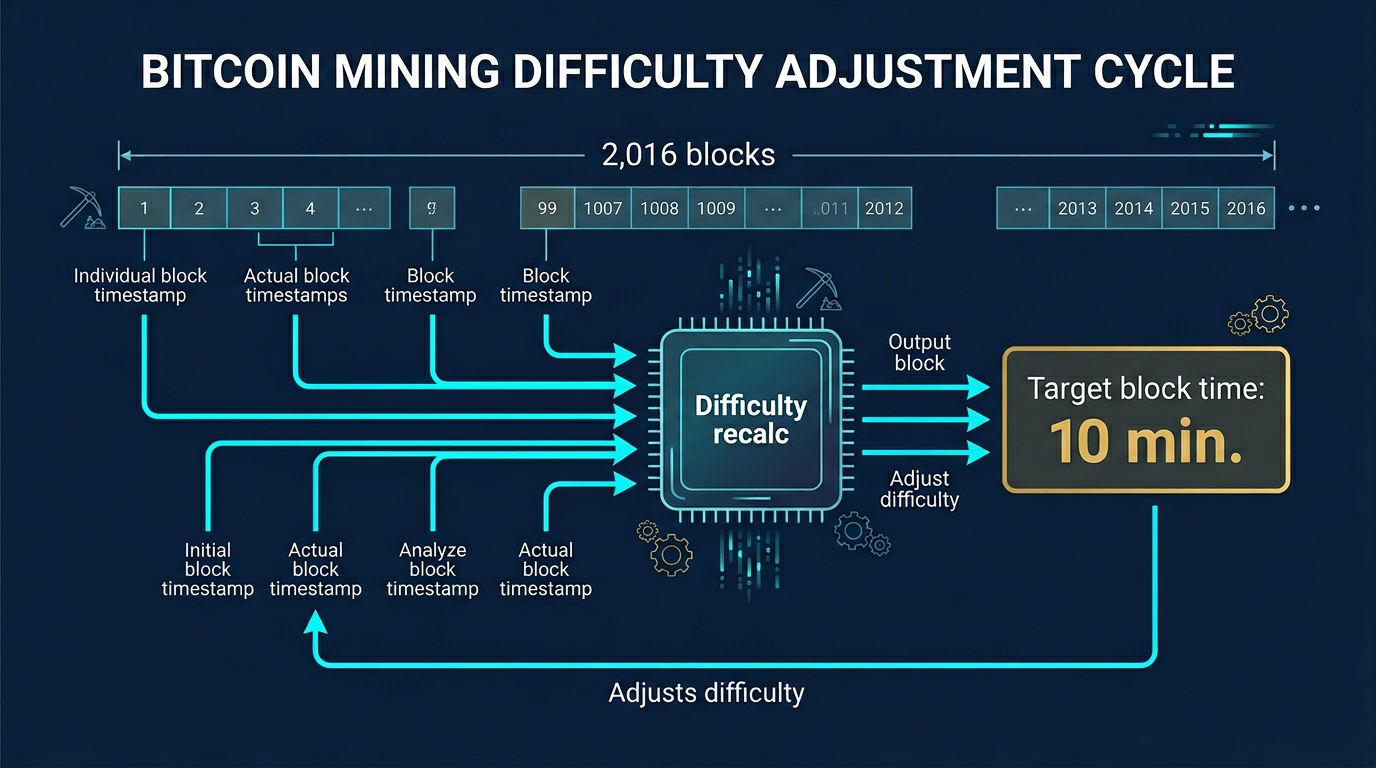
Bitcoin does not adjust difficulty after every block. Instead it waits for a full window of 2,016 blocks, which should take roughly two weeks at ten minutes per block. Once that many blocks have been mined, every node compares the actual time elapsed to the expected time and then computes a new target so that the next 2,016 blocks are expected to land closer to the ten-minute schedule.
Inside that window, miners can add or remove hash rate and blocks may arrive somewhat faster or slower than ten minutes on average. However, the protocol is only looking at the start timestamp and end timestamp of the window, not each individual block. This keeps the algorithm simple and predictable while still letting it respond to big swings in total mining power over weeks instead of seconds.
The reference timeline for those 2,016 blocks is fourteen days. If blocks arrived faster than that, difficulty must go up; if blocks arrived slower than that, difficulty must go down. This window-based approach smooths out randomness from individual blocks and focuses on long-term behavior, which is important because even at a fixed difficulty, block intervals naturally jump around due to the probabilistic nature of hashing.
The Difficulty Adjustment Formula
The core of the algorithm is surprisingly short. At the 2,016-block boundary, each node calculates the actual timespan between the new block and the block 2,016 blocks ago. It then compares that to the target timespan of 2,016 × 10 minutes. The new difficulty target is set so that expected time per block moves back toward ten minutes, using simple proportional scaling based on how far off the recent window was.
In plain language, if blocks arrived twice as fast as intended, the protocol doubles the difficulty; if they arrived twice as slowly, it halves the difficulty. To prevent wild swings from inaccurate timestamps or short-term anomalies, there is also a set of clamps that restrict any single adjustment to a 4× range. This means difficulty cannot jump more than four times up or down in a single period, which protects the network from timestamp manipulation or very sudden hash rate changes.
Because difficulty is always computed from the previous target and the observed window, every node independently arrives at the same new target when it validates a retarget block. There is no central coordinator issuing directives. If a miner proposes a block with an incorrect difficulty value for that boundary height, every honest node will compute the expected target and reject the invalid block, keeping the chain consistent without anyone having to “vote” on changes.
What Happens When Hash Rate Jumps or Crashes
Hash rate is the total amount of computation miners are throwing at the network. When miners plug in more ASICs or move fleets from one coin to another, the hash rate can change by large percentages over short timeframes. The retarget system is meant to absorb these shocks and keep the user experience stable, even though the infrastructure underneath is constantly changing.
If you want the foundational definition behind this concept, read Bitcoin Halving Explained: What Changes and Why.
For the risk side of this topic, see Wallet Address Reuse Risks: What It Exposes On-Chain.
The intuitive point is that difficulty does not react to price charts directly. It reacts to the physical reality of how much mining power is actually online during the last adjustment window. That is why users can see blocks speed up or slow down temporarily before the next retarget catches up.
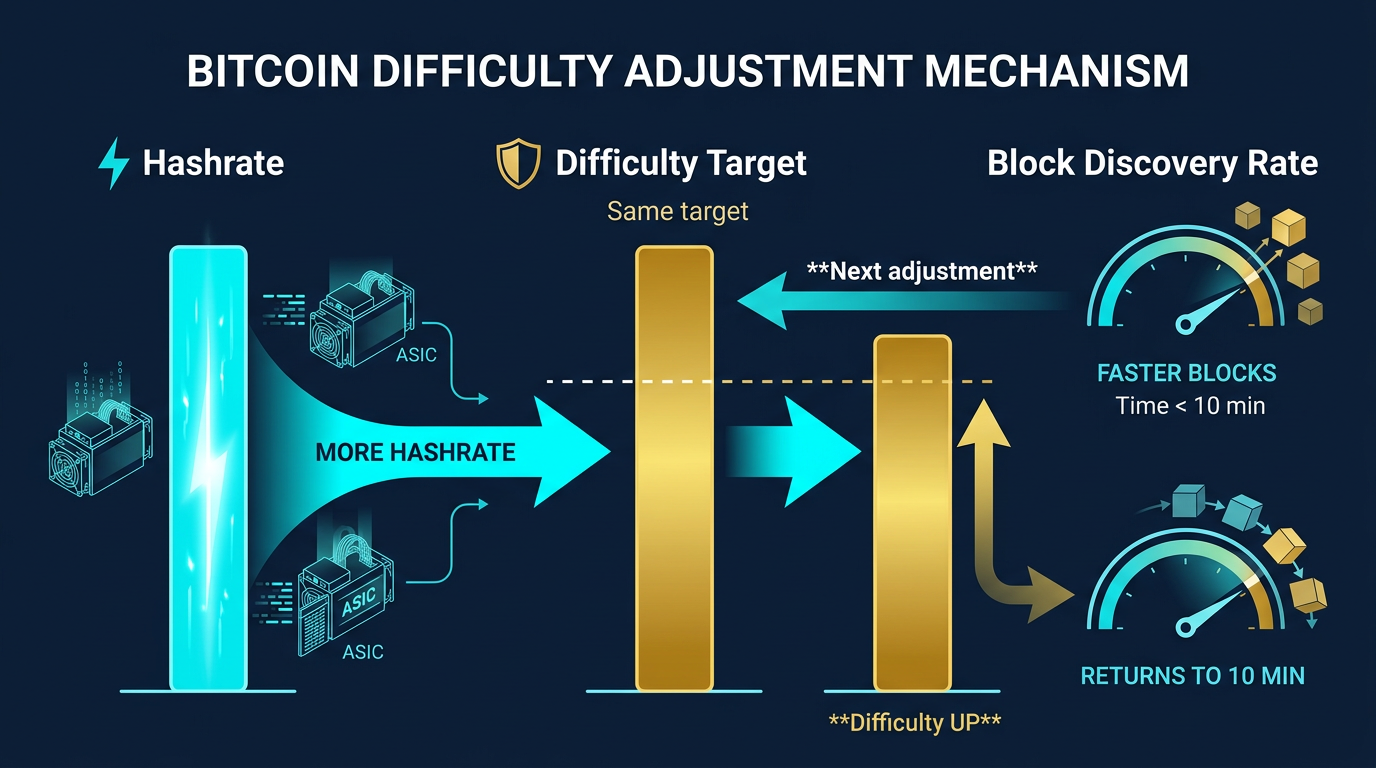
If hash rate spikes during a difficulty window, blocks will temporarily arrive quicker than ten minutes. Users may see confirmations arrive faster, and new transactions may get mined into blocks earlier than normal. At the next adjustment, difficulty steps up, making it harder for each individual hash to succeed. This raises miners’ costs per block and slows the chain back down toward its intended cadence, returning confirmation times to the usual range.
When hash rate suddenly drops, usually because mining becomes unprofitable for some operators, the opposite happens. Blocks arrive more slowly, mempools grow, and transaction fees can spike as users compete for limited block space. Bitcoin cannot instantly know who unplugged machines, but when the next 2,016-block window closes, the protocol lowers difficulty and makes it easier for remaining miners to find blocks. Over time that adjustment allows the network to continue even if a large fraction of hash power disappears.
Why Difficulty Stability Matters for Security
Difficulty is not just a scheduling tool; it is a direct input into Bitcoin’s security model. The higher the difficulty at a given block height, the more total work must be done to build an alternative chain of equal length. This is why we talk about “chain work” instead of just the number of blocks: a chain with fewer, high-difficulty blocks can actually be more secure than a longer chain with many easy blocks.
The difficulty adjustment algorithm helps maintain this security property through time. If difficulty never adjusted downward, modest drops in hash rate would make block production painfully slow and push users away. If difficulty adjusted too quickly or without limits, attackers might be able to manipulate timestamps or briefly flood the network with hash rate to force unsafe difficulty levels. The conservative, window-based design strikes a balance between responsiveness and robustness.
For everyday users, the important takeaway is that the protocol does not rely on miners promising to be honest. Instead, it continuously recalibrates how much work is needed for each block based on observable history, and every node independently verifies that calibration. This is part of why Bitcoin has managed to survive both massive mining booms and painful mining busts without any committee voting to change the rules in the middle of a crisis.
How Difficulty Affects Miners and Transaction Fees
From a miner’s perspective, the current difficulty directly shapes expected revenue. At a given bitcoin price and transaction fee environment, higher difficulty means fewer expected blocks per unit of hash rate, so each terahash of hardware earns less BTC over time. Lower difficulty means more expected blocks, but usually only appears during periods when many miners have already capitulated or when market conditions are poor.
Difficulty also interacts with transaction fees through block timing. When blocks arrive more slowly because difficulty is high relative to current hash rate, mempools can fill up and users may raise their fees to get included. When difficulty is low and blocks arrive slightly faster, mempools can drain and fees may fall. Over the long run, however, the adjustment keeps the average supply of block space roughly constant at one block every ten minutes, which is one reason fee dynamics tend to move in cycles with demand rather than spinning out of control.
Serious miners therefore monitor both raw hash rate and upcoming difficulty adjustments. They model how changes in difficulty will affect their margins, how much hardware they can afford to operate, and when it makes sense to shut down inefficient machines. While users rarely think about these internal decisions, the protocol’s difficulty rules create the predictable environment that allows mining businesses to plan multi-year operations instead of gambling on arbitrary rule changes.
Common Myths About Difficulty
One common misconception is that difficulty changes every time the price moves. In reality, the protocol has no concept of price, and nodes never query exchanges. Difficulty only responds to hash rate and block timing, not market charts. Price indirectly matters because it influences how many miners can profitably stay online, but the algorithm itself is blind to those economic details.
Another frequent myth is that difficulty endlessly rises and will eventually make mining impossible. Difficulty does not have a built-in upward drift. It will rise when new hash rate joins and fall when hash rate leaves, bounded by the maximum target rule. If the network ever experienced a sustained period of hash rate decline, difficulty would step down at each adjustment until remaining miners could again find blocks near the intended ten-minute average.
Finally, some people assume difficulty directly controls how secure individual transactions are. In practice, security is the result of the total work buried beneath a transaction, not just the current difficulty value. A transaction confirmed in a block during a relatively low-difficulty era can still be deeply secure once dozens of additional high-difficulty blocks have been built on top of it, because an attacker would have to redo the work of the entire chain, not just one block.
Practical Usage: Reading Difficulty Changes
For most users, the main role of the difficulty system is to quietly keep the protocol’s heartbeat steady. You do not need to watch every adjustment, but it helps to understand why block times sometimes speed up or slow down slightly and why fee pressure can temporarily spike before the next retarget. Difficulty is the self-correcting knob that brings the system back toward its intended schedule.
For a closely related follow-up, see Bitcoin Consensus: Proof Through Computational Work.
If you want the validation side of this mechanism, What Is a Bitcoin Node? is the most relevant local follow-up. Nodes are what enforce the target at each block height; miners do the work, but nodes decide whether that work satisfies the rules.
If you run your own node, the difficulty rules you enforce are what keep you in consensus with the rest of the network. Your node does not ask anyone’s permission to apply those rules; it simply verifies that every block meets the expected target for its height. If a miner tries to cheat by proposing a block with an invalid difficulty or an incorrect adjustment, your node will quietly reject it and follow the valid chain instead.
Whether you mine, hold, or just use Bitcoin for payments, understanding this retarget mechanism makes it clear why the system has remained stable through hardware revolutions, market cycles, and geopolitical shocks. The protocol turns something as messy as global hash rate fluctuations into a relatively smooth, predictable flow of blocks that users and applications can depend on over time.
Risks and Common Mistakes
A common mistake is reading every big adjustment as a market signal. Large upward moves often reflect new machines coming online or old hardware becoming profitable again, while large downward moves can follow shutdowns, energy disruptions, or miner capitulation. The mechanism describes mining conditions; it does not tell you where price will go next.
Another mistake is assuming the system responds instantly to shocks. It does not. If hash rate falls hard early in a 2,016-block window, blocks can stay slow for days until the next retarget arrives. That lag is a real mechanism, and it is why fee pressure and confirmation times can temporarily worsen before the network recenters itself.
Sources
- Bitcoin Developer Reference: Block Chain and Difficulty
- Bitcoin Core source code (difficulty adjustment logic)
- Bitcoin: A Peer-to-Peer Electronic Cash System (whitepaper)
FAQ
Does higher difficulty make transactions safer?
Higher difficulty increases the amount of work embedded in each block, which raises the total cost of rewriting recent history. Over time that contributes to stronger security guarantees, but safety for a specific transaction still depends on how many blocks have been built on top of it and the total work of the chain, not just the difficulty value at the moment it was confirmed.
For the mining-power side of this question, What Is Bitcoin Hashrate? is the more relevant local follow-up. Hashrate tells you how much raw computation is online; difficulty tells you how the protocol responds to that computation to keep timing stable.
How often does Bitcoin adjust mining difficulty?
Bitcoin adjusts mining difficulty every 2,016 blocks, which should be roughly once every two weeks if blocks arrive at the intended ten-minute average. The actual calendar interval can be shorter or longer when hash rate changes, but the algorithm always waits for a full window of 2,016 blocks before recalibrating.
Can miners vote to change the difficulty rules?
No. Miners cannot unilaterally change the difficulty adjustment rules because every full node independently enforces them. If miners tried to mine blocks with an invalid difficulty target or a non-standard adjustment formula, honest nodes would simply reject those blocks and follow the chain that respects the existing consensus rules.
Why do some difficulty adjustments seem unusually large?
Large difficulty jumps usually signal that hash rate has changed substantially over the previous two-week window. For example, a rapid build-out of new mining facilities or a major shutdown after an energy policy change can both create big swings. The algorithm caps each adjustment to a limited range, but within that band it is free to move as much as needed to pull block timing back toward ten minutes.
Does mining difficulty affect how many bitcoins are created?
Difficulty does not change the reward per block or the halving schedule; it only influences how quickly blocks are found. Over long periods the adjustment algorithm keeps block timing close enough to ten minutes that total bitcoin issuance stays very close to the intended curve, including predictable halving dates. Short-term deviations in block timing can slightly speed up or slow down issuance, but they average out over multiple difficulty periods.