

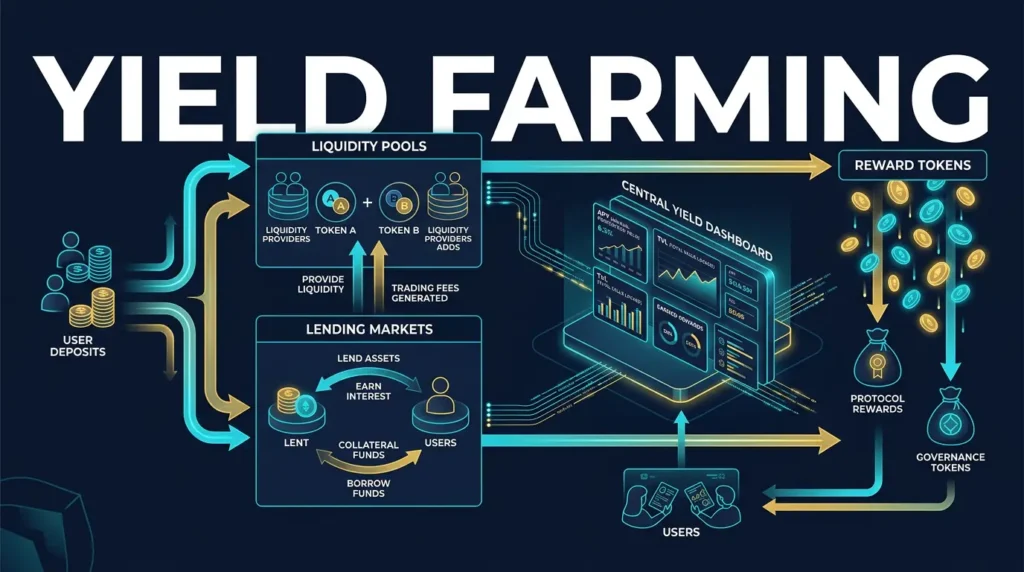
Yield farming is the practice of depositing crypto assets into DeFi protocols in order to earn returns from trading fees, lending activity, token incentives, or some combination of those sources. In many cases, the assets are placed into liquidity pools that other users trade against. In other cases, they are routed through lending markets, vaults, or structured strategies that stack several on-chain reward streams together.
The important idea is that farming yield is not a magic bonus attached to holding a token. The return comes from making your assets available to a protocol that needs capital for some function, such as enabling swaps, supporting lending, or attracting early liquidity. That is why the right question is always: what service is my capital providing, and who is paying for it?
This content is for educational purposes only and should not be considered financial or investment advice.
Yield exists because your capital serves a function someone pays for.
Key Takeaways
- Yield farming is DeFi capital deployment for return: Users place assets into protocols that pay fees, incentives, or both.
- The return can come from multiple layers: Trading fees, borrowing demand, governance-token emissions, and vault strategies can all contribute.
- Farming is not the same as staking: Staking secures a network; farming usually provides capital to a DeFi application.
- Headline APY can be misleading: Temporary token emissions often make farming returns look better than the underlying economics.
- The mechanism matters more than the label: If you cannot explain where the yield comes from, the strategy is probably not understood well enough.
What Is Yield Farming in Practice?
At the practical level, yield farming means allocating assets into a protocol that rewards you for supplying useful liquidity or usable capital. In a DEX pool, that capital helps other users swap tokens. In a lending market, it helps borrowers access funds. In a vault strategy, it may be moved between multiple protocols to capture several types of yield at once.
A useful mental model is to think of farming as renting out crypto inventory. Your assets are not just sitting there. They are being used by a system, and the system pays you in exchange for access to that capital. The hard part is that the payment can come from different places, and some of those places are far more durable than others.
Where the Yield Comes From
The most important step in evaluating any farming position is separating the return into its real components. A protocol may advertise one APY, but that number can hide several very different sources of return.
- Trading fees: DEX users pay fees when swapping through liquidity pools.
- Lending interest: Borrowers pay for access to supplied capital in lending markets.
- Protocol incentives: Governance tokens or emissions are distributed to attract liquidity.
- Compounding strategies: Vaults may reinvest rewards automatically to increase displayed APY.
One operator insight is that not all of these sources are equally trustworthy. Trading fees and borrowing demand come from real usage. Incentive emissions come from subsidy. A protocol paying most of its yield through inflationary token rewards may be buying growth temporarily rather than generating durable return.
How Liquidity Pools Fit Into Farming
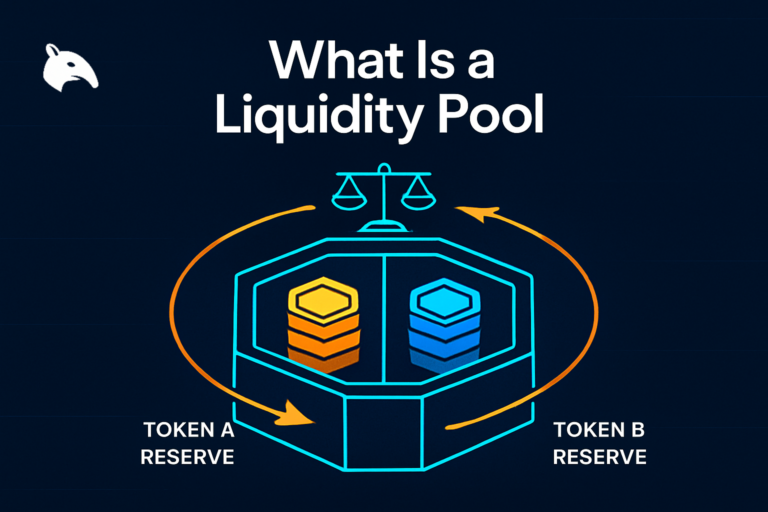
Liquidity pools are one of the most common farming venues. Users deposit assets into a pool, traders swap against that pool, and the protocol distributes fees to liquidity providers. Some protocols then add extra reward tokens on top of those fees, turning a basic LP position into a broader farming strategy.
That is why a liquidity pool is best understood as the mechanism and farming as the return strategy layered on top. For the direct mechanism explainer, see What Is a Liquidity Pool.
Why Farming Can Show Very High APY
Farming APY can spike because protocols often use token incentives to attract deposits quickly. If the reward token is priced optimistically and emissions are heavy, the annualized return can look enormous. But those numbers often depend on conditions that are unlikely to remain stable for long: high token price, sustained user interest, and continued volume or borrowing demand.
A second mental model helps here: a farming APY can be like a store discount funded by handing out coupons that the store itself printed. The value looks attractive at first, but the real question is whether those coupons still hold value once more people start selling them. That is why the source of the yield matters more than the percentage shown on day one.
How Yield Farming Differs From Staking
Staking and farming are often grouped together because both can produce on-chain yield, but they do different jobs. Staking helps secure a proof-of-stake network and earns protocol rewards. Farming usually helps a DeFi application attract capital, enable trading, or support lending activity. The return stream, risk profile, and sustainability are therefore different.
The direct comparison is already covered in Yield Farming vs Staking. The short version is that staking usually offers cleaner economics and lower operational complexity, while farming often offers more moving parts and more ways for the yield number to mislead.
Why Yield Farming Can Be More Complex Than It Looks
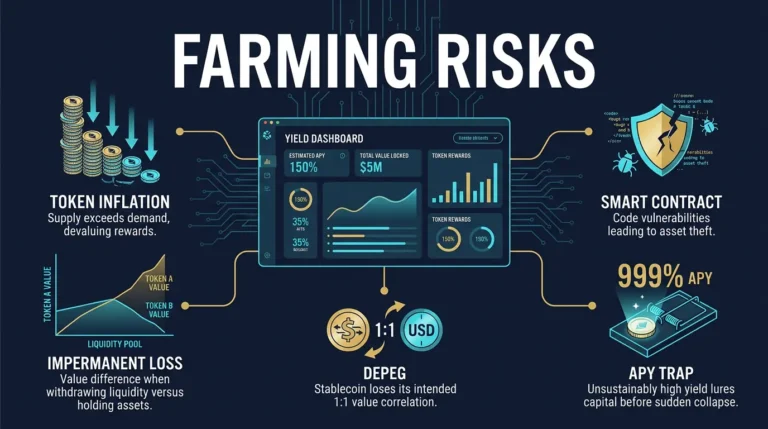
A farming position can involve multiple overlapping risks and dependencies. The deposited assets can move in price. The pool can rebalance. The reward token can weaken. The protocol can lose users. The smart contract can fail. And the displayed APY can change quickly when more capital enters or incentives are reduced.
This is why a farming position is rarely just “deposit and forget.” Even simple-looking vaults and pools often depend on liquidity depth, user demand, peg stability, and ongoing protocol credibility.
What Regular Users Should Watch
- What exact protocol action creates the return?
- How much of the APY comes from fees versus token incentives?
- What happens if the pair diverges sharply in price?
- What happens if the “stable” side of the position depegs?
- Would this position still be attractive without the bonus token emissions?
Those questions matter because many farming positions fail economically before they fail technically. The smart contracts may keep running while the strategy itself becomes unattractive or actively harmful relative to simply holding the assets.
Practical Usage: How to Read a Farming Opportunity
- Start with the mechanism: Is this a pool, a lending market, or a vault strategy built on top of other protocols?
- Break the yield into components: Separate fee income, interest income, and token incentives.
- Check the hidden trade-offs: Rebalancing risk, contract exposure, and depeg risk matter as much as APY.
- Ask what happens after incentives fall: A good strategy should still make some sense without promotional emissions.
- Prefer understandable yield over impressive yield: If the explanation is vague, the return may not be durable.
A practical frame is to ask: “If I removed the reward token from this position, would I still understand why this capital is being paid?” That question often reveals whether the strategy is built on actual usage or on temporary subsidy.
For the risk-focused companion pieces, the closest local references are Liquidity Pool Risks Explained and What Is Impermanent Loss in DeFi?.
Risks and Common Mistakes
For a closely related follow-up, see Liquid Staking vs Native Staking: Mechanics, Trade-Offs, and When to Use Each.
For a closely related follow-up, see Stablecoin Depeg Risk: What Breaks the Peg and How to Evaluate It.
- Chasing the highest APY blindly: A pool showing 180% APY may be paying most of that return in a freshly emitted governance token. If emissions slow or holders start selling rewards aggressively, the token price can fall faster than the displayed APY suggests, turning a “high-yield” position into a weak one within days.
- Ignoring where the yield comes from: Fees, incentives, and borrow demand are not interchangeable sources of return. A stable pool producing steady fee income from real swaps is a very different trade from a low-usage pool whose yield exists mostly because the protocol is temporarily paying users to stay.
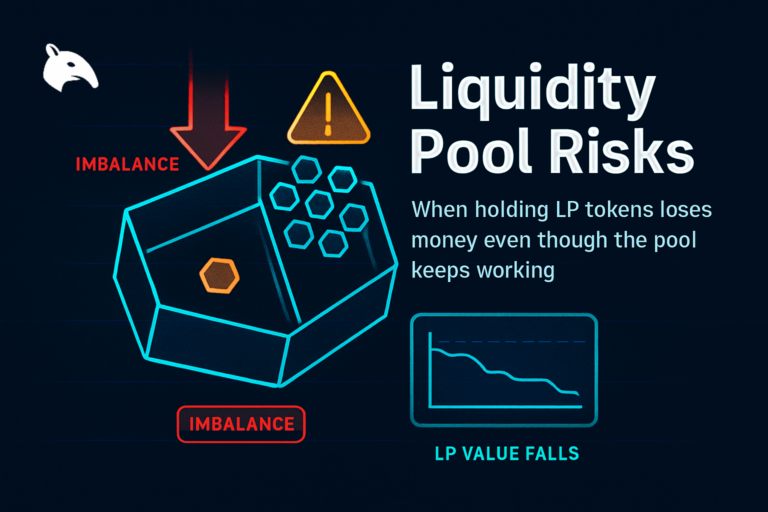
- Assuming pool yield behaves like staking yield: Farming depends more heavily on market conditions and protocol activity. For example, an LP position can look fine during calm trading but underperform badly when one asset rallies and the pool keeps rebalancing into the weaker side of the pair.
- Forgetting impermanent loss and depeg exposure: An ETH/USDC pool can lag simple holding during a sharp ETH move, while a “safe” stablecoin pair can become dangerous if one stablecoin loses its peg and the pool shifts you into more of the damaged asset.
- Treating complexity as sophistication: A vault that farms one protocol, auto-sells rewards, and redeposits into another may look advanced, but each extra layer adds contract, routing, and execution dependencies that can break or become uneconomic when market conditions change.
Sources
Frequently Asked Questions
What is yield farming in crypto?
It is the practice of placing crypto assets into DeFi protocols to earn returns from fees, borrowing demand, token incentives, or layered strategy payouts.
Is yield farming the same as staking?
No. Staking secures a proof-of-stake network, while farming usually provides capital to a DeFi application such as a pool or lending market.
Why is yield farming APY sometimes so high?
Because protocols often add aggressive token incentives on top of real fee income. Those subsidies can make the annualized return look much larger than the underlying business activity would support by itself.
Do yield farming returns always come from trading fees?
No. Returns can come from trading fees, lending interest, governance-token emissions, or auto-compounded vault strategies depending on the protocol design.
Can yield farming lose money?
Yes. A farming position can lose money through impermanent loss, token depreciation, depeg events, low real usage, or smart contract failure even if the headline APY looked attractive at entry.