

A good crypto wallet setup strategy starts by assigning each wallet a job before assigning it a balance. One wallet should protect long-term holdings, another should handle routine activity, and a smaller one may handle riskier Web3 interactions. The goal is not to own many wallets. The goal is to stop one mistake, approval, device compromise, or rushed decision from exposing every asset at once.
The practical rule is simple: the wallet that touches the most unknowns should hold the least value, and the wallet holding the most value should touch the fewest unknowns.
This content is for educational purposes only and should not be considered financial or investment advice.
Key Takeaways
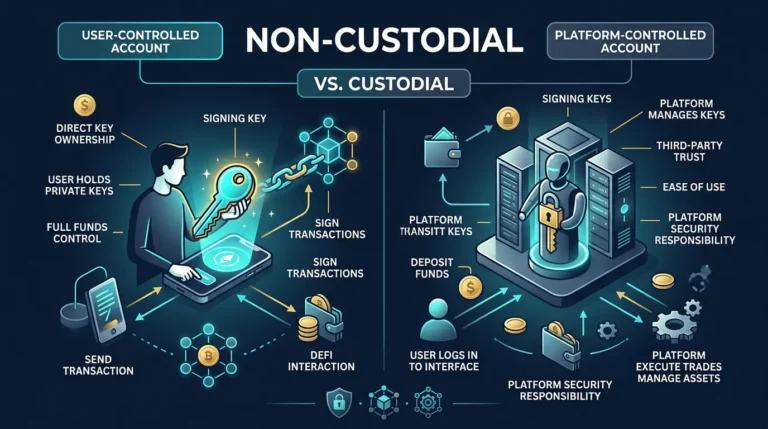
For a closely related follow-up, see Self Custody vs Custodial Wallets: Which Fits Your Risk?.
- Start with roles, not products: Decide what each wallet is for before deciding what app or device should fill that role.
- Separate value by risk and frequency: High-value storage and high-risk experimentation should not live in the same wallet.
- A simple setup is usually enough: Many users only need a vault wallet, a daily-use hot wallet, and optionally a burner wallet.
- Balance thresholds matter: Wallets become unsafe when convenience balances quietly grow into serious holdings.
- Complexity should be earned: Add more wallets only when they solve a real operational problem.
Quick Answer: A Practical Default Setup
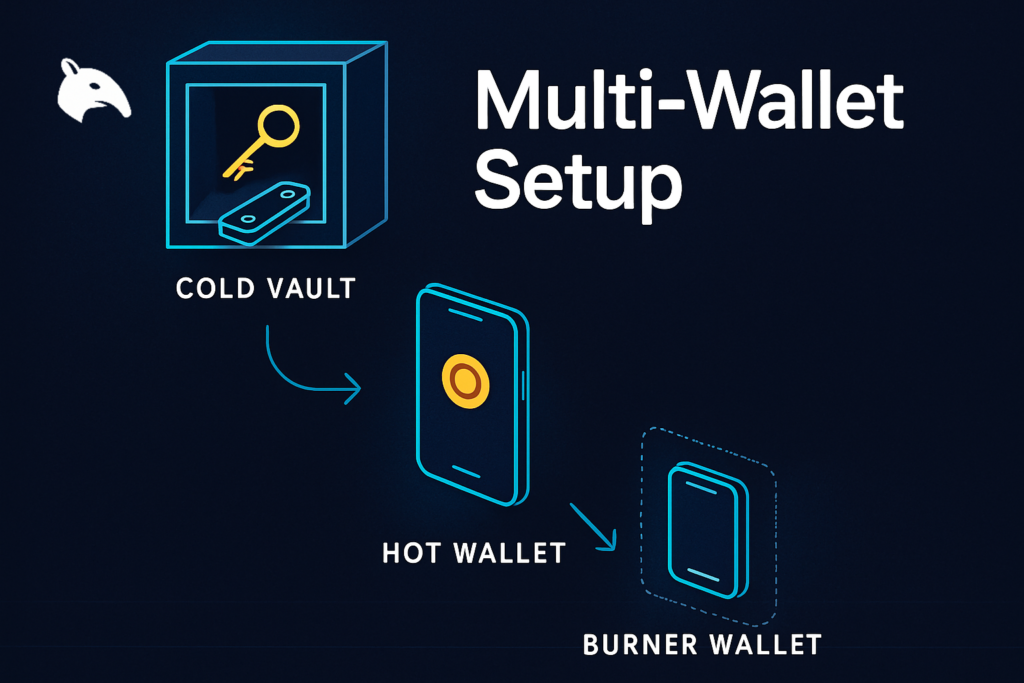
- Vault wallet: For long-term holdings and higher-value assets that rarely move.
- Hot wallet: For regular transfers, smaller balances, and day-to-day activity.
- Burner wallet: For unfamiliar dapps, claims, mints, bridges, and higher-risk approvals.
- Optional watch-only wallet: For monitoring without carrying spend authority on the same device.
If you only implement one change, separate long-term storage from active wallet activity. That single split removes a large amount of avoidable single-wallet risk.
Step 1: Decide What Each Wallet Is Allowed to Do
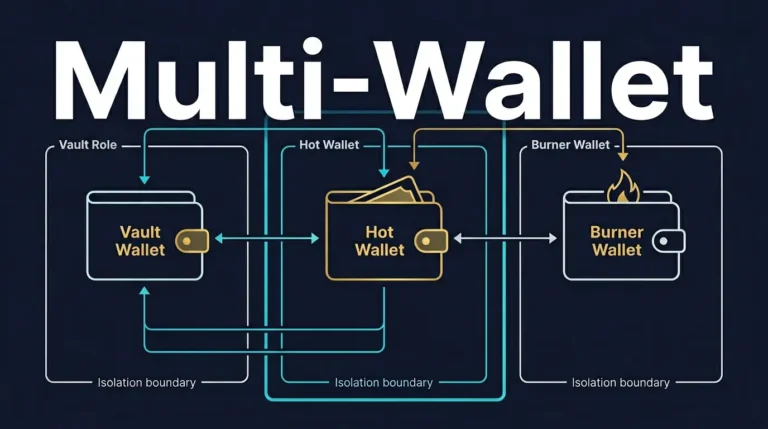
The cleanest wallet structures start with permission boundaries. Ask what actions each wallet is allowed to take. A vault wallet may be allowed to receive funds and sign rare outgoing transfers. A hot wallet may be allowed to make routine payments and connect to familiar apps. A burner wallet may be allowed to test riskier interactions but not hold meaningful balances.
This matters because users often think about wallet setup in terms of products instead of behavior. But the real security difference comes from what a wallet is exposed to, not just from what brand or interface it uses.
Step 2: Match Value to Exposure
The amount inside a wallet should reflect what that wallet is allowed to touch. High-value assets belong in the lowest-exposure layer. Smaller convenience balances belong in the higher-exposure layer. This is where many setups fail: users create separate wallets, then keep moving too much value into the easiest one because it feels convenient in the moment.
Real-world example: a user creates a hardware-wallet vault and a browser hot wallet, but gradually leaves more stablecoins and core holdings in the browser wallet because it is faster to use. The setup looks separated on paper, but the exposure keeps drifting back toward the most convenient layer. A wallet strategy only works if the balance discipline follows the role design.
Step 3: Build Around Three Common Roles
Vault wallet
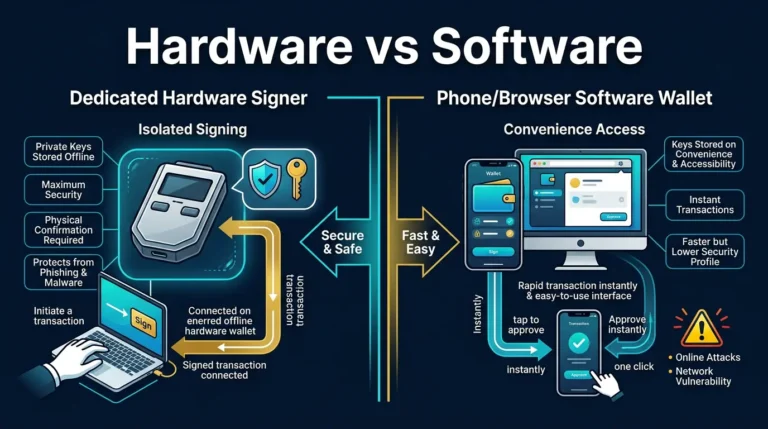
This wallet is for long-term storage, larger balances, and slower deliberate access. It should usually be the least connected wallet in the system. Many users pair this role with a hardware wallet or colder storage practice because the job is protection first, convenience second.
For a closely related follow-up, see How Much Crypto Should You Keep on an Exchange? A Safer Framework.
Hot wallet
This wallet is for routine transfers, active use, and balances that need convenience. It should hold enough to be useful, but not so much that a compromise becomes financially devastating. Operator insight: the hot wallet should feel replaceable, even if losing it would be annoying.
Burner wallet
This wallet is for unfamiliar dapps, one-off claims, mint pages, bridge tests, and workflows likely to create risky approvals or uncertain trust relationships. If you need the narrower definition first, the local explainer is What Is a Burner Wallet in Crypto?. If you need the decision layer, the next step is When to Use a Burner Wallet.
Step 4: Decide Where Watch-Only Monitoring Fits
Some users want visibility into the vault layer without carrying spending authority on the same phone or laptop. That is where a watch-only wallet becomes useful. It lets you monitor balances and incoming activity while leaving the signing keys in a more isolated environment.
The local explainer there is What Is a Watch-Only Wallet? How It Works. The main point for a wallet setup strategy is that visibility and signing do not always need to happen on the same device.
Step 5: Set Refill and Sweep Rules
A wallet setup stays safe only if money moves through it according to rules rather than mood. Decide in advance when the hot wallet gets refilled and when excess value gets swept back to the vault. Do the same with the burner wallet: decide how much it may hold and when it should be emptied or replaced.
Real-world scenario: a user says the hot wallet is “only for convenience,” but never moves gains back out after a rally. Weeks later, the convenience wallet contains far more value than the original plan allowed. The setup did not fail because the wallets were wrong. It failed because the balance rules were missing.
Step 6: Keep the Setup Understandable
Complexity can become its own risk. If you cannot clearly explain which wallet is for what, where the backups are, and what amount belongs in each bucket, the design may already be too complicated for daily use. A smaller clear system is usually safer than a sophisticated one you only half remember.
This is why the best starting point for many users is not a five-wallet architecture. It is the live bridge article 2-wallet setup in crypto, followed by selective expansion only when a real use case appears.
What a Good Setup Usually Looks Like for Most Users
For many people, a practical default is straightforward:
- One vault wallet: Higher-value assets and long-term holdings.
- One hot wallet: Normal transfers and familiar daily activity.
- One burner wallet only when needed: New dapps, claims, or unknown workflows.
This setup is often enough because it creates real separation without turning wallet management into a full-time system. The broader storage logic is covered in How to Store Crypto Safely. This article focuses on how to divide the jobs.
When a Setup Needs to Grow Beyond the Basics
You may need more structure if you manage business funds, maintain distinct personal and protocol wallets, need treasury oversight, or want stronger separation between different chains or asset groups. But those additions should answer a concrete problem. More wallets without a concrete reason usually means more room for confusion.
If you are still working from the definition layer, the clean conceptual background is What Is a Multi-Wallet Strategy in Crypto?. This article is the practical implementation layer on top of that idea.
Practical Usage: Questions to Ask Before Finalizing the Setup
- Which wallet should never connect to unknown apps?: That should usually be your vault layer.
- How much value is acceptable in the hot wallet?: Pick a number or range instead of leaving it undefined.
- Which actions justify a burner wallet?: Write down your own trigger moments, such as claims, mints, or new bridges.
- How will you monitor long-term holdings?: Decide whether watch-only visibility adds value without increasing spend exposure.
- What rule moves excess value back to safety?: Good setups use thresholds, routines, or schedules instead of good intentions.
A practical shortcut is this: if a wallet is frequently online, frequently signing, or frequently approving, it should not also be the wallet carrying the value you would least want exposed.
Risks and Common Mistakes
- Designing roles but ignoring balances: A user may label one wallet a vault and another a hot wallet, then still leave too much value in the hot layer because it is easier to access.
- Creating too many wallets too early: More separation sounds safer, but a setup you cannot explain clearly can create backup mistakes, misplaced funds, or wrong-wallet signing errors.
- Letting the burner wallet become permanent: A wallet created for one risky task can quietly accumulate approvals, assets, and history until it no longer behaves like a contained exposure bucket.
- Assuming product choice solves the whole problem: Even a strong hardware wallet does not fix sloppy refill rules, unclear role boundaries, or careless signing habits in the rest of the setup.
Sources
Frequently Asked Questions
How should I structure a multi-wallet setup?
Start by separating long-term storage, routine activity, and higher-risk interactions into different wallet roles, then size each wallet balance to match that role.
What wallets do most users need?
Many users only need a vault wallet for long-term holdings, a hot wallet for everyday use, and a burner wallet only when unfamiliar or riskier interactions justify it.
Should my hot wallet and vault wallet ever be the same?
Usually no. The wallet used for frequent activity should normally be different from the wallet protecting higher-value long-term assets.
When should I add a burner wallet?
Add one when you are interacting with unfamiliar dapps, claims, mints, bridges, or approval-heavy workflows where you want smaller exposure than your normal wallet allows.
Do I need a watch-only wallet in the setup?
Not always, but it can help if you want to monitor long-term holdings without carrying spend authority on the same device you use every day.