

Last Updated on April 10, 2026 by Snout0x
A watch-only wallet lets you monitor balances, addresses, and transaction history without storing the private keys needed to spend funds. It is useful because it separates visibility from signing authority. That means you can track a wallet from a phone or desktop app while keeping the actual signing keys somewhere else, such as a hardware device or offline setup.
A simple mental model is to think of it as a bank statement without the debit card. You can see what is there, what came in, and what went out, but you cannot authorize a transfer just by looking at the account history. That makes the concept much easier to place inside a broader wallet setup.
This content is for educational purposes only and should not be considered financial or investment advice.
Simple Definition
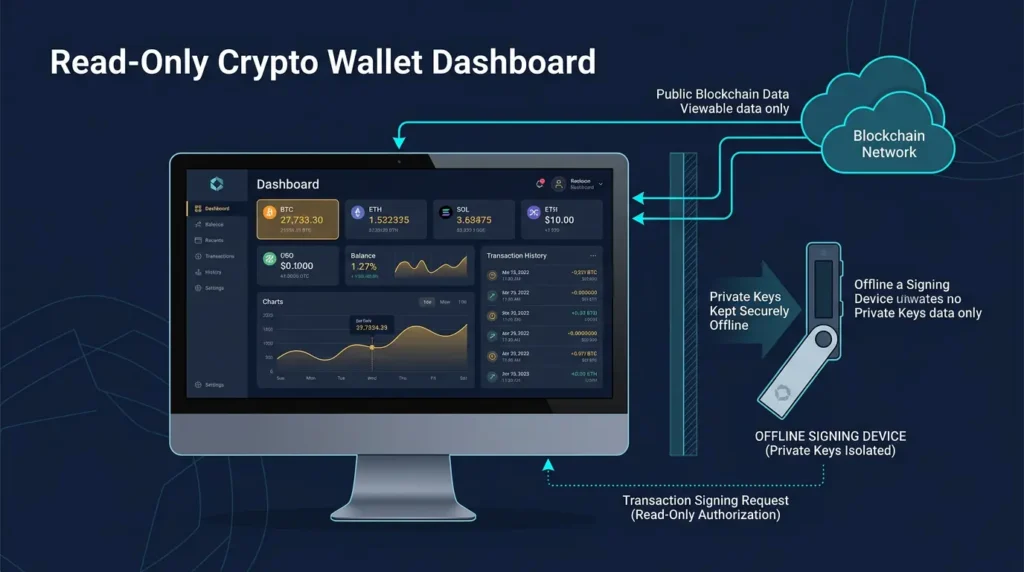
A watch-only wallet is a read-only wallet view. It can display addresses, balances, and incoming or outgoing transactions, but it cannot create a valid signature to move funds. The software can observe blockchain activity connected to a public key, address set, or extended public key, but it does not have the secret material needed to authorize spending.
That is the core distinction. A normal wallet both watches and signs. A read-only wallet watches only. In practice, this means the app can help you track holdings or verify incoming payments while leaving the actual spend authority in a separate environment.
A watch-only wallet is not a separate custody model. It is a monitoring layer that helps you see activity without moving signing authority onto the same device. In practical terms, it lets you keep convenience on one device and spend authority somewhere more isolated.
Why a Watch-Only Wallet Matters
Many users want visibility without exposing the keys that control funds. A read-only wallet provides that separation. You can check balances from a regular phone, monitor addresses for incoming payments, or follow a long-term holding without carrying the signing secret into an internet-connected device every time you want an update.
This is easiest to understand in contrast with a normal wallet: a normal wallet both watches and signs, while a watch-only wallet only watches.
This matters in self-custody because convenience and exposure often pull in opposite directions. A watch-only setup is one way to reduce unnecessary contact between everyday devices and the keys that actually control funds.
It is also useful for oversight. Someone can monitor treasury addresses, savings wallets, or incoming business payments without having the ability to spend. That makes the concept relevant beyond personal storage. It is about permission boundaries, not just convenience.
How a Watch-Only Wallet Works
The wallet works by importing public information rather than secret signing material. That public information is enough to observe the blockchain state, but not enough to authorize a spend.
It imports addresses or public derivation data
At the simplest level, a watch-only setup can import a single public address and then monitor that address for balances and transactions. More advanced versions can import an extended public key, often called an xpub, which lets the software derive many receive addresses from the same account structure without learning the private keys. That is why these wallets are often useful for monitoring larger address sets rather than only one destination.
If you need the address and derivation background, How Public Keys Become Wallet Addresses explains how public information can be used for receiving and tracking without revealing the private side of the keypair.
It observes transactions but cannot sign them
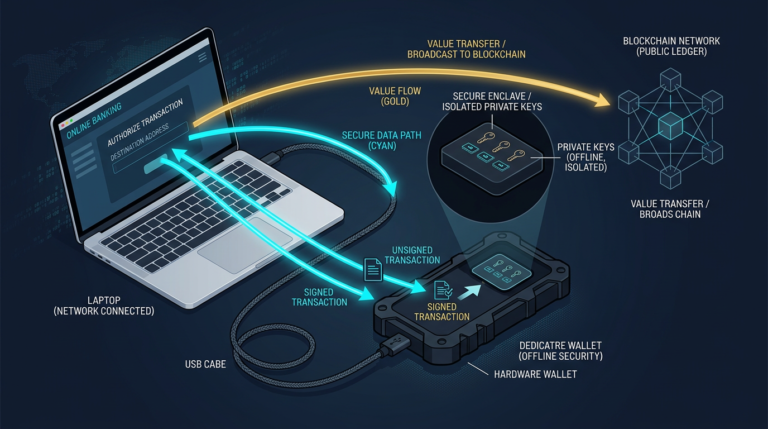
The software queries blockchain data for the imported addresses and updates the visible balance and transaction history. It may build unsigned transactions for review, but without the private key or signing device it cannot finalize them. That is the real security boundary. Visibility is present. Spend authority is not.
This is easiest to understand alongside What Is Transaction Signing in Crypto. A valid transaction needs a signature from the secret key. A read-only wallet can help you see what would be spent, but it cannot produce the signature that makes the spend valid.
It is often paired with a separate signing environment
A common pattern is to keep the signing keys on a dedicated device while using a read-only app for routine monitoring. That lets users check balances and addresses without plugging in the signer or exposing recovery material more often than necessary. The concept is not a replacement for secure storage. It is a companion view layered on top of it.
That is why the concept often appears in multi-wallet operational setups, but the monitoring layer is still narrower than the full strategy. The read-only view handles visibility. The signer handles approval.
Practical Usage: Common Mistakes
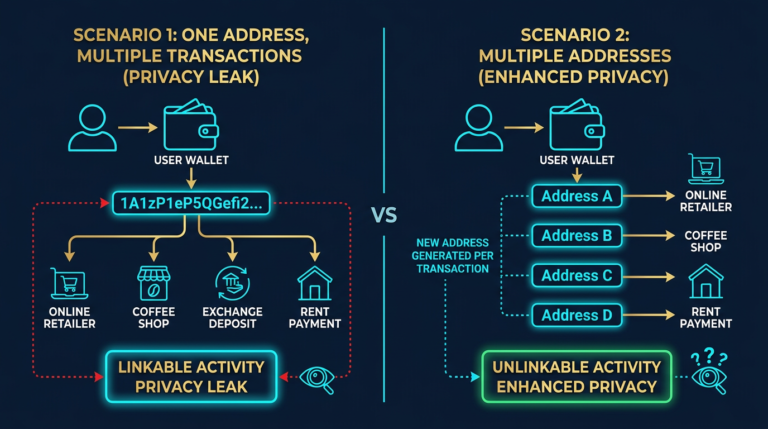
The first common mistake is assuming read-only means risk-free. It is safer than carrying private keys around unnecessarily, but it still exposes sensitive information if the imported addresses or xpub are shared too broadly. A monitoring setup can reveal balances, payment timing, and address relationships even when it cannot spend.
The second mistake is confusing a watch-only wallet with a backup. It is not a recovery method and it does not hold the signing secret. If the signing device and recovery phrase are lost, the read-only app does not restore access. It only preserves visibility into what you no longer control.
The third mistake is over-expanding the concept into a complete wallet strategy. This article is narrower. It explains the monitoring layer, not the entire custody architecture. If you want the broader role-based framework, How to Choose a Crypto Wallet is the better next step.
Security and Risk Considerations
The biggest security benefit here is reduced key exposure. If your phone only holds public wallet data, losing that phone is usually less dangerous than losing a hot wallet with active signing authority. But reduced key exposure is not the same as no exposure. Public wallet data can still reveal useful information about your holdings and activity.
That matters because privacy and key safety are separate problems. A read-only wallet can improve one while leaving the other unchanged. If the imported addresses are linked to your identity, the monitoring app may still reveal balance size, transaction timing, or address clusters. For the privacy side of that issue, Wallet Address Reuse Risks: What It Exposes On-Chain is the better next step.
There is also an operational trust issue around what exactly you import. Sharing a single address exposes one address. Sharing a broader public derivation path can expose much more of the wallet structure. The monitoring tool still cannot spend, but it may reveal more of your financial map than you intended. A watch-only setup reduces one kind of risk while creating visibility trade-offs that users should understand clearly.
Frequently Asked Questions
Can a watch-only wallet spend funds?
No. It can monitor balances and transactions, but it cannot create the valid signature required to move funds.
Is a watch-only wallet safer than a hot wallet?
For key exposure, usually yes, because it does not carry signing secrets. But it can still reveal sensitive wallet information, so it improves security differently than a fully signing wallet does.
Does it hold my recovery phrase?
No. A read-only wallet should not hold the seed phrase or private keys. It works from public wallet data only.
Why would someone use one with a hardware device?
Because it allows routine balance checks and payment monitoring without bringing the signing device into daily use every time.
Can it reduce privacy?
Yes. If the imported address or public derivation data is exposed, it can reveal balances, transaction timing, and wallet structure even though it cannot spend.
Sources
- BIP-32 Specification – Background on hierarchical deterministic wallets and extended public keys.
- Bitcoin Developer Documentation – Useful reference for key handling, addresses, and wallet behavior.
- NIST Digital Identity Guidelines – General baseline for authenticator trust and credential separation.