

Last Updated on March 30, 2026 by Snout0x
What Is Impermanent Loss in DeFi?
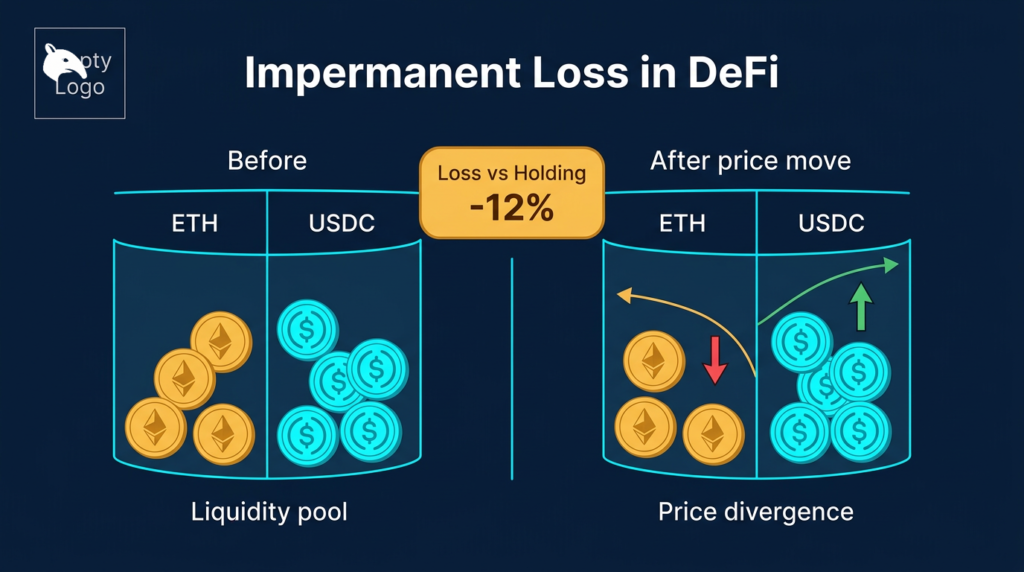
Impermanent loss is a reduction in the value of your position in a decentralized exchange liquidity pool compared to simply holding the same assets in your wallet. It happens whenever the price ratio between the two tokens in a pool changes after you deposit.
The more the ratio changes, the larger the loss. It is called “impermanent” because the loss only locks in when you withdraw; if prices return to their original ratio, the loss disappears. In practice, prices rarely return to the exact entry ratio, and fees earned may or may not compensate for it.
A simple way to think about impermanent loss is that the pool keeps selling some of your winners and buying more of your laggards every time the price ratio moves. You still own value, but you no longer own the same mix of assets you started with. That is why the comparison is always against simply holding the original tokens outside the pool.
This content is for educational purposes only and should not be considered financial or investment advice.
How AMM Liquidity Pools Work
Before understanding impermanent loss, you need to understand how automated market maker (AMM) pools work in decentralized finance (DeFi). A classic AMM pool like Uniswap V2 maintains a constant product formula: x times y equals k, where x and y are the quantities of two tokens and k is a constant. When someone trades Token A for Token B in the pool, the trade adjusts the quantities of both tokens to maintain k. The pool automatically reprices based on supply and demand.
As a liquidity provider (LP), you deposit both tokens in the pool at the current ratio. You receive LP tokens representing your proportional share of the pool. When the price ratio changes (one token appreciates relative to the other), the pool automatically rebalances by having traders arbitrage against the new market price, changing the quantity of each token you effectively hold.
Why Pool Rebalancing Causes Loss
Imagine you deposit 1 ETH and 2,000 USDC into a pool when ETH is $2,000. Total deposit value: $4,000. Now ETH appreciates to $4,000. Arbitrageurs see that the pool’s ETH is underpriced relative to external markets and buy ETH from the pool. This raises the pool’s ETH price to the market level but reduces the amount of ETH in the pool (and increases USDC). When you withdraw, you get roughly 0.707 ETH and 2,828 USDC, which is worth about $5,656 at the new price.
If you had simply held your original 1 ETH and 2,000 USDC, you would have $4,000 + $4,000 = $6,000. The difference ($6,000 – $5,656 = $344) is the impermanent loss on a 100% price move. In percentage terms, a 2x price change in one token relative to the other produces approximately 5.7% impermanent loss. A 4x change produces approximately 20% loss. A 10x change produces approximately 42% loss.

When Pool Loss Is Most Severe
Impermanent loss is most significant when:
- You are providing liquidity for a volatile/stable pair (ETH/USDC, BTC/USDC). When one token is stable and the other appreciates, you end up holding more of the stable and less of the appreciating asset.
- The price move is large and sustained. A 10x price increase causes approximately 42% impermanent loss relative to holding.
- You are in a low-fee pool where trading fee income does not offset the opportunity cost.
Impermanent loss is least severe when:
- Both tokens move together (correlated pairs like stETH/ETH or WBTC/renBTC). If both tokens appreciate together at the same rate, the price ratio stays constant and impermanent loss is near zero.
- You are in a stablecoin-to-stablecoin pool (USDC/USDT). If both tokens stay near peg, the price ratio barely changes.
- Fee income is high enough to compensate. High-volume pools generate substantial trading fees that can outweigh impermanent loss.
Why “Impermanent” Is Somewhat Misleading
The term “impermanent” creates a false sense of security. The loss is only reversed if the price ratio returns exactly to your entry ratio. In a strong bull market, ETH may go from $2,000 to $4,000 and never come back below $3,000 while you are an LP. Your loss versus holding locks in when you exit, which you will have to do eventually.
More accurate terms would be “divergence loss” or “rebalancing loss,” which better capture that the mechanism is the pool continuously rebalancing toward lower-appreciating tokens. These terms have gained traction in the DeFi research community but the “impermanent” label persists in common usage.
The intuitive takeaway is that impermanent loss is not a bug, fee, or exploit. It is the pool doing exactly what it was designed to do: stay balanced for traders. The cost is borne by the liquidity provider whenever the two assets stop moving together.
Practical Usage: Compare Fees vs Divergence
The economic case for providing liquidity is that trading fee income offsets or exceeds impermanent loss. In some pools, this is true: a high-volume stable pair can generate 10 to 30 percent annual fee income with near-zero impermanent loss. In others, it is not: a low-volume volatile pair can produce 2 percent annual fees while the underlying price move causes 20 percent impermanent loss.
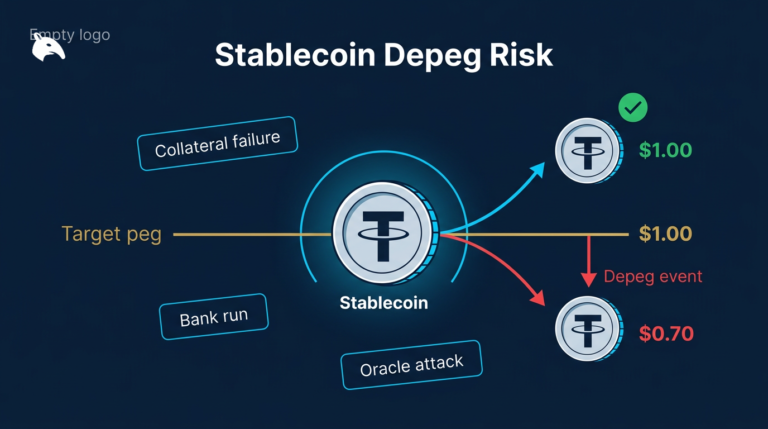
In stablecoin pools, the assumption of low divergence only holds while the peg remains credible, which is why stablecoin depeg risk matters when estimating expected loss versus fees.
This trade-off is one reason yield farming vs staking creates very different risk profiles even when both advertise yield.
The practical question is not whether a pool has yield, but whether the fee income is likely to outpace the rebalancing loss for that specific pair. Correlated pairs can survive with lower fees. Volatile pairs need much stronger fee generation to justify the same deposit.
Before depositing, compare the pair type first. A stablecoin pair and an ETH/USDC pair may both advertise yield, but they are not exposing you to the same mechanism.
Evaluating an LP position requires comparing expected fee income against expected impermanent loss for the specific price range and volatility of the assets. Uniswap analytics and similar LP dashboards can show historical fee generation and price divergence, but the key is still the same: are you being paid enough to keep rebalancing into the weaker side of the pair?
A practical way to apply this is to ask three questions before depositing: Are these assets correlated, how volatile is the pair, and what fee income has the pool actually produced during recent price swings? For example, a stablecoin pair can tolerate lower fees because price divergence is usually small, while an ETH/USDC pool needs much higher fee income to justify the same position. If you cannot explain where the fees come from or how large a 2x move would affect the position, you do not understand the trade yet.
Risks and Common Mistakes
The most common mistake is seeing high pool APY and assuming the fee number is the whole return story. For example, a user may deposit into an ETH/USDC pool after ETH has already started moving sharply, collect a few days of trading fees, and then discover that the pool has rebalanced them into more USDC and less ETH during the rally. The result is a position that underperformed simply holding the original assets.
Another mistake is treating correlated pairs and volatile pairs as if they carry the same trade-off. A stablecoin pair such as USDC/USDT behaves very differently from a volatile pair such as ETH/USDC. If you ignore that mechanism, you can end up chasing yield in a pool where one large price move wipes out months of fee income. The consequence is not a bug or exploit. It is the pool working exactly as designed while your expectations were wrong.
Frequently Asked Questions
Does this apply to Uniswap V3?
Yes, and it is more severe in concentrated liquidity positions. Uniswap V3 allows LPs to provide liquidity in a specific price range. Within that range, fee income is much higher. But if the price exits the range, the LP position is entirely in one token (the one that has depreciated) and earns no fees. Concentrated liquidity amplifies both the fee potential and the impermanent loss.
Can I lose more than I deposited?
In a standard AMM pool, no. The worst case is that the price ratio moves to an extreme and you end up with nearly all of one token and almost none of the other, but the total value does not go below zero. However, smart contract bugs or exploits in the pool contract could result in total loss of deposited funds, which is a separate risk.
Is the same effect seen on Curve Finance?
Curve uses a hybrid AMM that is optimized for stablecoin-to-stablecoin swaps and correlated asset pairs. Its bonding curve minimizes the rebalancing effect for assets that trade near parity. Impermanent loss exists but is much smaller than on a standard constant product AMM like Uniswap V2 for the same pool types.
Does this affect staking?
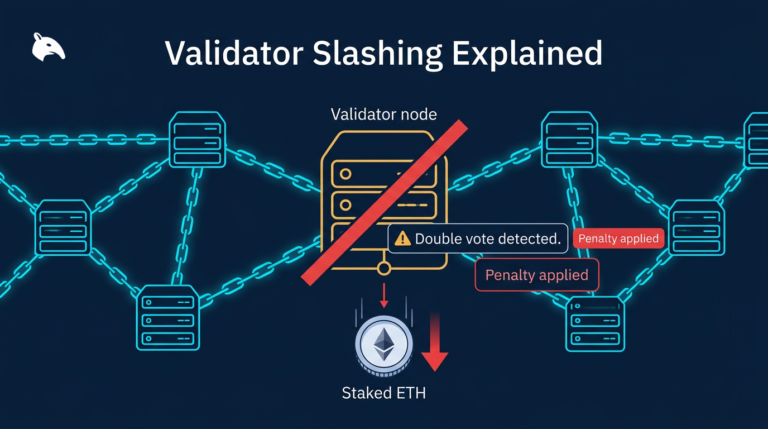
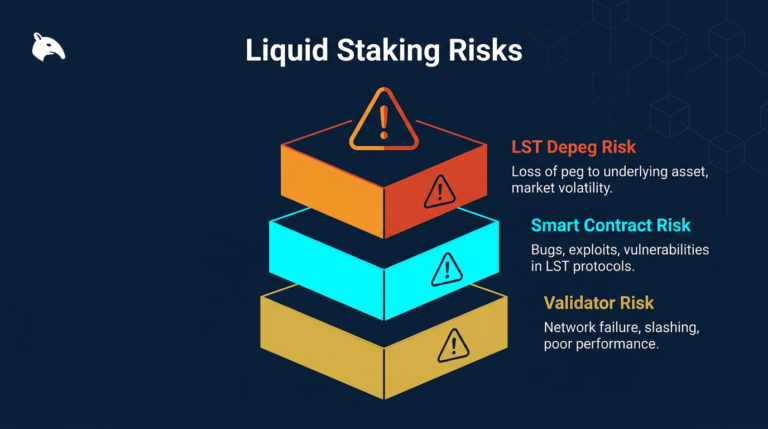
No. Impermanent loss is specific to AMM liquidity provision. When you stake a single token through a liquid staking protocol or directly as a validator, there is no price ratio or rebalancing mechanic. The risks in staking are different: slashing, protocol insolvency, and LST depeg. Impermanent loss is a DeFi liquidity provision concept.
Can I hedge against LP divergence?
Some protocols offer IL protection mechanisms that compensate LPs for divergence losses after a minimum liquidity provision period. Bancor v2.1 offered this but suspended it due to sustainability issues. Options on DeFi tokens or delta-neutral strategies can theoretically hedge IL but require sophisticated active management. For most retail LPs, the practical approach is choosing correlated asset pairs or high-fee pools where IL is less likely to dominate returns.