

DeFi stands for decentralized finance. It describes financial services built on blockchains that use smart contracts instead of relying entirely on banks, brokers, or centralized exchanges to process every action manually. In practice, that means users can trade, lend, borrow, provide liquidity, or earn yield by interacting with on-chain systems through their wallets.
The core idea is not that money suddenly exists without rules. It is that more of the rules move into transparent code and public blockchain state. Instead of a private company database updating balances behind the scenes, the financial logic is executed by smart contracts that anyone on the network can inspect and interact with.
This content is for educational purposes only and should not be considered financial or investment advice.
Quick Answer
DeFi is a blockchain-based financial system where smart contracts handle activities such as trading, lending, borrowing, and liquidity management without needing one central institution to operate each step manually.
Key Takeaways
- DeFi means on-chain finance: Financial activity runs through smart contracts on public blockchains.
- It changes the trust model: Users rely more on code, blockchain rules, and wallet control than on one company database.
- It includes many different products: Trading, lending, liquidity pools, stablecoin systems, and yield strategies all fall under the category.
- Wallets are the main access point: Users sign transactions directly instead of logging into a custodial platform for every action.
- It does not remove risk: Smart-contract flaws, bad incentives, market stress, and user-signing mistakes still matter.
What DeFi Actually Means
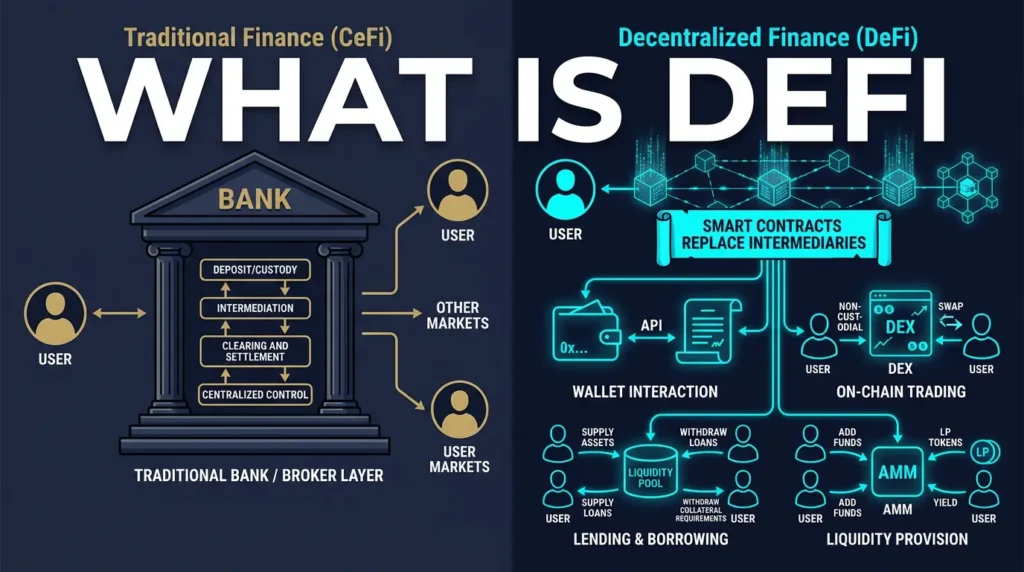
At the simplest level, decentralized finance means financial functions are carried out through blockchain-based systems rather than being controlled entirely by a single company or institution. The contracts define what happens when assets are deposited, borrowed, swapped, or withdrawn. The blockchain records those actions publicly and settles them according to network rules.
A useful mental model is to think of traditional finance as a system where the institution runs the ledger and approves the state changes, while DeFi moves more of that logic into shared code. The point is not that every person disappears from the system. Teams, interfaces, and governance groups may still exist. The point is that the financial engine itself is more visible, automated, and directly accessible on-chain.
How DeFi Works
DeFi works through smart contracts deployed on programmable blockchains. Those contracts hold assets, track balances, enforce collateral rules, distribute fees, manage liquidity, or perform other financial logic. Users interact with the contracts by connecting a wallet and signing transactions.
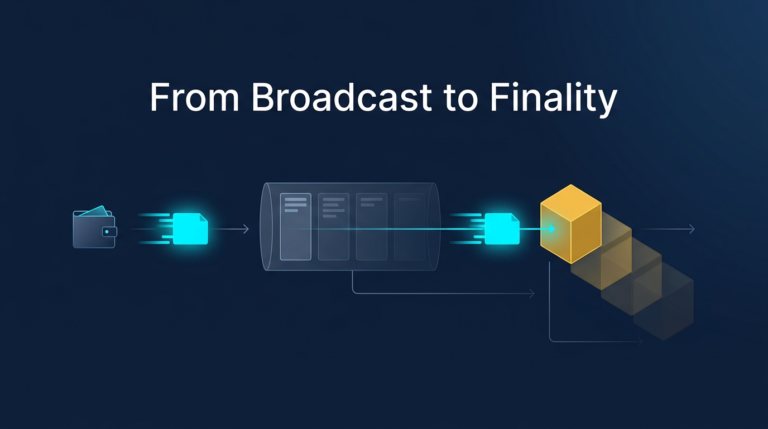
When you swap assets on a decentralized exchange, deposit collateral into a lending market, or add funds to a liquidity pool, you are not asking a support desk to update a private ledger. You are broadcasting a signed transaction that calls contract logic on-chain. The blockchain finalizes the result, and everyone can verify the updated state.
The execution layer behind this is covered best by What Is a Smart Contract?. If you want the user action behind every DeFi interaction, What Is Transaction Signing in Crypto is the cleanest follow-up.
How DeFi Differs From Traditional Finance
In traditional finance, institutions usually hold the ledger, define access internally, and settle transactions in closed systems. In DeFi, the ledger is public, the financial rules are embedded in smart contracts, and users can often interact with the system directly through a wallet if they have the right assets and network access.
That does not make the system automatically simple or safer. It just means the trust model changes. Instead of asking whether one company will honor the balance correctly, users often need to ask whether the contract logic is sound, whether the protocol incentives make sense, and whether the wallet interaction they are about to sign is safe.
Main Parts of the DeFi Ecosystem
Decentralized exchanges
These let users swap assets directly on-chain, often through liquidity pools instead of a centralized order book.
Lending and borrowing markets
These allow users to supply collateral, borrow assets, and face automated liquidation if their collateral becomes insufficient.
Liquidity pools
These are pools of assets deposited by users so other users can trade or interact with protocols without needing a centralized market maker.
Yield systems
These route capital into strategies that may earn fees, incentives, or other return sources depending on protocol design.
The most useful mechanism pages from here are What Is a Liquidity Pool, What Is Yield Farming, and Types of DeFi Protocols.
Why Wallets Matter So Much
In DeFi, the wallet is not just a storage tool. It is also the identity and authorization device for every interaction. Swaps, approvals, deposits, borrows, repayments, and withdrawals all begin with the wallet signing a transaction or message.
That makes wallet security central to DeFi usage. If you sign the wrong approval or connect to a malicious site, the blockchain can still process the action exactly as requested. The protocol is not deciding whether the request is wise. It is only deciding whether the signed instruction is valid.
Why People Use DeFi
People use DeFi for different reasons. Some want direct control over assets instead of relying on centralized platforms. Some want open access to on-chain trading, lending, or yield systems. Others want transparent market structure, composable applications, or exposure to new financial products that exist mainly in crypto-native ecosystems.
Operator insight: many users are not really choosing “decentralization” in the abstract. They are choosing a different trade-off set. They may accept more smart-contract and execution complexity in exchange for more direct asset control, broader access, and less dependence on one company account.
What DeFi Does Not Guarantee
DeFi does not guarantee safety, fairness, profits, or permanence. A protocol can be decentralized in some ways and still have powerful admin keys, weak incentives, fragile liquidity, or risky upgrade mechanisms. Smart contracts can fail. Oracle systems can be manipulated. Users can sign harmful transactions. Markets can unwind fast.
Real-world example: a user may connect a wallet to a promising yield app, see a polished interface and attractive returns, and assume the system is trustworthy because it is “on-chain.” But the underlying protocol may rely on unsustainable incentives, unaudited contracts, or approval flows the user does not really understand. The transparency of DeFi helps analysis, but it does not replace analysis.
Practical Usage: How to Think About DeFi
- Start with the financial job: Ask whether the protocol is mainly for trading, lending, liquidity, yield, or stable-value management.
- Look past the interface: The website is only one access layer; the contracts and permissions matter more.
- Understand what your wallet is signing: A valid on-chain action can still be a bad decision if you do not understand the prompt.
- Check where the return comes from: Sustainable fee flow and temporary token incentives are not the same thing.
- Treat DeFi as a system, not a slogan: Code quality, governance, liquidity, and user behavior all shape the real outcome.
A useful shortcut is this: DeFi is not “finance without trust.” It is finance where trust moves toward code, wallet control, public state, and protocol design.
If you want the foundational definition behind this concept, read What Is a DeFi Protocol? How It Works Without a Bank.
Risks and Common Mistakes
- Confusing the website with the protocol: A polished app can hide weak contracts, risky upgrade powers, or fragile token incentives underneath.
- Using yield as proof of safety: High returns may come from subsidy, weak liquidity, or unstable economics rather than durable product demand.
- Signing wallet prompts without understanding them: Approval requests, swaps, and deposits can all become irreversible on-chain actions if signed carelessly.
- Assuming “decentralized” means no trust is needed: Users still need to assess governance, oracle design, contract permissions, and market structure.
- Overlooking user-side security: Fake sites, phishing links, and malicious approvals remain major attack paths even when the protocol concept is legitimate.
Sources
Frequently Asked Questions
What does DeFi mean in simple terms?
It means decentralized finance: blockchain-based financial systems that use smart contracts instead of relying entirely on centralized intermediaries to process each step manually.
Is DeFi the same as crypto trading?
No. Trading is one part of DeFi, but the category also includes lending, borrowing, liquidity provision, stablecoin systems, and yield strategies.
Do I need a wallet to use DeFi?
Usually yes. Wallets are the main way users connect to protocols and authorize on-chain actions such as swaps, deposits, and approvals.
Is DeFi safer than centralized finance?
Not automatically. It changes the trust model, but users still face smart-contract risk, market risk, governance risk, and wallet-security risk.
What is the biggest misunderstanding about DeFi?
The biggest misunderstanding is thinking decentralization removes risk. It mainly changes where the risk sits: in code, protocol design, wallet behavior, and market structure rather than in one centralized operator alone.