


Last Updated on April 20, 2026 by Snout0x
Crypto tax reporting broke most spreadsheets years ago. In 2026 it is worse: staking rewards, LP positions, cross-chain bridges, airdrops, and wallet-to-wallet transfers each create a separate taxable event with its own cost-basis calculation. Miss one import, and the entire gain/loss chain is wrong. The IRS now receives more standardized third-party data from exchanges via Form 1099-DA, which means a mismatch between your reported gains and broker-reported proceeds is no longer invisible — it is flagged. The right tax software does not just generate forms. It reconstructs the complete transaction history that makes those forms defensible.
Tax software pays for itself the moment it catches one missing cost basis that would have inflated your reported gain.
This content is for educational purposes only and should not be considered financial, tax, or legal advice. Always consult a qualified tax professional before filing.
This article may contain affiliate links. Snout0x may earn a commission at no additional cost to you.
#1 Best for US filers: CoinLedger — strongest 1099-DA reconciliation, wallet-level basis tracking, and DeFi classification for US tax reporting.
#2 Best for international users: Koinly — supports 100+ country tax formats, stronger multi-jurisdiction coverage, excellent exchange/wallet import breadth.
#3 Best for power users / deep data: CoinTracking — most granular reporting control, deepest historical data support, free tier up to 200 transactions.
Rule of thumb: If you have more than 20 transactions, multiple wallets, or any DeFi activity, manual tracking is no longer reliable. Pick CoinLedger for US reporting, Koinly for international, or CoinTracking for maximum data control.
Key Takeaways
- Manual spreadsheet tracking breaks the moment you have staking rewards, swaps, and transfers across multiple wallets in the same tax year.
- The IRS now receives standardized crypto transaction data from exchanges. A mismatch between your return and broker-reported proceeds creates audit exposure.
- CoinLedger is the strongest option for US filers. Koinly is the strongest for international users. CoinTracking is the best fit for power users who need maximum data control.
- All three platforms identify tax-loss harvesting opportunities that often pay for the subscription cost.
- Wallet-level cost-basis tracking is no longer optional — under Rev. Proc. 2024-28, loose universal-pooling habits are much harder to defend.
Crypto Tax Software Comparison
| Dimension | CoinLedger | Koinly | CoinTracking |
|---|---|---|---|
| Best for | ★ US filers, 1099-DA reconciliation | International / multi-jurisdiction | Power users, deep historical data |
| Jurisdiction fit | US-focused (some intl) | 100+ countries (UK, AU, CA, DE, EU…) | US, DE, AT, selected others |
| DeFi handling | Strong (LP, staking, swaps, wrapped) | Strong (LP, staking, swaps, wrapped) | Moderate (manual adjustment often needed) |
| Free tier | Free import — pay for report download | Free tracking — pay for report download | Free up to 200 transactions |
| HW wallet / xpub import | Yes — xpub and public address | Yes — xpub and public address | Yes — xpub and public address |
| 1099-DA reconciliation | Tight integration | Generates 8949, less reconciliation depth | Basic 8949 support |
| Ideal activity type | US exchange + DeFi + cold storage | Multi-country, broad exchange mix | Legacy portfolios with years of history |
| Reporting granularity | Streamlined (8949, Schedule D, TurboTax) | Streamlined (localized per-country reports) | Maximum (25+ report types, custom filters) |
| Starting price | $49/yr (100 tx) | $49/yr (100 tx) | Free (200 tx) / $119/yr |
★ #1 — CoinLedger
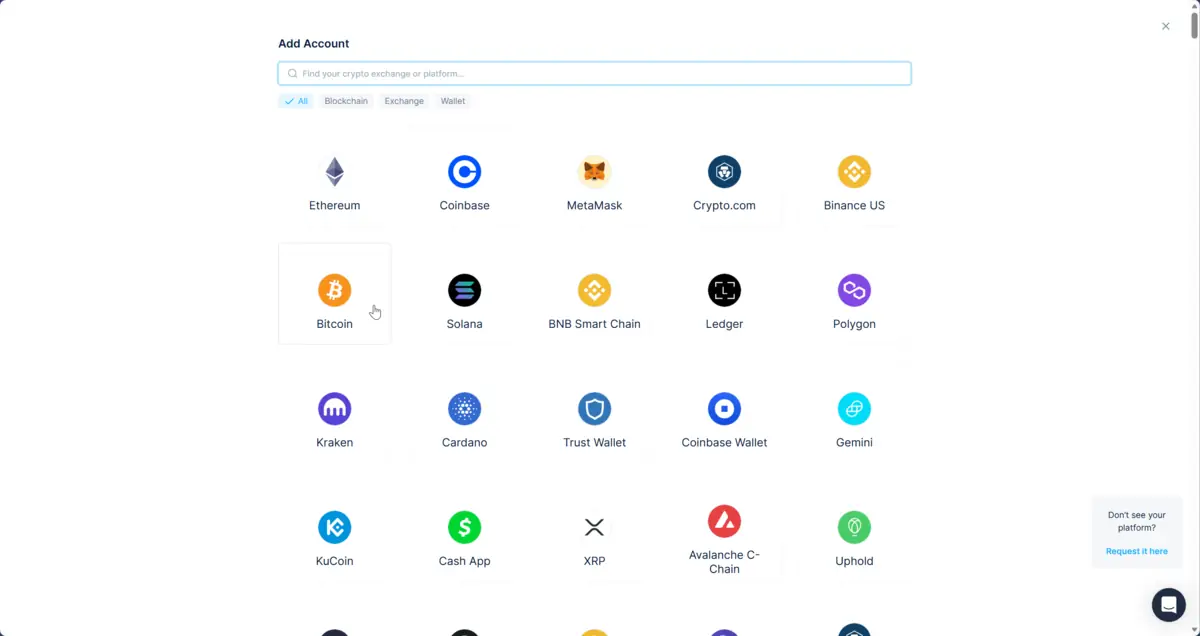
Best for: US filers who need 1099-DA reconciliation, wallet-level basis tracking, and DeFi classification.
Price: $49/yr (Hobbyist, 100 tx) — $299/yr (Unlimited).
Trade-off: US-focused. International users with non-US tax formats get better support from Koinly.
Try CoinLedger Free — Code CRYPTOTAX10 for 10% Off →CoinLedger is the best crypto tax software for US filers in 2026 because it is built around the specific problems this filing season creates. The platform pulls transaction history from exchanges and wallets via API or public address, reconstructs the cost-basis chain across all of them, and generates pre-filled IRS Form 8949 and Schedule D reports.
The feature that matters most in 2026 is 1099-DA reconciliation. When a broker reports gross proceeds to the IRS but does not have your full basis history (because you transferred assets in from self-custody), your return needs to show the complete basis record. CoinLedger is designed to close that gap by importing your full wallet history and matching it against broker-reported data.
For DeFi users, CoinLedger handles LP positions, wrapped tokens, staking rewards, and token swaps without misclassifying them as simple sales. It also identifies tax-loss harvesting opportunities — unrealized losses you can strategically realize to offset gains. This single feature often pays for the subscription.
- Built for US tax workflows (Form 8949, Schedule D)
- Strong 1099-DA reconciliation for 2025/2026 filings
- Wallet-level basis tracking (Rev. Proc. 2024-28 aligned)
- Strong DeFi classification (LPs, staking, swaps)
- Tax-loss harvesting identification
- Free import — only pay when downloading reports
- TurboTax, H&R Block, and TaxAct integration
- US-focused — weaker coverage for non-US tax jurisdictions
- Per-year pricing model (pay each tax year separately)
- Some DeFi edge cases still require manual review
Who should skip CoinLedger: International users who need local tax format support for non-US jurisdictions. Koinly covers 100+ countries with localized reporting. Users with fewer than 20 simple exchange trades per year may not need paid software yet.
#2 — Koinly
Best for: International users (UK, EU, AU, CA, and 100+ countries) and US filers who need broader jurisdiction support.
Price: $49/yr (Newbie, 100 tx) — $279/yr (Trader, 10,000+ tx).
Trade-off: Strong overall coverage, but US-specific 1099-DA reconciliation is not as tightly integrated as CoinLedger’s.
Try Koinly Free →Koinly is the strongest crypto tax platform for international users. It supports localized tax report formats for 100+ countries including the UK (HMRC), Australia (ATO), Canada (CRA), Germany, and the EU. If you file taxes outside the US, Koinly is almost certainly the better fit.
Koinly also works for US filers and generates IRS Form 8949, but its core strength is the breadth of jurisdiction coverage and the largest exchange/wallet integration library in the category. DeFi support is strong — LP tracking, staking rewards, and wrapped token handling all work well. The free tier lets you import everything and preview your tax summary before paying for the actual report download.
- 100+ country tax format support (HMRC, ATO, CRA, BZSt, and more)
- Largest exchange and wallet integration library in the category
- Strong DeFi classification (LP, staking, swaps, wrapped tokens)
- Free portfolio tracking — pay only for report download
- Tax-loss harvesting identification
- Clean, modern interface with clear error flagging
- Generates IRS Form 8949 for US filers too
- US-specific 1099-DA reconciliation less tightly integrated than CoinLedger
- Wallet-level basis tracking under Rev. Proc. 2024-28 is not the core design focus
- Higher-tier plans ($279/yr for 10,000+ tx) can be expensive for high-volume traders
- Some complex multi-chain DeFi flows still need manual adjustment
For the full head-to-head breakdown, see CoinLedger vs Koinly 2026.
Who should skip Koinly: US filers whose primary concern is 1099-DA reconciliation and wallet-level basis tracking under the new US reporting framework. CoinLedger is more tightly built for that specific workflow. Users who file only in one country and need very deep US-specific compliance features will find CoinLedger a tighter fit.
#3 — CoinTracking
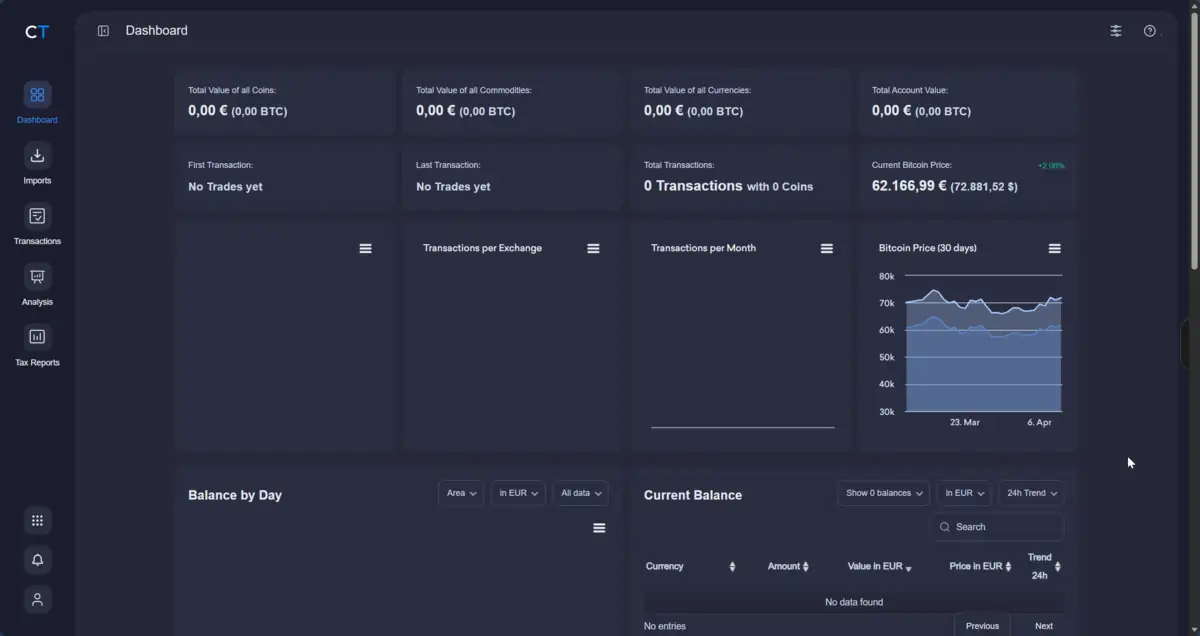
Best for: Power users who need maximum reporting granularity, deep historical data reconstruction, and full control over cost-basis methods.
Price: Free (up to 200 tx) / $119/yr (Pro, 3,500 tx) — $479/yr (Unlimited).
Trade-off: Steeper learning curve and less polished interface than CoinLedger or Koinly. DeFi auto-classification is weaker — expect more manual adjustments.
Try CoinTracking Free →CoinTracking is one of the oldest crypto tax platforms in the market and remains the deepest in raw reporting capability. It supports over 25 report types — including capital gains, income, donations, mining, margin trading, and custom filtered reports — which gives accountants and power users a level of control that neither CoinLedger nor Koinly match.
The platform’s primary strength is historical data reconstruction. If you have years of exchange activity spread across defunct platforms, CSV-only imports, and legacy wallets, CoinTracking handles that breadth better than most alternatives. The free tier covers 200 transactions — the most generous in the category — which makes it a real option for users with moderate activity who want to avoid paid plans entirely.
Where CoinTracking falls behind CoinLedger and Koinly is in DeFi auto-classification and interface polish. LP positions, wrapped tokens, and cross-chain swaps often require manual tagging, which adds friction for DeFi-heavy users. The UI is functional but dense — optimized for data control rather than guided workflows. Users who want a streamlined experience will find CoinLedger or Koinly faster to set up.
- 25+ report types (capital gains, income, mining, margin, custom)
- Deepest historical data reconstruction in the category
- Most generous free tier: 200 transactions at no cost
- Full manual control over cost-basis methods (FIFO, LIFO, AVCO, HMFO)
- Tax professional and CPA collaboration features
- Strong support for German (BZSt) and Austrian (BMF) reporting
- DeFi auto-classification significantly weaker than CoinLedger or Koinly
- Interface is dense and data-heavy — steeper learning curve
- 1099-DA reconciliation not as tightly integrated as CoinLedger
- Higher-tier plans ($479/yr Unlimited) are expensive
- No TurboTax direct integration
Who should skip CoinTracking: Users whose primary activity is DeFi (LP positions, staking, cross-chain swaps) — CoinLedger and Koinly handle automated DeFi classification much better. Beginners who want a guided workflow. US filers whose top priority is 1099-DA reconciliation.
Also Worth Knowing
Manual spreadsheet tracking — Works for users with fewer than 20 simple exchange transactions per year on a single platform, no DeFi, no staking, and no cross-wallet transfers. The moment activity crosses multiple wallets or chains, cost-basis errors compound and become nearly impossible to catch by hand. If you are still in the spreadsheet zone, you probably do not need paid software yet — but you will the moment your activity grows.
When Crypto Tax Software Becomes Necessary
Not everyone needs paid tax software. Here is the decision framework:
- Under 20 transactions, single exchange, no DeFi: Manual tracking or your exchange’s built-in report is probably enough.
- 20–100 transactions, 2+ exchanges or wallets: Tax software prevents cost-basis errors from compounding. Start with CoinLedger (US), Koinly (international), or CoinTracking (data control).
- 100+ transactions, DeFi, staking, or cross-chain activity: Paid software is not optional. Manual tracking at this scale produces errors that can trigger audit exposure.
- Multi-year history with incomplete records: Import everything into a tax platform now. Reconstructing years of activity during tax season is where the worst errors happen.
Why 2026 Is Different: The Reporting Landscape
Two regulatory developments make crypto tax software more important in 2026 than any previous year:
Form 1099-DA — The IRS now receives standardized broker-reported crypto transaction data. If the proceeds on your broker’s 1099-DA do not match the gains on your return, you need documentation showing how your cost basis was calculated. This is the core reason CoinLedger exists: it reconstructs the full basis chain that brokers cannot see. IRS guidance on Form 1099-DA.
Revenue Procedure 2024-28 — The IRS has tightened wallet-level basis tracking requirements. The old habit of treating all wallets as one pooled bucket is much harder to defend. Tax software that tracks basis per wallet, per account, per lot is no longer a convenience — it is a compliance requirement for many users. Rev. Proc. 2024-28 on IRS.gov.
A broker-reported 1099-DA shows gross proceeds — what you received when you sold. It does not show defensible cost basis — what you originally paid, adjusted for transfers, splits, and wallet movements. If you transferred crypto from self-custody to an exchange before selling, the broker has no record of your original purchase price. The IRS sees the full proceeds; without a complete basis chain, your entire gain is treated as taxable. This is the single most common source of inflated tax bills, and it is the core problem that tax software exists to solve.
Common Crypto Tax Mistakes
- Missing wallet imports. If even one exchange or wallet is missing from your import, every gain/loss calculation downstream can be wrong.
- Misclassified DeFi activity. LP deposits, bridge transfers, staking rewards, and token wrappers are frequently misread as simple sales by generic tools.
- Assuming exchange forms are complete. A broker 1099-DA reports proceeds. It does not always report correct basis — especially for transferred-in assets.
- Waiting until tax season. Reconstructing a year of multi-wallet activity in one weekend is where errors multiply fastest.
- Confusing convenience with compliance. The easiest-looking software is not always the right one if your activity spans DeFi, cold storage, staking, and multiple chains.
Verdict: Best Crypto Tax Software Overall
If you file taxes in the US, CoinLedger is the best crypto tax software in 2026. It solves the two problems that matter most this year: 1099-DA reconciliation (matching broker-reported proceeds against your actual cost basis) and wallet-level basis tracking (the stricter standard under Rev. Proc. 2024-28). The DeFi classification handles LP positions, staking rewards, and token swaps without misreading them as simple sales. The tax-loss harvesting tool identifies unrealized losses that can legally reduce your tax bill. At $49–$299/year, it costs less than one misreported trade.
If you file taxes outside the US, Koinly is the better choice. It supports 100+ country tax formats (HMRC, ATO, CRA, BZSt, and dozens more), has the broadest exchange and wallet integration library in the category, and generates localized reports that match your jurisdiction’s requirements. For multi-country filers or anyone who needs non-US tax form outputs, Koinly is the clear pick.
If you need maximum data control, CoinTracking is the right third option. It has the deepest reporting library in the category (25+ report types), the most generous free tier (200 transactions), and the strongest historical data reconstruction for legacy portfolios. It ranks below CoinLedger and Koinly because its DeFi auto-classification is weaker and its interface requires more manual effort — but for accountants, CPAs, and power users who want granular control over every cost-basis method, it is a legitimate choice.
For everyone else: if you have more than 20 transactions, the question is not whether to use tax software but which one fits your jurisdiction and activity type.
1099-DA reconciliation, wallet-level basis tracking, DeFi classification, tax-loss harvesting.
Try CoinLedger Free →100+ country tax formats, broadest exchange/wallet library, localized reports for HMRC, ATO, CRA, BZSt.
Try Koinly Free →25+ report types, deepest historical data, maximum cost-basis control, most generous free tier.
Try CoinTracking Free →For the full head-to-head comparison, see CoinLedger vs Koinly 2026. For the broader investor tool stack, see Essential Crypto Tools 2026.
Frequently Asked Questions
Will I receive a 1099-DA for my MetaMask activity?
Generally, not directly from MetaMask itself. Form 1099-DA is associated with broker reporting. However, wallet activity becomes relevant if it connects to exchange-based inflows, outflows, or sales — which is why importing your full wallet history into tax software matters.
What are the penalties for incorrect crypto tax reporting?
Consequences can include additional tax owed, interest, civil penalties, and in more serious cases, enforcement escalation. The outcome depends on the size of the error and whether the conduct appears negligent or willful.
Which crypto tax software is best: CoinLedger, Koinly, or CoinTracking?
CoinLedger is strongest for US filers because of its 1099-DA reconciliation and wallet-level basis tracking. Koinly is strongest for international users because it supports 100+ country tax formats. CoinTracking is strongest for power users who need maximum reporting granularity and deep historical data reconstruction. All three handle DeFi, but CoinLedger and Koinly auto-classify it more reliably. See CoinLedger vs Koinly 2026 for the head-to-head comparison.
Can I just do crypto taxes manually in a spreadsheet?
Yes, if your activity is minimal — under 20 transactions on a single exchange with no DeFi, staking, or cross-wallet transfers. Beyond that threshold, spreadsheets produce cost-basis errors that compound with every additional transaction.
When should I start tracking crypto transactions for tax purposes?
Immediately. Import all wallets and exchanges as early as possible. The most expensive tax errors come from reconstructing a full year of multi-wallet activity during a single tax-season weekend.
Does crypto tax software work with hardware wallets?
Yes. CoinLedger, Koinly, and CoinTracking all import hardware wallet history via public addresses (xpub or individual addresses). No private keys are shared. This is how the software tracks transfers between exchanges and cold storage.