

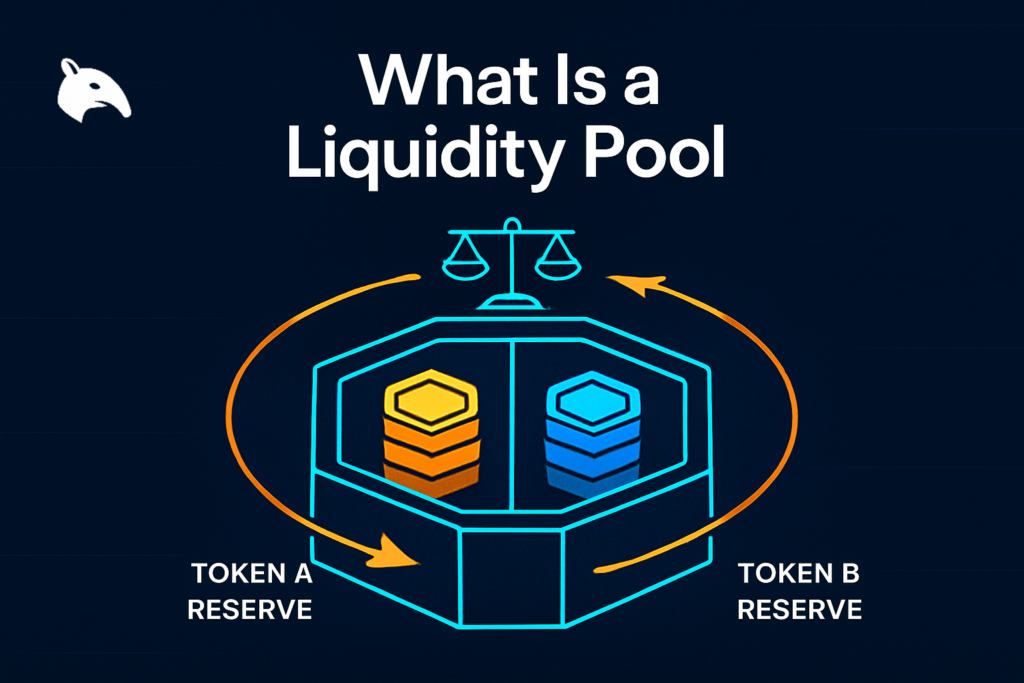
A smart-contract-controlled reserve of tokens lets users deposit assets so other users can trade against that reserve without needing a traditional order book. Instead of matching one buyer with one seller directly, the protocol lets traders swap against assets already sitting inside the pool. That is one of the core mechanisms behind decentralized exchanges such as Uniswap-style AMMs.
The simple idea is that the pool is shared market inventory. Liquidity providers contribute token pairs or other supported assets, traders pay fees to use that inventory, and the protocol updates prices according to a formula. This design is what lets DeFi trading keep working continuously even when there is no visible central market maker posting quotes the way a traditional exchange would.
This content is for educational purposes only and should not be considered financial or investment advice.
A liquidity pool is shared inventory that reprices every asset it holds with every trade.
Key Takeaways
For a closely related follow-up, see Liquid Staking Risks: What Changes When You Use a Protocol.
For a closely related follow-up, see Liquid Staking vs Native Staking: Mechanics, Trade-Offs, and When to Use Each.
- A pool is on-chain trading inventory: Users deposit assets so others can swap against them.
- AMMs replace the traditional order book with formulas: Prices move as the token balances inside the pool change.
- Liquidity providers earn fees for supplying assets: Their return comes from trader activity and sometimes extra incentives.
- Pool mechanics enable DeFi trading but create trade-offs: Repricing, slippage, and rebalancing risk are part of the model.
- The same mechanism that enables yield also creates risk: Impermanent loss and smart contract exposure come from how the pool works, not from separate add-ons.
How a Liquidity Pool Works
At the most practical level, this mechanism is a smart contract holding assets that can be swapped under predefined rules. In a classic two-token AMM, users deposit both tokens into the contract. Traders then exchange one token for the other by interacting with that contract rather than with another user on the other side of the screen.
A useful mental model is to think of the pool as a vending machine filled by the crowd. The machine always quotes a trade based on what is inside it right now. If one token gets depleted by repeated buys, the machine automatically makes the next purchase more expensive. If more of that token flows back in, the price adjusts the other way.
For the execution layer beneath that contract logic, the closest local background piece is What Is a Smart Contract?.
Traditional exchanges use order books, where buyers and sellers post bids and asks. That works well when there is enough centralized coordination and enough active counterparties. DeFi needed a more automated approach that could function on-chain without depending on one market operator constantly placing quotes. These pooled reserves solve that by putting assets into a shared reserve and using deterministic pricing rules to handle swaps.
That means a trader does not need to wait for a specific counterparty to accept a price. The trader only needs enough pool depth at the current formula-driven price. The deeper the pool, the easier it is to execute a trade with less slippage. The shallower the pool, the more the trade itself moves price.
How an AMM Pool Works
Many early DeFi pools used the constant-product model often summarized as x * y = k. Here, x and y are the quantities of two tokens in the pool and k is a constant. When a trader adds more of one token to buy the other, the balance changes and the formula reprices the pool automatically.
One operator insight is that a pool does not “know” the right market price by itself. External traders and arbitrageurs keep it in line with the broader market. If the pool drifts away from outside prices, arbitrageurs trade against it until the mismatch closes. That is helpful for market function, but it is also why liquidity providers absorb rebalancing effects when prices move.
A second mental model helps here: the pool is like a self-adjusting scale. Every trade shifts the weight on both sides. The price changes because the pool is trying to preserve its rule under the new balance, not because a human market maker manually updated a quote.
How Liquidity Providers Participate
Liquidity providers, often called LPs, deposit assets into the pool and receive a claim on a proportional share of its reserves. In many systems that claim is represented by LP tokens or an equivalent accounting record. If you own 1% of the pool, you are entitled to roughly 1% of the assets and a matching share of the fees it earns, subject to the pool’s design.
LPs are effectively renting out capital to the trading system. They are not predicting every trade individually. They are making inventory available and collecting compensation when other users consume that inventory through swaps.
Where the Yield Comes From
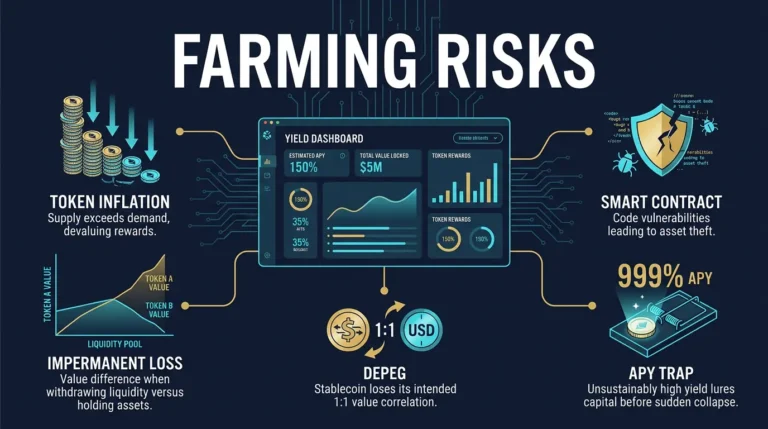
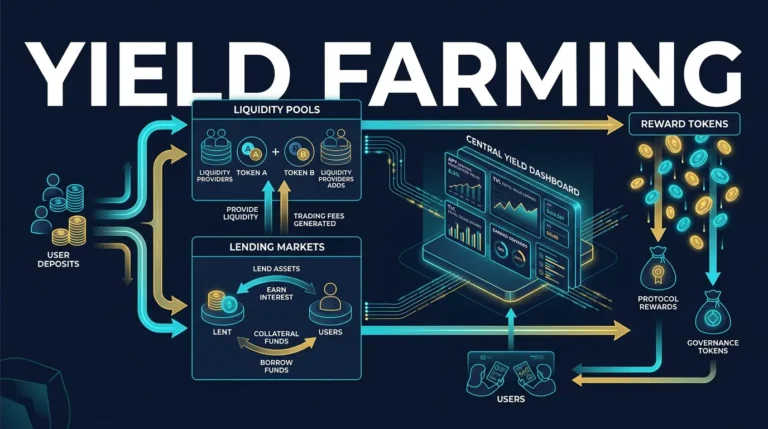
The most durable source of LP return is trading fees. When users swap through the pool, a percentage of the transaction is paid into the pool and distributed to liquidity providers according to the protocol’s rules. Some protocols also add governance-token incentives or other emissions on top of fee income, which can make the headline yield look much higher for a period.
This is why the phrase “yield” can be misleading if it is not broken down. Fee income is one source. Token incentives are another. The first depends on real trading activity. The second may depend on temporary subsidy. For the broader comparison between LP-style yield and staking yield, see Yield Farming vs Staking.
Why Pools Reprice and Why That Matters
As traders use the pool, the token balances change. That changes the price available to the next trader. Large trades move price more than small trades, especially in shallow pools. This is why liquidity depth matters so much: deeper pools can absorb larger trades with smaller price impact.
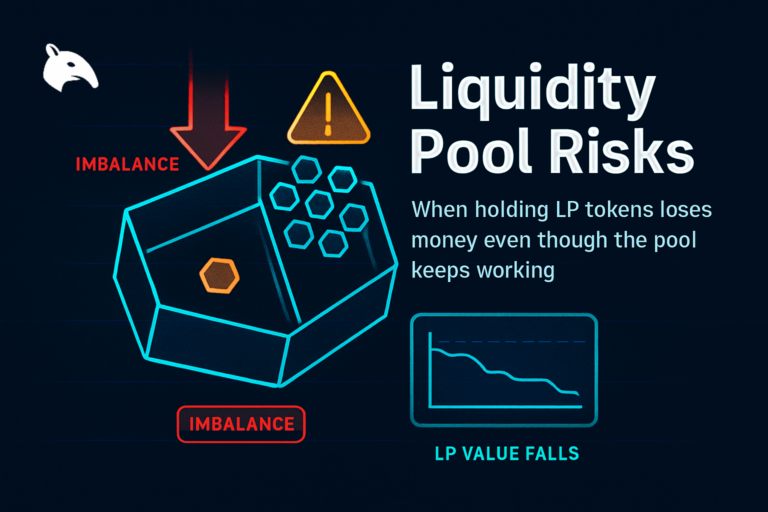
This repricing is not just a trader issue. It is also the reason LPs face rebalancing risk. When one asset in the pair moves strongly relative to the other, the pool gradually sells some of the outperforming asset and accumulates more of the underperforming one. That mechanism is the foundation of impermanent loss.
Common Pool Types
- Volatile pairs: Examples include ETH/USDC or BTC/ETH. These can earn strong fees but also face meaningful rebalancing risk.
- Stable pairs: Examples include USDC/USDT. These usually have less price divergence but depend heavily on peg stability and volume.
- Correlated-asset pairs: Examples include wrapped or liquid-staking variants that tend to move together more closely than unrelated assets.
- Concentrated-liquidity designs: Some protocols let LPs choose narrower price ranges in exchange for more active management.
Those categories matter because a pool is not one universal product. A stablecoin pool and a volatile-token pool may both advertise yield, but they expose providers to very different mechanics.
For traders, pools are what make DEX swaps available without waiting for another user to post the exact opposite order. For LPs, pools are one of the main ways to earn DeFi fee income. For the broader market, they are part of what makes decentralized trading, routing, and price discovery work continuously on-chain.
But the same mechanism that enables easy swapping also creates risk. Traders can face slippage in shallow pools. LPs can face divergence loss, contract risk, and misleading APY marketing. That is why it is important to understand the pool as infrastructure first and yield product second.
Practical Usage: How to Read a Pool Before Using It
- Check what assets are inside: A stable pair behaves very differently from a volatile pair.
- Check liquidity depth: Deeper reserves usually mean lower slippage for traders and more durable fee generation for LPs.
- Check where the yield comes from: Separate fee income from incentive-token emissions.
- Check how much active management the design requires: Some pool types need more monitoring than others.
- Check the risk link, not just the APY: If you cannot explain the rebalancing trade-off, the yield number is incomplete.
A practical frame is to ask two questions before you use any pool: “What service is this pool providing?” and “What cost am I absorbing in exchange for the fee stream?” That keeps the focus on actual mechanics rather than on headline marketing.
Risks and Common Mistakes
For the risk side of this topic, see What Is a Crypto Honeypot? How Tokens Trap Buyers.
- Assuming pool yield is free money: The return exists because your assets are being used for trading and repricing.
- Ignoring the asset pair: A pool of correlated assets behaves very differently from a volatile pair.
- Reading APY without separating incentives from fees: Short-term token emissions can make returns look more sustainable than they are.
- Forgetting smart contract exposure: The pool is software, and software risk does not disappear just because the interface looks simple.
- Treating impermanent loss like a side issue: It comes directly from how the mechanism works and should be evaluated before deposit, not after.
Sources
Frequently Asked Questions
What is this pool used for?
It is used to provide on-chain trading inventory so users can swap assets through a smart contract without relying on a traditional order book.
How do liquidity providers make money?
They usually earn a share of trading fees generated by swaps through the pool, and in some protocols they may also receive additional incentive tokens.
Is this the same as yield farming?
Not exactly. The pool is the mechanism holding the assets and enabling swaps. Yield farming is the broader practice of using pools and other DeFi strategies to pursue returns.
Why do these pools change prices?
They change prices because the token balances inside the pool change with every trade, and the AMM formula recalculates the next price from those updated balances.
Do these pools always carry impermanent loss?
Not in the same degree. The mechanism exists wherever assets in the pool can diverge in price, but the severity depends on the pair type, volatility, and pool design.