


Last Updated on April 19, 2026 by Snout0x
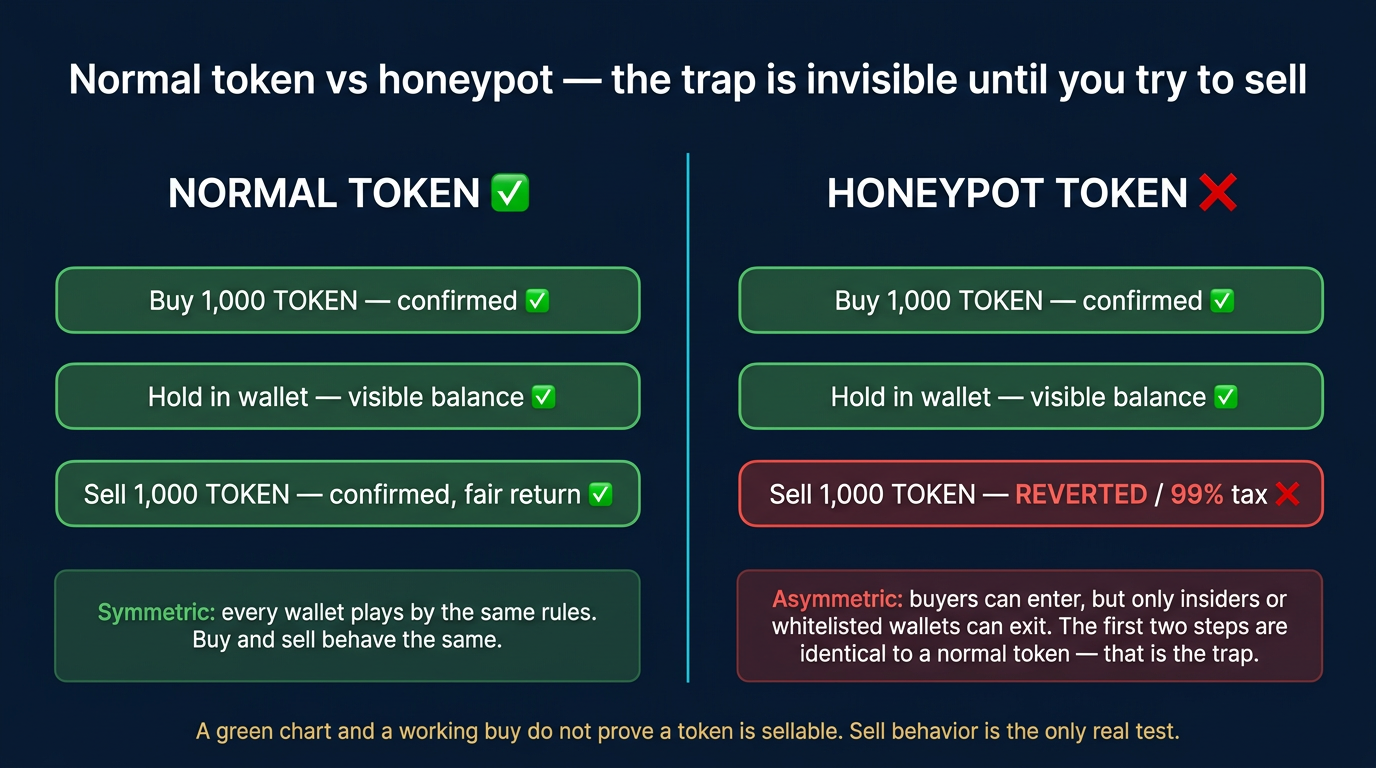
A honeypot token is a scam setup that lets users buy normally but prevents them from selling later. From the outside, it can look like a hot new token with rising price action and active volume. The trap only becomes obvious when regular buyers try to exit and discover that the transaction fails, the sell tax is effectively confiscatory, or only privileged wallets are allowed to trade out.
This content is for educational purposes only and should not be considered financial or investment advice.
Simple Definition
A honeypot token is a token that appears tradable but includes rules that block or cripple selling for ordinary buyers. Those rules can be written directly into the token contract, hidden in connected contracts, or enforced through whitelists, blacklists, or extreme fees. The result is that insiders or privileged wallets can exit while retail buyers are trapped.
A useful mental model is a nightclub with an open front door and a locked fire exit. Getting in is easy, which creates the impression that everything is normal. The trap becomes visible only when people try to leave. Honeypot tokens use the same basic psychology. The buy works, the chart looks alive, and the problem is discovered only at the exact moment the buyer needs liquidity.
A honeypot is a token that lets you in but does not let you out. The contract treats buyers and insiders differently — buying works for everyone, but selling is blocked, taxed near 100%, or only allowed for whitelisted wallets. The “scam” is asymmetric exit rights: insiders can leave at fair value while ordinary buyers are stuck holding the token.
Key Takeaways
- A honeypot is built around exit failure: Buying appears normal, but selling is blocked, penalized, or selectively allowed only for insiders.
- The contract logic is often the trap: Sell restrictions can be hidden in transfer rules, taxes, external calls, or whitelist logic.
- Price action can be misleading: Rising candles do not prove a token is freely tradable if buyers cannot actually exit.
- Honeypots overlap with other scams but are distinct: They are related to rug pulls and drainers, but the defining feature is that regular holders are trapped at the contract or market-exit level.
- Detection is about sellability, not just hype: The practical question is not whether a token is going up. It is whether a normal buyer can sell under real conditions.
How a Honeypot Token Works
Most honeypots exploit the fact that users assume tradability after a successful buy. On EVM chains, token behavior is controlled by smart contracts. That means the contract can include special transfer conditions, dynamic fees, blacklist rules, or privileged exemptions that do not affect every wallet equally. A buyer may see a working liquidity pool and a green chart, but the actual transfer logic can still be hostile.
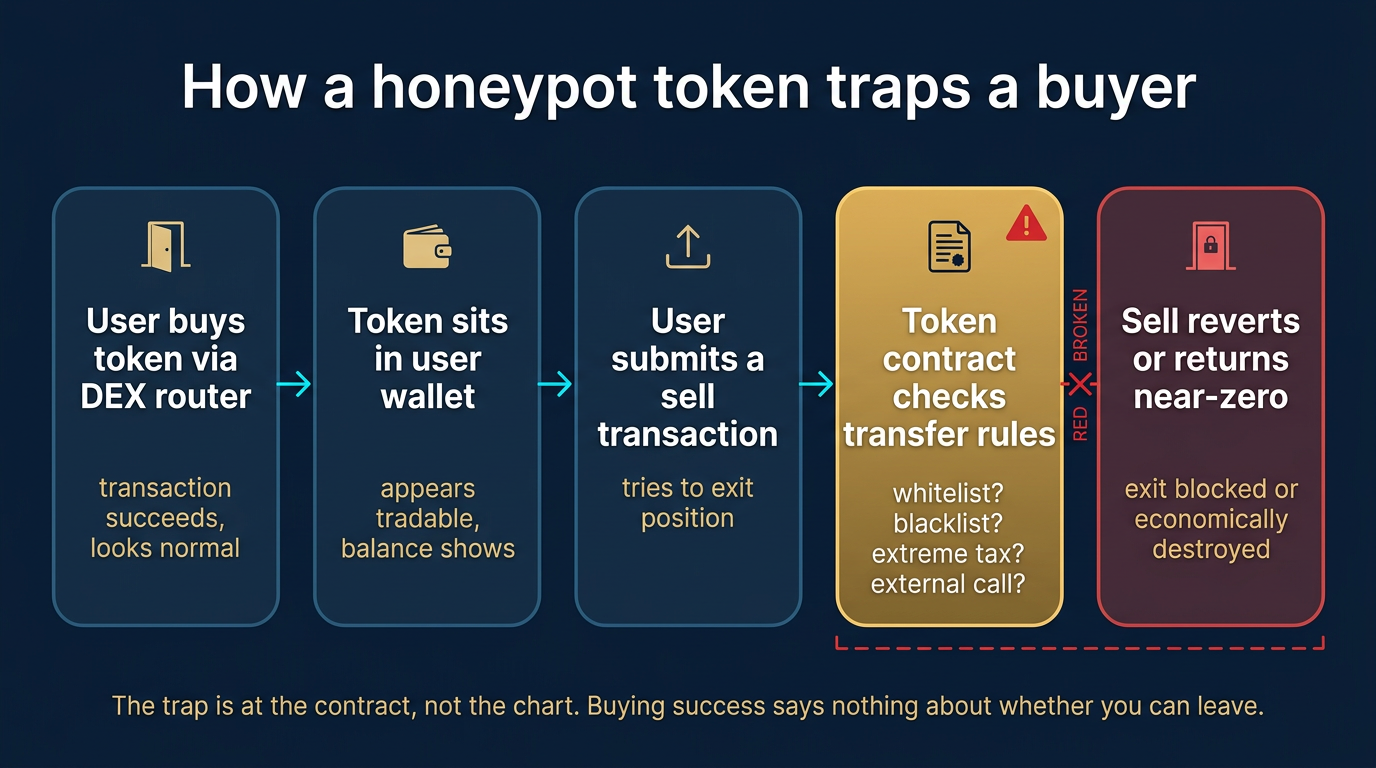
Buying succeeds, selling fails
The simplest honeypot pattern is straightforward: a token can be purchased through a DEX router, but a later sell transaction reverts or silently becomes uneconomic. That may happen because the contract blocks transfers to the liquidity pool, checks whether the sender is whitelisted, or calls another contract that marks buyers as restricted after purchase. From the buyer’s point of view, the first transaction looked normal. The second transaction reveals the actual rules.
Not every honeypot blocks the sell outright. Some make selling technically possible but economically useless by applying a near-total tax or a dynamic fee that turns the exit into a wipeout. From a buyer’s perspective, that behaves almost like a hard lock. The token may not say “you cannot sell,” but if the transaction returns almost nothing, the practical effect is the same.
That matters because scammers can point to successful transactions and argue that selling is allowed. The detail they avoid is whether normal users can exit at anything close to fair value. A token does not need a literal blacklist to behave like a trap.
Why Honeypots Differ From Rug Pulls
People often treat honeypots and rug pulls as identical, but the mechanics are different. A crypto rug pull usually involves insiders withdrawing liquidity, dumping supply, or abandoning a project after demand forms. A honeypot is more specific: the trap is centered on the buyer’s inability to sell under normal conditions. The market may still look active while the trap is operating.
That distinction matters because the warning signs differ. For a rug pull, you worry about who controls liquidity, how supply is distributed, and whether insiders can disappear with funds. For a honeypot, the central question is whether the contract and market structure allow normal exit in the first place. Some projects can show traits of both, but not every trap works the same way.
The trap can be active before the chart breaks
A rug pull often becomes obvious when the price collapses suddenly. A honeypot can remain visually convincing for longer because buying pressure and insider-controlled activity can keep the chart alive. That is why price alone is a poor safety test. A token can trend upward and still be structurally hostile to anyone who arrives late.
The honeypot angle is narrower than a general exit-scam checklist: the most important question is not just whether insiders can leave, but whether you can.
Common Honeypot Mechanisms
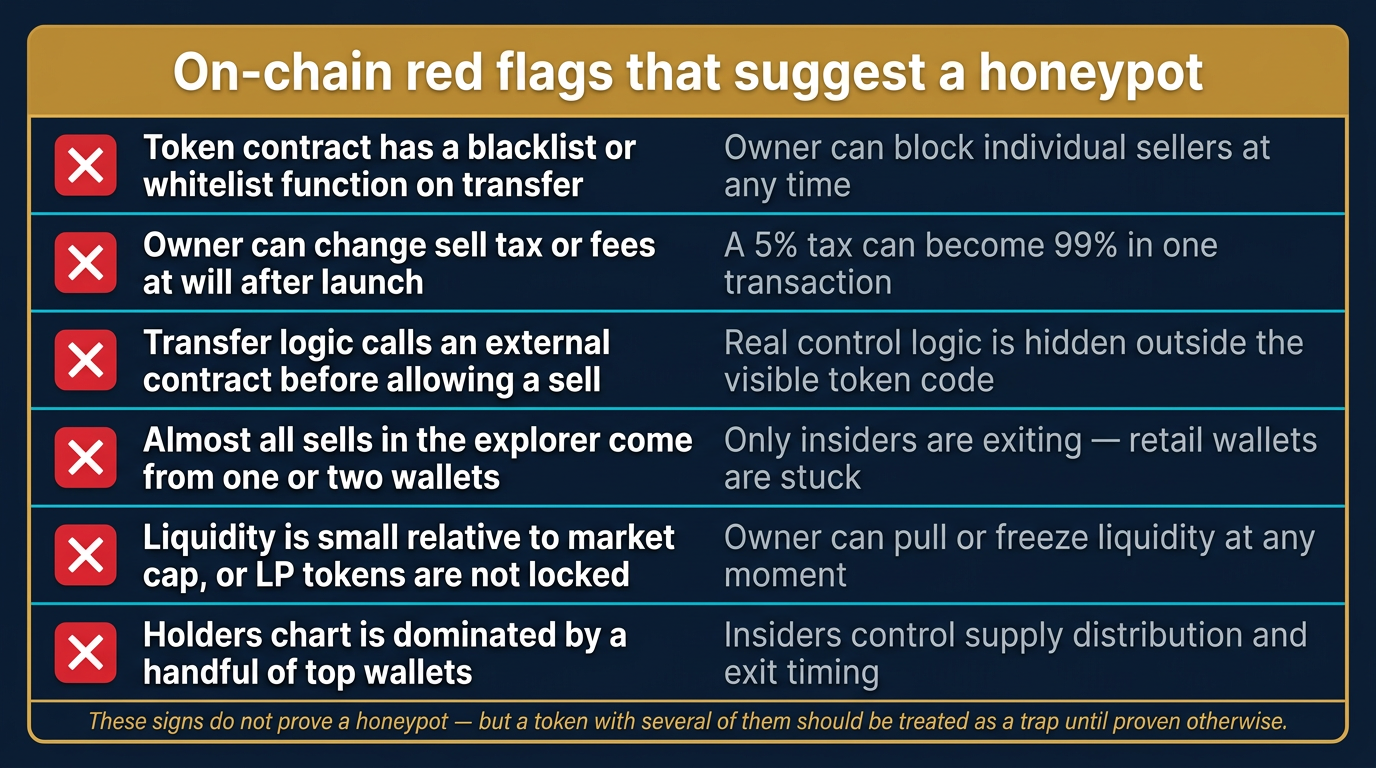
Honeypots are implemented in several recurring ways. The contract may contain obvious restrictions, or the malicious logic may be hidden behind external contract calls and misleading variable names. The goal in each case is the same: create the appearance of an open market while preserving asymmetric exit rights for insiders.
Whitelist-only selling or blacklist rules
Some contracts allow only approved wallets to sell, or they quietly add buyers to a blocked list after purchase. In those designs, the owner’s wallets or favored addresses can exit while everyone else hits a revert or a transfer restriction. This mechanism is simple and effective because it creates different rules for different participants inside what looks like one public market.
More advanced honeypots move the malicious logic outside the obvious token code. The token may call another contract before allowing a transfer, and that outside contract can decide who is allowed to sell. This makes casual inspection harder because the dangerous rule is no longer sitting in one visible place. Buyers who only skim the token contract may miss the real control point entirely.
Sell limits, gas traps, or punitive fees
Other traps rely on transaction conditions that normal users cannot meet. The token may require specific sell sizes, fail under common gas settings, or impose a tax so high that the exit becomes meaningless. These approaches are effective because they let scammers claim that selling is technically possible while keeping the outcome unusable for most buyers.
How Users Get Trapped
Most victims do not buy a honeypot after a deep contract review. They buy because the token appears active, the community looks excited, and the chart suggests momentum. That makes honeypots part technical trap and part behavioral trap. The contract blocks the exit, but hype gets the victim into position first.
FOMO, screenshots, and fake liquidity confidence
Social posts showing rapid gains, chat rooms pushing “early entry,” and recycled claims about the next big launch create the right emotional conditions. Buyers see trades happening and assume the market is functioning normally. In reality, the activity may be insider-controlled, bot-driven, or limited to wallets that are exempt from the trap. The chart becomes part of the lure.
This is one place where honeypots overlap with other scam patterns. The psychological setup often resembles the hype and urgency seen in pump-and-dump schemes, but the exit failure is more structurally coded into the token itself.
Practical Usage: How to Think About Honeypot Risk
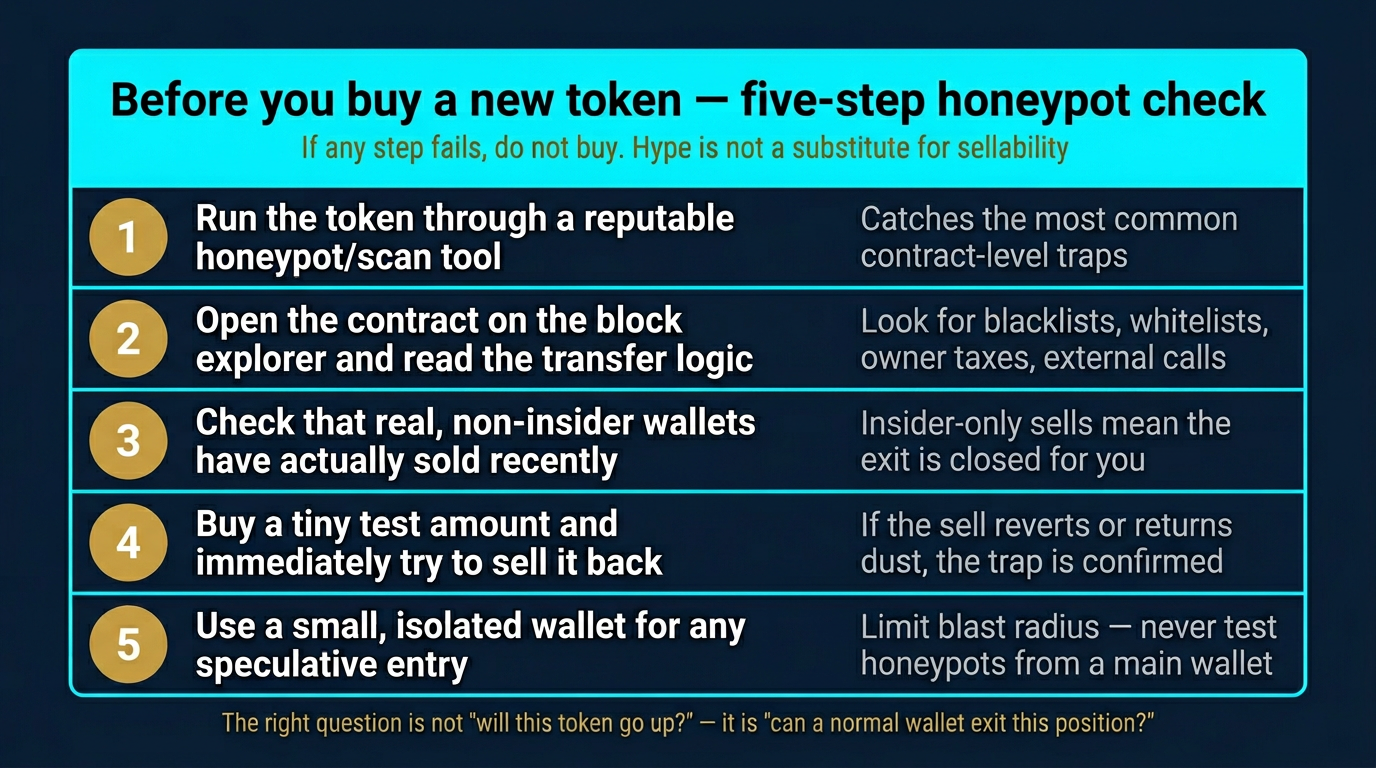
The practical goal is not becoming a smart-contract auditor overnight. It is learning to ask the right question before buying: can a normal wallet exit this position under real conditions? That mindset shifts attention away from marketing promises and toward market mechanics.
- Treat buy success as meaningless on its own: A token is not proven safe just because the entry transaction worked.
- Test exit assumptions before sizing up: If you cannot independently confirm normal sell behavior, do not treat the position like a normal liquid market.
- Keep speculative trades isolated: Use a smaller, separate wallet for high-risk experiments rather than exposing the same wallet you use for serious holdings.
- Check contract and market context together: Contract behavior, liquidity quality, wallet distribution, and live sellability all matter more than community hype.
- Assume urgency is part of the trap: The more a token is sold to you as “buy now or miss it,” the more carefully exit conditions should be questioned.
Risks and Common Mistakes
- Assuming volume proves safety: Active-looking trades can still exist in a market where regular buyers cannot exit fairly.
- Confusing a honeypot with a normal dip-buy opportunity: A token that fails to sell is not simply “illiquid for now.” It may be structurally hostile.
- Ignoring contract asymmetry: Different wallets may play by different rules, and that is exactly what makes the trap work.
- Using the same wallet for every experiment: High-risk token tests should not live beside serious holdings or broad allowances.
- Relying on social proof instead of exit proof: Screenshots, communities, and hype are not substitutes for real sellability.
Sources
- Ethereum.org: Smart Contracts
- OpenZeppelin ERC-20 Documentation
- CertiK: The Proliferation of Honeypot Contracts in Web3
Frequently Asked Questions
What is a honeypot token?
A honeypot token is a token or contract setup that allows users to buy but prevents ordinary holders from selling normally. The trap may come from sell restrictions, hidden blacklist logic, or extreme fees that make exit effectively impossible.
How is a honeypot different from a rug pull?
A rug pull usually centers on insiders removing liquidity, dumping supply, or abandoning the project after demand forms. A honeypot is more specific: the token is structured so regular buyers cannot exit normally even while the market appears active.
Can a honeypot token still show rising prices?
Yes. A honeypot can still display upward price action if buyers keep entering and insiders or exempt wallets control the visible trading activity. Price movement alone does not prove that ordinary holders can sell.
Are honeypots always obvious in the contract?
No. Some are straightforward, but others hide the restriction logic in external contracts, dynamic fee paths, or owner-controlled rules that are easy for casual buyers to miss.
What is the safest way to think about a suspected honeypot?
The safest mindset is to focus on exit conditions, not hype. If you cannot establish that a normal wallet can sell under normal market conditions, you should not treat the token like a standard liquid trade.