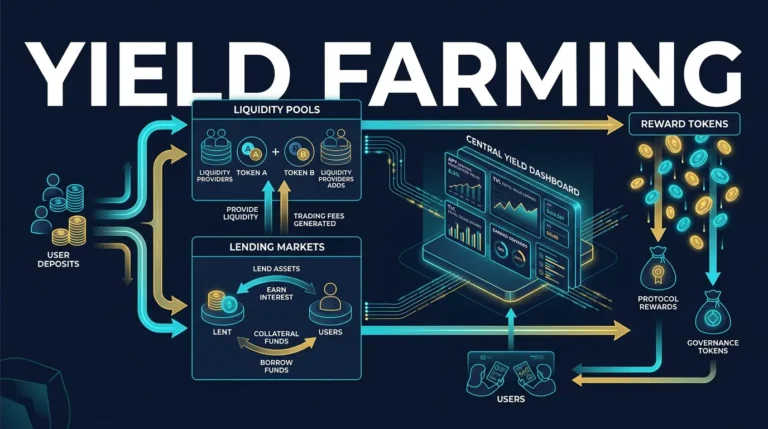


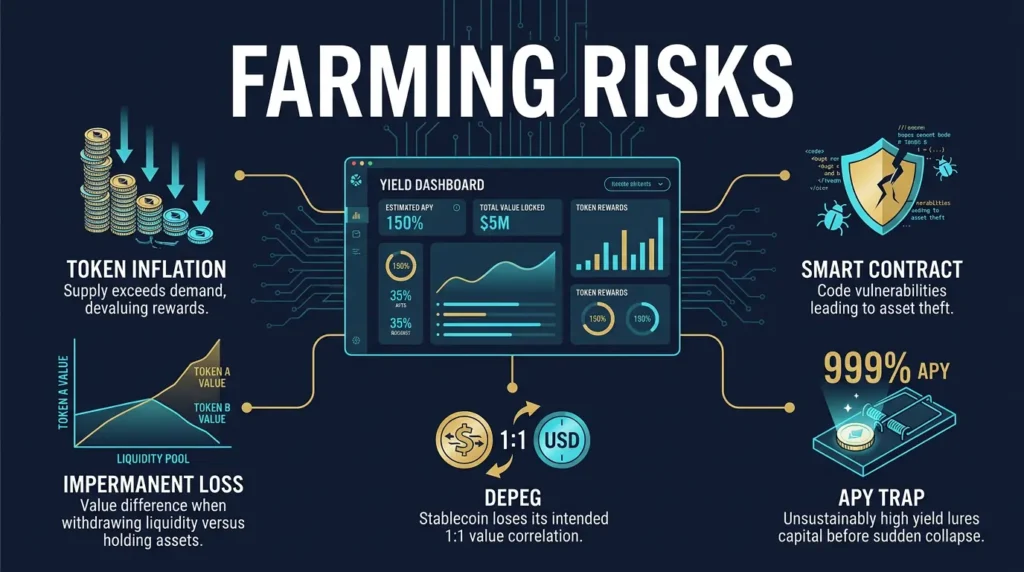
Yield farming can produce attractive headline returns, but those returns often sit on top of multiple moving risks at the same time. A farming position may depend on trading fees, token emissions, lending demand, pool composition, peg stability, and smart-contract safety all at once. That means a farm can look excellent on the surface while hiding weak economics underneath.
The key mistake is to read farming APY as if it were a clean interest rate. In reality, the number may combine subsidy, volatile reward tokens, changing user behavior, and protocol-specific assumptions that do not hold for long. The practical question is not “how high is the APY?” It is “what exact conditions have to remain true for this yield to still make sense?”
This content is for educational purposes only and should not be considered financial or investment advice.
High APY reveals the reward but hides every condition sustaining it.
Key Takeaways
- High APY can hide fragile economics: Token incentives often make farms look healthier than they really are.
- Farming risk is stacked risk: Pool mechanics, protocol design, reward-token behavior, and smart-contract safety all matter together.
- Impermanent loss is only one component: It matters for LP strategies, but it is not the only thing that can break the trade.
- Depegs and low-quality assets can turn “stable” farms dangerous: Apparent safety can disappear quickly when the pair assumptions fail.
- Headline yield is less important than durable yield: If the return only works while subsidies last, the strategy may not be strong enough.
Risk 1: Incentive Tokens Inflate the APY
Many farms advertise returns that are boosted by reward-token emissions rather than by actual protocol usage. That means the APY can stay high only while the protocol keeps handing out newly created tokens and while the market continues valuing those tokens generously. If either condition weakens, the displayed yield can collapse quickly.
A useful mental model is to treat emission-driven APY like a subsidy rather than like interest. The protocol is paying users to stay, not necessarily because the underlying business activity supports the payout. That can work temporarily, but it is not the same as durable fee income.
For the direct warning angle behind this, the most relevant local follow-up is Why 20% APY Is a Trap.
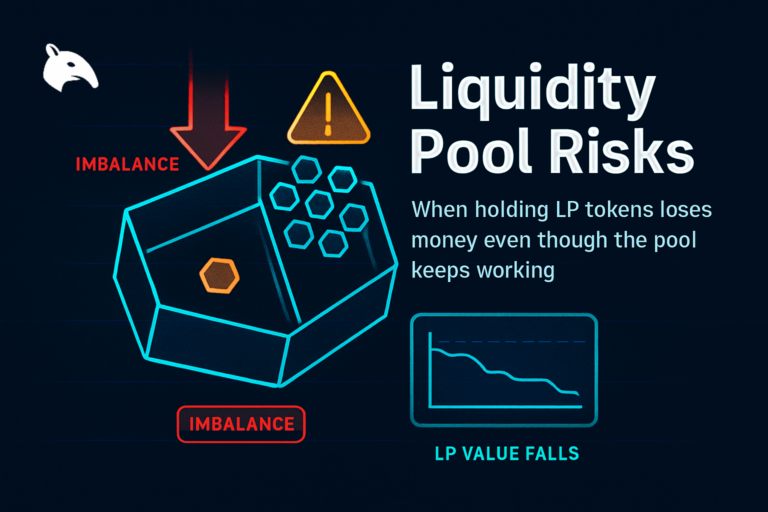
Risk 2: Impermanent Loss in LP-Based Farms
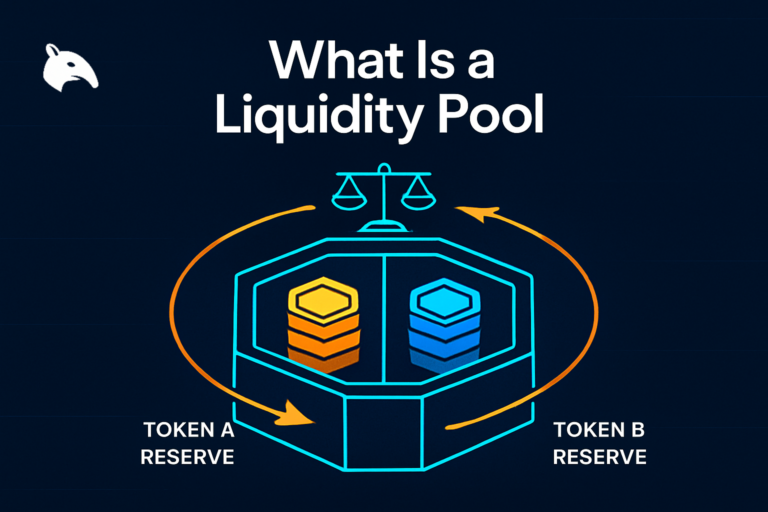
When a farming strategy is built on top of a liquidity-pool position, you inherit the pool’s rebalancing trade-offs. If one side of the pair moves sharply, the pool automatically shifts your asset mix. That can leave you with fewer units of the outperforming asset than if you had simply held the tokens outside the pool.
Example: a user deposits ETH and USDC into a farm because the APY looks strong during a rally. ETH then continues higher, traders keep arbitraging the pool, and the LP position gradually ends up holding more USDC and less ETH. Even after collecting yield, the user may still underperform simply holding the starting assets. The core mechanism is explained in What Is Impermanent Loss in DeFi?.
Risk 3: Smart Contract and Vault Failure
Farming often layers one smart contract on top of another. A user may deposit into a vault, which deposits into a pool, which routes rewards through another token contract, which depends on oracle inputs or governance settings. Each additional layer adds another surface where assumptions can fail or attackers can find a path to exploit.
One operator insight is that complexity is often mistaken for sophistication. A highly optimized auto-compounding strategy may look more professional than a simple LP position, but it also introduces more moving parts that can break or become uneconomic under stress.
For the base execution layer beneath those strategies, see What Is a Smart Contract?.
Risk 4: Stablecoin and Correlation Breaks
Some farms look safer because they use stablecoin pairs or correlated assets. That can reduce day-to-day divergence risk, but it creates concentrated dependence on the assumption that the peg or correlation holds. If a stablecoin breaks peg or a supposedly correlated pair stops tracking closely, the farm can become dangerous very quickly.
For example, a user may farm a USDC-style stable pair expecting low volatility and steady fees. If one asset in the pair loses confidence during a market event, the farm can rebalance into more of the damaged side while the user is still thinking of the position as “the safe one.” The direct follow-up here is Stablecoin Depeg Risk.
Risk 5: Low-Quality Volume and Unsustainable Demand
A farm can look healthy because the protocol reports strong volume or usage, but the quality of that activity matters. If volume comes from short-lived speculation, wash-style behavior, or mercenary incentive chasing, the fee stream can disappear quickly once the subsidy weakens. A strategy based on temporary attention is not the same as a strategy backed by durable demand.
A second operator insight is that “real yield” and “visible yield” are not the same thing. Visible yield is what the dashboard shows today. Real yield is what still makes sense after the easiest promotional tailwinds fade.
Risk 6: TVL and Size Can Mislead
Large TVL often makes a farm look trustworthy, but TVL mainly shows how much capital is parked in the system. It does not prove that the underlying assets are strong, that the emissions are sustainable, or that the protocol can retain users once incentives drop. A farm can be large because it is heavily subsidized, not because it is economically sound.
The direct local breakdown is Why High TVL Does Not Mean Safe in Crypto.
Risk 7: User-Side Execution Mistakes
Some of the worst farming outcomes are not caused by protocol failure alone. They come from users entering a strategy they do not actually understand. Common mistakes include approving the wrong contract, ignoring the pair composition, reading APY without checking the reward token, or assuming a familiar-looking stable asset removes the need for risk analysis.
In practice, bad process is often what turns a manageable farming position into a bad one. If you cannot explain the yield source, pair behavior, and main failure modes before deposit, the farm is already too complex for the amount of confidence you have in it.
How to Evaluate Yield Farming Risks Before Depositing
- Break the APY into real components: How much is fee income, how much is token subsidy, and how much depends on compounding assumptions?
- Check whether the strategy is pool-based: If it is, understand the divergence and pair-composition risk before anything else.
- Check what happens when incentives fall: A good strategy should still make sense after promotional emissions cool down.
- Check whether “safe” assets are only conditionally safe: Stablecoins and correlated pairs depend on assumptions that can break.
- Check protocol complexity honestly: More contracts and more auto-routing can mean more ways for the strategy to fail.
A practical frame is to ask: “If this dashboard APY dropped by half tomorrow, would I still understand why this position deserves my capital?” If the answer is no, the yield may be selling the strategy harder than the economics deserve.
For the mechanism and comparison pieces behind these risks, the closest local references are What Is Yield Farming in Crypto, Liquidity Pool Risks Explained, and Yield Farming vs Staking.
Risks and Common Mistakes
- Chasing emissions instead of economics: A farm paying most of its return in newly issued tokens can deteriorate quickly once holders start selling rewards.
- Forgetting LP-style downside: If the strategy sits on top of a pool, impermanent loss can erase much of the fee income during sharp price moves.
- Assuming “stable” means safe: Stablecoin and correlated-asset farms still depend on pegs and relationships that can break.
- Using APY as a shortcut for quality: A large number says little by itself about durability, contract safety, or demand quality.
- Underestimating strategy complexity: Auto-compounding and multi-layer vault designs can add fragility, not just convenience.
Sources
Frequently Asked Questions
What is the biggest risk in yield farming?
There is no single answer for every farm. The biggest issue may be token-incentive decay, impermanent loss, contract failure, depeg risk, or weak underlying demand depending on the strategy.
Can yield farming lose money even with high APY?
Yes. A farm can underperform or lose money if reward tokens weaken, pool assets diverge, a peg breaks, or the protocol’s actual usage does not support the advertised return.
Is yield farming riskier than staking?
Often yes, because farming usually involves more moving parts such as pool mechanics, incentive emissions, and protocol complexity beyond simple consensus rewards.
Does high TVL make a farm safer?
No. High TVL can reflect incentives or temporary popularity, but it does not prove code quality, sustainable usage, or strong underlying assets.
How should users judge a farming opportunity?
Users should judge it by the yield source, pair behavior, contract quality, incentive dependence, and how the strategy behaves when the easy promotional conditions stop.