

Last Updated on April 17, 2026 by Snout0x
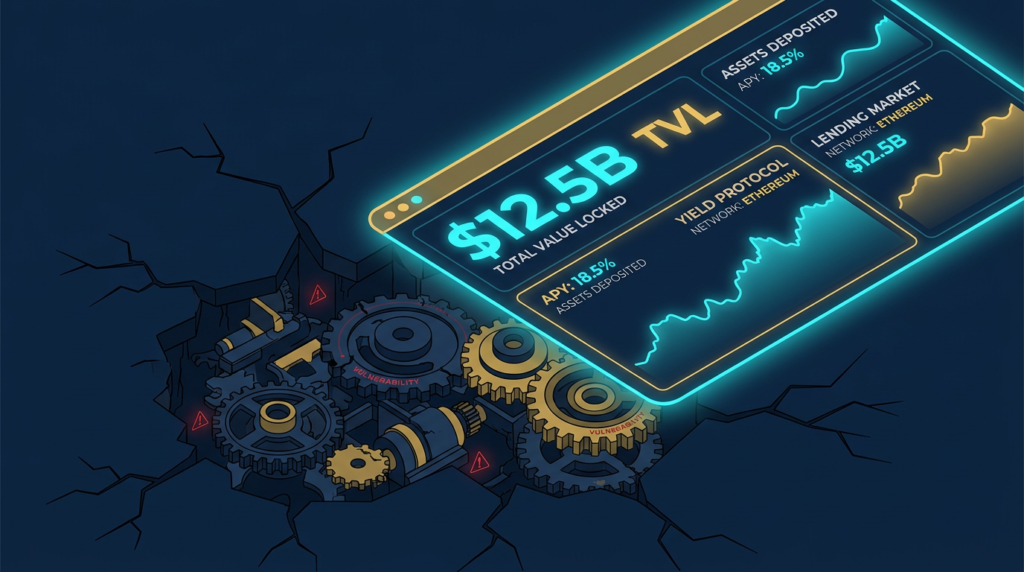
Total value locked, or TVL, measures how much asset value is deposited in a DeFi protocol. Because big numbers look reassuring, many users treat high TVL as proof that a protocol is established, trusted, and therefore safe. That conclusion is too strong. TVL can show adoption and capital concentration, but it does not directly measure code quality, governance quality, exploit resistance, or whether the users providing that liquidity have durable conviction.
This matters because many risky protocols can attract large deposits before their weaknesses become obvious. Yield incentives, leverage loops, token emissions, and speculative hype can all inflate TVL quickly. A large number on a dashboard can mean a protocol is popular right now. It does not mean the protocol is structurally sound.
This content is for educational purposes only and should not be considered financial or investment advice.
Key Takeaways
- TVL measures deposited value, not safety: It shows how much capital is inside a protocol, not whether the protocol deserves that capital.
- High TVL can be temporary: Incentives, leverage, and short-term farming behavior can make a protocol look stronger than it really is.
- Large protocols still get hacked: Big balances can attract more attackers, and success can increase the size of the eventual loss.
- TVL should be read with context: Code audits, governance controls, liquidity composition, token design, and exploit history matter more than the headline number alone.
- Safety is about failure modes: The useful question is not “How much money is here?” but “What happens if something breaks?”
What TVL Actually Measures
TVL is the dollar value of assets deposited into a protocol’s smart contracts. In a lending app, it may reflect supplied collateral and borrowed assets. In a decentralized exchange, it may reflect liquidity in pools. In a staking or restaking protocol, it may reflect assets delegated into the system. The common idea is that TVL measures economic value currently sitting inside the protocol.
That makes TVL a useful activity metric. It can tell you whether a protocol is attracting users, whether it has enough liquidity to support trading, and whether it has grown relative to competitors. But none of those are the same as safety. An airport can be crowded without being well managed. In the same way, a DeFi protocol can be heavily used without being securely designed.
A practical mental model is to treat TVL like the number of cars parked outside a restaurant. It tells you the place is attracting people. It does not tell you whether the kitchen is clean, whether the food is profitable, or whether the building passes inspection. The signal is real, but it answers a narrower question than many investors assume.
Why High TVL Looks Safer Than It Really Is
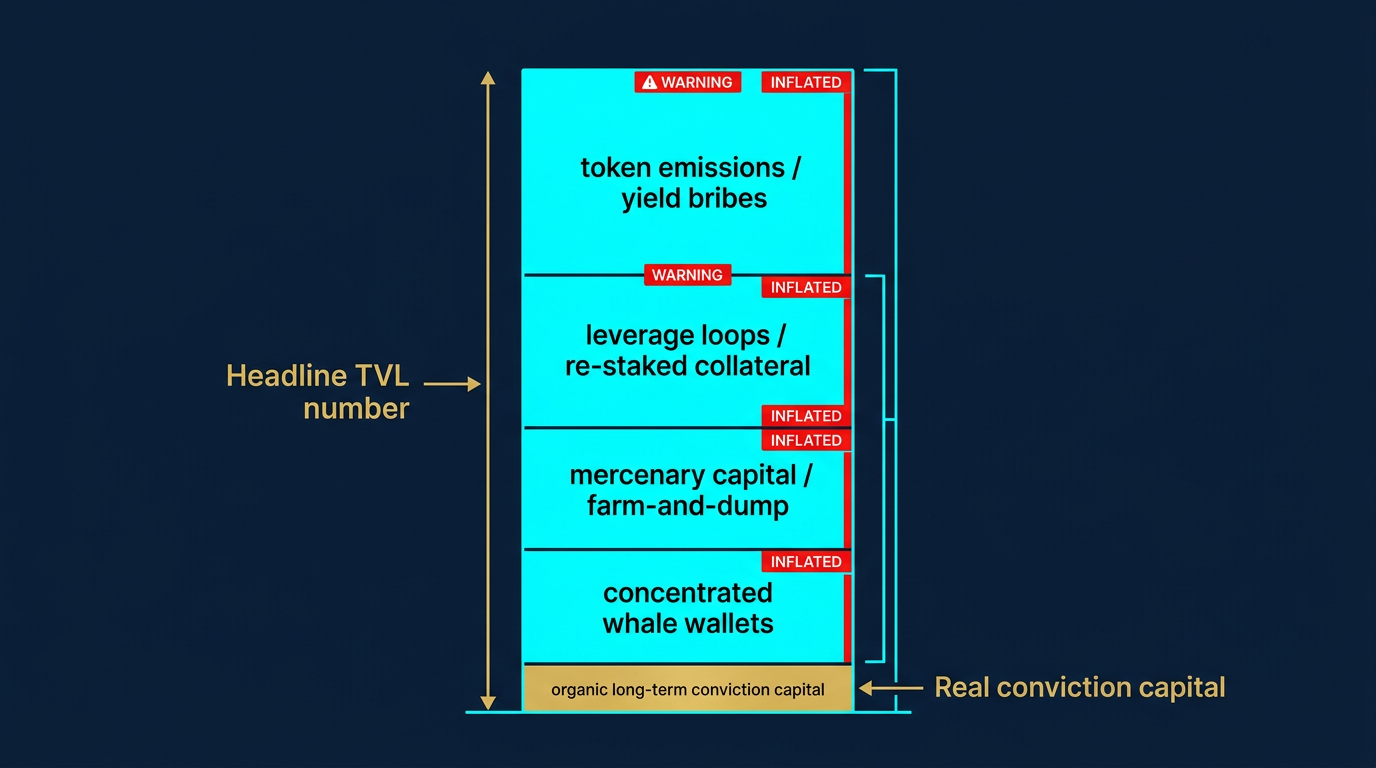
Users often infer safety from popularity because, in many markets, popularity and durability overlap. With DeFi, that shortcut can fail. Capital moves fast, especially when incentives are high and switching costs are low. A protocol may accumulate billions in deposits because it is paying for growth, because looping strategies amplify reported value, or because a few large holders dominate the deposits.
One operator insight is that mercenary capital often looks like trust until the rewards change. If users are in a protocol mainly for token emissions or short-lived yield advantages, the capital can leave just as quickly as it arrived. A dashboard snapshot can hide how fragile that participation really is.
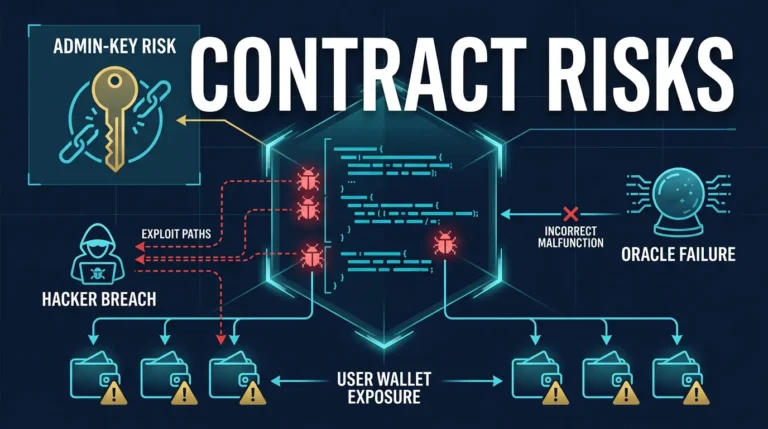
Another operator insight is that large TVL can actually increase attack attractiveness. A protocol holding a large amount of user value becomes a bigger target for smart-contract exploits, oracle attacks, governance abuse, and social engineering around admin keys. The presence of more money does not reduce the incentive to attack. In some cases, it increases it.
What TVL Does Not Tell You
It does not prove the code is safe
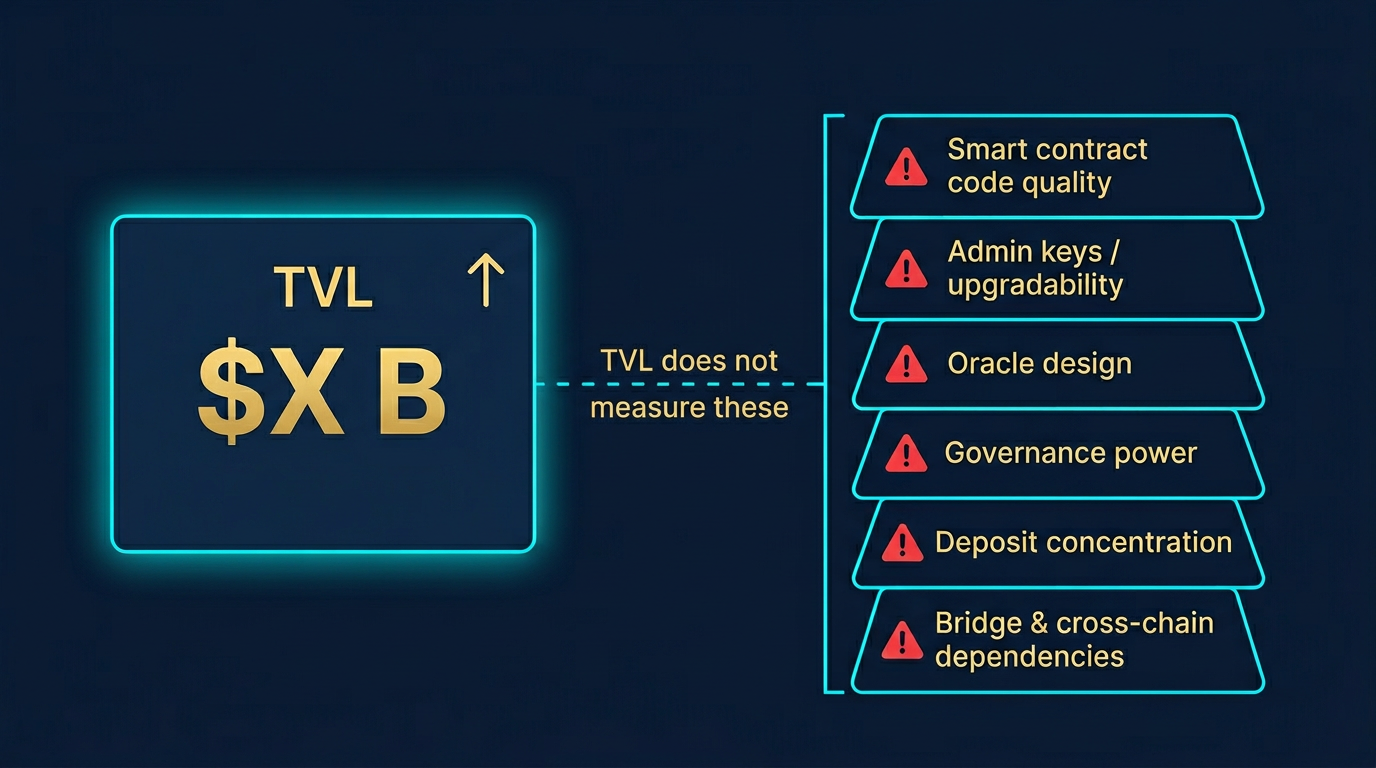
A protocol can attract large deposits before its code has been meaningfully battle tested. Even audited systems can fail, and unaudited systems can temporarily accumulate capital during bullish conditions. TVL does not tell you whether upgrade permissions are dangerous, whether the oracle design is manipulable, or whether the contracts can be paused, changed, or abused by insiders.
It does not show who controls the deposits
A protocol with 500,000 small users is very different from a protocol whose TVL depends on a few large wallets, treasury deposits, or internal related-party capital. Concentrated deposits create different failure modes. If a handful of large providers leave, the protocol can look healthy until it suddenly does not.
It does not reveal circular or incentive-driven capital
Some TVL growth comes from users borrowing against deposited assets and redepositing elsewhere, or from protocols counting capital that is economically linked to the same incentive loop. In those cases, the headline figure can overstate how much independent conviction is actually supporting the system.
A second mental model helps here: TVL is like seeing water in a set of connected pipes without knowing whether the water comes from fresh supply or the same water being pumped around the system. The total may look impressive, but the resilience depends on what is underneath the flow.
It does not rule out fraud or extractive design
High deposits do not protect users from bad incentives, hidden admin powers, or manipulative token structures. If the design allows insiders to change rules, extract value, or abandon the system, large deposits simply mean more value is exposed. For the explicitly fraudulent version of this pattern, see What Is a Crypto Rug Pull?.
When TVL Is Still Useful
TVL is not worthless. It becomes useful when it is placed in context. A larger pool can reduce slippage on swaps. Sustained deposits across market cycles can suggest some level of product-market fit. Relative TVL can help compare whether users are adopting one venue more than another. The mistake is treating TVL as a shortcut that replaces analysis instead of one input into analysis.
In practice, TVL is most informative when you compare it with other questions: How long has the capital been there? How much is organic versus incentive-driven? Is the protocol simple or highly composable? How dependent is it on one chain, one oracle, one bridge, or one governance structure? Those comparisons turn TVL into context rather than marketing.
This is similar to how users should think about impermanent loss in DeFi. A single metric can be real and still be incomplete. Useful metrics help when you understand what they measure and what they leave out.
Practical Usage: What to Check Beyond TVL
A safer workflow is to treat TVL as a starting filter, not a green light. If a protocol has low deposits, you may decide it is too early. But if a protocol has high deposits, that should trigger more questions, not fewer.
- Check contract and admin risk: Look for audits, upgradeability, pause powers, multisig structure, and whether critical permissions are transparent.
- Check deposit composition: Ask whether capital seems broad-based or dominated by a few wallets, treasury funds, or reward-chasing loops.
- Check dependency risk: Identify whether the protocol relies heavily on one oracle, one bridge, one chain, or one external protocol.
- Check incentive quality: If growth depends mainly on emissions or extreme yields, ask what remains when those incentives fade.
- Check failure response: Read past incidents, governance communications, and whether users have a clear path if something breaks.
A practical operator routine is to imagine the yield going away tomorrow. If most of the case for the protocol collapses with that one change, the TVL may be less durable than it looks. Another useful test is to ask whether you can clearly explain the protocol’s main failure mode to a cautious friend in two sentences. If you cannot, the headline number is not the missing piece.
Risks and Common Mistakes
- Equating size with safety: A large pool of deposits is not the same as audited, resilient, or well-governed infrastructure.
- Ignoring capital quality: TVL funded by incentives, leverage loops, or a few large depositors can disappear faster than users expect.
- Skipping operational details: Admin keys, governance powers, oracle design, and bridge dependencies often matter more than the top-line number.
- Assuming adoption means trustworthiness: Users can chase yield and narrative momentum without doing deep technical diligence.
- Using one metric as a substitute for understanding: No single DeFi metric should carry the full burden of a risk decision.
Sources
Frequently Asked Questions
What does TVL mean in DeFi?
TVL means total value locked. It refers to the dollar value of assets deposited into a DeFi protocol’s contracts. It is mainly an activity and capital-concentration metric, not a direct safety score.
Does high TVL mean a protocol is safe?
No. High TVL can signal adoption or liquidity, but it does not prove the code is secure, the governance is sound, or the incentives are sustainable. It should be treated as one data point, not a guarantee.
Why can TVL be misleading?
It can be inflated by short-term incentives, concentrated depositors, leverage loops, and speculative enthusiasm. A large number can make a protocol look established even when the underlying risk is still high.
What matters more than TVL when checking DeFi risk?
Contract design, audits, upgrade permissions, oracle dependencies, governance controls, deposit concentration, and incident history usually matter more. Those factors describe how the protocol can fail, which is the real safety question.
Should I ignore TVL completely?
No. TVL can still help you judge liquidity and adoption, especially when compared across similar protocols. The key is to use it as context rather than as a shortcut for trust.