

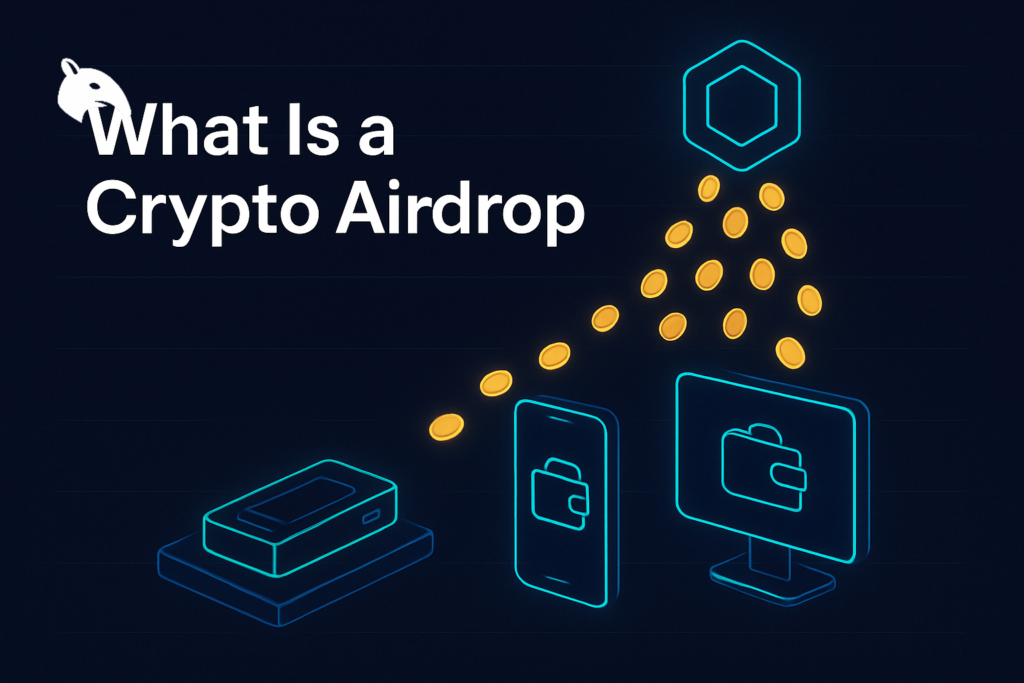
An airdrop in crypto is a token distribution that sends assets to eligible wallet addresses or accounts, usually as part of a project launch, growth campaign, governance rollout, or community reward program. The key idea is simple: instead of selling every token through an exchange or private allocation, a project gives some tokens directly to users who meet certain conditions.
If you want the foundational definition behind this concept, read What Is a DeFi Protocol? How It Works Without a Bank.
That can make airdrops look like free money, but they are better understood as a distribution mechanism. Projects use them to attract attention, reward early activity, spread ownership, or bootstrap network participation. Some are legitimate incentives tied to real protocol goals. Others are marketing stunts or outright scams. Understanding the mechanism helps you separate the useful concept from the risky hype around it.
This content is for educational purposes only and should not be considered financial or investment advice.
Quick Answer
An airdrop is when a project distributes tokens directly to users, usually based on wallet activity, prior usage, staking, community participation, or a snapshot of eligible addresses. The goal is usually distribution, awareness, or user alignment rather than direct fundraising.
Key Takeaways
- Airdrops are token distributions: They are a way to allocate tokens, not just a giveaway trend.
- Projects use them for strategy: Common goals include bootstrapping adoption, rewarding early users, and spreading governance tokens more widely.
- Eligibility usually follows rules: Snapshots, wallet activity, staking, testnet use, or community participation often determine who qualifies.
- Not every “airdrop” is safe: Fake claim pages, malicious approvals, and phishing links are common attack paths.
- The token arriving is not the same as value being guaranteed: Airdropped assets can be illiquid, speculative, or worth very little.
How Airdrops Work
The project first defines who qualifies and how many tokens each eligible user should receive. That rule set might be based on a blockchain snapshot, historical usage, governance participation, staking behavior, NFT ownership, testnet activity, or some other measurable condition. Once the eligibility list is final, the project distributes tokens either automatically or through a claim process.
For a deeper dive into this specific angle, read UTXO Consolidation Explained: What It Is and When to Do It.
Sometimes the tokens simply appear in the wallet after distribution. In other cases, the user must visit the project’s official claim interface and submit an on-chain transaction to receive the allocation. That distinction matters because claim flows can create fees, approvals, and scam opportunities that do not exist in fully automatic distributions.
Why Projects Use Airdrops
Airdrops are rarely random charity. They are usually tied to a project goal. A new protocol may want to reward early users who helped create liquidity or test the product before launch. A governance system may want broader token ownership so voting power is not concentrated entirely in investors or insiders. A consumer app may use an airdrop to create attention and bring users back into the ecosystem.
Operator insight: projects often use airdrops to convert past behavior into future alignment. If you used the protocol before the token existed, the project may want you to become a token holder because that makes you more likely to stay engaged, govern, stake, or promote the ecosystem.
Common Types of Airdrops
Snapshot-based airdrops
A snapshot-based airdrop uses a blockchain record taken at a specific time. Wallets that held or used qualifying assets at that moment become eligible. This is common when a protocol wants to reward existing holders or users without requiring them to sign up anywhere.
User-activity airdrops
These reward past interaction with an app or protocol, such as providing liquidity, bridging assets, minting NFTs, trading, or using a testnet. The idea is to reward actual participation instead of passive wallet ownership alone.
Claim-based airdrops
In a claim-based model, the project publishes an official page where eligible users connect a wallet and claim the allocation. This can reduce wasted distribution to inactive users, but it also creates more room for fake clone sites and malicious claim prompts.
Promotional airdrops
Some distributions are mainly marketing events designed to create attention. They may require social tasks, referrals, or signups instead of meaningful on-chain participation. These are usually the least useful for understanding the core mechanics of token distribution, but they are common in the public imagination.
Automatic Distribution vs Claiming
An automatic airdrop is operationally simpler for the user. Tokens arrive without extra action beyond controlling the wallet. A claim-based airdrop requires the user to interact with a site or contract. That can be legitimate, but it also means the user must verify the domain, contract, wallet prompt, and any approval request carefully.
Real-world example: a legitimate protocol may publish a claim page that asks you to sign a standard transaction to receive tokens. A fake site can imitate that flow and instead ask for a malicious approval or signature. That is why airdrop claims overlap so often with phishing and approval-scam mechanics.
For the risk side of those claim flows, the most relevant local references are Fake Airdrop Scams and Crypto Approval Scams.
What airdrops do and do not tell you
An airdrop can tell you that a project wants distribution, attention, or community alignment. It does not tell you that the token will hold value, that liquidity will be strong, or that the project is high quality. The market may value the token highly, ignore it completely, or dump it quickly after launch.
The right mindset is to separate the distribution event from the asset thesis. Receiving tokens answers the question “Why did I get them?” It does not answer “Should I hold them?” or “Is this project strong?”
Why Airdrops Attract Scams
Airdrops mix three powerful ingredients: greed, urgency, and confusion about technical prompts. Attackers know users may connect a wallet quickly if they think a reward is waiting. That is why fake claim pages, fake social posts, impersonated support accounts, and malicious approval prompts often borrow the language of airdrops.
Real-world example: a user sees a viral post about a “live token claim,” connects a wallet to a fake site, and signs a prompt that is not a harmless claim at all. The attacker uses that approval or signature to drain tokens later. The user thought they were collecting a reward, but the actual event was a wallet-security failure.
If you want the broader mechanics of the lure, What Is Crypto Phishing? is the best local follow-up.
Practical Usage: How to Evaluate an Airdrop
- Verify the source first: Use bookmarked project links or official channels, not search ads, DMs, or reply spam.
- Understand the eligibility rule: Legitimate projects usually explain why certain wallets qualify.
- Check whether the claim requires approvals: A true token claim should not automatically justify unlimited token-spend permissions.
- Use a lower-risk wallet for uncertain interactions: Do not expose a high-value wallet to unknown claim flows.
- Treat the token separately from the hype: Distribution does not guarantee lasting demand or price support.
A useful operator rule is this: if the airdrop logic is unclear and the claim flow is urgent, assume the risk is higher than the reward looks. Legitimate distributions may still require care, but scam distributions usually rely on speed and confusion.
Risks and Common Mistakes
- Assuming every token claim is harmless: Claim flows can hide malicious approvals or dangerous signatures.
- Using a main wallet for every claim: Airdrop curiosity should not expose long-term holdings to unnecessary contract risk.
- Confusing distribution with value: Receiving tokens does not prove the asset is liquid, durable, or fundamentally strong.
- Following unofficial links: Search ads, DMs, reply threads, and fake support accounts are common attack paths.
- Ignoring the tokenomics context: Even a legitimate airdrop can lead to fast sell pressure, weak liquidity, or unclear long-term utility.
Sources
Frequently Asked Questions
What is an airdrop in simple terms?
It is a token distribution where a project sends or allocates tokens to eligible wallets or users, often to reward activity or spread ownership.
Why do crypto projects do airdrops?
They often use them to reward early users, bootstrap attention, distribute governance tokens, or align communities around a new network or app.
Do I always need to claim an airdrop manually?
No. Some airdrops are sent automatically, while others require an official claim process. Claim-based models need more verification because they create more scam surface.
Are airdrops free money?
Not really. They may have value, but they can also be illiquid, speculative, taxable in some jurisdictions, or tied to risky claim flows and token volatility.
What is the biggest risk with airdrops?
The biggest risk is treating every claim as safe, because fake airdrops often use phishing or malicious approvals to steal funds instead of distributing anything real.