

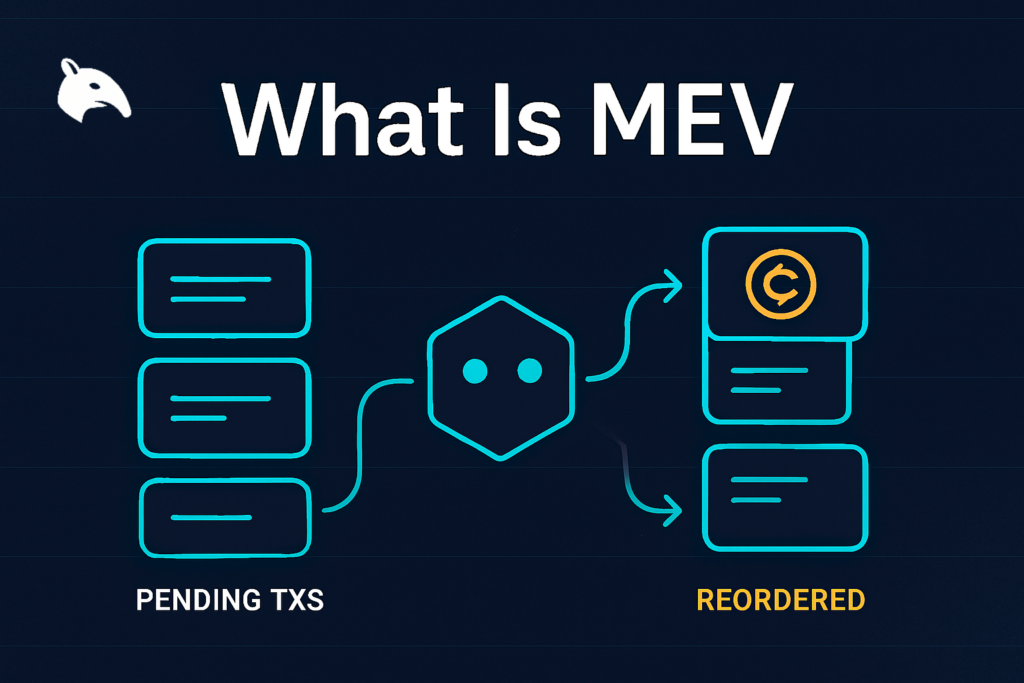
MEV stands for maximal extractable value. It describes the extra value that can be captured by controlling, influencing, or predicting transaction ordering inside a block. In practice, MEV appears when participants can profit not just from what transactions say, but from where those transactions are placed relative to others. That is why MEV is mainly a transaction-ordering problem, not just a trading problem.
The easiest way to understand MEV is to stop thinking of the mempool as a neutral waiting room. On smart-contract chains, pending transactions often reveal profitable intentions before they are finalized. If someone sees a large swap, liquidation, or arbitrage opportunity in flight, they may try to insert, reorder, or bundle transactions around it. That ordering power can extract value from ordinary users, from protocols, or from other sophisticated actors competing in the same flow.
This content is for educational purposes only and should not be considered financial or investment advice.
Key Takeaways
- MEV is about transaction ordering: The profit comes from position inside the block, not only from holding the right asset.
- It appears most clearly in DeFi: Swaps, liquidations, arbitrage, and lending activity create visible profit opportunities before finalization.
- Multiple actors compete for it: Searchers, builders, relays, and validators each play different roles in the extraction pipeline.
- Not all MEV is the same: Some forms improve price alignment, while others such as sandwiching directly harm users.
- Regular users feel it through worse execution: Slippage, front-running, failed swaps, and unexpected value loss are the practical symptoms.
What MEV Actually Means
At the protocol level, a block producer or someone coordinating with a block producer has influence over which transactions enter a block and in what order. That influence can be monetized. If ordering a liquidation first earns a reward, if placing an arbitrage trade before someone else’s swap captures spread, or if surrounding a trade worsens that user’s execution while creating profit for the attacker, the ordering rights themselves have economic value. That is MEV.
A useful mental model is to think of block space as a queue where position has price. In a normal queue, you care about getting served. In an MEV-sensitive queue, participants care about who stands directly before and after whom, because adjacency can change profit. The block is not just a container. It is an ordered sequence with market consequences.
Why MEV Exists
MEV exists because public blockchains often expose pending transaction data before final settlement, while smart contracts create deterministic state changes that can be predicted and traded against. If a pending trade will move a pool price, liquidate a borrower, or open an arbitrage gap, other actors can see that intention early and respond before the original transaction lands.
The mempool is one major reason this happens. Pending transactions frequently reveal price impact, size, counterparties, and method calls before confirmation. For the queue mechanics behind that exposure, the best local background piece is Bitcoin Mempool Explained: How the Transaction Queue Works, even though the most aggressive forms of extraction show up more clearly on smart-contract chains than on Bitcoin.
One operator insight is that MEV is not a bug accidentally discovered after DeFi launched. It is a structural byproduct of transparent pending order flow plus programmable settlement. Once those two ingredients exist together, transaction ordering becomes economically valuable whether a protocol explicitly wants it or not.
Who Captures It
In modern Ethereum-style ecosystems, MEV extraction is usually split across several specialized roles rather than performed by one actor doing everything alone.
- Searchers: Bots or firms scanning pending order flow for arbitrage, liquidations, and ordering opportunities.
- Builders: Actors assembling transaction bundles and candidate blocks to maximize block value.
- Relays or marketplaces: Infrastructure coordinating private order flow or block submission in some ecosystems.
- Validators: Final block proposers who ultimately accept profitable block content under protocol rules.
That is why MEV should not be reduced to “bots on DEXs.” The extraction pipeline often sits closer to the block-production market itself. For the validator role in that pipeline, the nearest local follow-up is What Is a Validator Node?.
Common Forms of MEV
Arbitrage
If prices temporarily diverge across pools or venues, a searcher can submit trades that restore alignment and capture the spread. This is often described as a cleaner form of extraction because it can improve price consistency, even though it still monetizes privileged speed and ordering.
Liquidations
Lending protocols often reward the first actor who liquidates an undercollateralized position. That creates a race to submit the winning transaction at the right time and position. The value comes from being first in line when a profitable protocol event becomes valid.
Sandwich attacks
A sandwich attack places one transaction before a victim’s trade and another after it, exploiting the price movement the victim creates. The attacker buys first, lets the victim move price in the attacker’s favor, then sells into the changed price. This is one of the most user-harmful forms of extraction because the victim often receives materially worse execution than expected.
Back-running and reordering
Some strategies profit from landing immediately after a visible event rather than before it. Others combine multiple transaction bundles to maximize value from complex state changes. The important point is that ordering rights themselves have become a competitive market.
Why It Matters for Regular Users
Most users never see the extraction pipeline directly. They feel its effects indirectly through worse swap execution, unexpected slippage, failed trades, or suspicious price movement between wallet approval and confirmation. In other words, MEV often shows up as friction and hidden cost rather than as a clearly labeled line item.
A practical way to frame it is this: if your transaction reveals profitable information before finalization, someone else may try to trade around that information first. That is why order size, slippage tolerance, route selection, and private-order-flow tools can matter so much for active DeFi users.
For the step-by-step skill of inspecting those transactions after the fact, the closest local reference is How to Read a Blockchain Transaction.
What MEV Is Not
- It is not just “front-running” in a generic sense: Some extraction is after-the-fact, bundled, or tied to protocol liquidations rather than a simple jump ahead.
- It is not limited to one chain or one exchange: The mechanics differ, but any transparent order-flow environment can create ordering games.
- It is not always obviously malicious: Arbitrage can tighten prices even while still monetizing ordering advantage.
- It is not solved just by paying higher fees: Higher fees may help priority, but they do not eliminate the structural incentive to extract value from visible order flow.
Practical Usage: How to Reduce MEV Exposure
Most users cannot eliminate exposure entirely, but they can reduce how easy their transactions are to exploit. The goal is to make your order flow less predictable, less generous, or less exposed to public competition.
- Use tighter slippage settings when appropriate: Wide slippage tolerance gives extractors more room to profit at your expense.
- Avoid oversized market orders in thin pools: Large visible swaps create clearer opportunities for surrounding trades.
- Split sensitive trades when it makes sense: Smaller execution can reduce obvious one-shot extraction targets.
- Use wallets and routes that consider private order flow: Some tools try to reduce exposure before public broadcast.
- Review transaction details before signing: Suspicious routes, approvals, and method calls can worsen already risky execution paths.
A second operator insight is that the most important user defense is not trying to outcompete professional searchers. It is recognizing when you are entering an environment where your trade reveals value before settlement, and then adjusting execution habits accordingly.
Risks and Common Mistakes
- Reducing MEV to a buzzword: If you treat it as a vague DeFi meme, you miss the actual transaction-ordering mechanics that create the risk.
- Assuming all extraction is identical: Arbitrage, liquidation races, and sandwiching affect users differently and should not be collapsed into one bucket.
- Ignoring execution quality: A trade can succeed on-chain while still giving you materially worse pricing than you expected.
- Using loose slippage in volatile pools: This can hand too much exploitable room to competitors watching the same order flow.
- Thinking validators alone “cause” the issue: The incentives run through the whole order-flow pipeline, not just the final proposer.
Sources
Frequently Asked Questions
What does MEV stand for in crypto?
It stands for maximal extractable value, meaning the extra value that can be captured by controlling or exploiting transaction ordering inside a block.
Is MEV the same as front-running?
No. Front-running is only one pattern. MEV also includes liquidations, arbitrage, sandwiching, back-running, and other ordering-based strategies.
Why does MEV happen mostly in DeFi?
DeFi creates visible, programmable state changes around swaps, lending, and liquidation logic. That makes pending order flow easier to analyze and trade around before final settlement.
Can regular users avoid MEV completely?
Usually not completely. But users can reduce exposure by using tighter slippage, avoiding oversized visible orders in thin pools, and choosing better routing or private-order-flow tools when available.
Is all MEV bad for the network?
No. Some forms such as arbitrage can improve price alignment, while others such as sandwich attacks directly harm users. The important distinction is who benefits and who pays.