

Last Updated on March 23, 2026 by Snout0x
A seed phrase backup is the only way to recover a self-custody wallet. Every hardware wallet ships with a paper card, but paper burns at approximately 230 degrees Celsius and degrades in water and humidity. Purpose-built metal backup devices exist to address exactly this vulnerability. This guide covers the main types and compares them by material, setup method, durability, and price, so you can choose what fits your setup.
For the risk side of this topic, see self custody.
The practical decision framework is simple: choose a stamping kit if cost matters most, a tile-based system if error prevention matters most, and an engravable plate only if you want a middle-ground option and are comfortable trading some durability for simplicity. The best device is the one you can set up accurately and store confidently, not the one with the most marketing around fire resistance.
This content is for educational purposes only and should not be considered financial or investment advice.
This article may contain affiliate links. If you purchase through these links, Snout0x may earn a commission at no additional cost to you.
Key Takeaways
- Metal seed backup devices survive house fire temperatures and flooding; paper does not.
- Stamping kits are the most affordable approach but require more manual effort to use accurately.
- Tile-based systems are easier to set up correctly and allow error correction without ruining the plate.
- Titanium and 316L stainless steel are the preferred materials for long-term corrosion resistance.
- Always verify every word and number position twice before relying on the backup.
Types of Metal Seed Backup Devices
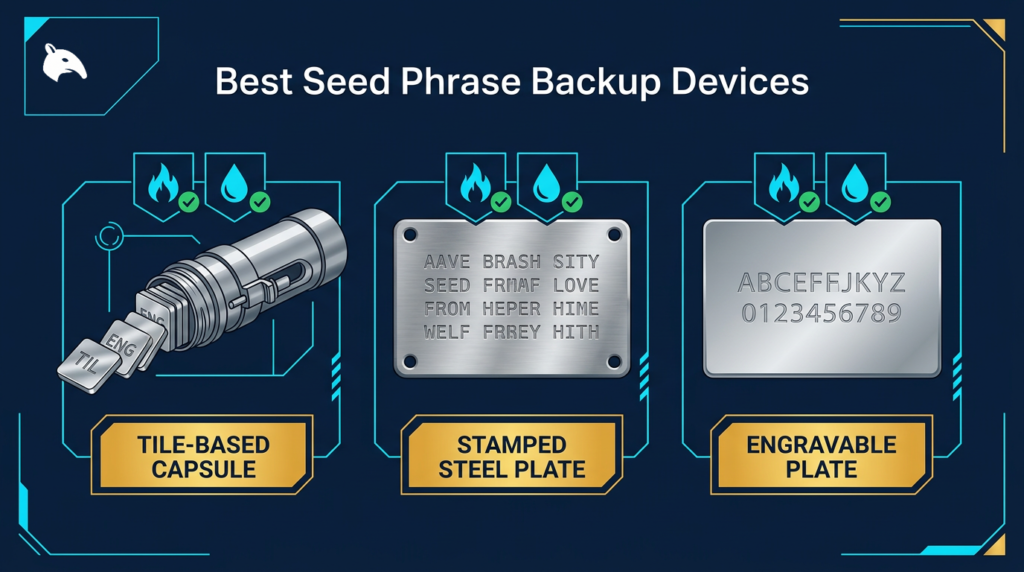
Three main formats exist: stamping plates, engravable plates, and tile-based letter systems. Each has trade-offs in price, ease of use, and accuracy. If you are new to self-custody hardware, What Is a Hardware Wallet? helps frame why the backup matters as much as the device itself.
- Stamping plates. You use a letter punch set to stamp each word (or first 4 letters, which is sufficient for BIP-39 disambiguation) into a stainless steel plate. Affordable but the manual stamping process requires care to avoid misaligned characters or skipped words.
- Engravable plates. Flat steel or titanium plates with a grid for engraving characters. Some come with a stylus. The result is less durable than stamped letters but adequate for most use cases.
- Tile systems. Letter tiles or slots lock into a frame. Words or letters are physically inserted rather than permanently stamped. This allows changes without ruining the plate. The Keystone Tablet Plus uses this approach. More expensive but easier to set up without errors.

Notable Products
If you are choosing between categories rather than brands, start broad: Best Crypto Hardware Wallets helps with the device decision, while this comparison is specifically about the backup layer. The right pairing is usually a wallet you trust plus a backup format you can record without mistakes.
For a closely related follow-up, see Hardware Wallet Setup: How to Do It Safely from the Start.
For the broader overview around this topic, see Best Crypto Passive Income: 5 Low-Risk Strategies (No Ponzis).
Keystone Tablet Plus
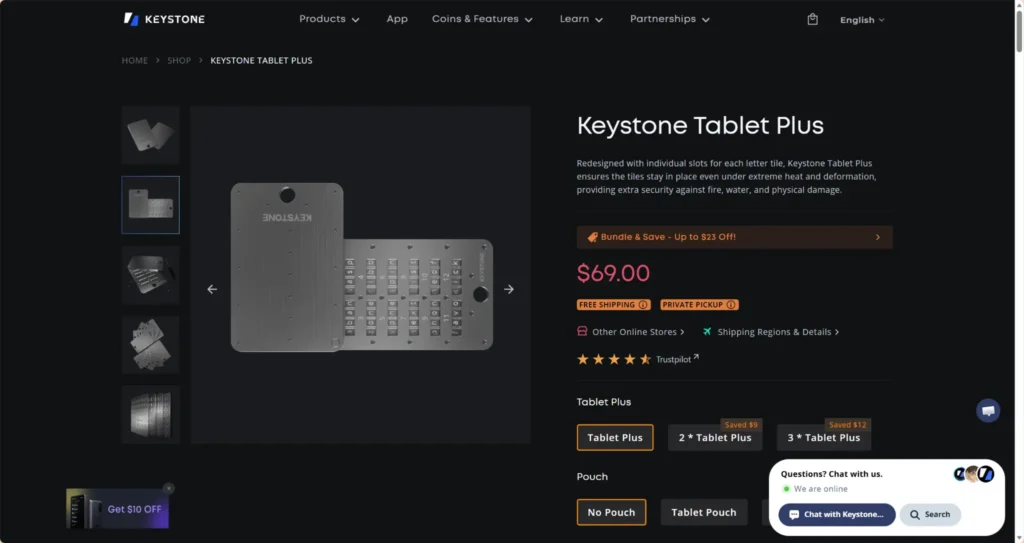
The Keystone Tablet Plus is a tile-based system that uses individual letter slots locked into a stainless steel frame. Words are entered tile by tile, making it easy to correct errors during setup. The locked tiles survive fire and water without the words becoming unreadable. Suitable for both 12-word and 24-word seeds.
Trezor Keep Metal
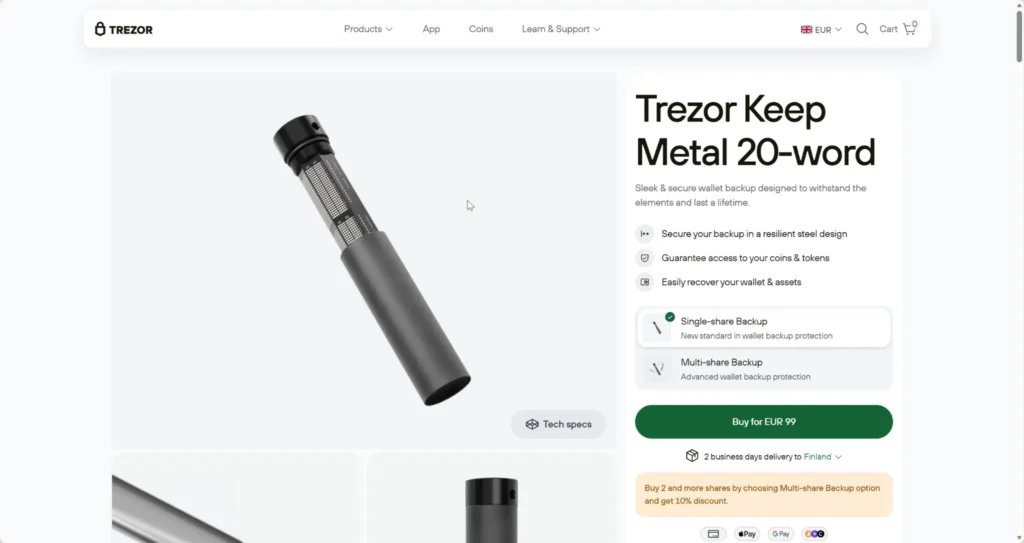
Trezor offers two metal backup options: the Keep Metal 24 (for 24-word seeds) and the Keep Metal 20 (for 20-word seeds). These use stamped letter punches into a stainless steel plate. The process is straightforward and the result is durable. Best for users already in the Trezor ecosystem.
Cryptosteel Capsule
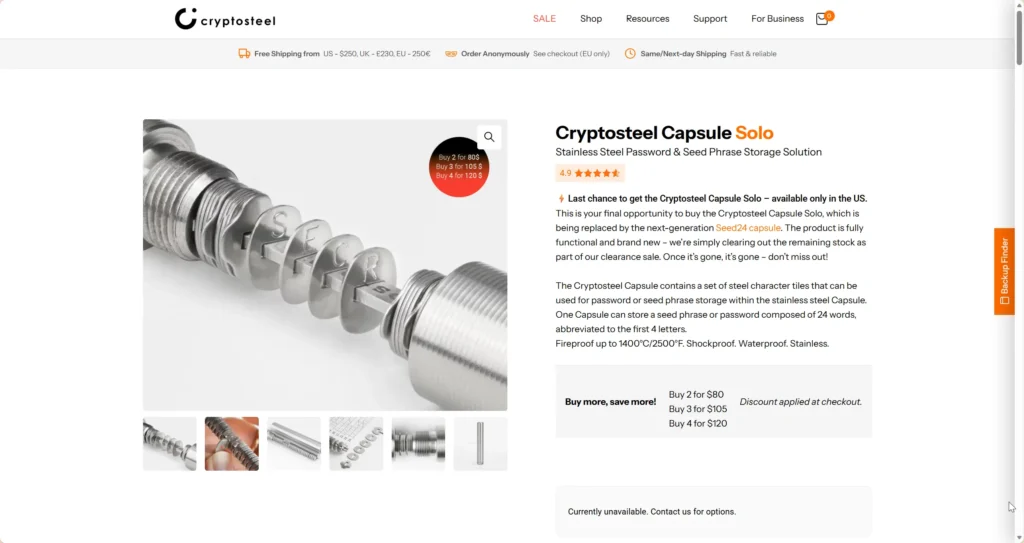
A well-established tile-based option using letter tiles loaded into a stainless steel capsule. Compatible with all major hardware wallets and seed standards. Rated for high fire resistance and fully waterproof. The capsule format protects tiles from falling out if dropped.
Stamping Kits (Generic)
Affordable stainless steel plates paired with a hammer and letter punch set are available from multiple vendors. These are functional and fire-resistant but require care during use. The main risk is misaligned characters or skipped words due to manual entry. Always work slowly and double-check every word against the seed card before sealing.

Practical Usage: Choose a Backup That Matches Your Setup
- Material: 316L stainless steel or titanium for maximum corrosion and heat resistance.
- Word capacity: Confirm the device supports 24-word seeds if your wallet uses them.
- Error correction: Tile systems allow fixing mistakes. Stamped plates do not.
- Readability after damage: Stamped or tile-locked characters remain readable even after extreme physical exposure. Engraved characters can be harder to read after heavy deformation.
The verdict by use case is clearer than the product list alone suggests. Tile systems are usually the best choice for users who care most about setup accuracy and want the lowest chance of transcription mistakes. Stamping kits are the best value for experienced users who are comfortable working slowly and double-checking each word. Engravable plates are acceptable, but they are rarely the strongest option on either price or resilience, which is why they tend to be the compromise choice rather than the obvious winner.
Risks and Common Mistakes
The most common mistake is not verifying the backup. After creating the backup, test that it matches the original seed phrase word by word, in the correct order, with correct numbering. A single transposed word makes recovery fail.
Storing the backup in the same place as the device eliminates the value of a backup. A fire or theft that destroys the device will also destroy the backup. Keep them physically separate. For a direct format comparison, Metal vs Paper Seed Storage explains when metal is worth the extra effort.
Frequently Asked Questions
Do I need to back up all 24 words?
Yes, every word in the exact order. The seed phrase is the master key. Missing or transposed words make recovery impossible.
Is titanium better than stainless steel for seed backups?
Both are excellent. Titanium is lighter and has slightly better corrosion resistance. Stainless steel (316L grade) is more affordable and equally suitable for most long-term storage scenarios. The material difference matters less than the quality of the specific product and how carefully you create and store the backup.
Can I use an existing stainless steel plate I already have?
You can stamp or engrave any quality stainless steel plate. However, purpose-built devices are designed with the right dimensions, word number grids, and BIP-39 word support to reduce setup errors. A custom plate works but requires more careful design to avoid mistakes.
Should I store a passphrase on the metal backup too?
Only if you use a passphrase and have a strategy for its separate storage. A passphrase (sometimes called the 25th word) is a separate layer of protection stored apart from the seed phrase. Storing both together removes the benefit of the passphrase. Keep them in separate, secure locations.
How many copies should I make?
At minimum two copies in different physical locations. A home safe plus an off-site location (bank safe deposit box, trusted family member’s secure storage) provides meaningful protection against single-location disasters.