

Last Updated on April 12, 2026 by Snout0x
Every cycle, the same crypto narratives come back.
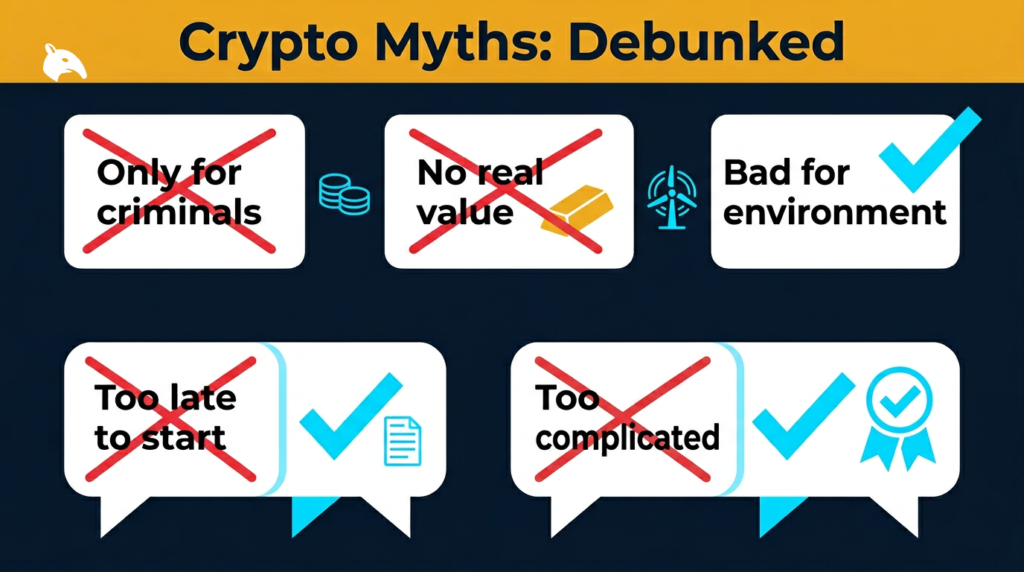
“Bitcoin is mostly used by criminals.”
“Crypto has no intrinsic value.”
“It’s terrible for the environment.”
“You’re already too late.”
None of these claims survives contact with the data.
In this guid,e we break down the most common crypto myths using real research from Chainalysis, the UN Office on Drugs and Crime, and energy studies from the Cambridge Centre for Alternative Finance.
Because if you’re making financial decisions based on headlines instead of facts, you’re not investing, you’re volunteering to be exit liquidity.
5 Key Takeaways
- The “Criminal” Myth: Less than 1% of all crypto transactions are illicit (Chainalysis 2025). Between 2% and 5% of global GDP moves through traditional money laundering channels every year. The blockchain is a permanent, public record. It is the worst possible place to hide dirty money.
- The “Fake Money” Myth: All money is collective belief. Fiat is backed by government decree and an unlimited printing press. Bitcoin is backed by math and a hard cap of exactly 21 million coins. If it solves a real problem, it has value.
- The “Eco-Disaster” Myth: Ethereum’s transition to Proof of Stake cut energy use by 99.95%. Modern PoS chains like Solana and Cardano run on the energy equivalent of a small town. Bitcoin targets stranded and otherwise-wasted energy.
- The “Too Late” Myth: BlackRock’s Bitcoin ETF crossed $50B AUM in under 12 months, making it the fastest ETF launch in Wall Street history. Institutions are just beginning to allocate. The meme-coin lottery is over. The infrastructure buildout is not.
- The Fix: Stop reading headlines. Start learning OpSec. Get a hardware wallet, learn to stake, and ignore the noise on both sides.
Welcome to the Noise Machine

Most bad crypto decisions do not come from stupidity. They come from bad information repeated loudly enough and often enough to feel like fact.
Open X (formerly Twitter) or turn on CNBC, and you get two competing versions of reality. On one side: the promoters. Screaming “WAGMI,” posting rented Lambos, pushing coins named after misspelled dog breeds. Loud, persistent, and usually selling something. On the other side: the skeptics. Politicians, legacy bankers, and commentators with no real exposure to the technology. Crypto is a scam. A bubble. A terrorist tool. The reason the ice caps are melting.
The truth is not in the middle. It is in the data, which most people never look at.
At Snout0x, I am not selling a course and I am not your financial advisor (NFA). The goal is simple: stop you from being exit liquidity for the people who actually understand how this works.
Before you think about cold storage or yield strategies, we need to clear some myths. Let’s look at the numbers.
Disclaimer: This content is for educational and informational purposes only and does not constitute financial, investment, tax, or legal advice. Cryptocurrency markets are volatile and involve risk. Always conduct your own research and consult a qualified professional before making financial decisions.
Myth 1: “Crypto is Mostly Used for Illicit Activity”
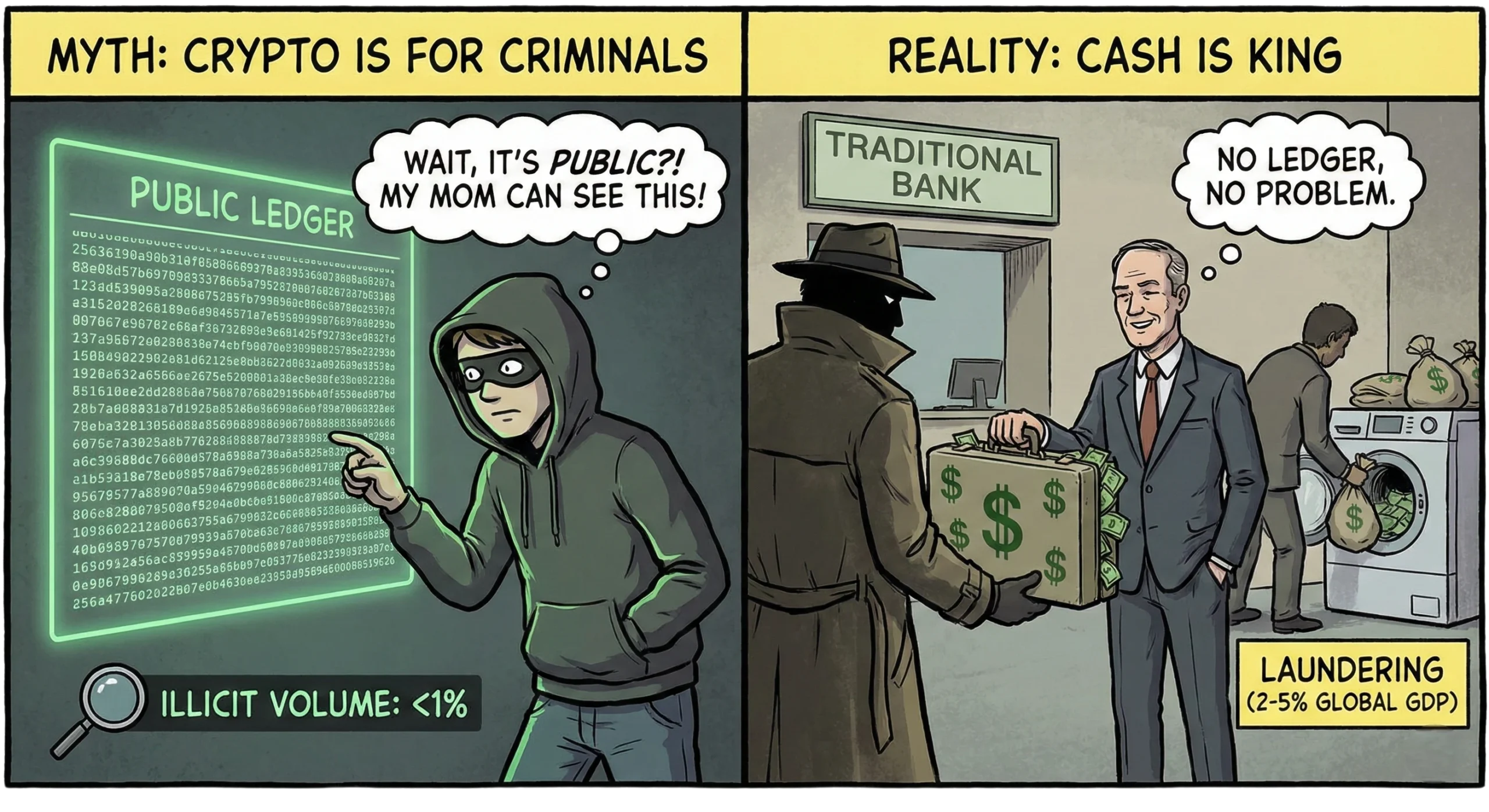
This is the favorite talking point of every regulator who wants to sound tough on crime while ignoring the trillions laundered through major banks every year. The narrative is simple: “Bitcoin is anonymous, so only drug dealers and criminals use it.”
The Reality Check: The “Public Ledger” Problem
If you are a criminal, using Bitcoin is strategically stupid.
The blockchain is a public, immutable ledger. Every transaction that has ever happened on the Bitcoin network is visible to anyone with an internet connection. It is the most transparent accounting system in human history.
When you pay with cash, the transaction disappears the moment the bills change hands. No metadata, no timestamp, no permanent record.
When you use crypto, you leave a permanent digital trail. Companies like Chainalysis and Elliptic have built billion-dollar businesses doing nothing but tracking those trails, mapping exactly where money came from, where it went, and in many cases, who owns the wallet. Several major exchange hacks and criminal operations have been fully unravelled years after the fact using on-chain data alone.
The Data
According to the 2025 Crypto Crime Report by Chainalysis, illicit activity accounts for less than 1% of all crypto transaction volume. Meanwhile, the United Nations Office on Drugs and Crime (UNODC) estimates that between 2% and 5% of global GDP, up to $2 trillion annually, is laundered through the traditional fiat banking system.
The “crypto is for crime” narrative does not hold up to the data.
The Snout0x Take
Transparency is a feature, not a bug. The only actors who should fear a public ledger are those who profit from the opaque, backroom dealings of the traditional financial system.
If you are worried about safety in crypto, the right question is not “is Bitcoin used by criminals?” It is: “is my own security tight enough?”
Recommended Reading:
- Understand how the public ledger actually works: Why “Simple” Blockchain Guides Usually Fail You
- Reduce your exposure to the most common attack vectors: Mobile Wallet Security 2026: 5 Critical Risks and How to Fix Them
Myth 2: “It Has No Intrinsic Value”
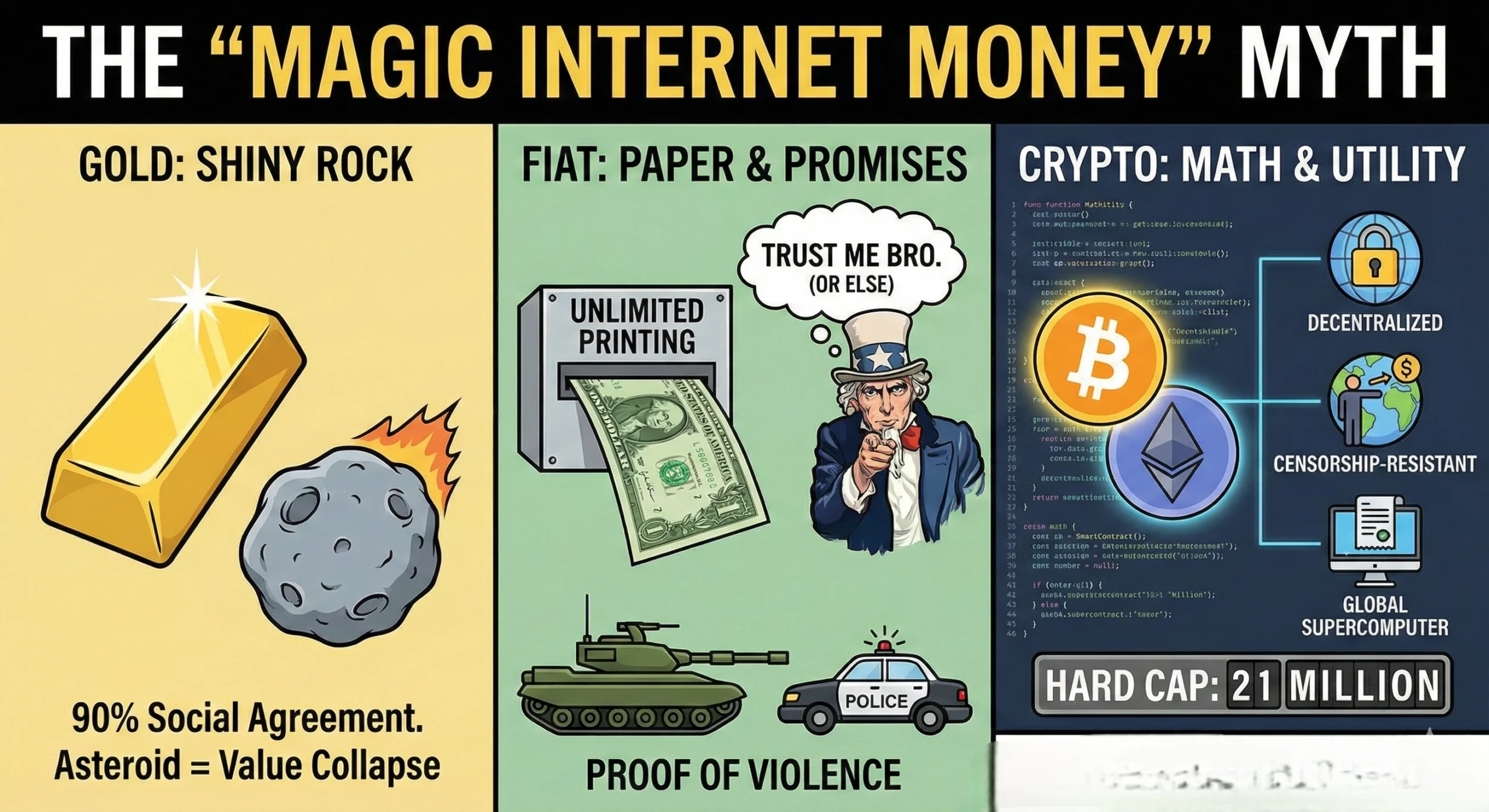
“You can’t hold a Bitcoin. It’s just air. It’s not real like this dollar bill.”
This argument exposes how little most people understand about money itself. It is worth examining carefully.
The Reality Check: What Is “Value”?
Let’s look at the “intrinsic value” of the things we already trust:
- Gold: A shiny metal with modest industrial use in electronics. The vast majority of its value is a collective social agreement that “Gold = Wealth.” If we discovered an asteroid made of solid gold tomorrow, that value would collapse overnight.
- Fiat Currency (USD/EUR): Since 1971 and the end of the Gold Standard, the dollar is backed by nothing tangible. Only “The Full Faith and Credit of the US Government.” Its value exists because the government mandates it for taxes, and because non-compliance has consequences. That is Proof of Authority, not intrinsic value.
- Crypto: Derives value from Utility and Scarcity.
The Utility of the Network
When you buy Bitcoin, you are not buying a digital coin. You are buying access to the only decentralized, censorship-resistant financial network in the world. Its value proposition: “I can send value to anyone, anywhere, anytime, without asking permission from a bank or government.” That is a powerful and genuinely novel service.
When you buy Ethereum or Solana, you are paying for compute time on a global programmable network. You need these tokens to run smart contracts, DeFi applications, and on-chain assets. The value: “I can execute a programmable agreement without a lawyer or a middleman.”
The Snout0x Take
If a network solves a massive global problem, remittance fees, runaway inflation, financial censorship, it has value. The paper bill in your pocket loses 2 to 5% of its purchasing power every single year. Bitcoin has a hard cap of 21 million coins that cannot be changed by any government, bank, or politician.
Which sounds more like “magic money”: the one they can print trillions of on a whim, or the one governed by math?
Recommended Reading:
- See this “magic money” earn real yield: Staking Crypto in 2026: Risks and Real Yields
- Understand the Store of Value vs. Utility layers: CeFi vs DeFi Explained
Myth 3: “It’s Terrible for the Environment”
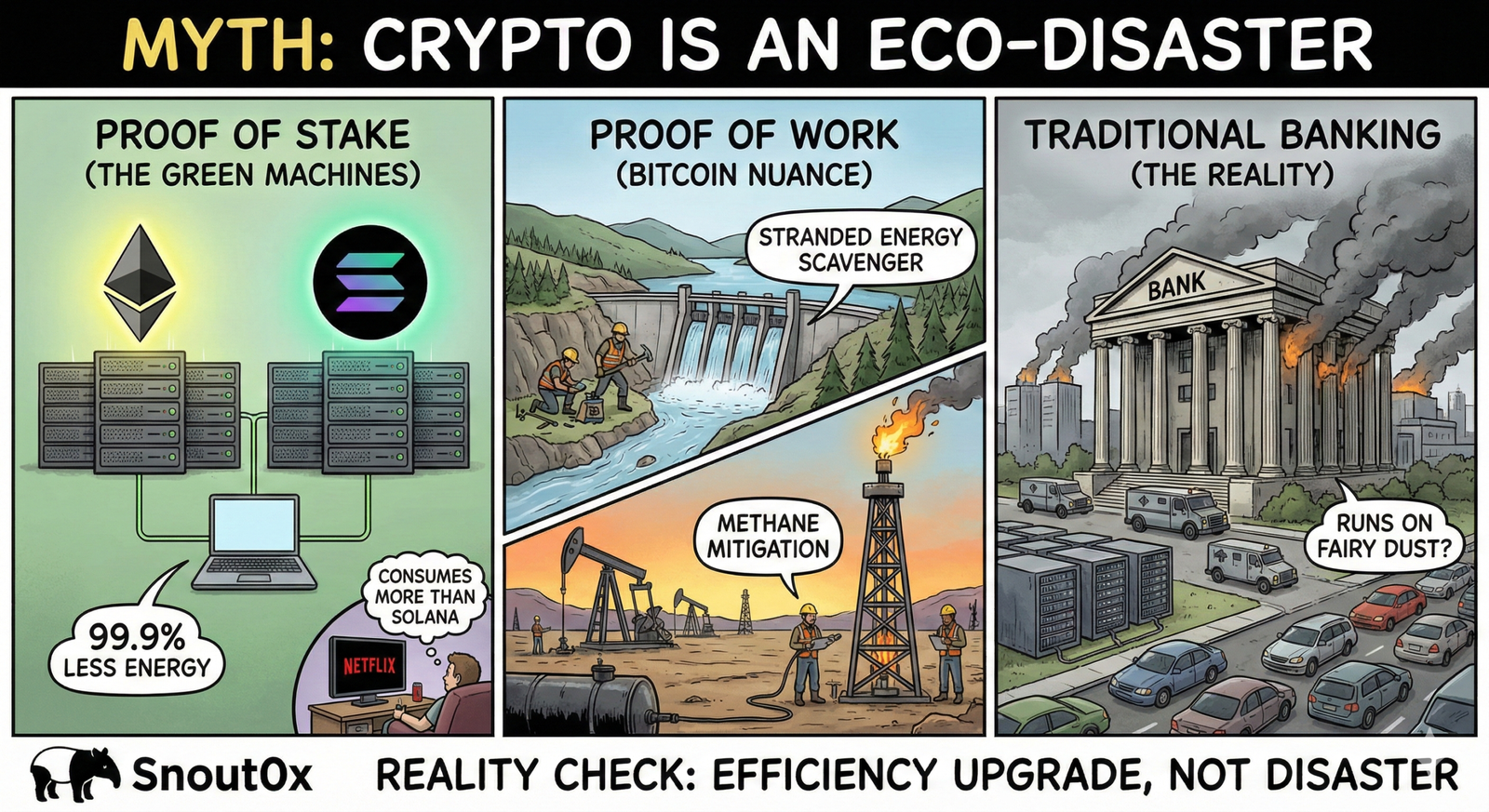
The environmental argument is one that sounds compelling until you look at how different blockchains actually consume energy. The details matter here.
The Reality Check: Not All Blockchains Are the Same
You cannot lump all crypto into one “energy” bucket. The two main consensus mechanisms work completely differently: Proof of Work (PoW) and Proof of Stake (PoS).
1. Proof of Stake (The Green Machines)
Ethereum, Solana, Cardano, and virtually every modern blockchain use Proof of Stake. Instead of energy-hungry miners competing to solve puzzles, PoS uses validators — standard servers or consumer hardware — that lock up coins to secure the network.
- Energy Use: According to the Cambridge Centre for Alternative Finance, Ethereum’s transition to Proof of Stake reduced its energy consumption by approximately 99.95%, from roughly 78 TWh/year to under 0.01 TWh/year.
- Comparison: Watching Netflix or streaming YouTube globally consumes vastly more energy than the entire Solana network.
2. Proof of Work (Bitcoin)
Bitcoin still uses energy-intensive mining. The nuance matters.
- The “Stranded Energy” Scavenger: Bitcoin miners are mobile. They go where energy is cheapest, typically stranded renewable energy (hydro in remote mountain regions, wind in unpopulated areas) that cannot be economically transported to cities. According to the Cambridge Bitcoin Electricity Consumption Index, a significant and growing share of Bitcoin mining uses sustainable energy sources. Without miners, much of that energy is simply wasted.
- Methane Mitigation: Miners are increasingly co-locating on oil fields to combust flare gas that would otherwise be vented directly into the atmosphere. Burning methane through a generator is measurably cleaner than open-air flaring. In these cases, Bitcoin mining actively reduces net emissions.
The Snout0x Take
Does the traditional banking system run on fairy dust? Consider the energy cost of building and heating 50,000 bank branches worldwide, armored trucks moving physical cash daily, Visa and Mastercard data centers processing billions of transactions, and every employee commuting to every financial office on earth.
Bitcoin secures a trillion dollars of value without an army of middlemen. That is an efficiency argument, not a disaster.
Recommended Reading:
- Earn yield on the green side of crypto: Best Staking Coins 2026: Low-Risk Yields That Won’t Rug You
Myth 4: “It’s Too Late to Get Involved”
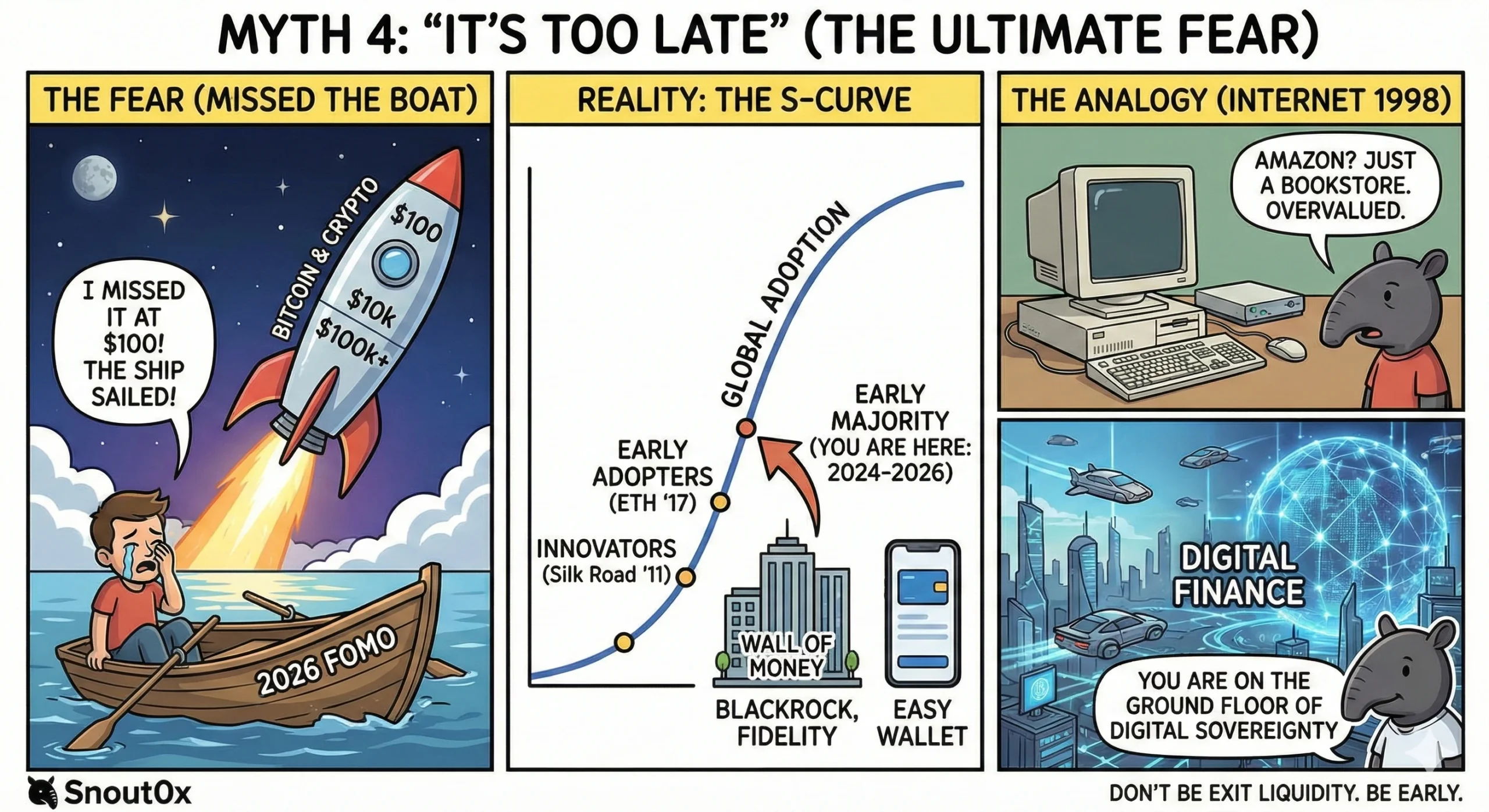
“I missed Bitcoin at $100. I missed it at $10,000. It is 2026. Surely the ship has sailed.”
This is fear speaking. And fear, in markets, has a name: FOMO.
The Reality Check: The S-Curve of Adoption
Technological adoption follows an S-Curve. Every major technology, electricity, the internet, the smartphone, moved through these phases:
- Innovators (The Cypherpunks): Buying on Silk Road in 2011. Technically brilliant. Socially invisible.
- Early Adopters (The Techies): Buying ETH in 2017. Passionate. Still ridiculed by mainstream finance.
- Early Majority (You Are Here): 2024 to 2026. Infrastructure is ready. Institutions are entering.
We are in the phase where the rails are finally ready for mass adoption.
- Institutions are here: BlackRock’s Bitcoin ETF crossed $50B AUM in under 12 months, the fastest ETF launch in Wall Street history. Fidelity, pension funds, and sovereign wealth funds are just beginning to allocate 1 to 2% of portfolios. That wall of capital has not fully hit the market.
- Usability is improving: Wallets are getting dramatically simpler. Account abstraction means you may not need to manually store a 24-word seed phrase in the near future (though you still should for now).
The “Internet in 1998” Analogy
Imagine it is 1998. The internet is slow and clunky. People are saying “Amazon is just a bookstore. It’s overvalued.” If you did not buy Amazon at the IPO, were you too late? No. You had 25 years of compounding growth ahead of you.
Crypto is upgrading the backend of the entire financial world. We are moving from analog finance, with T+2 settlement, markets closed on weekends, and permission required at every step, to digital finance with instant settlement, 24/7 operation, and programmable money. This transition will take decades. You are looking at the ground floor of a new asset class.
The Snout0x Take
You may be too late to turn $10 into $1,000,000 on a meme coin (unless you are gambling, which this is not). But you are early to Digital Sovereignty, the concept of actually owning your own money, free from bank bail-ins, exchange freezes, and government seizure.
Recommended Reading:
- If you are jumping in now, use the right tools: Is Ledger Nano X Safe in 2026?
- Start slow. Earn yield instead of trading: Best Crypto Passive Income 2026: 5 Low-Risk Strategies
Bonus Myth: “It’s Too Complicated for Normal People”
This one shows up in my DMs regularly. “I’m not a coder. I can’t do this.”
In 2016? Fair. It was a command-line nightmare. In 2026, if you strip away the trading noise, it is easier than your banking app.
You need exactly three tools to be in the top 10% of crypto users:
- A Hardware Wallet: To hold your keys offline. No keys means not your coins. Start here: Best Crypto Hardware Wallets 2026: Security Ranking and Buyer Guide.
- A Reliable Exchange: To buy and sell, with proper KYC so you stay on the right side of regulations.
- Tax Software: To keep the IRS off your back when the bull market hits.
That is it. You do not need to understand SHA-256 encryption. You just need to know how to click “Send” and “Receive.”
Recommended Reading:
- Simplify your setup in one read: 7 Essential Crypto Tools 2026: Trading, Taxes and Security Apps
- Build good security habits from day one: Crypto Wallet Hygiene Checklist: 15 Rules to Avoid Getting Hacked
Final Thoughts: The Mental Shift
Debunking these myths is the first step to becoming a clear-headed participant. When you stop seeing crypto as a get-rich-quick scheme (Myths 2 and 4), you stop chasing pumps and start building a real position. When you drop the “Criminal” narrative (Myth 1), you recognize the power of financial privacy and OpSec. When you understand the energy nuance (Myth 3), you can allocate with a clear conscience.
Crypto is a technology, not a magic lottery ticket. Treat it with respect, learn the risks, and for the love of Satoshi, get your coins off the exchange.
Next Steps:
- Secure Your Bags: If you hold more than $500 in crypto, get it offline. Ledger Nano X vs. Trezor Safe 7: Which Wins in 2026?
- Stay Legal: The tax man is coming for crypto gains. Do not get wrecked by an audit. Best Crypto Tax Software 2026: CoinLedger Review
Don’t navigate the trenches alone. I post daily insights, rug-pull warnings, and general sarcasm on X.
Follow me on X: @Snout0x
FAQ
Q: Is crypto actually safe or will I get hacked?
A: The Bitcoin blockchain has maintained 99.99% uptime and the protocol itself has never been compromised. What gets exploited are people and centralized exchanges. Click a phishing link or leave your funds on a poorly run platform and you will lose them. Use a hardware wallet, practice solid OpSec, and your holdings are substantially harder to target than a standard bank account.
Q: Do I need to buy a whole Bitcoin?
A: No. Bitcoin is divisible to 8 decimal places. You can buy $10 worth of BTC. Start small. The minimum viable position is whatever you can afford to lose.
Q: Will the government ban crypto?
A: They can restrict the on-ramps, meaning the banks that interface with exchanges. They cannot shut down the Bitcoin network itself. With institutions like BlackRock now running regulated crypto ETFs, a total ban is becoming both politically and financially unthinkable in most major jurisdictions.
Q: Is crypto just gambling?
A: Buying a memecoin because a celebrity tweeted about it is gambling. Buying Bitcoin as a long-term hedge against currency debasement is investing. Using Ethereum to access DeFi applications is utility. The market contains all three. You choose which game you play.