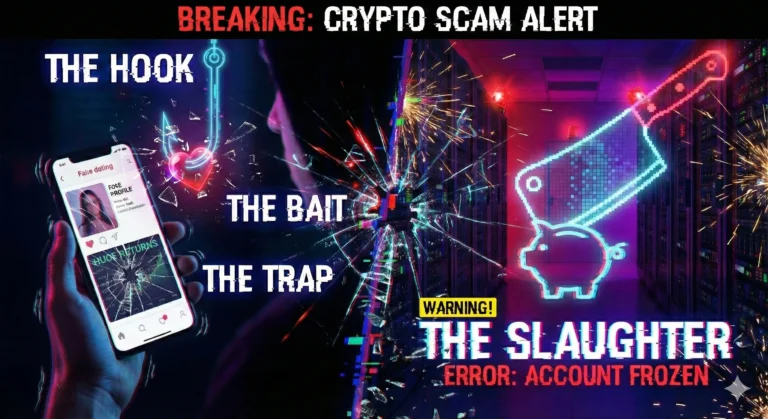


Crypto Myths That Are Keeping You Poor (And How to Fix Your Brain)
TL;DR:
-
The “Criminal” Myth: Cash is still the king of crime. Blockchain is a public ledger aka the worst place to hide illegal money. Transparency is a bug for criminals, but a feature for us.
-
The “Fake Money” Myth: All money is a collective hallucination. Fiat is backed by “trust me, bro” from politicians; Crypto is backed by math and code. If it solves a problem (like censorship resistance), it has value.
-
The “Eco-Disaster” Myth: Outdated FUD. Proof-of-Stake (Ethereum, Solana) runs on the energy equivalent of a few laptops. Bitcoin utilizes “stranded energy” that stabilizes power grids.
-
The “Too Late” Myth: We are still in the dial-up phase of finance. Institutions are just arriving. You missed the “easy 1000x on a jpeg,” but you are early for the generational wealth shift.
-
The Fix: Stop reading headlines, start learning OpSec. Get a hardware wallet, learn to stake, and ignore the noise.
Welcome to the Noise Machine
If you open X (formerly Twitter) or turn on CNBC, you get two versions of reality.
On one side, you have the “Crypto Bros.” These guys are screaming about “WAGMI” (We’re All Gonna Make It), posting pictures of Lambos they rented for the day, and trying to get you to buy a coin named after a misspelled dog breed. They are annoying, loud, and usually wrong.
On the other side, you have the “Skeptics.” These are usually politicians, old-guard bankers, or that one uncle who still prints out his emails. They tell you crypto is a scam, a bubble, a tool for terrorists, and the reason the polar ice caps are melting.
The truth? It’s not in the middle. The truth is burying itself in the code while everyone else argues.
At Snout0x, I don’t care if you buy Bitcoin or not. I’m not selling a course, and I’m definitely not your financial advisor (NFA). My goal is simple: I want you to stop being “Exit Liquidity” for the people who actually understand how this stuff works.
Before you can even think about cold storage or yield farming, we need to do some demolition work on your brain. We need to clear out the garbage myths that mainstream media has been feeding you for the last decade.
Let’s look at the data.
Myth 1: “Crypto is Mostly Used for Illicit Activity”
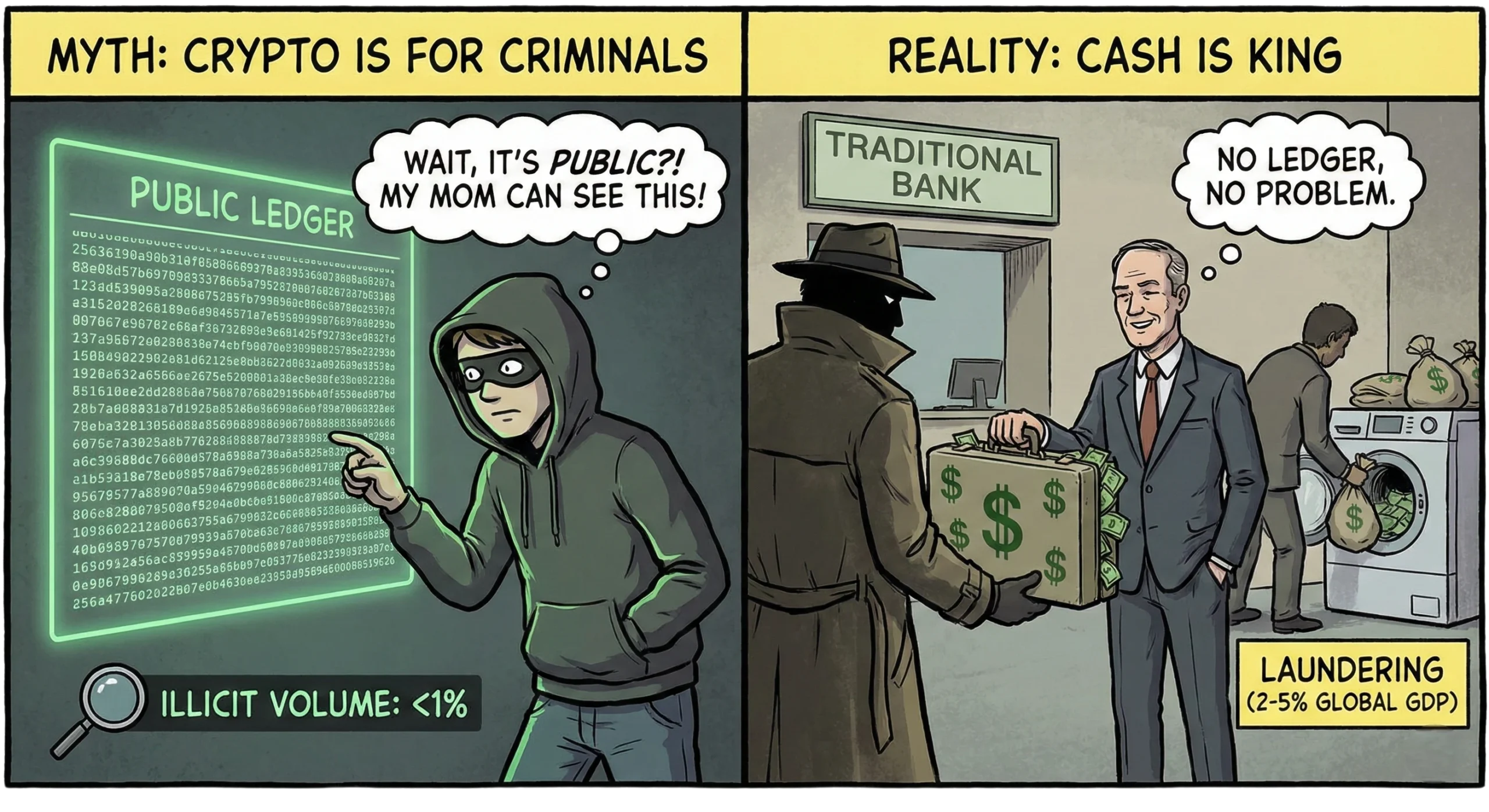
This is the favorite talking point of every regulator who wants to sound tough on crime while ignoring the trillions of dollars laundered through major banks every year. The narrative is simple: “Bitcoin is anonymous, so only drug dealers and hitmen use it.”
The Reality Check: The “Public Ledger” Problem
If you are a criminal, using Bitcoin is chemically stupid.
Why? Because the blockchain is a public, immutable ledger. Every single transaction that has ever happened on the Bitcoin network is visible to anyone with an internet connection. It is the most transparent accounting system in human history.
When you buy drugs with cash, the transaction disappears the moment the paper bills change hands. There is no metadata, no timestamp, and no permanent record.
When you use crypto, you leave a permanent digital footprint. Companies like Chainalysis and Elliptic have built billion-dollar businesses doing nothing but tracking these footprints. They can see exactly where the money came from, where it went, and in many cases, who owns the wallet.
The Data
According to the 2025 Crypto Crime Report (and consistent data from previous years), illicit activity typically makes up less than 1% of all crypto transaction volume. In comparison, the UN estimates that between 2% and 5% of global GDP is laundered annually through the traditional fiat banking system.
The “crypto is for crime” narrative is a statistical lie.
The “Snout0x” Take
Transparency is a feature, not a bug. The only people who should be afraid of a transparent ledger are the ones who benefit from the opaque, backroom dealings of the traditional financial system.
If you are worried about safety, your concern shouldn’t be “is Bitcoin used by criminals?” It should be “is my own security tight enough?”
Recommended Reading:
-
To understand exactly how this ledger technology works, read my guide: What Is a Blockchain? The Simple Explanation
-
Worried about your own safety? Don’t be the low-hanging fruit. Read: Mobile Wallet Security 2026: 5 Critical Risks & How to Fix Them
Myth 2: “It Has No Intrinsic Value It’s Just Magic Internet Money”
“You can’t hold a Bitcoin! It’s just air! It’s not real like this dollar bill!”
I love this one because it exposes how little people understand money itself.
The Reality Check: What is “Value”?
Let’s look at the “intrinsic value” of the things we trust:
-
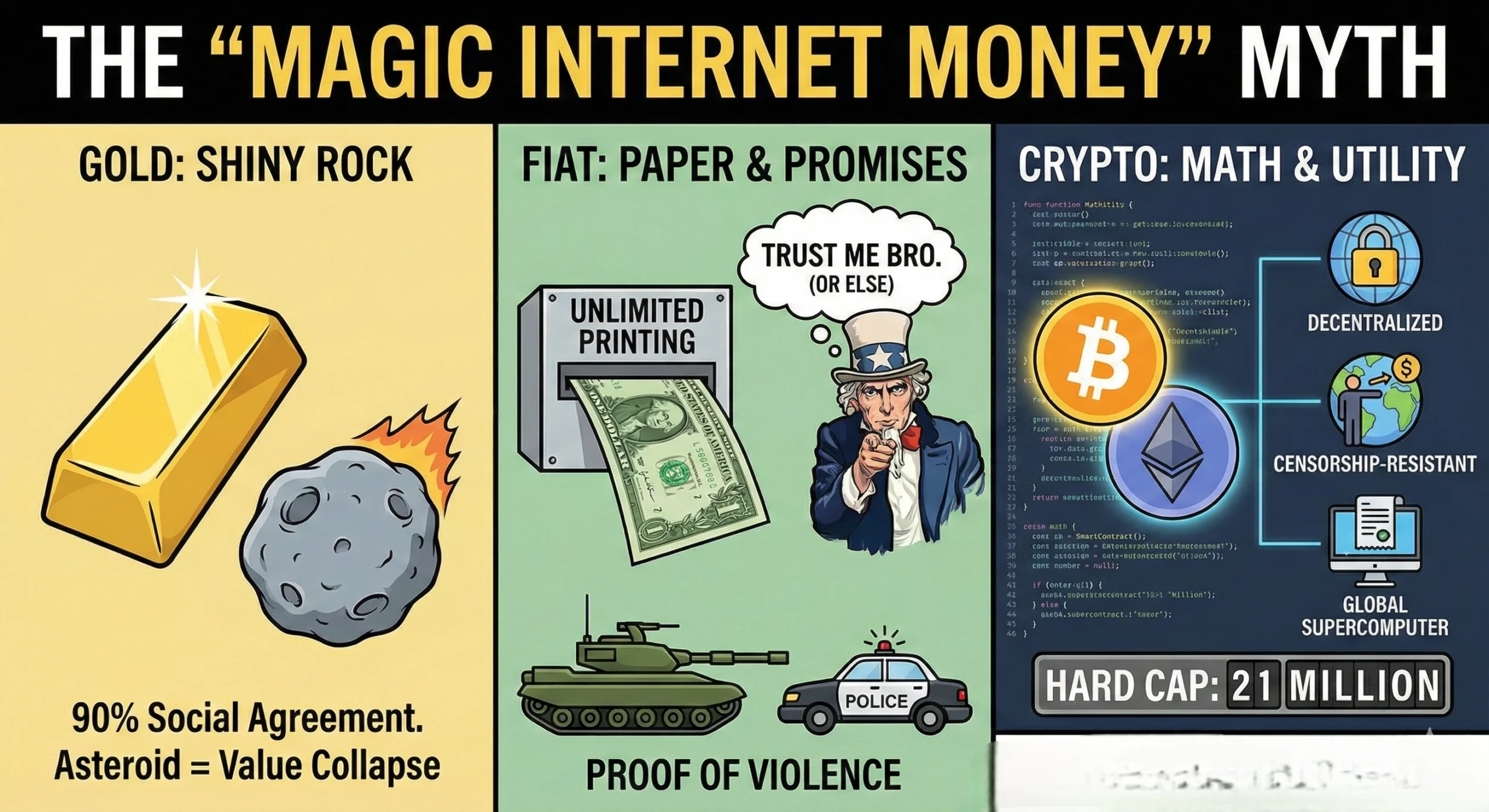
Gold: It’s a shiny rock. It has some industrial use in electronics, but 90% of its value comes from a collective social agreement that “Gold = Wealth.” If we found an asteroid made of gold tomorrow, that value would collapse.
-
Fiat Currency (USD/EUR): Since 1971 (the end of the Gold Standard), the dollar is backed by… nothing. It is backed by “The Full Faith and Credit of the US Government.” It has value because the government says it does, and because if you don’t pay your taxes in it, men with guns will come to your house. That is “Proof of Violence,” not intrinsic value.
-
Crypto: Cryptocurrencies derive value from Utility and Scarcity.
The Utility of the Network
When you buy Bitcoin, you aren’t buying a digital coin; you are buying shares in the only decentralized, censorship-resistant banking network in the world. Its value is: “I can send value to anyone, anywhere, anytime, without asking permission from a bank or government.” That is an incredibly valuable service.
When you buy Ethereum or Solana, you are paying for “gas” to use a global supercomputer. You need these tokens to run smart contracts, DeFi applications, and NFTs. The value is: “I can execute a programmable contract without a lawyer or a middleman.”
The Snout0x Take
If a network solves a massive global problem like remittance fees, inflation, or financial censorship it has value. The paper bill in your pocket is losing 2-5% of its purchasing power every year due to inflation. Bitcoin has a hard cap of 21 million coins.
Which one sounds like “magic money” to you? The one they can print trillions of on a whim, or the one governed by math?
Recommended Reading:
-
Want to see the utility in action? Learn how to earn interest on this “magic money”: What is Crypto Staking? A Simple Guide to Passive Income & Rewards 2026
-
Understand the difference between the “Store of Value” and “Utility” layers: CeFi vs DeFi Explained
Myth 3:
It’s Terrible for the Environment
This is the one that gets people yelled at during Thanksgiving dinner.
The Reality Check: Not All Blockchains Are the Same
You cannot lump all crypto into one “energy” bucket. We have to distinguish between the two main consensus mechanisms: Proof of Work (PoW) and Proof of Stake (PoS).
1. Proof of Stake (The Green Machines)
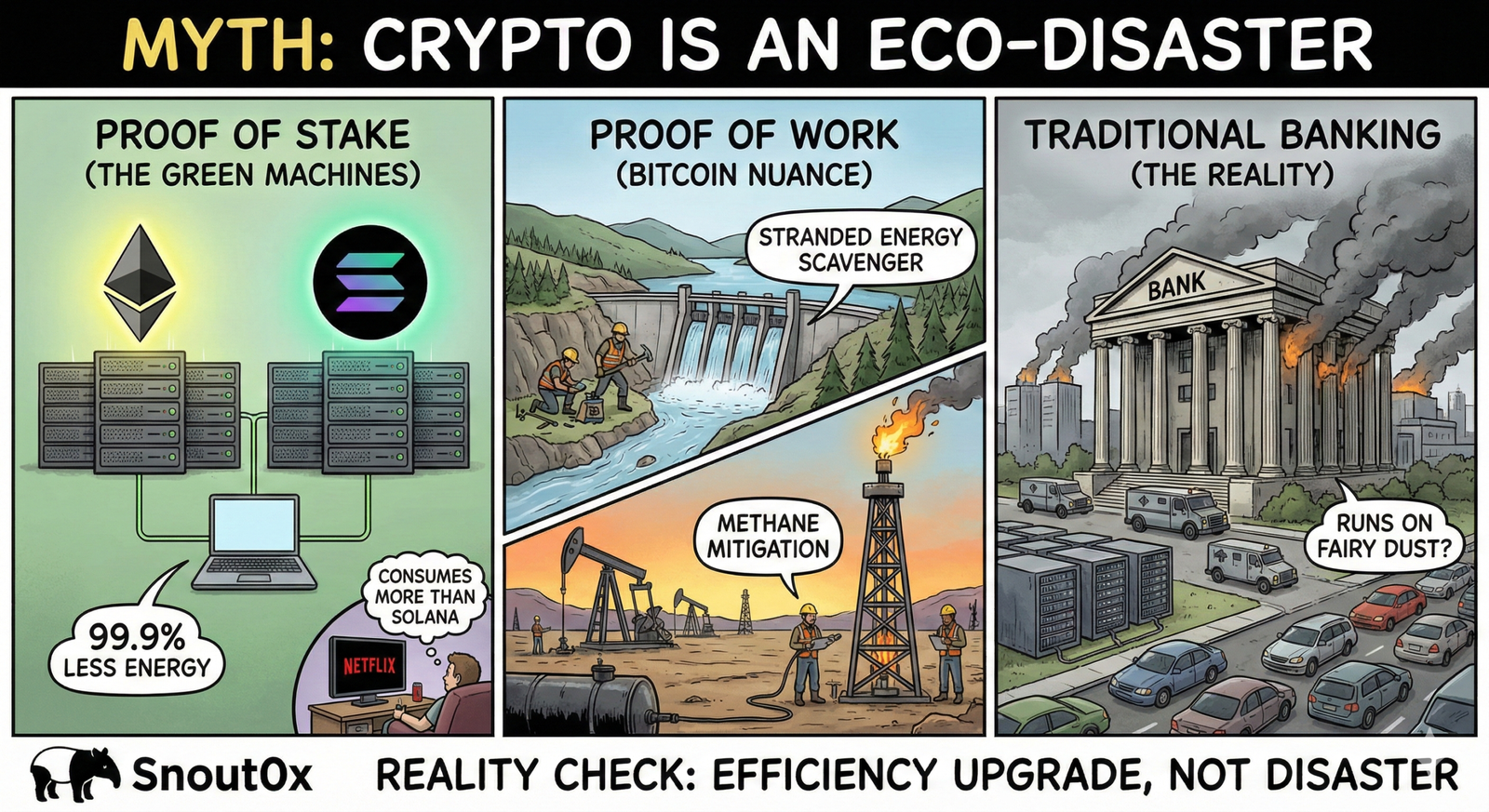
Ethereum, Solana, Cardano, and almost every modern blockchain use Proof of Stake. In this system, you don’t need energy-hungry miners. You just need “validators” (essentially servers/laptops) that lock up coins to secure the network.
-
Energy Use: The Ethereum network consumes about as much energy as a small town, reducing its carbon footprint by 99.9% after the “Merge.”
-
Comparison: Watching Netflix or using YouTube consumes vastly more global energy than the Solana network.
2. Proof of Work (Bitcoin)
Bitcoin still uses energy-intensive mining. However, the nuance is critical:
-
The “Stranded Energy” scavenger: Bitcoin miners are mobile. They go where energy is cheapest. Often, this is “stranded” renewable energy (like hydro in remote areas) that cannot be transported to cities. If that energy isn’t used, it’s wasted. Bitcoin monetizes wasted energy.
-
Methane Mitigation: Miners are setting up on oil fields to burn “flare gas” (methane) to power miners. This actually reduces carbon emissions because flaring is less efficient than running it through a generator.
The Snout0x Take
Does the traditional banking system run on fairy dust? Think about the energy cost of:
-
Building and heating 50,000 bank branches.
-
Armored trucks driving cash around.
-
Data centers for Visa/Mastercard.
-
Commuting employees.
Bitcoin uses energy to secure a trillion dollars of value without an army. That is an efficiency upgrade, not a disaster.
Recommended Reading:
-
Interested in the “Green” side of crypto (Proof of Stake)? Best Staking Coins 2026: Low-Risk Yields That Won’t Rug You
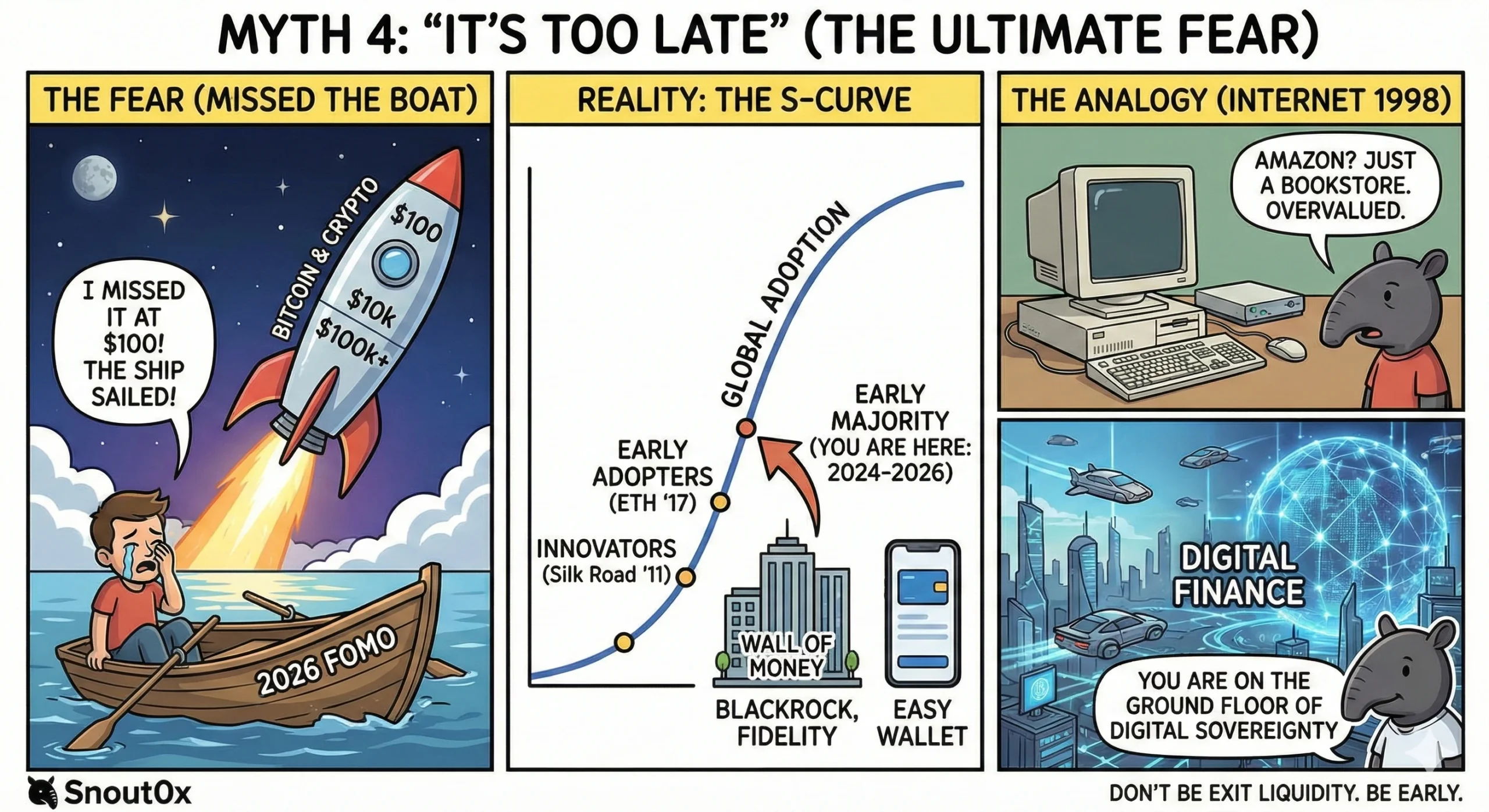
Myth 4: “It’s Too Late to Get Involved”
“I missed Bitcoin at $100. I missed it at $10,000. It’s 2026, surely the ship has sailed.”
This is pure fear speaking.
The Reality Check: The S-Curve of Adoption
Technological adoption follows an “S-Curve.”
-
Innovators (The Cipher-Punks): Buying drugs on Silk Road in 2011.
-
Early Adopters (The Techies): Buying ETH in 2017.
-
Early Majority (You Are Here): 2024-2026.
We are currently in the phase where the “infrastructure” is finally ready.
-
Institutions are here: BlackRock, Fidelity, and pension funds are just starting to allocate 1-2% of their portfolios. That is a wall of money that hasn’t fully hit the market yet.
-
Usability is improving: Wallets are getting easier to use. Account abstraction means you might not even need to write down 24 words soon (though you still should).
The “Internet in 1998” Analogy
Imagine it’s 1998. The internet is slow, clunky, and people are saying, “Amazon is just a bookstore, it’s overvalued.” If you didn’t buy Amazon at the IPO, were you “too late”? No. You had 25 years of growth ahead of you.
Crypto is currently upgrading the backend of the entire financial world. We are moving from “analog finance” (T+2 settlement, closed weekends) to “digital finance” (instant settlement, 24/7). This transition will take decades. You are looking at the ground floor of a new asset class.
The Snout0x Take
You might be too late to turn $10 into $1,000,000 overnight on a meme coin (unless you get lucky, which is gambling, not investing). But you are early to the concept of Digital Sovereignty. You are early to the idea of owning your own money.
Recommended Reading:
-
If you are going to jump in now, don’t do it on a sketchy exchange. Get the right tools. Ledger Nano X Review 2026
-
Start slow. Don’t trade. Earn yield. Best Low-Risk Crypto Passive Income 2026
Bonus Myth: “It’s Too Complicated for Normal People”
I added this one because I see it in my DMs every day. “Snout, I’m not a coder. I can’t do this.”
In 2016? You were right. It was a nightmare. In 2026? It’s easier than your banking app, if you strip away the trading noise.
You need exactly three tools to be in the top 10% of crypto users:
-
A Hardware Wallet: To hold your keys.
-
A Reliable Exchange: To buy/sell.
-
Tax Software: To keep the IRS/Government off your back.
That’s it. You don’t need to understand SHA-256 encryption. You just need to know how to click “Send” and “Receive.”
Recommended Reading:
-
Start here to simplify your life: 7 Essential Crypto Tools 2026: Trading, Taxes & Security Apps
Final Thoughts: The Mental Shift
Debunking these myths is the first step to becoming a smart user. When you stop seeing crypto as a “Get Rich Quick” scheme (Myth 2 & 4), you stop chasing pumps and start building a portfolio. When you stop fearing the “Criminal” narrative (Myth 1), you realize the power of privacy and OpSec. When you understand the energy nuance (Myth 3), you can invest ethically.
Crypto is a technology, not a magic lottery ticket. Treat it with respect, learn the risks, and for the love of Satoshi, get your coins off the exchange.
Next Steps:
-
Secure Your Bags: If you have more than $500 in crypto, get it offline. Ledger Nano X vs. Trezor Safe 7: Which Wins in 2026?
-
Stay Legal: The tax man is coming for crypto. Don’t get wrecked by an audit. Best Crypto Tax Software 2026: CoinLedger Review
Don’t navigate the trenches alone. I post daily insights, rug-pull warnings, and general sarcasm on X.
👉 Follow me on X: @Snout0x
FAQ:
Q: Is crypto actually safe or will I get hacked?
A: Crypto itself (the blockchain) has never been hacked. Bitcoin has 99.99% uptime. What gets hacked are people and centralized exchanges. If you click a scam link or leave your money on a shady exchange, you will lose it. If you use a hardware wallet and practice good OpSec, it is safer than your bank account.
Q: Do I need to buy a whole Bitcoin?
A: No. This is a massive misconception. Bitcoin is divisible up to 8 decimal places. You can buy $10 worth of Bitcoin (0.000something BTC). Start small; you don’t need to be a millionaire to enter.
Q: Will the government ban crypto?
A: They can try, but they can’t kill it. They can ban the on-ramps (banks connecting to exchanges), but they cannot shut down the Bitcoin network. However, with massive institutions like BlackRock now selling crypto ETFs, a total ban is becoming politically and financially impossible.
Q: Is crypto just gambling?
A: Buying a memecoin because a celebrity tweeted about it is gambling. Buying Bitcoin as a hedge against currency debasement is investing. Buying Ethereum to use DeFi applications is utility. The market has both; you get to choose which game you play.


Subscribe to our newsletter
Enjoy exclusive special deals available only to our subscribers.