

Last Updated on March 25, 2026 by Snout0x
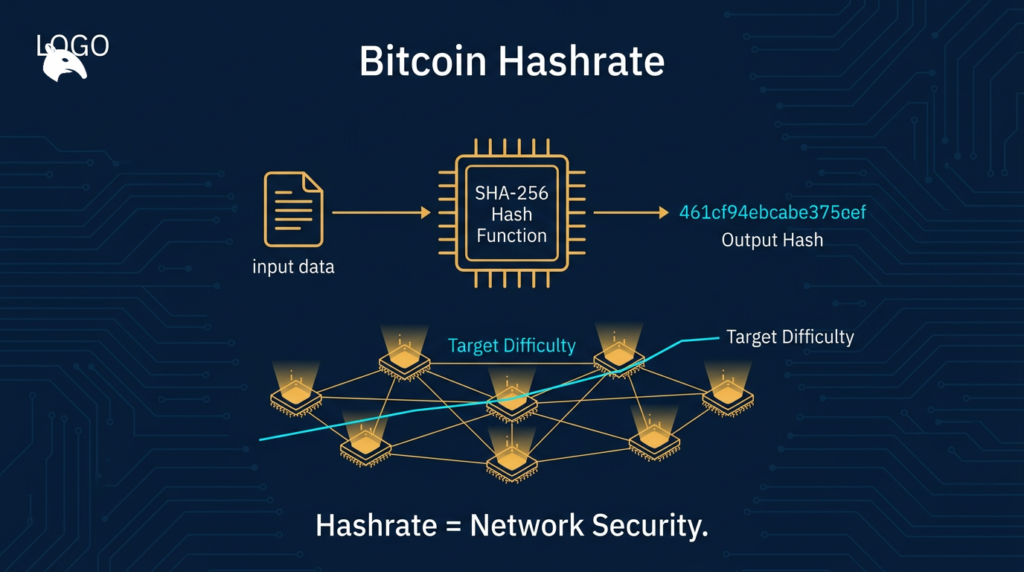
Bitcoin network hashrate is a measure of the total computational power being applied to mining the Bitcoin blockchain at any given moment. It is expressed in hashes per second: the number of individual SHA-256 calculations the entire network performs each second.
A higher reading means more computing power is competing to find valid blocks, which directly translates to a more expensive and more difficult blockchain to attack.
A simple way to think about hashrate is as Bitcoin’s security budget expressed in real-time computation.
It is not money sitting in an account, but it reflects how much hardware and energy the mining industry is continuously committing to defend the chain. More hashrate means more work an attacker would have to outmatch.
This content is for educational purposes only and should not be considered financial or investment advice.
What Is a Hash?
Before hashrate makes sense, you need to understand what a hash is. A hash function takes any input data and produces a fixed-length output string that looks random. Bitcoin uses the SHA-256 hash function. Feed any block header data into SHA-256 and you get a 256-bit output.
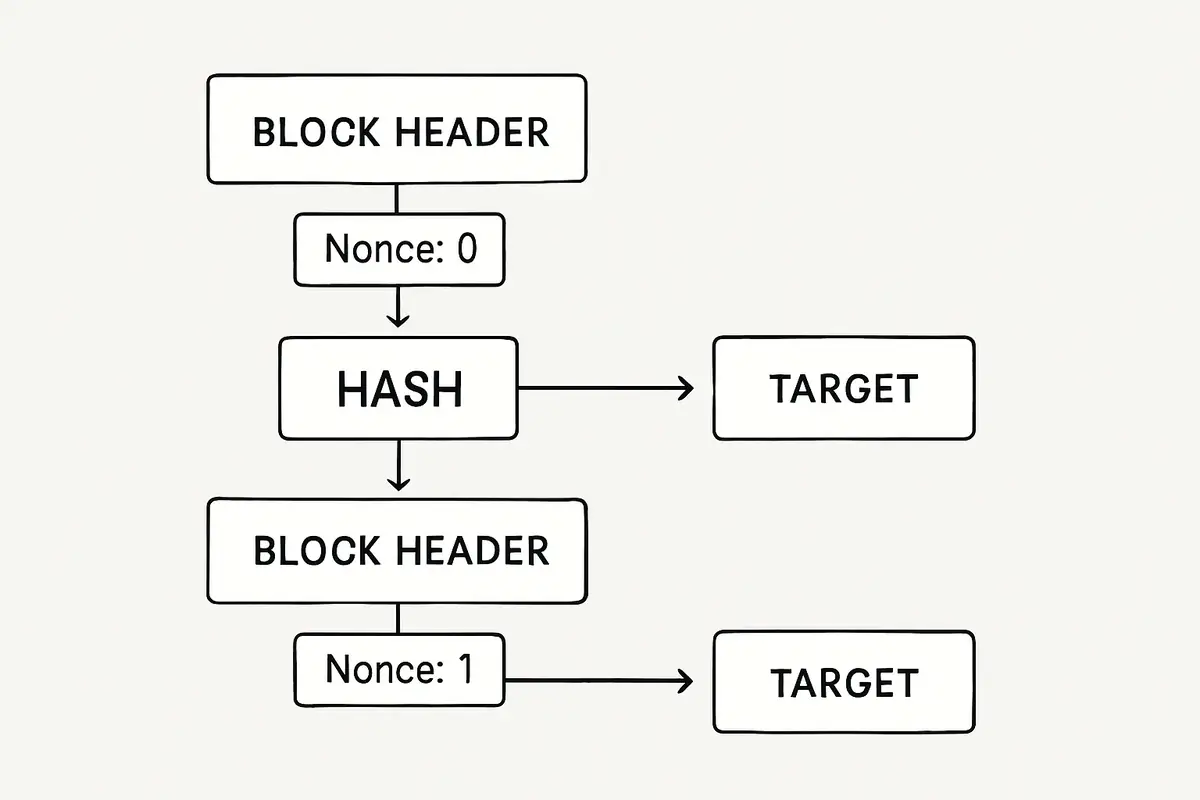
The rule in Bitcoin mining is that a valid block must have a hash that begins with a specific number of zeroes. This is the difficulty target. The more zeroes required at the start, the harder it is to find a valid hash, because you cannot predict what output SHA-256 will produce from a given input.
Miners have to try billions of slightly different inputs (by changing a field called the nonce) until one produces a hash that meets the target. Each confirmed block pulls its transactions from the Bitcoin mempool, the waiting room for unconfirmed transactions.
Hashrate is just the speed at which miners are doing this guessing. A miner performing 100 terahashes per second (TH/s) is trying 100 trillion input combinations every second. The entire Bitcoin network currently operates in the hundreds of exahashes per second range, meaning hundreds of quintillions of hash attempts per second.
Why Bitcoin Hashrate Matters for Security
The security model of Bitcoin’s proof-of-work consensus rests on the assumption that an attacker cannot control 51% or more of the total hashrate. If they could, they could rewrite recent transaction history: reversing confirmed transactions, double-spending funds, and blocking new blocks from competing miners.
The reason this attack is difficult is the cost of acquiring that much hashrate. You would need to purchase or build more ASICs (purpose-built mining hardware) than the rest of the network combined, plus secure the energy supply to run them. At Bitcoin’s current hashrate scale, this represents an enormous and continuously increasing financial commitment.
As hashrate grows, the cost of a 51% attack grows proportionally. This is why increasing hashrate is generally read as a signal of improving network security.
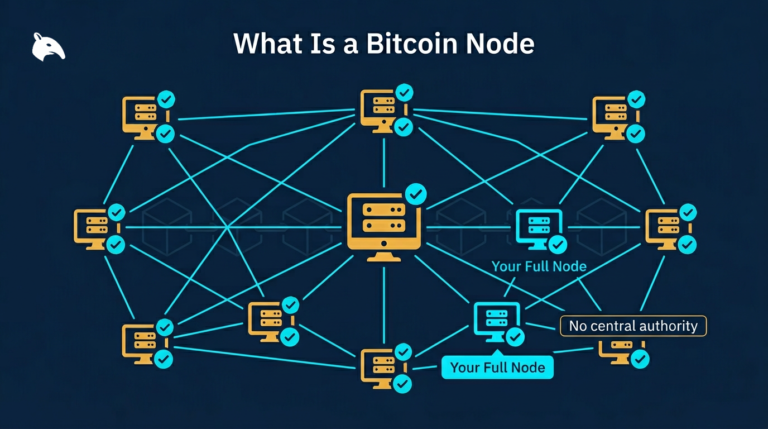
The enforcement side of that security is handled by Bitcoin full nodes, which independently validate every block and reject any that violate the rules. It means more capital is committed to defending the chain, and any attack attempt requires outcompeting that entire committed capital base.
The intuitive point is that hashrate does not “guarantee” safety on its own. It raises the price of attacking the network. Nodes still enforce the rules, but hashrate determines how expensive it is to dominate block production long enough to make an attack matter.
How Mining Difficulty Adjusts to Hashrate
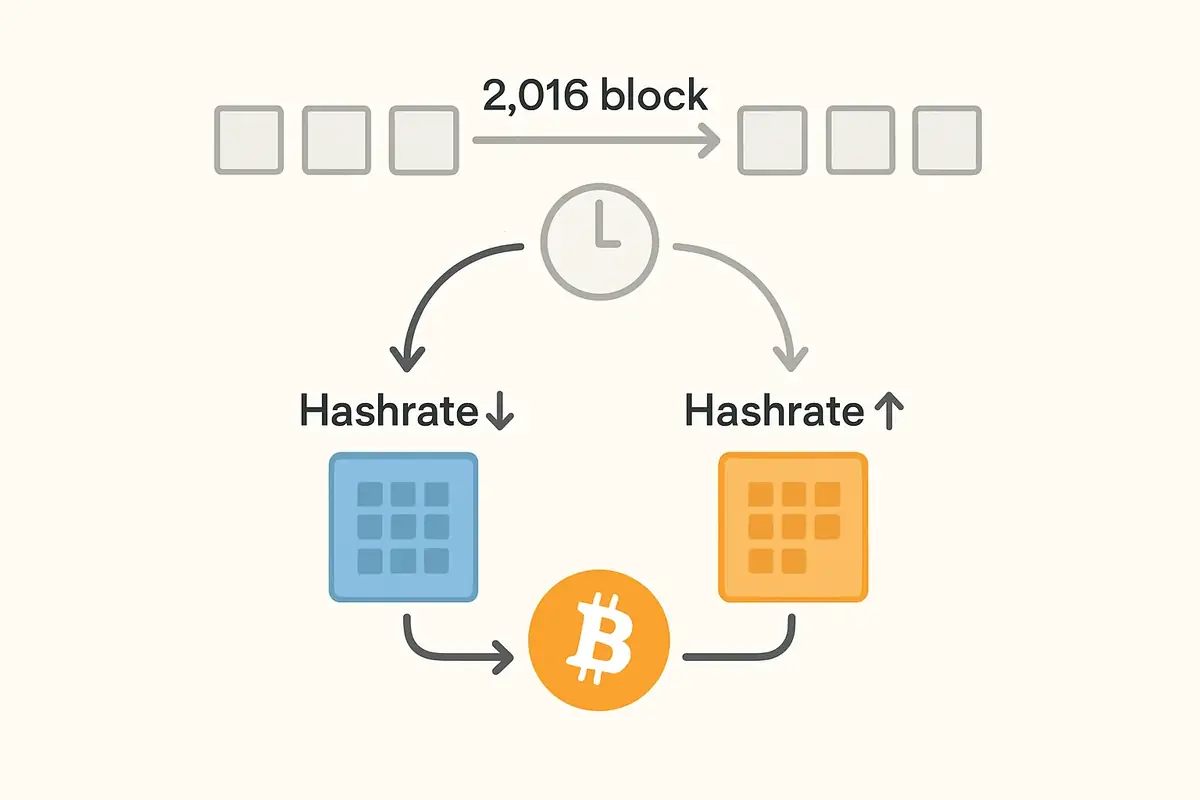
Bitcoin is designed to produce a new block approximately every 10 minutes on average. To maintain this pace as hashrate fluctuates, Bitcoin adjusts its mining difficulty every 2,016 blocks (roughly two weeks). If blocks were being found faster than 10 minutes on average during the previous period, difficulty increases. If blocks were slower, difficulty decreases.
This means rising hashrate does not lead to faster block production. The difficulty adjustment absorbs the extra computing power and keeps the pace stable. It also means that when miners leave the network (such as during bear markets when mining profitability drops), difficulty adjusts downward to make it easier for remaining miners to find blocks at the target pace.
The difficulty adjustment is one of the most elegant mechanisms in Bitcoin’s design. It makes the network self-regulating: the block production schedule stays on target regardless of how much or how little hashrate is present at any moment.
Hashrate Units Explained
Hashrate is measured in hashes per second, but at Bitcoin’s scale the practical units are much larger. From smallest to largest:
- KH/s: kilohashes per second (thousands)
- MH/s: megahashes per second (millions)
- GH/s: gigahashes per second (billions)
- TH/s: terahashes per second (trillions)
- PH/s: petahashes per second (quadrillions)
- EH/s: exahashes per second (quintillions)
A single modern ASIC miner like the Antminer S21 Pro operates around 200 TH/s. The Bitcoin network as a whole operates at several hundred EH/s. To put that in perspective: a single exahash is a million terahashes, so the entire network is running the equivalent of millions of top-tier ASICs simultaneously.
Practical Usage: Reading Hashrate Trends
A rising hashrate is a useful indicator of network health and miner confidence. Miners invest in hardware when they expect to be profitable, and profitability is tied to Bitcoin’s price and transaction fees. High and rising hashrate generally suggests that the mining industry expects current or higher price levels to justify continued investment.
For a closely related follow-up, see UTXO Consolidation Explained: What It Is and When to Do It.
Hashrate does not directly predict price. It is a lagging indicator. Miners invest in hardware based on future price expectations, and hardware orders take months to fulfill. By the time new capacity comes online, the market environment may have shifted. Do not read hashrate as a trading signal.
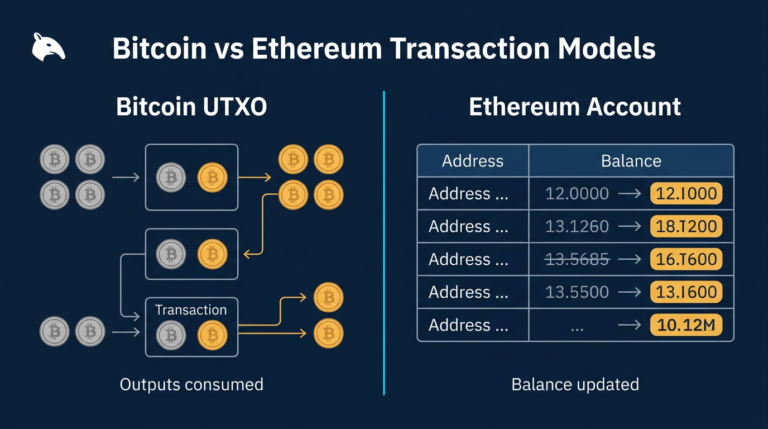
Hashrate also does not tell you much about transaction volume or how actively the network is being used. A blockchain can have high hashrate and low transaction volume, or vice versa. They measure different aspects of the network. For the transaction-structure side of Bitcoin, Bitcoin vs Ethereum Transaction Model is the more relevant local follow-up.
Risks and Common Mistakes
The most common mistake is reading a rising hashrate as a direct buy signal. Mining expansion reacts to price, hardware delivery schedules, and energy costs with a lag. By the time new machines are online, market conditions may already have changed, so using hashrate alone to time trades is a weak decision process.
Another mistake is assuming a temporary drop means the network is failing. Large mining regions can go offline after power outages, regulation changes, or heat waves, and block production can slow until the next difficulty adjustment. The consequence is short-term disruption, not automatic collapse. The safer interpretation is to watch how quickly difficulty, block times, and miner participation normalize together.
Frequently Asked Questions
Can hashrate fall suddenly?
Yes. If a major mining region shuts down (such as after a regulatory crackdown or power outage) or if Bitcoin’s price drops sharply and makes older, less efficient hardware unprofitable, hashrate can fall quickly. Bitcoin survived major hashrate drops in 2021 and 2022 and the difficulty adjustment brought mining back to a sustainable pace within two weeks.
Is higher hashrate always better?
From a security standpoint, yes. More hashrate means a more expensive 51% attack. The only trade-off is energy consumption: higher hashrate requires more power globally. There are ongoing debates in the Bitcoin community about the energy mix used for mining and its environmental implications.
Who contributes to Bitcoin’s hashrate?
Professional mining operations (large farms running thousands of ASICs) contribute the overwhelming majority of Bitcoin’s hashrate. Individual home miners contribute a tiny fraction. Most miners operate through mining pools, which combine hashrate from many participants and distribute rewards proportionally.
How is hashrate different from difficulty?
Hashrate is the actual computational power being applied. Difficulty is the target value that a valid block hash must be below. Difficulty adjusts every two weeks to keep block time at 10 minutes. Hashrate fluctuates in real time based on mining activity. Difficulty is a derived response to hashrate trends over the previous period.
Does hashrate affect Bitcoin transaction fees?
Not directly. Transaction fees are determined by mempool demand and block space availability. Hashrate affects how quickly blocks are found (through the difficulty adjustment mechanism) but does not change the available block space or user fee competition. High hashrate means the network is secure, not that transactions will be cheaper.