

Last Updated on April 14, 2026 by Snout0x
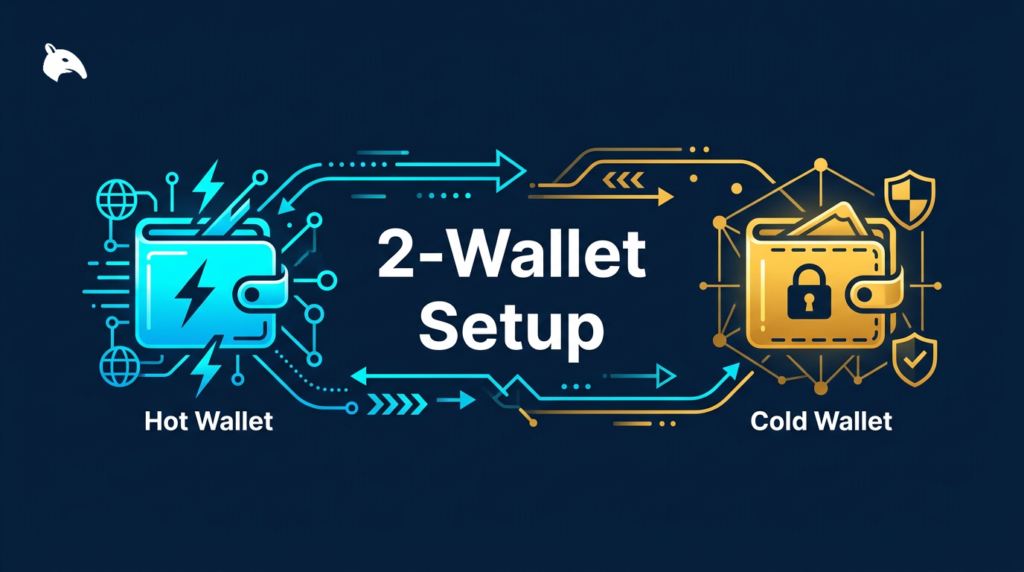
A 2-wallet setup is a security practice where a crypto holder uses two separate wallets for different purposes: one for active use and one for long-term storage. The active wallet holds a small working balance. The storage wallet holds the majority of funds and remains offline or inactive between transfers. This separation limits the risk that a single compromise can drain an entire portfolio.
This content is for educational purposes only and should not be considered financial or investment advice.
You cannot lose what you never expose to the internet.
Key Takeaways
- A 2-wallet setup separates active funds from long-term storage to limit damage from any single compromise.
- The hot wallet holds only what you can afford to lose. The cold wallet stays offline.
- Each wallet must use a separate, independently generated seed phrase.
- Security depends on consistent discipline, not initial configuration alone.
Simple Definition
A 2-wallet setup divides crypto holdings into two functional layers:
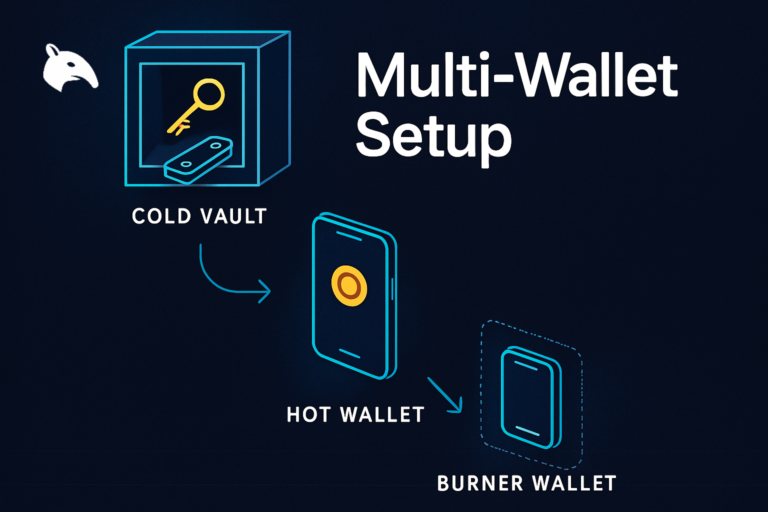
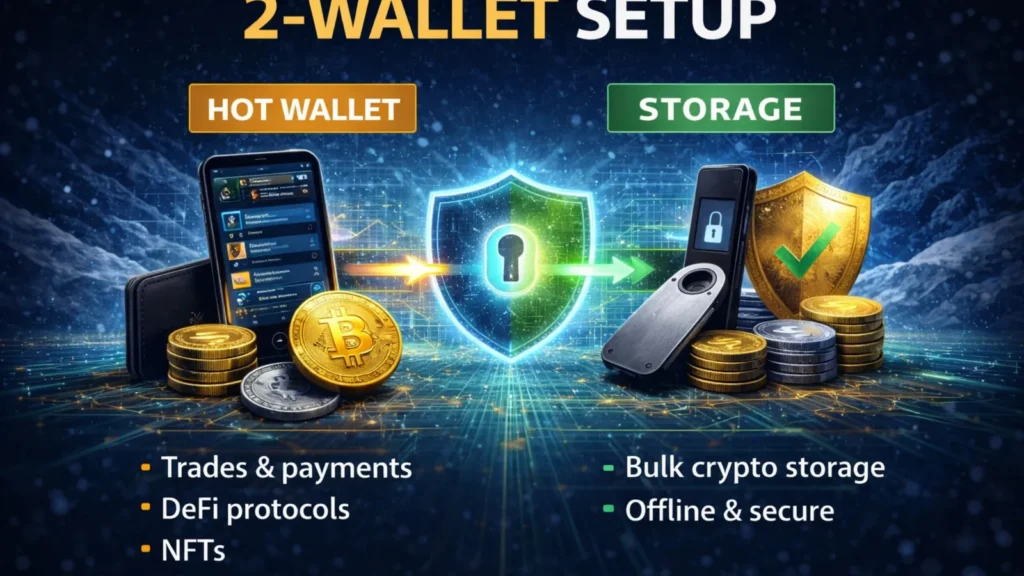
- Hot wallet (active): A software wallet, mobile app, or browser extension connected to the internet. Used for trading, interacting with DeFi protocols, or sending regular payments. Holds a limited amount of funds at any given time.
- Cold wallet (storage): A hardware wallet or air-gapped device that stays offline. Holds the bulk of crypto assets. Only accessed when moving larger amounts between wallets. For a detailed explanation of how offline key storage works, see What Is Cold Storage in Crypto?
The core idea is that you cannot lose what you do not expose. By keeping the majority of funds in a cold wallet that rarely connects to anything, you reduce the attack surface to a fraction of what a single-wallet setup creates. The two wallets serve entirely different roles and are never treated as interchangeable.
Why It Matters
Every crypto wallet connected to the internet is a potential target. Browser extensions can be compromised. Mobile apps can be exploited. Phishing sites can trick users into approving malicious transactions. If all holdings sit in a single point of access, a single failure produces total loss.
A 2-wallet setup limits damage by design. Even if the hot wallet is fully compromised, the cold wallet remains unaffected because it never shared the same attack surface. The hot wallet holds only what you can accept losing in a worst-case scenario. The cold wallet holds everything else. The difference is not whether compromise is possible; it is how much damage a compromise can cause.
This structure also reinforces financial discipline. Moving funds into cold storage creates deliberate friction. That friction slows impulsive decisions, discourages treating long-term savings as a trading float, and builds the operational habits that separate secure users from those who lose everything to a single mistake.
How a 2-Wallet Setup Works
Setting up a 2-wallet system requires choosing one wallet for each role and establishing a consistent protocol for transferring funds between them.
Choosing a Hot Wallet
The hot wallet should be a reputable software wallet with a documented security track record. It holds only funds you are actively using. A practical ceiling is five to ten percent of total crypto holdings, or whatever amount you are prepared to lose without it materially affecting your financial position.
Choosing a Cold Wallet
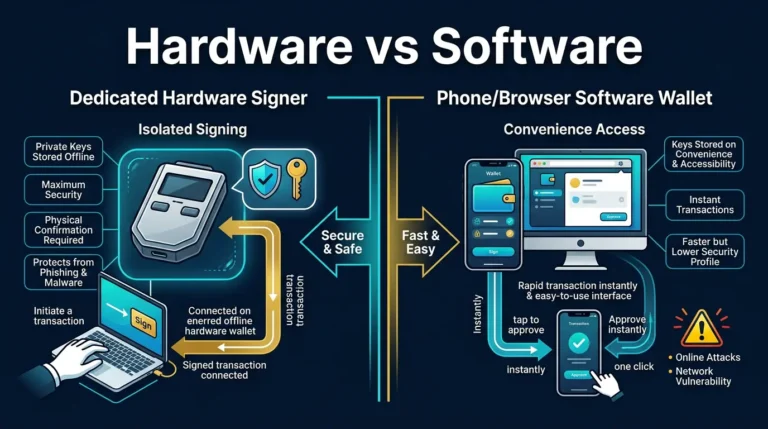
The cold wallet should be a hardware device from a reputable manufacturer. Hardware wallets store private keys on a dedicated security chip that never exposes them to the connected computer or the internet. When a transaction is signed, the process happens entirely on the device. The private key never leaves the hardware wallet under normal operation.
Transfer Protocol
When moving funds between wallets, connect the hardware device only for the specific transaction. Verify the receiving address on the hardware wallet’s own screen, not your computer display. Disconnect and store the device immediately after the transfer completes. Transfer only the amount needed. Periodically sweep accumulated funds from the hot wallet back to cold storage as routine maintenance.
Seed Phrase Separation
Each wallet must have its own unique seed phrase. Never import the same seed phrase into both wallets. If both share the same recovery phrase, they share the same vulnerability. Compromise one and you compromise both. Generate each wallet independently and store each seed phrase in a separate secure location.
Common Mistakes
Storing too much in the hot wallet. The most common failure mode. Users load a significant portion of holdings into a hot wallet for convenience and neglect to move funds out. Enforce the limit you set, not the limit you intend to set eventually.
Reusing the same seed phrase. This makes the 2-wallet setup functionally identical to a single-wallet setup from a security perspective. Every wallet in the setup must be independently generated with a separate recovery phrase.
Skipping the cold wallet recovery test. A hardware wallet you cannot recover from is not a backup. Before loading significant funds onto any hardware device, wipe it and test the full recovery process using your recorded seed phrase.
Trusting the computer screen over the device screen. A hardware wallet protects private keys from extraction. It does not protect against malware that alters the destination address on your computer. Always verify the receiving address on the hardware wallet’s physical display before approving any transaction.
Security and Risk Considerations
A 2-wallet setup reduces your attack surface but does not eliminate all risk. Understanding where the remaining vulnerabilities sit separates a functional security model from a false sense of safety.
Seed phrase storage. Both wallets have seed phrases. Both require secure, offline storage in separate physical locations. Neither seed phrase should appear in a photograph, a cloud document, a password manager, or any email. Physical recording on durable material stored in a secure location is the baseline.
Physical security of the device. A hardware wallet protected by a PIN resists casual physical attack but is not impervious. Storing the device and the seed phrase in the same location eliminates the layered protection. The device and its backup belong in separate secure locations.
Operational consistency. Security practices erode over time. Address verification, hot wallet limits, and seed phrase storage are permanent operating procedures. They do not expire after the initial setup. For broader storage strategy, see How to Store Crypto Safely.
Sources
- Bitcoin.org, Secure Your Wallet
Frequently Asked Questions
What is the difference between a hot wallet and a cold wallet in a 2-wallet setup?
A hot wallet stays connected to the internet and is used for active transactions such as trading, DeFi interactions, or payments. A cold wallet stays offline and holds the majority of funds. In a 2-wallet setup, these two wallets serve entirely different roles with a clear operational boundary between them.
How much crypto should I keep in my hot wallet?
A common guideline is no more than five to ten percent of total holdings. The right amount depends on your activity level, but the governing principle is: keep only what you actively need and what you can accept losing in a worst-case scenario.
Do both wallets need separate seed phrases?
Yes. Using the same seed phrase for both wallets removes the primary security benefit of the 2-wallet setup. If the hot wallet is compromised and both wallets share a seed phrase, the cold wallet is also fully exposed. Each wallet must be generated independently with a distinct recovery phrase.
Can I use a free software wallet as my hot wallet?
Yes. Most users use a reputable free software wallet for the hot wallet role. The hot wallet does not require a hardware device because it holds a limited, explicitly risk-managed balance by design. The important factor is the wallet’s security reputation and track record, not its cost.
What happens if I lose my cold wallet device?
If the physical device is lost but the seed phrase is intact and securely stored, the wallet can be fully recovered on a new hardware device of the same or a compatible type. The seed phrase backup is what protects the funds, not the physical device itself. This is why secure seed phrase storage is more critical than protecting the device.