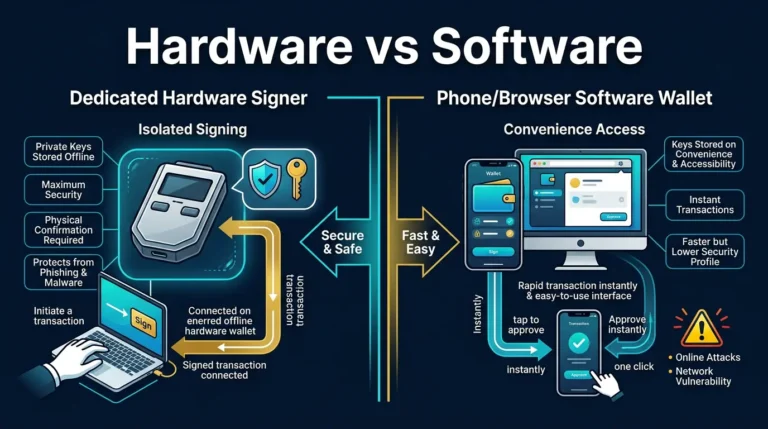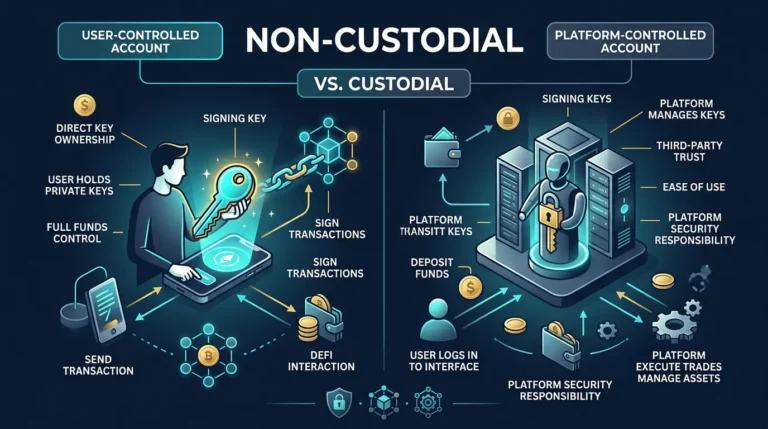


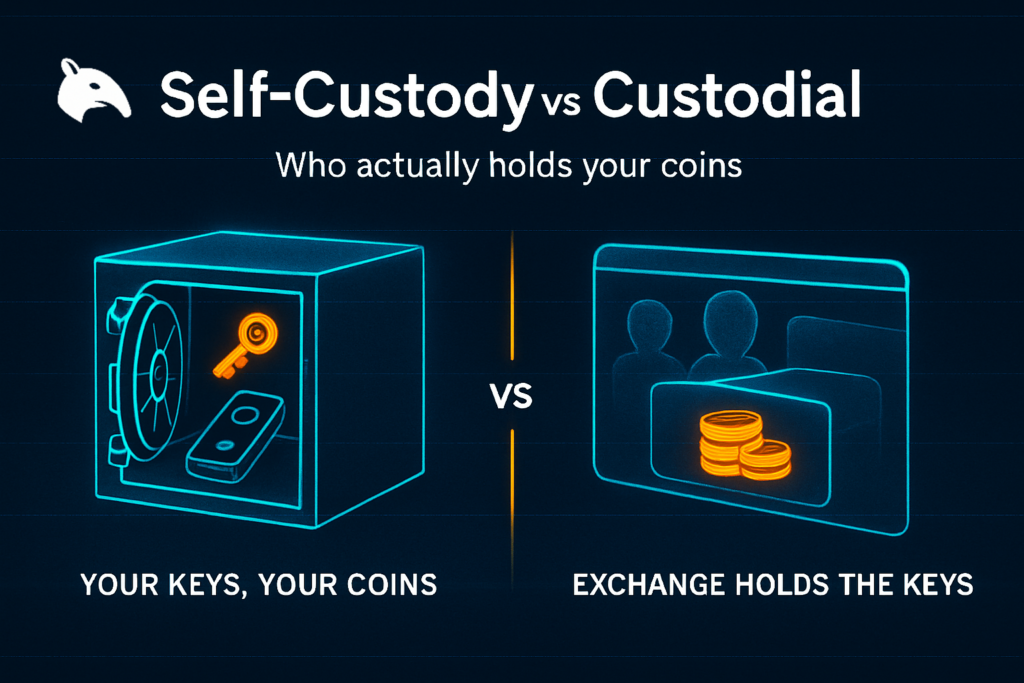
The real difference between self-custody and a custodial wallet is not branding or interface quality. It is who controls the keys, who controls recovery, and who has the final ability to move funds. That difference changes almost everything else: convenience, security model, support expectations, withdrawal risk, and what happens when something goes wrong.
This article is the practical comparison layer. If you want the term-level definitions first, start with What Is Crypto Custody and What Is Self-Custody in Crypto?.
This content is for educational purposes only and should not be considered financial or investment advice.
Key Takeaways
- Custodial wallets optimize for convenience: Password recovery, fiat access, and easy trading come at the cost of relying on a platform.
- Self-custody optimizes for direct control: You hold the keys, but you also carry the responsibility for backups, verification, and recovery.
- The safer choice depends on the job: Active trading balances and long-term reserves usually should not live in the same custody model.
- Each model fails in different ways: Custodial setups are exposed to platform and identity risk, while self-custody is exposed to user error and signing mistakes.
- Many users need both: A practical setup often combines exchange access for operations and self-custody for meaningful long-term holdings.
The Core Trade-Off
Custodial wallets make access easier because a company manages the key infrastructure, the login flow, and the account recovery process. Self-custody removes that third-party dependency by putting the keys or recovery material under your control. In short, you are trading convenience for control, and the right choice depends on what kind of risk you are actually trying to reduce.
Operator insight: many people frame this as a debate about ideology, but for most users it is really an operations question. What balance needs fast trading access? What balance needs durable storage? What balance would become catastrophic if one account or one device failed?
Quick Comparison Table
| Factor | Custodial wallet | Self-custody |
|---|---|---|
| Key control | Platform controls the keys | User controls the keys or recovery material |
| Recovery | Usually account-based and support-assisted | User-managed backups and restore process |
| Trading and fiat access | Usually easier | Usually requires transfers to another service |
| Main security risk | Platform failure, account takeover, withdrawal restrictions | Seed loss, device compromise, signing mistakes |
| Best fit | Near-term operational balances | Long-term holdings and funds you want to control directly |
When Custodial Wallets Make More Sense
A custodial wallet is usually the easier tool when you need fast conversions, exchange liquidity, or a smoother account-recovery experience. New users often begin here because the platform handles infrastructure, wallet management, and access restoration in a way that feels familiar. That does not remove risk, but it moves the risk toward platform dependence rather than backup mistakes.
Real-world scenario: a user buys small amounts regularly, sometimes sells to fiat, and is not yet ready to manage seed backups. In that case, a reputable custodial setup may be more realistic in the short term than forcing self-custody before the user can handle recovery responsibly.
The limit is that convenience can quietly turn into overexposure. If long-term savings remain on a platform simply because the app is already open, then a trading tool has become a storage layer by accident. For the specific sizing problem, see How Much Crypto Should You Keep on an Exchange?.
When Self-Custody Makes More Sense
Self-custody usually makes more sense when the balance is meaningful, long-term, or important enough that you do not want withdrawals, access, or solvency risk tied to a third party. This model is strongest when the user is ready to protect backups, verify addresses carefully, and keep signing decisions deliberate instead of impulsive.
Real-world scenario: a holder has built a position meant to sit for years, not for next week’s trade. In that case, leaving the funds on an exchange can create unnecessary platform exposure. A wallet under the user’s control is often the better match because the job is storage, not constant access.
Self-custody is not automatically safer just because it is more sovereign. It is safer only when the owner can actually manage the backup and signing process correctly. If not, the setup may trade platform risk for user-generated loss.
How Each Model Usually Fails
The most useful comparison is not “Which one is secure?” but “How does each one usually break?”
Custodial failure modes
- Platform risk: The exchange or custodian can freeze withdrawals, fail operationally, or become insolvent.
- Identity-layer attacks: Email compromise, SIM swapping, phishing, and fake support flows can lead to account takeover.
- Policy dependence: Access can depend on compliance checks, account reviews, or internal processing delays.
Self-custody failure modes
- Backup failure: Losing or exposing the seed phrase can permanently compromise access.
- Signing error: A wrong address, bad approval, or malicious dApp interaction can move funds irreversibly.
- Device and process failure: Poor recovery planning, weak device hygiene, or unclear wallet separation can expose more funds than intended.
Operator insight: custodial systems often fail because you trusted the wrong institution or recovery stack. Self-custody often fails because you trusted your own process more than it deserved.
Security vs Convenience Is Not a Simple Slider
People often talk as if convenience always means less safety and self-custody always means more safety. Reality is more conditional. A beginner with weak backup habits may be less safe in self-custody than on a reputable exchange with strong account security. A long-term holder with meaningful savings may be less safe leaving funds on a platform than in a well-managed hardware-wallet setup.
The key is to match the model to the balance. Convenience is valuable for money in motion. Control is valuable for money at rest.
Recovery Changes the Decision More Than Most People Expect
Custodial recovery usually feels easier because it resembles normal account support: password resets, identity verification, email access, and support tickets. Self-custody recovery is different. The recovery plan is whatever you documented before something went wrong. If the backup is weak, the recovery story is weak too.
This is why many users should not rush into a more advanced setup just because it sounds more secure in theory. If you are not ready to protect a seed phrase, verify a restore path, and separate active wallets from reserve storage, you are not ready to put a meaningful balance into deeper self-custody yet.
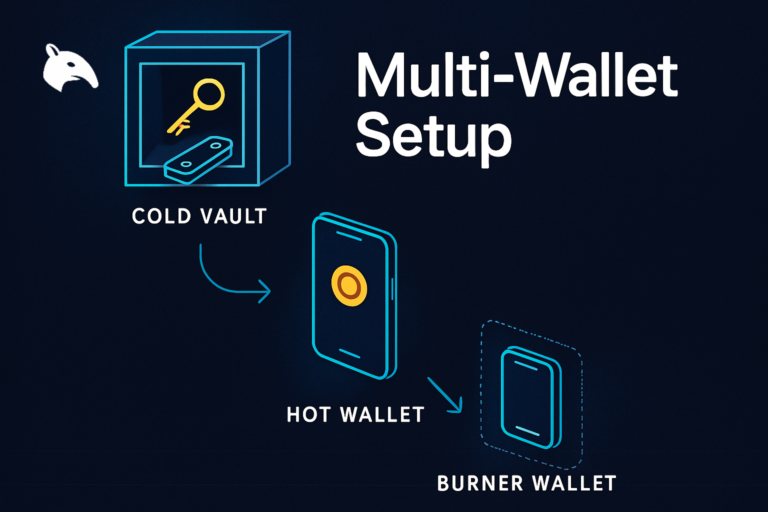
Where Different Balances Usually Belong
- Active trading capital: Often belongs in a custodial exchange environment because access speed matters most.
- Small experimental on-chain balances: Often belong in a self-custody hot wallet because you need direct signing access.
- Long-term reserves: Often belong in a stronger self-custody setup because the goal is durable control, not instant trading.
- Cash-out funds with a near-term date: May temporarily stay in a custodial account if they are already queued for conversion or withdrawal.
Practical Usage: A Decision Framework
A useful operator rule is this: the more important the balance and the less often it needs to move, the stronger the case for a user-controlled wallet. The more immediate the operational task, the stronger the case for a custodial tool. Most mistakes come from leaving funds in the wrong layer after their job changed.
Risks and Common Mistakes
- Using one custody model for every balance: Trading money, DeFi spending money, and long-term reserves usually should not all share the same risk stack.
- Rushing into self-custody without a tested backup plan: A user who cannot restore safely is not gaining real control, only a new failure mode.
- Leaving long-term holdings on an exchange by inertia: Convenience drift turns operational access into unnecessary storage exposure.
- Treating account access as equivalent to key control: A dashboard balance is not the same as direct signing authority.
- Ignoring identity risk on custodial accounts: Strong blockchains do not protect weak email security, careless support interactions, or bad recovery hygiene.
Sources
Frequently Asked Questions
Is self-custody safer than a custodial wallet?
It can be, but only if the user can handle backups, recovery, and transaction verification correctly. Otherwise it may simply replace platform risk with user error risk.
When should I keep funds in a custodial wallet?
Custodial access is often most useful for active trading balances, near-term fiat conversions, and users who are not yet ready to manage self-custody responsibly.
When does self-custody make more sense?
It usually makes more sense for meaningful long-term holdings, reserve balances, and funds you do not want dependent on exchange withdrawal processes or platform solvency.
Do most users need both models?
Yes, often. Many users are best served by keeping operational balances in custodial systems while moving meaningful long-term reserves into wallets they control directly.
What is the biggest mistake in this comparison?
The biggest mistake is treating one model as correct for every balance. The right answer usually depends on the job, risk tolerance, and recovery readiness of each fund bucket.