

Last Updated on April 19, 2026 by Snout0x
An HD wallet, short for hierarchical deterministic wallet, is the architecture behind almost every modern crypto wallet in use today. Instead of managing separate private keys for each address, an HD wallet derives an entire tree of addresses from a single root seed. This design solved two of the most persistent problems in early crypto: complicated backups and poor on-chain privacy.
This article is for educational purposes only and does not constitute financial or investment advice.
Hierarchical deterministic (HD) means one master seed mathematically generates an entire tree of private keys and addresses in a fixed, repeatable order. “Hierarchical” is the tree shape. “Deterministic” is the guarantee that the same seed always produces the same keys — on any wallet that follows the same standard.
Key Takeaways
- An HD wallet generates an unlimited number of addresses from a single master seed
- All private keys are derived mathematically from the same root, so one seed phrase backs up everything
- Losing the seed phrase means permanent loss of access to every address in the wallet tree
- Fresh addresses on each transaction improve on-chain privacy without complicating backups
- BIP-32, BIP-39, and BIP-44 are the open standards that define how HD wallets function
What Is an HD Wallet?
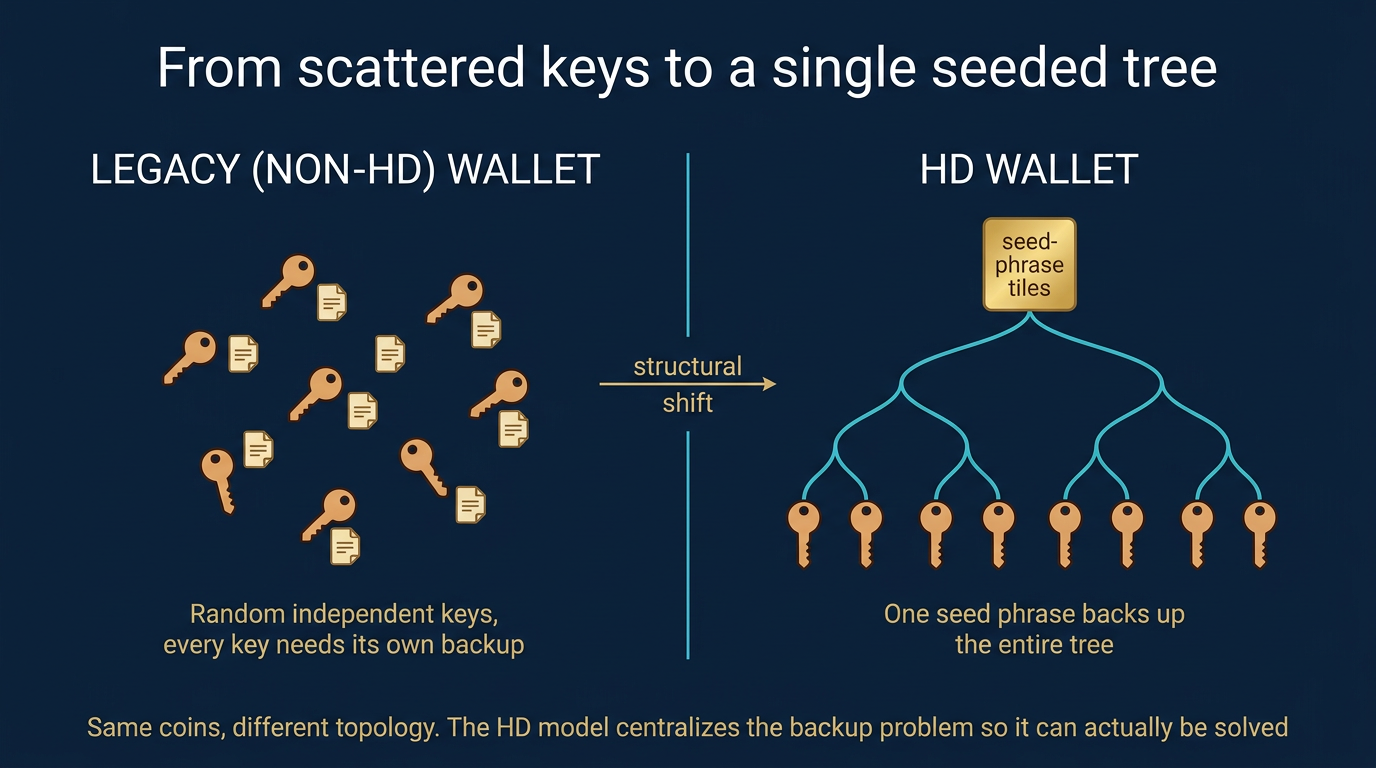
Before HD wallets existed, crypto wallets generated private keys randomly and independently. Each new address meant a new private key, and each private key required its own separate backup. Lose the backup file and those funds were gone permanently.
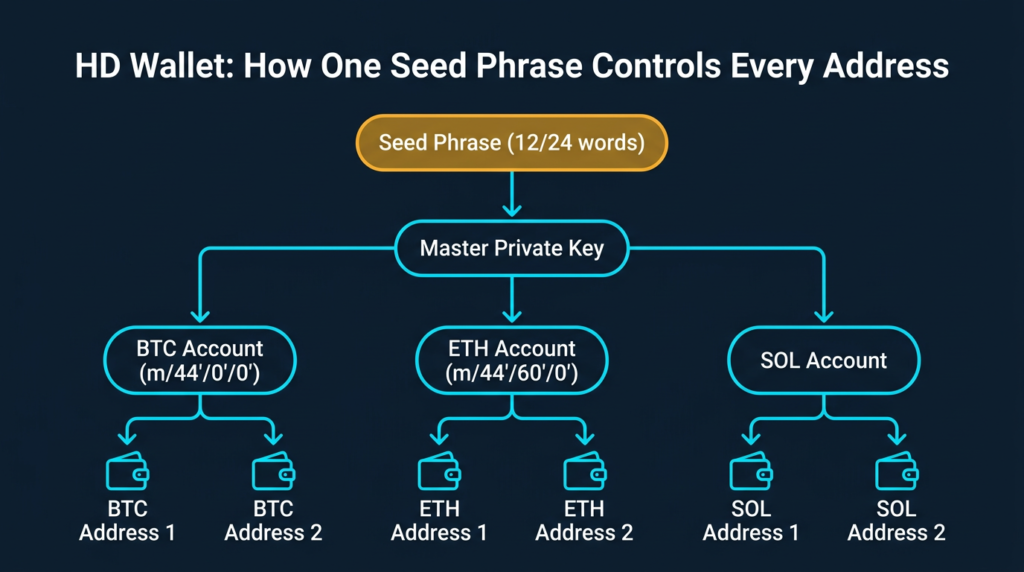
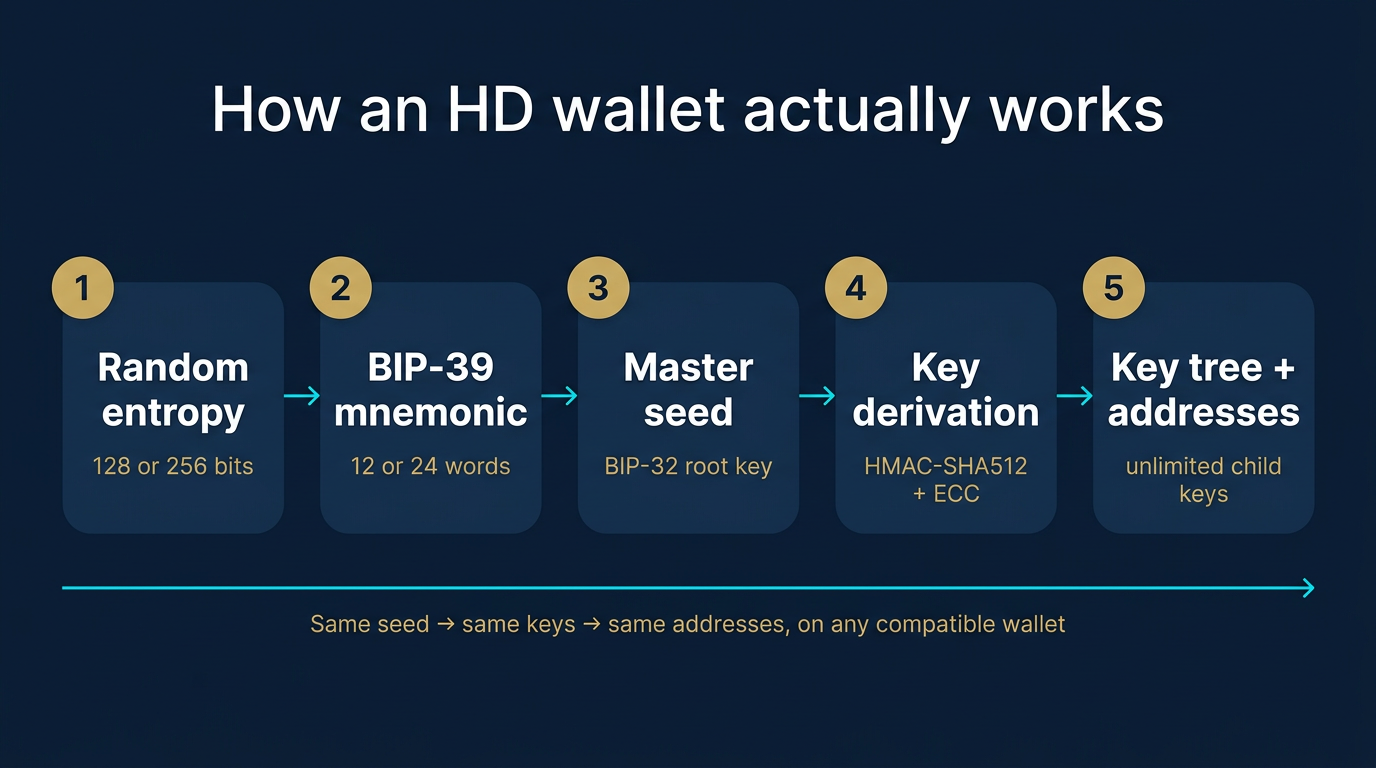
The HD wallet model replaced that system entirely. A hierarchical deterministic wallet generates every key it will ever use from a single master seed. That master seed is derived from your seed phrase, typically a list of 12 or 24 words assigned when you first set up a wallet.
Because every key shares the same mathematical origin, a single backup of that seed phrase can recover every address the wallet has ever created or will ever create. The tree is deterministic: the same seed always produces the same keys, in the same order, on any compatible wallet.
How an HD Wallet Generates Keys
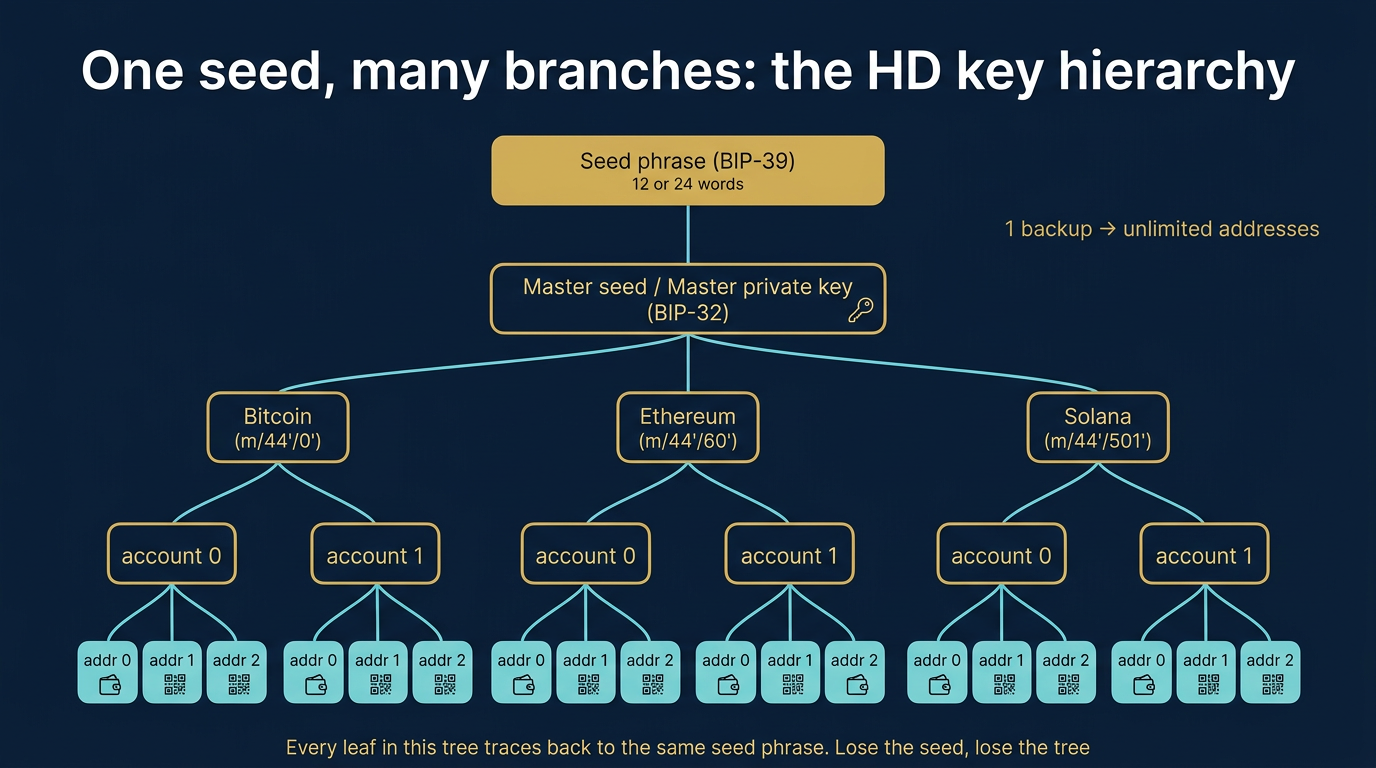
The key generation process follows a branching tree structure. The master seed sits at the root. From there, the wallet derives branches called accounts, and from each account it derives individual receiving addresses.
Each branch is identified by a derivation path, a string that specifies exactly where in the tree a particular key lives. A standard path looks like m/44'/0'/0'/0/0, where each number represents a level in the hierarchy: purpose, coin type, account, change, and address index.
The mathematics behind this process use HMAC-SHA512 hashing combined with elliptic curve cryptography. A parent key and an index value go in, and a deterministic child key comes out. The same inputs will always produce the same output, which is the core guarantee that makes the entire system work.
Understanding how wallet derivation paths work gives you a deeper view into why different wallet apps can sometimes show different addresses from the same seed phrase.
The BIP Standards Behind HD Wallets
Three Bitcoin Improvement Proposals form the technical foundation of every mainstream HD wallet in use today.
BIP-32 introduced the hierarchical deterministic wallet structure itself. It defines exactly how master seeds generate child keys across a branching tree, including the mathematical operations and data formats involved.
BIP-39 defined how seed phrases work. It converts the raw entropy of a master seed into a human-readable list of words drawn from a standardized 2,048-word vocabulary. Your 12 or 24-word phrase is a BIP-39 mnemonic that encodes the master seed in a form humans can reliably write down and store.
BIP-44 extended BIP-32 by adding a standardized multi-coin path structure. It allows one seed phrase to manage keys for Bitcoin, Ethereum, and many other blockchains simultaneously, with each coin type occupying its own branch in the derivation tree.
These three standards work together. BIP-39 converts entropy into a phrase you can store. BIP-32 turns that phrase into a key tree. BIP-44 organizes that tree across multiple blockchains. The full technical specification for BIP-44 is available in the Bitcoin Improvement Proposals repository on GitHub.
Why One Seed Phrase Controls Everything
The relationship between a seed phrase and the key tree is mathematically deterministic. Given the same seed phrase and the same derivation path, the same private key will always be produced. This is not a coincidence. It is a cryptographic guarantee built into the protocol specification.
This is why hardware wallets instruct you to write down your seed phrase during setup. That phrase is not a backup for one address. It is the root from which your entire wallet hierarchy can be reconstructed on any compatible device, at any time, without contacting any third party.
Understanding what a private key is and how it connects to your seed phrase is essential before placing any significant funds in an HD wallet. The seed phrase is the master key. Whoever holds it controls every address the wallet has ever generated.
HD Wallets and On-Chain Privacy
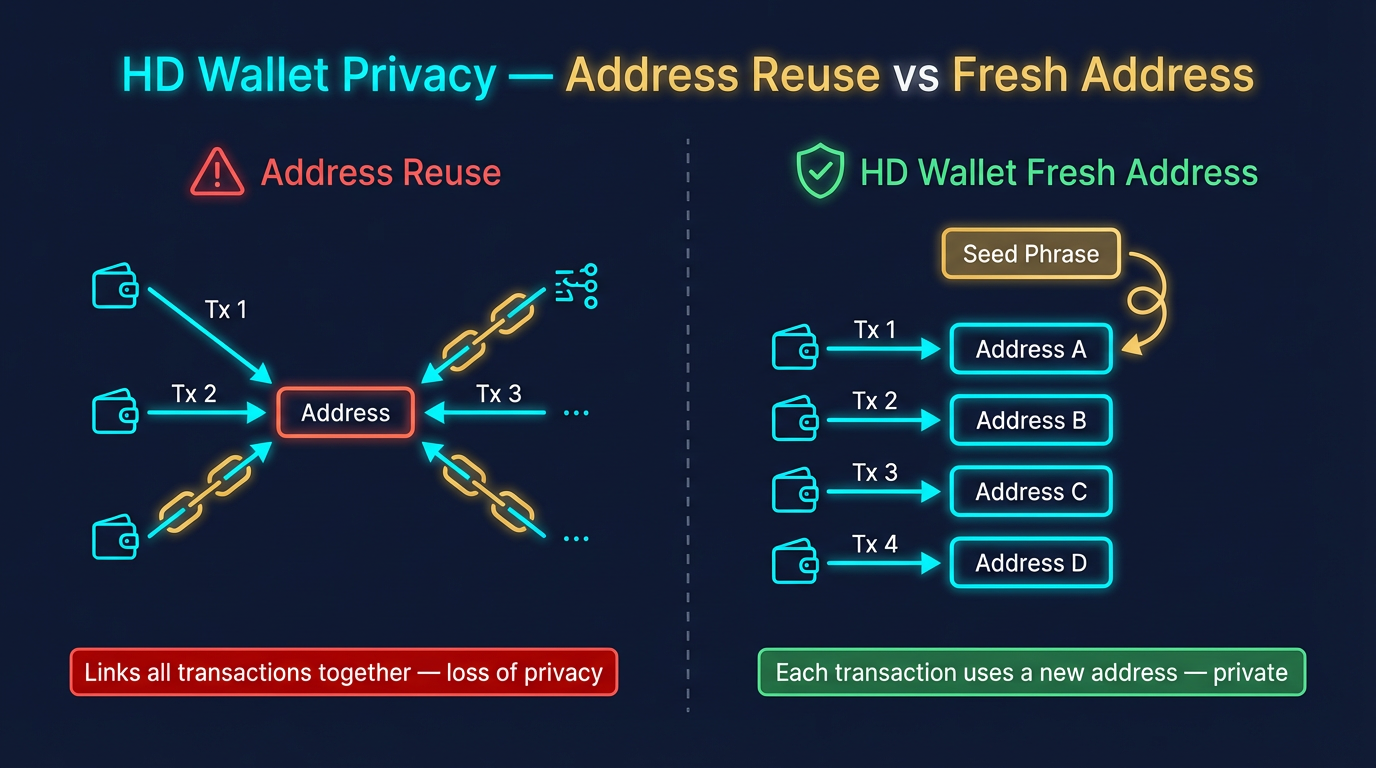
Public blockchains expose all transaction history. If you use the same address repeatedly, anyone with a block explorer can trace your balance, your spending patterns, and your full transaction history from the moment that address received its first deposit.
HD wallets solve this by making fresh-address generation effortless. Because every address in the tree derives from the same seed, the wallet can rotate to a new receiving address after each transaction without creating any additional backup burden. All those addresses still recover from one seed phrase.
Most modern wallets handle this rotation automatically. The address you share today is different from the one the wallet will show tomorrow, but the private keys behind both addresses trace back to the same master seed.
How public keys become wallet addresses explains the cryptographic steps that connect the key derivation process to the addresses you actually receive funds on.
HD Wallets vs Legacy Wallets
The practical difference between HD and legacy wallet designs is significant. Legacy wallets generated random keys that had no mathematical relationship to each other. Every new address meant a new key file to back up.
| Feature | Legacy Wallet | HD Wallet |
|---|---|---|
| Key generation | Random and independent | Deterministic from master seed |
| Backup requirement | Every new private key | Single seed phrase |
| Address reuse | Common by necessity | New address per transaction |
| Recovery process | Complex, key-by-key | Single seed phrase entry |
| Multi-coin support | Limited | Multi-chain via BIP-44 |
Every major hardware wallet on the market today uses HD wallet architecture as its foundation. If you are evaluating devices, the best crypto hardware wallets guide covers the security models and practical differences between current options.
Multi-Chain and Multi-Account Support
One of the less-discussed advantages of the HD wallet model is its native support for multiple blockchains and multiple accounts from a single device and single seed phrase.
Using BIP-44 paths, a wallet can maintain completely separate address trees for Bitcoin, Ethereum, Solana, and dozens of other networks simultaneously. Each blockchain gets its own coin-type branch in the derivation tree, and each account within that blockchain gets its own sub-branch.
This is how hardware wallets like Ledger and Trezor manage assets across multiple chains without requiring separate devices or separate seed phrases. The hierarchy handles everything, organized under one root.
Risks and Common Mistakes
The elegant design of HD wallets does not eliminate risk. It concentrates risk in a new place: the seed phrase itself.
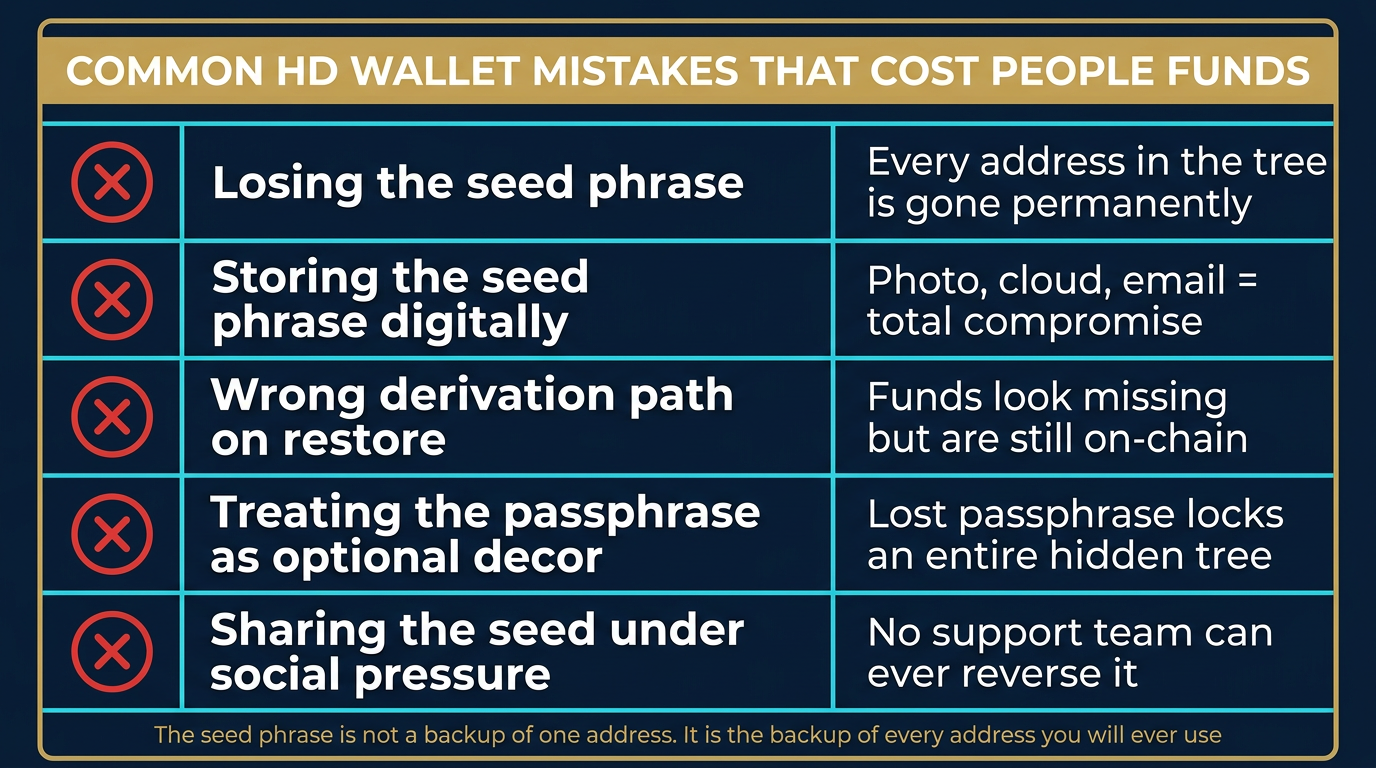
Losing the seed phrase. If you lose your seed phrase, you lose access to every address in the entire key tree. There is no recovery process, no support team, and no alternative path. This is how the protocol is designed. The seed phrase is the only backup that matters.
Storing the seed phrase digitally. Taking a photo of your seed phrase, storing it in cloud notes, or emailing it to yourself exposes the root key to any attacker who can access that device or account. The seed phrase should only exist on physical media, preferably in more than one secure location.
Using non-standard derivation paths. Some wallets use custom path structures that deviate from the BIP-44 defaults. If you restore a seed into a different wallet app that uses a different default path, your addresses will appear empty. Your funds are not gone. You need to identify and input the correct derivation path used by the original wallet.
Misunderstanding the passphrase option. Many HD wallets support an optional extra word, sometimes called the 25th word or passphrase. This creates a completely separate wallet tree derived from the same base seed. Losing the passphrase is the equivalent of losing a separate private key. The passphrase does not appear in the seed phrase backup. It must be stored independently.
The Crypto Wallet Security Checklist covers the full range of habits and practices that protect HD wallet users from these and other common failure points.
Sources
- BIP-32: Hierarchical Deterministic Wallets
- BIP-44: Multi-Account Hierarchy for Deterministic Wallets
- Bitcoin Developer Documentation
Frequently Asked Questions
What does HD wallet mean?
HD wallet stands for hierarchical deterministic wallet. It refers to a wallet that generates all its private keys and addresses from a single master seed using a defined mathematical process. Every address the wallet creates traces back to the same root, which is why one seed phrase can recover the entire wallet.
Is every modern crypto wallet an HD wallet?
Almost all mainstream wallets released after 2013 use HD wallet architecture. This includes hardware wallets from Ledger, Trezor, and Coldcard, as well as software wallets like MetaMask, Exodus, and Trust Wallet. Legacy non-HD wallets still exist but are uncommon in current use.
Can I recover my HD wallet on a different device?
Yes. Because the key tree is deterministic, entering your seed phrase into any compatible HD wallet will reproduce the same addresses and private keys. The wallet brand and model do not need to match. You do need to ensure the replacement wallet uses the same derivation path standard as the original.
What happens if I use different derivation paths across wallets?
If you restore your seed phrase into a wallet that uses a different derivation path than the original, the addresses shown will be different. Your funds on the original addresses will appear missing. They are not lost. You need to manually specify the original derivation path in the new wallet’s advanced settings to access those addresses again.
Is my seed phrase the same as my HD wallet backup?
For most users, yes. The seed phrase is the human-readable representation of the master seed that generates your entire key tree. Backing up your seed phrase is backing up your entire HD wallet. If you also use an optional passphrase, that must be stored separately since it does not appear in the seed phrase itself.