

Last Updated on April 16, 2026 by Snout0x
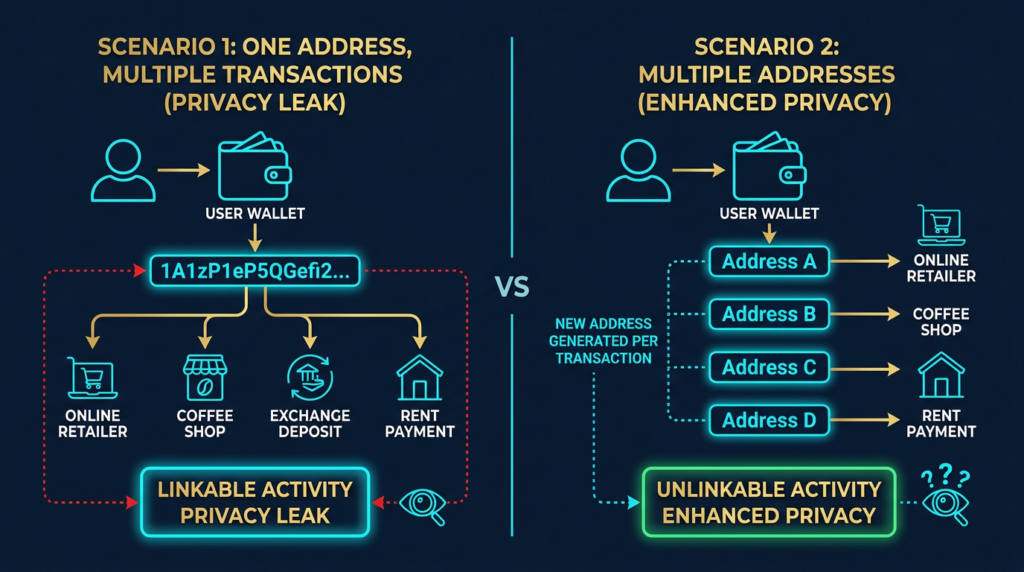
Wallet address reuse means receiving multiple payments to the same public address. It still works technically, but on transparent blockchains it makes your balance, payment history, and counterparties easier to trace. That matters because privacy loss in crypto is usually permanent, not temporary. Once an address is linked to your identity, one public string can reveal far more about your activity than most users expect.
In practice, the safer rule is simple: use a fresh receive address whenever your wallet supports it, and separate public payment flows from private savings. If one address has been shared publicly, linked to KYC withdrawals, or allowed to accumulate a meaningful balance, it should stop being your default receiving address.
This content is for educational purposes only and should not be considered financial or investment advice.
Key Takeaways
- One reused address creates one visible history: incoming payments, outgoing spends, and current holdings become easier to map together.
- Privacy loss is often identity loss: once a reused address is tied to your name, employer, exchange account, or public profile, the chain data becomes personally revealing.
- Bitcoin wallets usually avoid this by design: modern HD wallets generate fresh receiving addresses automatically, so manually reusing one is usually unnecessary.
- Explorers make the exposure easy to inspect: anyone can review balances, transaction timing, and linked activity without contacting you.
- The right fix is operational, not cosmetic: rotate receive addresses, separate public and private activity, and avoid merging funds carelessly later.
The core issue is visibility, so the first step is understanding what actually becomes visible when one address is used repeatedly.
Why Reusing One Address Breaks On-Chain Privacy
A public blockchain does not forget. Repeating the same receiving address turns separate payments into one trackable record.
One address becomes a visible transaction cluster
Each new payment to the same address strengthens the link between all earlier and later activity touching that address. An outside observer does not need your wallet app, seed phrase, or exchange login to see this. They only need the address string. From there, a blockchain explorer can show deposits, spends, timestamps, and often the current balance associated with that address.
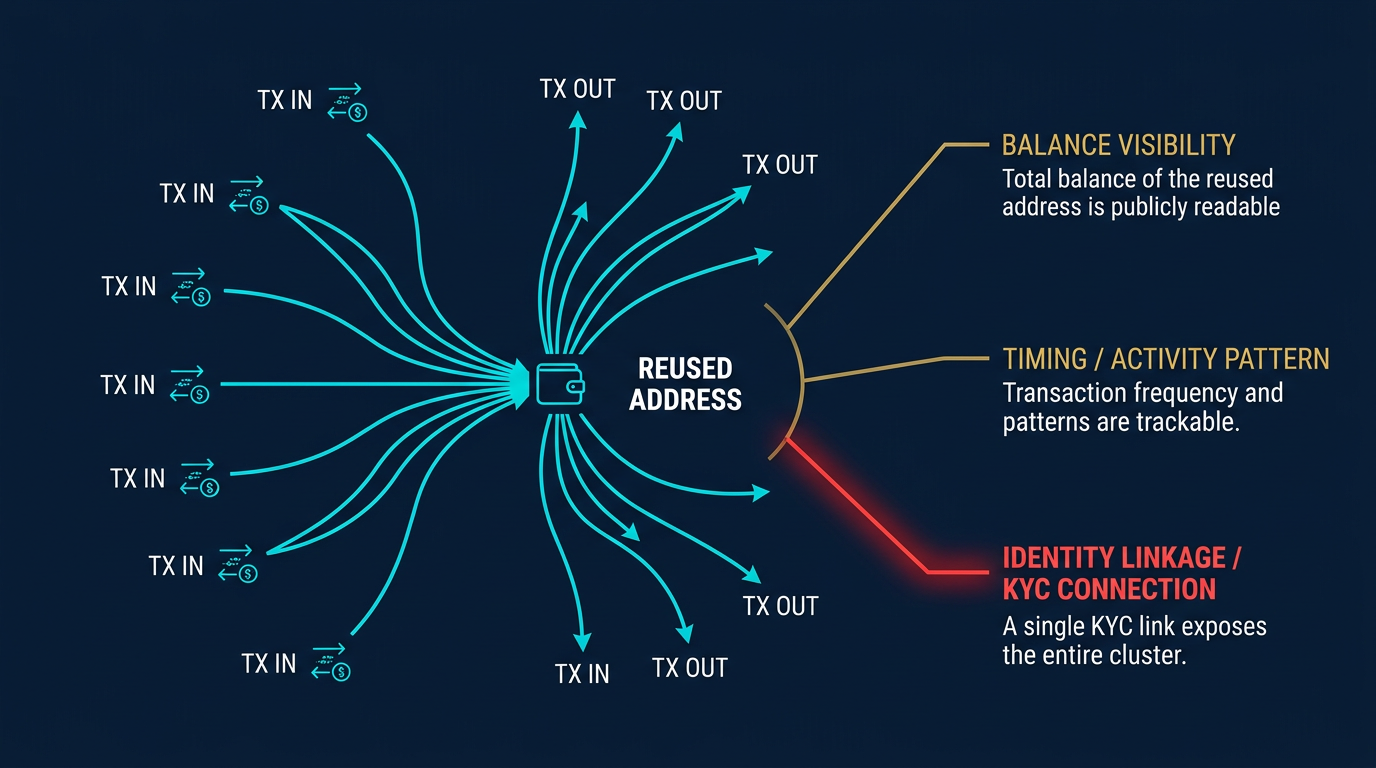
For the transparency model underneath this, the next useful background step is What Is Blockchain?. The important practical point is simpler: when one address receives multiple unrelated payments, those payments stop looking unrelated on-chain.
Balance visibility changes the security exposure
A reused address does not only reveal history. It can also reveal scale. If customers, friends, followers, or counterparties can see that one visible address now holds a meaningful amount, your privacy problem becomes a personal security problem. This is why operational privacy matters even when the cryptography itself remains intact.
If a receiving address is public-facing, assume the balance tied to it is also public-facing. That is a bad default for meaningful holdings.
Once the privacy impact is clear, the next question is what a normal observer can actually infer with standard explorer tools.
What a Blockchain Explorer Can Learn From One Reused Address
You do not need advanced chain analysis software to learn a lot from reused addresses. Standard explorer pages already reveal more than most users intend to share.
A useful mental model is to treat a reused address like a public folder, not a sealed envelope. Every new payment dropped into that same folder makes it easier for outsiders to understand what belongs together.
Timing, counterparties, and income patterns become easier to infer
If the same address receives funds at regular intervals, observers can infer payment schedules, customer cadence, or treasury behavior. If one payment is publicly attributable, for example a posted donation address or a withdrawal someone saw you share, the rest of the history inherits that context. Repetition is what turns isolated transactions into a pattern.
This is where the issue stops being abstract. It allows outsiders to ask practical questions they should not be able to answer easily: How often do funds arrive? How much came in last month? Did the balance spike after a public event? Those are not guesses when the address history is stable and visible.
Identity linkage is usually the irreversible step
The worst case is not random internet curiosity. It is identity attachment. That can happen through a KYC withdrawal, an invoice, a forum signature, a public profile, a donation page, or simply sending the same address to multiple people who know you. Once that link exists, the history is no longer anonymous history. It is your history in public.
The correct mental model is strict: if an address has been public enough to identify you once, do not keep treating it like a private receiving endpoint.
That leads to a practical comparison between the safer pattern and the exposed one.
Address Patterns Compared
The privacy difference is not theoretical. The receiving pattern you choose directly changes what outsiders can link together.
The comparison is operational, not theoretical. The pattern you choose changes what other people can connect with ordinary explorer tools.
| Pattern | What outsiders can link | Risk Level | Better default |
|---|---|---|---|
| One static receive address | All receipts to that address, visible balance, and related timing patterns | High | Avoid for repeated payments |
| Fresh address for each payment in the same wallet | Less direct linkage at receipt time, though later spending can still reconnect funds | Lower | Use the wallet’s next receive address |
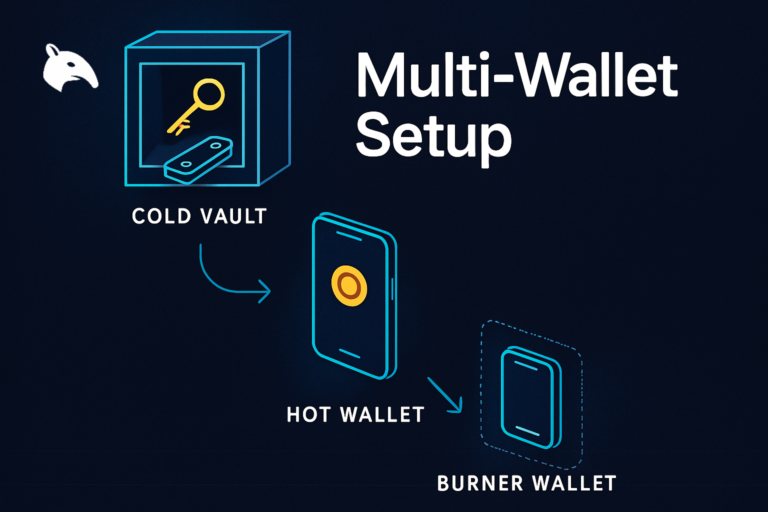
| Separate public and private wallets or accounts | Public activity stays isolated from long-term storage or unrelated receipts | Lowest practical default | Use when identity is public or payments are recurring |
The right default is not memorizing one convenient address. It is minimizing how much one public identifier can reveal.
Whether your wallet can rotate addresses easily depends on the chain model and the wallet architecture, so that distinction matters next.
Why Bitcoin and Ethereum Behave Differently
Address reuse is not identical across all chains. The privacy cost exists broadly, but the operational fix depends on how the chain and wallet model ownership.
Bitcoin wallets usually generate fresh receiving addresses automatically
Bitcoin wallets commonly use HD derivation, which lets one seed phrase generate many receiving addresses. For the derivation mechanics behind that, see How Public Keys Become Wallet Addresses and HD Wallets Explained. In practice, this means you usually do not need to reuse one address manually. The wallet can hand you a fresh one while still keeping all funds under the same seed.
Bitcoin privacy is still not automatic. If you later spend multiple UTXOs together, chain observers can connect them through common-input heuristics. That is why rotating addresses helps, but careless spending can reconnect what receipt hygiene initially separated.
Ethereum-style accounts are reused by design
On Ethereum and other account-based chains, one account address usually holds a running balance and is reused continuously. There is no standard wallet behavior that gives you Bitcoin-style fresh receive addresses inside one account. If privacy matters, the operational answer is different: use separate accounts for separate contexts instead of treating one public account as a universal receiving endpoint.
If you want privacy on an account-based chain, one address is not enough. You need separation at the account level.
Once the chain-specific mechanics are clear, the remaining task is operational: what should you actually do in normal wallet use?
Practical Usage: How to Reduce Address Reuse
Most users do not need advanced privacy tooling to improve this. They need better receiving habits and clearer separation between public and private activity.
One operator insight is that address reuse often happens by habit, not by decision. Users keep copying the same address because it is bookmarked, saved in chat, or already known by a customer. That convenience turns into permanent visibility faster than most people realize.
For personal receiving, accept the wallet’s next address
If your wallet generates a new receive address, use it. Do not keep copying the old one just because it is familiar. A fresh address does not require a new seed phrase or a new wallet. It is usually just another branch of the same wallet. Users who avoid the fresh address because it looks unfamiliar are often recreating privacy problems that the wallet already solved for them.
If your funds come from a KYC exchange, treat the withdrawal path as sensitive from the start. Repeatedly withdrawing to the same visible address makes it easier to connect identity, amount, and timing. For the custody context around public exchange activity, see How Much Crypto Should You Keep on an Exchange.
A practical routine works better than vague caution here. Set one rule for personal receipts, one rule for exchange withdrawals, and one rule for public-facing payments. For example: personal payments always go to the next fresh wallet address, exchange withdrawals never repeat a visible public address, and donation or merchant flows use a dedicated public wallet or processor.
For public payments, use separation instead of convenience
Public donation pages, merchant checkouts, social profiles, and repeat invoice flows should not point directly at the same address you use for broader holdings. Use a dedicated public wallet, a processor that rotates addresses, or separate accounts for public-facing activity. Convenience is not a good reason to publish a permanent map of your receipts.
The practical rule is simple: public money flow should stay separate from private storage.
A second operator insight is that “I only shared it with a few people” is not real privacy control once one of those people posts it publicly, forwards it, or connects it to a known identity. Address exposure tends to spread asymmetrically. It is easy to create and hard to unwind.
A concrete example: if you are a freelancer receiving bitcoin from multiple clients, reusing one address lets those clients see the same receipt history and infer payment timing. A better setup is a fresh address for each invoice. If you run a public donation page, use a dedicated public address set that is intentionally separate from long-term holdings.
Some cases are serious enough that the right move is not just better hygiene, but an immediate stop.
Decision Triggers: When to Stop Reusing an Address
Certain situations mean the address should no longer be treated as a normal receiving address.
- The address has been posted publicly on a profile, website, or donation page
- The address has received KYC-linked exchange withdrawals more than once
- The address now holds a meaningful balance
- Multiple customers, employers, or counterparties should not be able to see each other
- You are using Bitcoin and your wallet already offers fresh receive addresses
When one of these is true, stopping is better than rationalizing. Reusing one address is usually an avoidable operational leak, not an unavoidable cost of using crypto.
Even after you stop reusing an address, there are a few mistakes that can recreate the same visibility later.
Risks and Common Mistakes With Address Reuse
The main failure mode is thinking the problem ended just because you generated a new address. In practice, later behavior can still reconnect funds.
Fresh address does not mean fresh wallet
Some users resist address rotation because they think each new receive address creates a separate wallet to manage. In HD wallets that is not how it works. One seed can control many addresses, and the wallet software tracks them for you. If you skip fresh addresses because you think they create operational overhead, you are solving the wrong problem.
Merging funds later can undo earlier privacy gains
On Bitcoin, spending many separate UTXOs together can reveal common ownership even if the deposits originally arrived at different addresses. For a practical next step on that trade-off, see UTXO Consolidation Explained. Address rotation improves receipt privacy, but later wallet behavior still matters.
The goal is not to hide everything forever. The goal is to avoid making your transaction history easier to map than it needs to be.
Reusing one address is rarely a software failure. It is an operational choice. The better decision is to limit how much one visible address can reveal about your identity, counterparties, and holdings before that exposure becomes permanent.
Sources
- BIP-32 Specification – Defines hierarchical deterministic wallets and the derivation model that enables fresh receiving addresses from one seed.
- BIP-44 Specification – Standardizes multi-account derivation paths used by many wallets for organized address generation.
- Bitcoin Developer Documentation – Reference material for Bitcoin transaction structure, addresses, and wallet behavior.
FAQ: Reused Wallet Addresses
Is reusing a wallet address unsafe or just bad for privacy?
Usually it is a privacy problem first, not a cryptographic break. The funds can still arrive correctly, but outsiders can map more of your transaction history, balances, and counterparties than they could if you used fresh addresses.
Does this privacy problem matter more on Bitcoin than on Ethereum?
It matters on both, but the operational fix differs. Bitcoin wallets often support fresh receive addresses under one seed, while Ethereum-style accounts are reused by default and usually require separate accounts if you want better separation.
Can someone see my full balance from one reused address?
They can often see the balance and full history associated with that address on public explorers. On Bitcoin, related spending patterns can also expose broader ownership links. On account-based chains, the address itself often shows the running balance directly.
Do modern wallets already prevent this?
Many Bitcoin wallets reduce it by generating a fresh receiving address automatically. That only helps if you actually use the fresh address. On account-based chains, most wallets do not solve the problem for you because the same account address is meant to be reused.
When is it acceptable to reuse an address?
It is acceptable only when you understand and accept the visibility cost. For low-sensitivity or intentionally public use, you may decide the convenience is worth it. For recurring personal receipts, KYC-linked funds, or meaningful balances, reusing the same address is a weak default.