

Last Updated on April 19, 2026 by Snout0x
A hardware wallet supply chain attack happens before you ever create a PIN or write down a recovery phrase. Instead of attacking your wallet after setup, the attacker interferes with the device, packaging, accessories, or delivery path before it reaches you. That matters because the compromise can look legitimate at first glance. If you plan to trust a hardware wallet with long-term funds, you need to decide whether the device in your hands is authentic before you decide what to store on it.
For most users, the practical defense is not complicated: buy direct, reject secondhand devices, compare the setup path against the official vendor process, generate the recovery phrase on-device yourself, and stop at any sign of a preconfigured state. A supply chain attack succeeds when you accept someone else’s setup before you realize you have done it.
This content is for educational purposes only and should not be considered financial or investment advice.
Buy direct from the manufacturer — lower tampering risk.
Inspect packaging and setup flow — stop obvious compromises early.
Verify firmware and initialize the seed yourself — do not trust a preconfigured device.
If a wallet arrives pre-seeded, pre-unlocked, or with setup shortcuts already done, do not use it. A suspicious device should be treated as compromised, not merely imperfect.
Key Takeaways: Tampered Hardware Wallets
- The attack happens before first use: The attacker tries to control the device, instructions, or recovery flow before you set up the wallet.
- Pre-generated seed phrases are a hard failure: If recovery words are already provided or the wallet appears initialized, the device is not safe to trust.
- Buying source matters: Manufacturer-direct purchases reduce the number of people who can intercept, swap, or modify the device.
- Verification is part of the product: A hardware wallet is only as trustworthy as the setup process that proves the device is genuine.
- Meaningful balances require stricter checks: If the amount is large enough to matter, you should verify the wallet before moving any long-term funds.
The next step is understanding where a supply chain attack actually enters the process.
Where Tampering Enters the Process
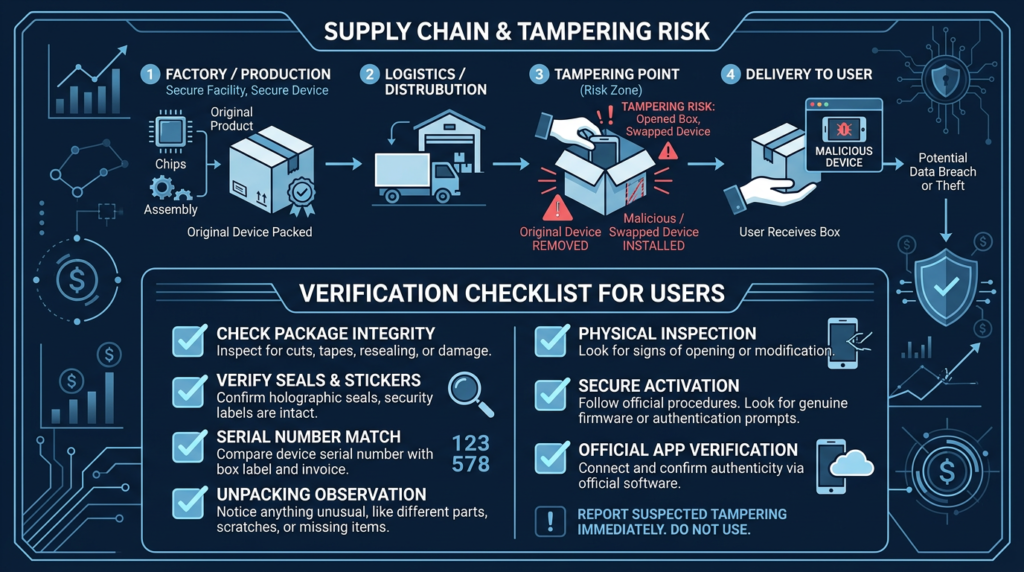
The supply chain is not just shipping. It includes manufacturing, packaging, distribution, resale, and the first-time setup environment.
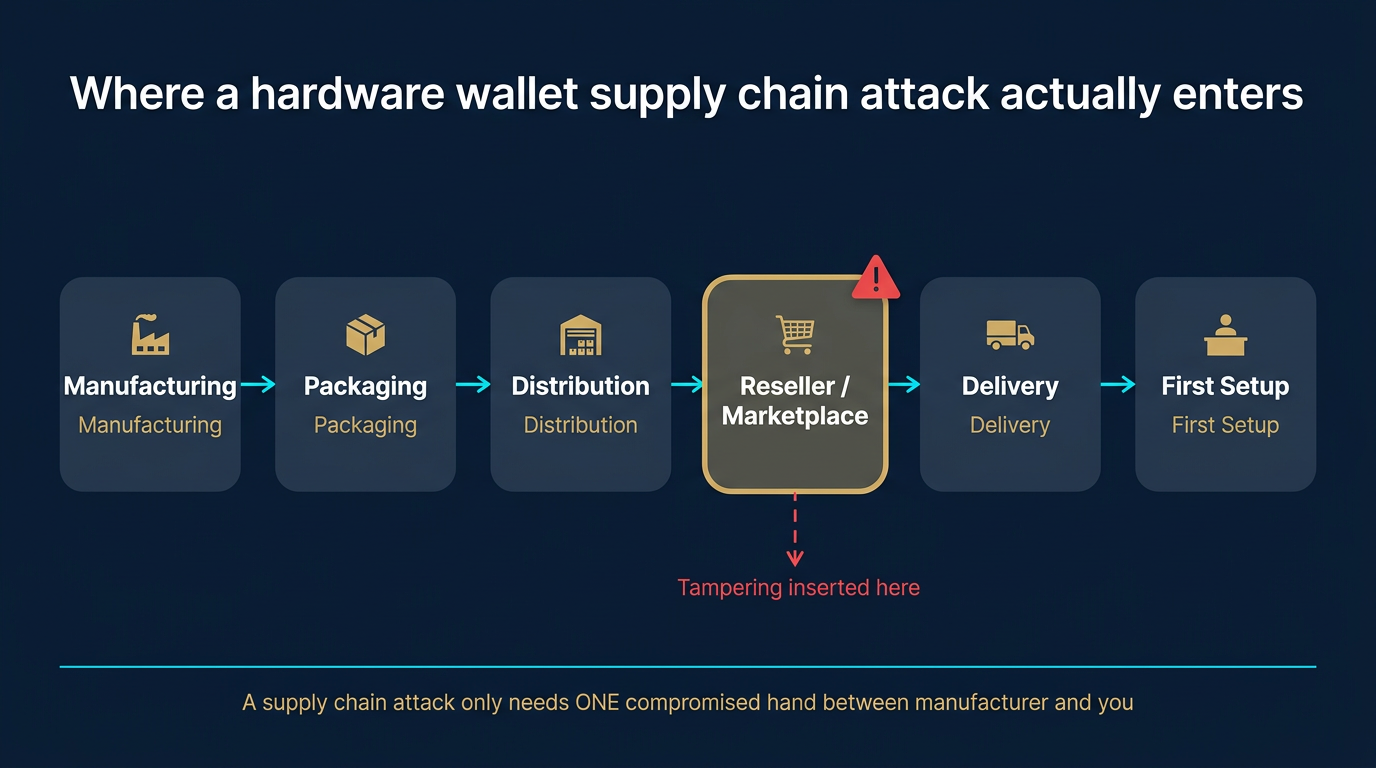
A useful mental model is to treat the wallet like a sealed key, not like ordinary consumer electronics. If the chain of custody is uncertain, the correct response is not “maybe it is fine.” It is “this is no longer a trustworthy storage tool.”
Attackers target trust before the device reaches your desk
This attack works by moving the compromise earlier than most users expect. Instead of trying to steal a seed phrase after you create it, the attacker tries to influence which device you receive, what instructions you follow, or what credentials you think are safe to use. That can include resealed packaging, fake manuals, modified accessories, swapped devices, or inserted cards telling you to restore from a seed phrase “provided for convenience.”
This attack path is effective because it exploits trust, not cryptography. A legitimate hardware wallet can be secure by design and still become dangerous if the buyer accepts a preconfigured state, follows malicious setup instructions, or never checks authenticity. If a wallet asks you to trust someone else’s recovery process, the wallet is already disqualified.
Resellers, secondhand channels, and repackaged devices increase uncertainty
The more hands between the manufacturer and you, the harder it is to know whether the device, box contents, or onboarding materials are original. That does not mean every reseller is malicious, but it does mean the attack surface expands. A manufacturer-direct purchase usually removes unnecessary uncertainty. If you are about to store serious funds, reducing uncertainty is worth more than saving a small amount on price.
Secondhand devices are especially weak because you cannot meaningfully prove how they were handled before you received them. A used hardware wallet might be perfectly clean, but that is not enough. Long-term storage decisions should not rest on optimistic assumptions about a previous owner.
The practical decision is simple: if the source is questionable, the device should not be trusted for long-term storage.
How Tampered Hardware Wallets Try to Steal Funds
Most real-world tampering attempts rely on setup shortcuts and user confusion rather than exotic hardware implants.
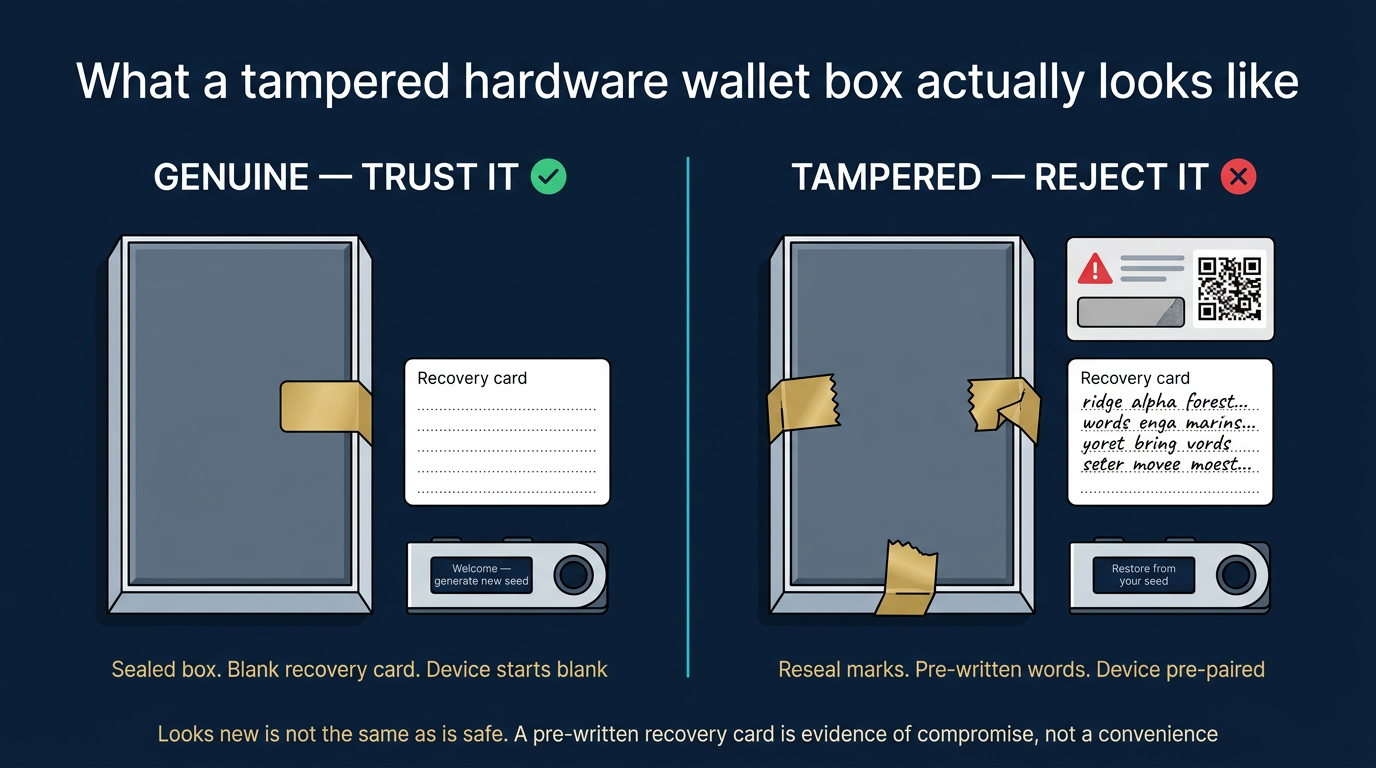
One operator insight is that most real supply chain compromises do not need advanced implants. They only need to get you onto the wrong setup path once. That is why fake recovery cards, tampered inserts, and repackaged devices matter more in practice than dramatic Hollywood-style hardware hacks.
A second operator insight is that “looks new” is not the same as “is safe.” Clean plastic, intact tape, and a polished app interface do not override a suspicious seller, a prewritten recovery phrase, or setup instructions that differ from the vendor’s own documentation.
Pre-generated recovery phrases are the most obvious trap
The classic scam is simple: the device or packaging includes a ready-made recovery sheet and tells you to use it. If you do, the attacker already knows the seed phrase and can drain funds whenever value appears. This is one of the clearest red flags in wallet security. A hardware wallet should generate the seed phrase on the device during your setup, not before shipment.
The moment someone else knows the recovery words, the wallet is no longer meaningfully yours. A prewritten seed phrase is not a convenience feature. It is evidence of compromise.
Modified setup instructions can redirect you into unsafe behavior
Some attacks do not modify the device at all. They modify the instructions around it. A fake card in the box, a QR code to a phishing site, or a printed prompt to “verify” the wallet by entering your seed phrase on a website can be enough. Hardware wallets protect keys during transaction signing, but they do not protect against following malicious setup instructions outside the device trust boundary.
This is why packaging review matters, but only up to a point. You are not trying to become a forensic investigator. You are trying to catch anything that changes the expected initialization path. If the setup route asks for secrets in the wrong place, stop immediately.
Firmware trust and device integrity checks matter more than cosmetic seals
A sticker or seal can be useful, but it is not the full verification model. The stronger check is whether the wallet’s official setup flow confirms device integrity and whether the firmware path matches the vendor’s documented process. For a deeper breakdown, this connects to Hardware Wallet Firmware Verification Explained. If you skip firmware authenticity checks, you are trusting appearance more than the device’s actual security state.
Cosmetic tamper evidence can fail for innocent reasons or be reproduced by determined attackers. Firmware and initialization checks are more decisive because they test whether the device behaves like a genuine wallet should. The right question is not “Does the box look clean?” It is “Does this device follow the authentic setup path from the manufacturer?”
Once you understand the attack methods, the next question becomes practical: what should you check before trusting the device?
What to Check Before You Trust the Device
The goal of the first setup is not speed. The goal is to verify that the wallet is genuine and clean.
- Buy direct from the manufacturer. Do not purchase from resellers, marketplaces, or secondhand sellers.
- Inspect packaging before opening. Compare box contents against the manufacturer’s official documentation.
- Generate the seed phrase on-device. The setup wizard will prompt you. Never restore from a prewritten phrase.
- Verify firmware during first setup. Follow the manufacturer’s documented verification flow before adding funds.
- Send a small test transaction first. Confirm the deposit-and-recovery cycle before moving significant value.
A hardware wallet should earn your trust through the setup flow. It should not receive trust just because the brand is reputable.
Decision Triggers: When to Reject the Wallet Immediately
Some warning signs are strong enough that you should stop rather than troubleshoot.
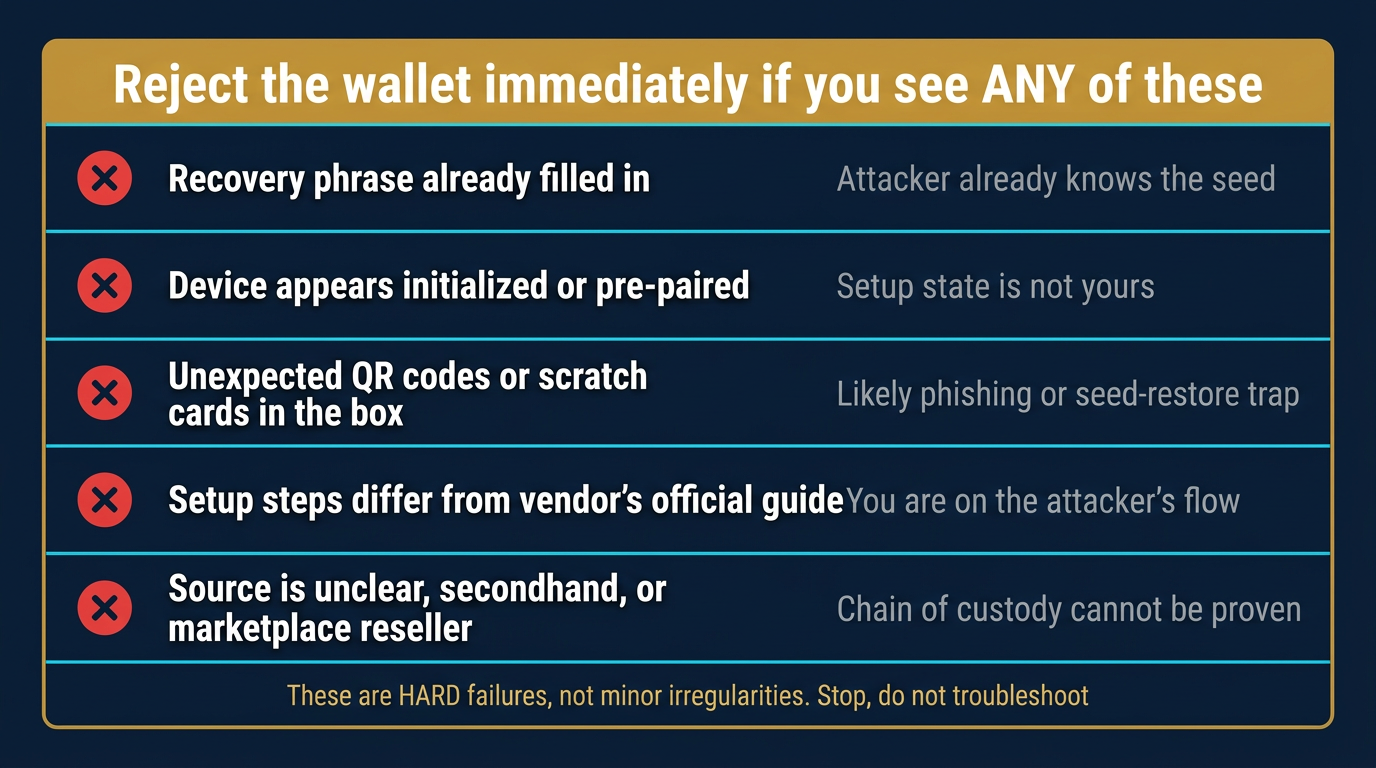
- The device arrives with a recovery phrase already filled in
- The wallet appears initialized or asks you to trust a pre-existing setup
- The box includes unexpected setup cards, QR codes, or web links
- The official app or setup guide does not match what the package instructs you to do
- The device source is unclear, secondhand, or routed through an untrusted marketplace seller
Do not argue with these signals. A suspicious hardware wallet should be rejected, returned, or replaced. The correct response is to restart the process with a trusted device source, not to “be extra careful” while using a wallet that already failed the trust test.
Users get into trouble when they downgrade a hard failure into a minor inconvenience. A mismatched setup path, a preconfigured seed, or an unclear seller is not a cosmetic issue. It means the trust boundary has already been broken. If the starting state is uncertain, the safest choice is to abort before any real funds touch the device.
Practical Usage: How to Decide Whether the Wallet Is Safe Enough
The decision is not whether hardware wallets are good in general. The decision is whether this specific device is safe enough for this specific balance.
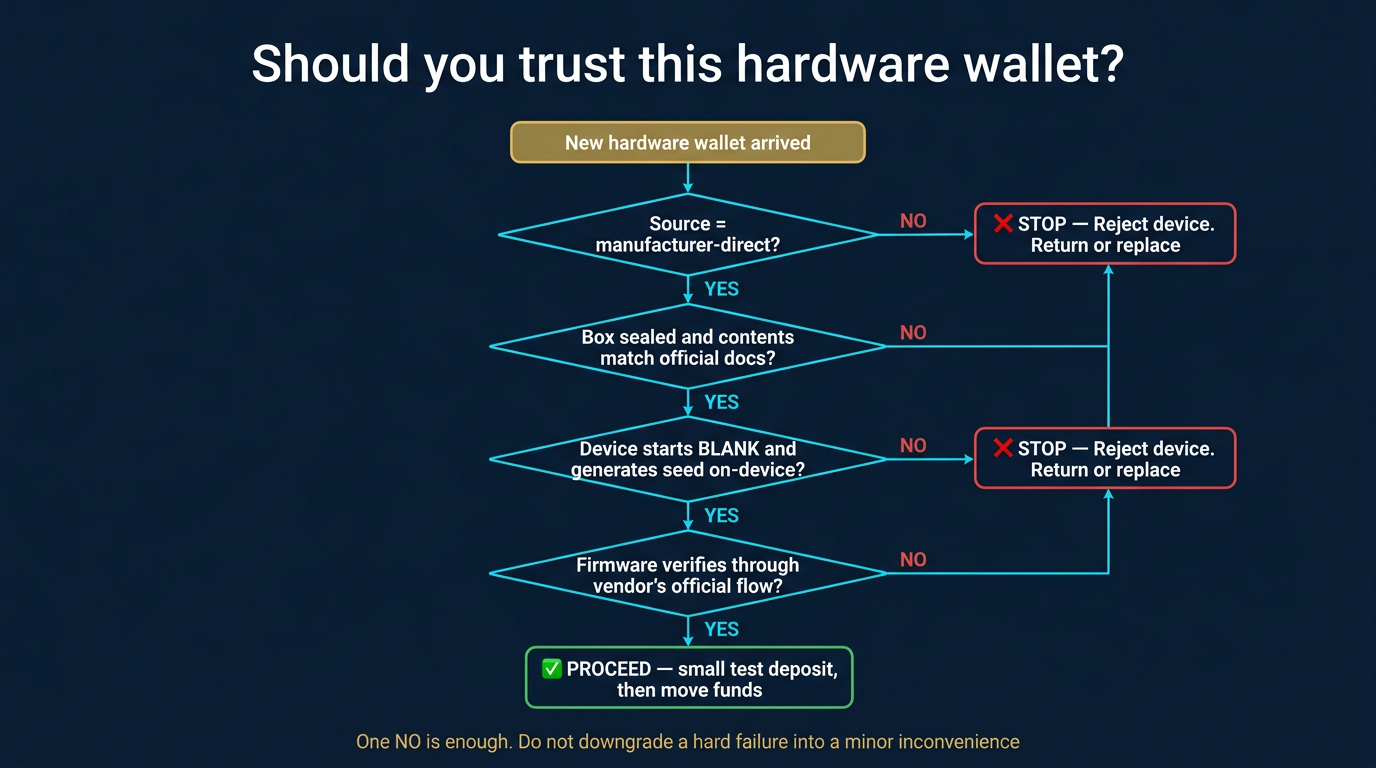
A practical framework is to match verification depth to the balance at risk. If you are testing workflow with a trivial amount, you are still checking source, blank initialization, official setup, and on-device seed generation before the first transfer. If the wallet will hold serious long-term funds, add a stricter routine: buy direct, verify packaging against vendor docs, complete the genuine-check flow, confirm firmware via the official path, and use a small test deposit before any meaningful transfer.
- Low-value test use: You can evaluate setup and workflow with a trivial balance after completing authenticity checks.
- Meaningful long-term balance: Buy direct, verify setup path, generate the seed yourself, test with a small transfer, then move funds.
- Any unresolved doubt: Do not use the device for long-term storage.
A real-world example: if a marketplace seller ships a device with a scratch card containing recovery words and a QR code for “faster activation,” that wallet should never be funded. By contrast, if a device arrives from the official vendor, starts blank, passes the official verification flow, and generates the recovery phrase on the device in your presence, it has passed the core supply-chain checks and can move to the normal setup stage.
A hardware wallet supply chain attack is dangerous precisely because it targets you before normal wallet security habits start. The right decision is to be strict early. Reject ambiguity, verify the setup path, and only store meaningful funds once the device has earned trust through documented checks.
Risks and Common Mistakes
The biggest mistake is treating visible tamper signals as small irregularities instead of hard failures. Users sometimes keep going because the brand is reputable, the wallet app opens normally, or the package only looks slightly different than expected. That is the wrong standard. A compromised setup can still look usable. In this topic, uncertainty itself is a risk signal.
A second mistake is funding the wallet before the trust checks are finished. If the source is unclear, the seed is prewritten, or the setup route asks for secrets in the wrong place, stop before any meaningful transfer. Security improves when you reduce avoidable exposure early, not after funds are already at risk.
Sources
- NIST Digital Identity Guidelines – Useful baseline guidance for identity proofing, authenticator trust, and secure onboarding decisions.
- OWASP Cryptographic Storage Guidelines – Practical security principles for protecting cryptographic material and reducing unsafe handling of secrets.
- BIP-39 Specification – Reference for mnemonic seed phrases and why pre-generated recovery words undermine wallet ownership.
FAQ: Tampered Hardware Wallets
Can a hardware wallet be hacked before I open the box?
Yes. This risk targets the device, accessories, or setup instructions before first use. In practice, it often means modified packaging, fake recovery materials, swapped devices, or malicious setup directions rather than dramatic hardware implants.
Is a pre-written recovery phrase always a scam?
For a new hardware wallet, yes. The recovery phrase should be generated by the device during your setup. If the words are already provided, someone else may already know the secret needed to control the wallet.
Should I avoid buying a hardware wallet from a marketplace seller?
If you plan to use the device for meaningful long-term storage, buying direct from the manufacturer is the safer default. The more uncertain the distribution path, the more unnecessary trust you are adding to the process.
What is the safest first transfer to a new hardware wallet?
The safest first transfer is a small test amount after you complete setup and verification. Confirm that the wallet shows the expected address, the transfer arrives correctly, and the recovery process is documented before moving larger balances.
When should I reject the wallet completely?
You should reject the wallet if it arrives pre-seeded, initialized, paired to an account, or with setup instructions that differ from the official vendor flow. Long-term storage should not begin from a compromised or uncertain starting point.