

Last Updated on April 16, 2026 by Snout0x
A hardware wallet is a dedicated device that stores private keys separately from an internet-connected computer or phone. If you are asking what is a hardware wallet, the practical answer is that it isolates signing credentials in hardware built for key management and transaction approval. That matters because most wallet compromises happen through the device you use every day, not through a failure of the blockchain itself.
A simple way to think about it is this: the laptop or phone is the messenger, but the dedicated signer is the approver. The messenger can prepare a transaction and broadcast it, but it should not be trusted to hold the secret that authorizes spending. The device exists to keep that approval step in a smaller, more controlled environment.
This content is for educational purposes only and should not be considered financial or investment advice.
What Is a Hardware Wallet? Simple Definition
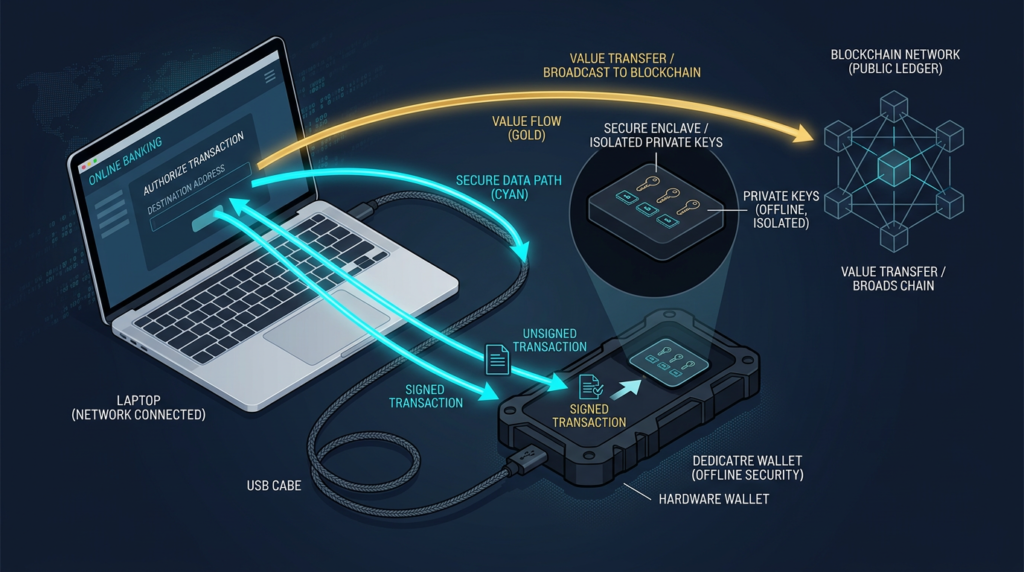
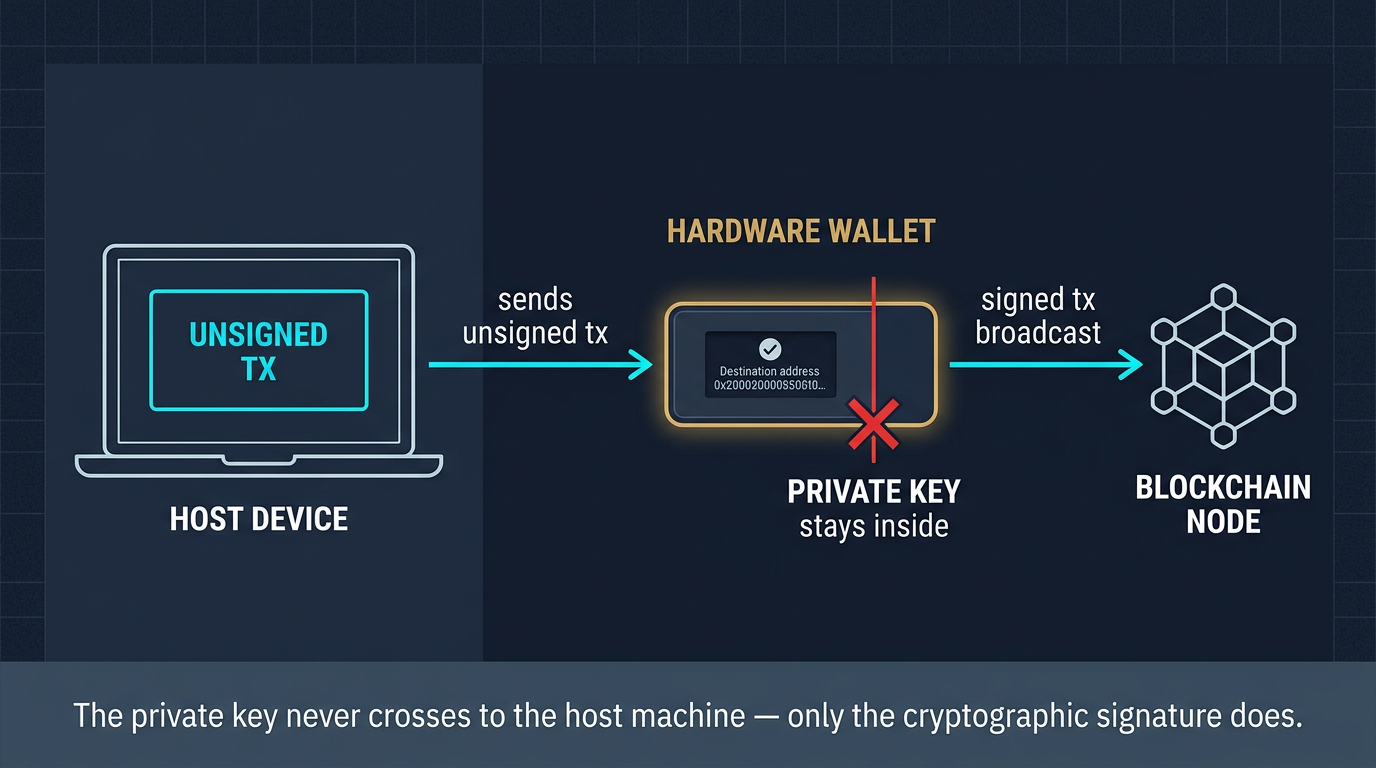
A hardware wallet is a dedicated physical device that holds your private keys offline and signs transactions without exposing those keys to your computer. The computer prepares the transaction. The device approves and signs it. The keys never leave the device.
This device is a physical signing tool used to protect crypto private keys from the internet-connected environment where malware, browser exploits, and fake wallet prompts usually appear. The key idea is separation. The computer prepares a transaction, but the wallet device verifies the details and signs it without exposing the secret key to the host machine.
In practice, you connect the device to companion software, review the recipient and amount on the wallet screen, approve the action on the device itself, and then broadcast the signed transaction to the network. The blockchain sees a valid signature, but the computer never handles the raw secret directly.
They are not magic storage boxes. They are specialized signing tools built to keep key control separate from the most exposed parts of normal internet use. If you want the broader storage framework around that role, How to Store Crypto Safely is the more relevant next step.
Why It Matters
Crypto ownership is really key ownership. If someone controls the private key, they can usually move the funds. That makes storage and signing architecture more important than app design, token branding, or exchange convenience.
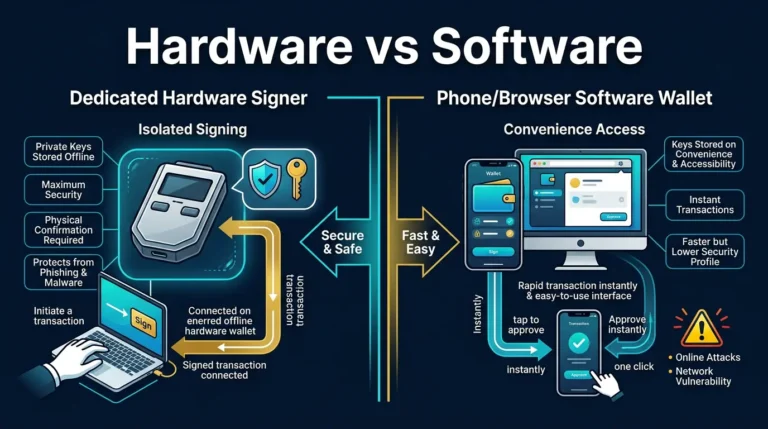
A phone wallet or browser extension keeps signing logic inside an environment that also handles email, messaging, extensions, websites, downloads, and potentially malware. A dedicated device narrows that attack surface. It does not remove risk entirely, but it changes the trust model in a meaningful way. The strongest benefit is not abstract security branding. It is that transaction approval happens on a separate screen and button path that malware on the host cannot fully control.
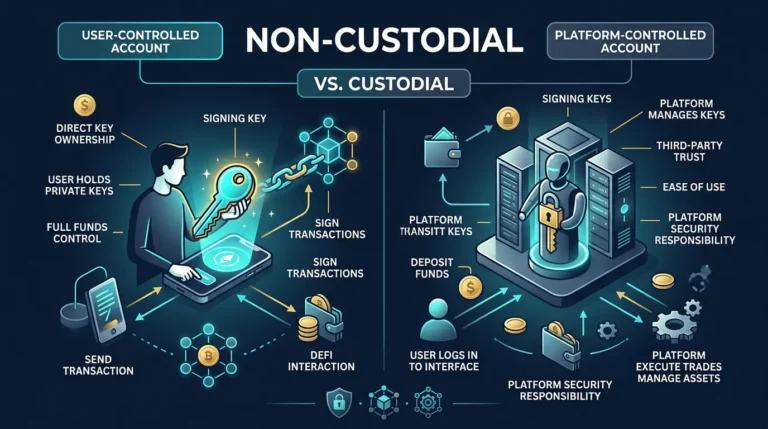
This also matters for self-custody. The hardware device is one implementation choice inside that model, usually chosen when balances become meaningful enough that hot-wallet convenience no longer outweighs exposure. In practice, it is less about “maximum security” in the abstract and more about moving the signing secret away from the device you browse, message, and download files on every day.
How It Works
The device does not hold coins. It holds the keys and signs the instructions that move assets on-chain. Understanding that sequence makes the role of the device much clearer.
Private keys stay on the device
When you initialize the wallet, it generates or restores the seed phrase and derived private keys inside the device environment. Those secrets are then used to approve future transactions. The computer or phone can request a signature, but the device is supposed to keep the signing secret inside its own boundary. That is the core design difference between a dedicated signer and a hot wallet.
The recovery phrase remains the root backup. The hardware is the operational tool that uses the derived keys without forcing them to live inside your everyday device. For the backup side of that decision, Best Seed Phrase Backup Devices is the more useful local follow-up.
Transaction signing happens in two environments
The host device usually constructs the unsigned transaction. It fills in destination address, amount, fee, and chain-specific details. That unsigned payload is then sent to the wallet device for confirmation. The signer shows you the critical details on its own screen, and only after you approve does it create the cryptographic signature needed for broadcast.
That process is easier to understand if you read What Is Transaction Signing in Crypto. The key security point is simple: signing should happen in the environment with the smaller attack surface, while broadcasting can happen on the internet-connected machine.
Cold storage does not mean zero interaction
Many people use the phrase cold storage loosely. A hardware device is often part of a cold-storage workflow, but the category is broader than one product type. Some setups remain connected only during transaction approval. Others are used alongside air-gapped or more advanced storage models. The device is best understood as a signing endpoint, not as a synonym for every secure storage method.
If you want the operational differences between offline approaches, Cold Storage vs Air-Gapped Wallets covers that distinction. The hardware device fits into that conversation, but it is not the whole conversation by itself.
When It Makes Sense to Use One
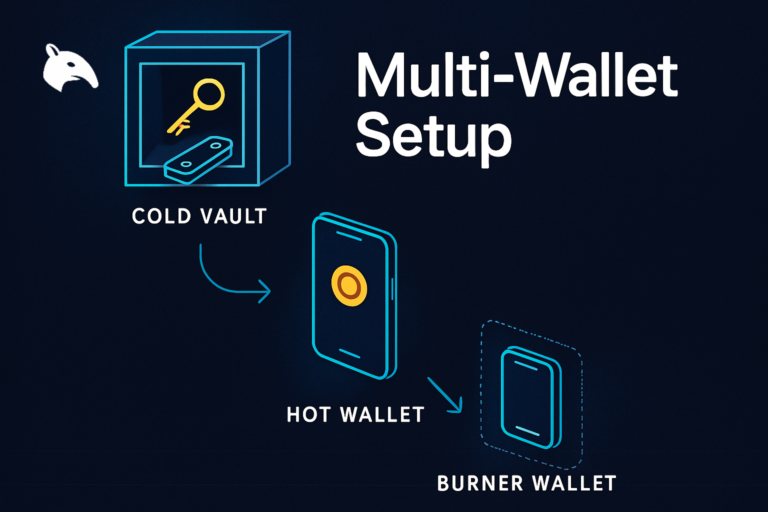
A hardware wallet makes the most sense when you plan to hold meaningful value for longer periods, want a more deliberate signing routine, or no longer trust a browser extension or phone as the main place to approve transactions. If you want a fuller amount-versus-convenience framework, When to Use a Hot Wallet vs Cold Wallet is the direct next read.
A hot or software wallet may still be enough when balances are small, you transact often, and convenience matters more than maximum key isolation. If the amount at risk is still modest and you are optimizing for speed, you do not need to force hardware before your habits and threat model justify it. If you are still choosing a first wallet and want a simpler setup before moving into dedicated hardware, Best Crypto Wallets for Beginners is the better comparison path.
The practical dividing line is not ideology. It is whether the downside of keeping keys on an everyday device now feels more expensive than the added friction of separate signing. When that answer becomes yes, the next step is not buying blindly but comparing actual device trade-offs in Best Crypto Hardware Wallets. Buying a device before you understand its trust model, setup path, and backup assumptions only changes the shape of the risk.
If you already know you want dedicated hardware and are deciding between the two most common trust-model approaches, Ledger vs Trezor Security Model is the most relevant product-level follow-up.
Practical Usage: Common Mistakes
The most common mistake is assuming the device makes every surrounding habit safe. It does not. If someone types the recovery phrase into a phishing site, stores it digitally, buys from a bad seller, or approves an address they did not verify on the device screen, the security model can still fail.
Another mistake is confusing the device with the backup. The wallet can break, be lost, or be wiped. The seed phrase is what preserves recovery. The physical gadget is important, but it is not the ultimate source of control. Users who misunderstand that often protect the device carefully while handling the recovery words poorly, which reverses the actual risk priorities.
Setup mistakes are also common. Users often assume the device itself creates safety automatically, when in reality the recovery path and transaction-confirmation habits still determine much of the real-world outcome. The device is only as strong as the setup path and recovery discipline around it.
Security and Risk Considerations
The main security benefit of the device is isolation, not invincibility. It reduces the chance that malware on a laptop or phone can access signing keys directly, but it does not protect against every threat. Supply chain tampering, malicious firmware, bad setup instructions, physical theft, and user error all remain relevant. The device narrows risk. It does not eliminate the need for judgment.
This is why source and firmware matter so much. A device bought through an untrusted path or updated through an unofficial process can undermine the very separation it is supposed to provide. The trust model begins before first use and continues through every update.
The other major trade-off is usability. A dedicated signer is usually slower and less convenient than a browser extension or phone wallet. That inconvenience is not accidental. It is part of the protection model. The point is not that everyone needs one immediately. The point is understanding why people choose one when key exposure starts to matter more than speed.
What a Hardware Wallet Protects You From , and What It Does Not
A hardware wallet meaningfully reduces one specific class of risk: key exposure on an everyday internet-connected device. It makes remote theft harder when the usual attack path is malware, a compromised browser extension, or a hostile host trying to reach signing secrets directly. That is a real improvement because it changes where approval happens and how much the laptop or phone is trusted.
It does not solve every loss path around the wallet. It does not fix careless seed phrase handling, it does not stop you from approving a phishing transaction, and it does not remove the need to verify addresses and amounts on the device screen itself. The device helps most when the user keeps the recovery path clean, rejects fake setup flows, and treats on-device verification as the final security checkpoint.
Sources
- Bitcoin Developer Documentation – Useful reference for transaction structure, key handling concepts, and wallet behavior.
- BIP-39 Specification – Background on mnemonic recovery phrases used by many wallet systems.
- NIST Digital Identity Guidelines – Baseline guidance on authenticator trust and secure credential handling.
Frequently Asked Questions
Does the device store my coins?
No. Assets stay on the blockchain. The device stores or protects the private keys used to sign transactions that move those assets.
Is the device the same as cold storage?
Not exactly. A hardware device is often used in a cold-storage setup, but cold storage is a broader category of keeping signing credentials away from everyday internet exposure.
Can malware on my computer still affect me if I use one?
Yes. Malware may not extract the key directly, but it can still try to trick you into approving the wrong transaction or visiting a phishing setup path. That is why the device screen and confirmation flow matter.
Do I still need a seed phrase if I use one?
Yes. The recovery phrase is still the main backup. If the device is lost, damaged, or wiped, the seed phrase is what restores access.
Who should consider using one?
People usually consider one when they want stronger key isolation for long-term holdings, larger balances, or a more deliberate signing workflow than a hot wallet provides.