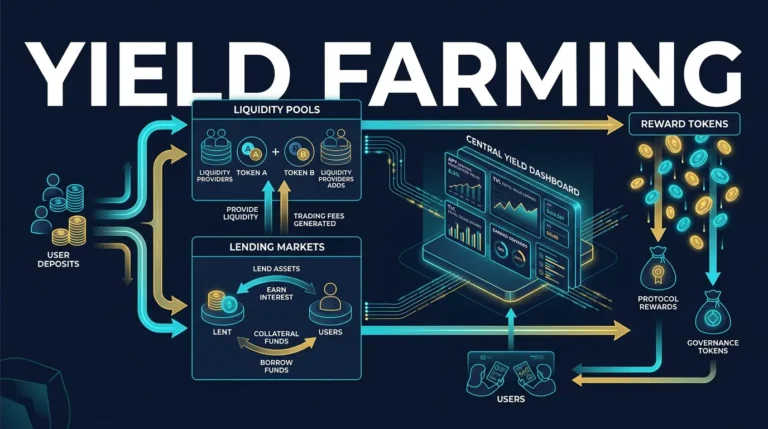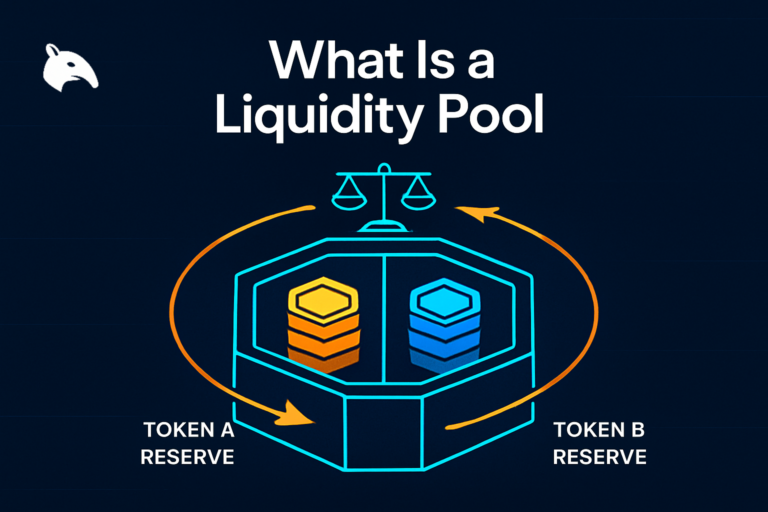


Liquidity pools make decentralized trading possible, but they are not passive-income machines with risk removed. When you provide liquidity, you are taking on a package of market, contract, and incentive risks in exchange for fees and possible token rewards. The core mistake is to see the yield first and the mechanism second. In reality, the mechanism is what creates the yield and the risk at the same time.
The practical question is not whether a pool pays. The practical question is what can go wrong before the fees arrive. Price divergence, smart contract exploits, stablecoin depegs, shallow liquidity, and temporary incentive programs can all turn a high-APY position into a poor trade. That is why LP risk evaluation has to start before deposit, not after the pool underperforms.
This content is for educational purposes only and should not be considered financial or investment advice.
Every source of pool yield is simultaneously a channel for pool loss.
Key Takeaways
- Impermanent loss is only one part of the risk picture: It matters, but contract risk, depeg risk, and bad incentives matter too.
- High APY can hide low-quality yield: Token incentives can inflate returns without improving the underlying economics.
- Pool type changes the risk profile: Stable pairs, volatile pairs, and correlated-asset pairs do not expose LPs to the same failure modes.
- TVL alone is not a safety guarantee: A large pool can still have bad incentives, poor token quality, or concentrated exit risk.
- The best LP defense is understanding the pair and the protocol: If you cannot explain where fees come from and what breaks the trade, you are not ready to deposit.
Risk 1: Impermanent Loss
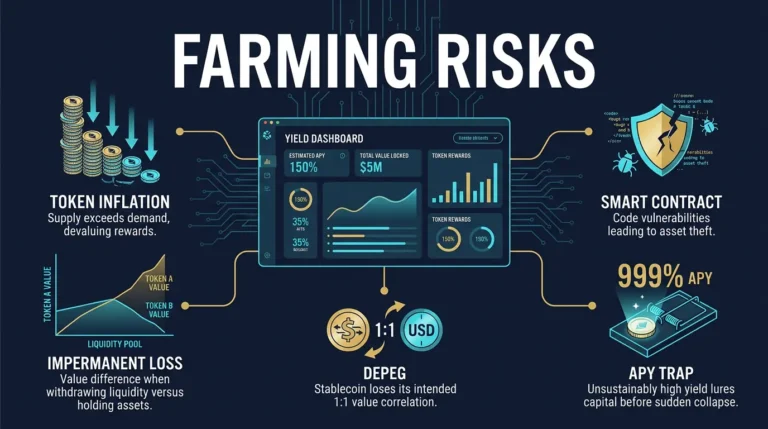
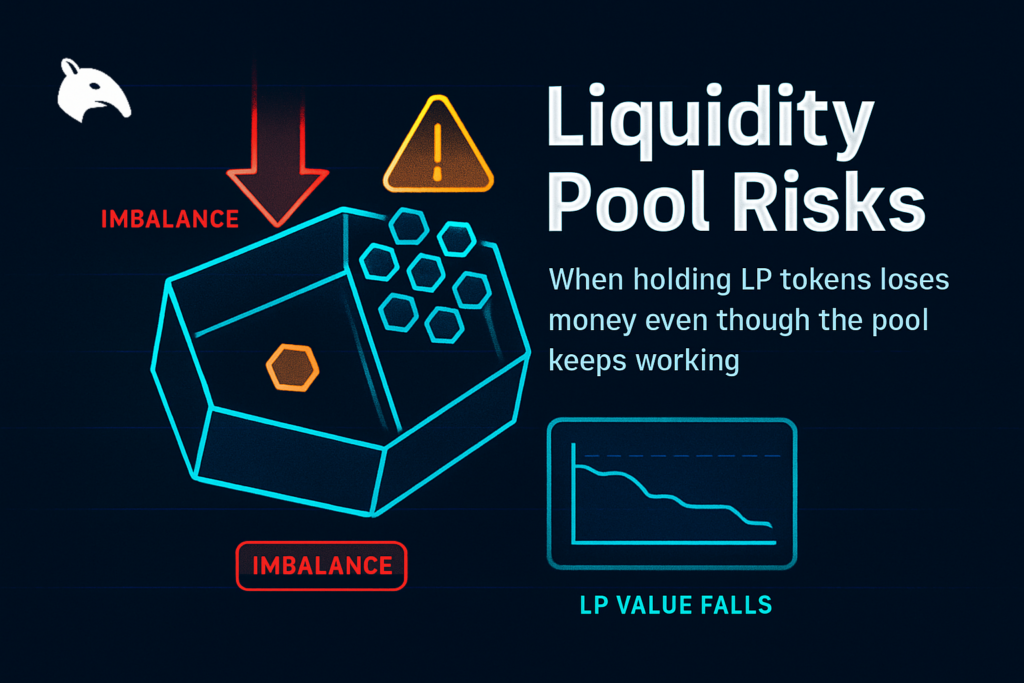
Impermanent loss is the most discussed LP risk because it comes directly from how AMM pools rebalance when asset prices diverge. If one token in the pair moves sharply relative to the other, the pool sells some of the outperforming asset and accumulates more of the underperforming one. That can leave you worse off than if you had simply held the original assets outside the pool.
The deeper explanation is already covered in What Is Impermanent Loss in DeFi?. The practical point here is that fee income must compensate for that rebalancing effect, or the LP position is not doing its job.
Risk 2: Smart Contract Failure
A pool is software. That means bugs, flawed assumptions, oracle mistakes, governance errors, and exploit paths can threaten the deposited assets regardless of how well the pricing formula works. A contract exploit is different from impermanent loss because it is not a market trade-off. It is a software failure or adversarial attack that can lead to partial or total loss of funds.
A useful mental model is to separate “the pool did what it was designed to do” from “the pool code failed.” Impermanent loss belongs in the first category. Contract exploits belong in the second. Both matter, but they are not the same risk and they are not mitigated the same way.
For the execution layer beneath that risk, the closest local background piece is What Is a Smart Contract?.
Risk 3: Stablecoin or Asset Depeg Risk
Stable or correlated pairs often look safer because they usually produce less divergence loss. But that lower day-to-day volatility can hide a different danger: peg break or correlation break. If a “stable” asset in the pair loses confidence and trades away from parity, LPs can be rebalanced into more of the damaged asset at exactly the wrong time.
That is why a USDC/USDT-style pool is not risk-free just because both assets usually trade near one dollar. If one side breaks peg during a crisis, the pool can steer you into the weaker asset while the fee headline still looks calm. The direct local follow-up here is Stablecoin Depeg Risk.
Risk 4: Thin Liquidity and Bad Volume Quality
Pool depth matters for both traders and LPs. Thin liquidity means larger price impact per trade, higher slippage, and more volatile fee generation. It also means a few bigger trades can distort the economics of the pool quickly. A pool can show an eye-catching yield while still being too shallow to support stable execution quality.
One operator insight is that not all volume is equally useful. Real, organic trading volume is what sustainable fee income comes from. Wash trading, incentive-chasing, or short-lived token hype can create volume that looks strong for a while but disappears as soon as the subsidy or speculation fades.
Risk 5: Incentive Distortion and Misleading APY
Many DeFi pools advertise yield that combines actual trading fees with protocol token emissions. That can make a position look much better than it really is. If most of the return comes from new reward tokens rather than real fee flow, the yield may be temporary, dilutive, or dependent on a governance token that is likely to weaken as more of it is distributed.
A second operator insight is that LPs often evaluate yield backward. They see the number first and ask what risks come with it later. The better order is the reverse: identify the risk stack first, then ask whether the fee stream justifies taking it.
For the adjacent strategy comparison, the best local follow-up is Yield Farming vs Staking.
Risk 6: High TVL Does Not Guarantee Safety
A large TVL number can make a pool or protocol look safer than it is, but TVL mainly measures capital parked in the system. It does not prove the incentives are healthy, the smart contracts are robust, or the underlying assets are good. Big pools can still be fragile if the capital is mercenary, concentrated, or dependent on unstable token incentives.
That matters because users often treat a large reserve like an endorsement. In reality, TVL can be sticky or fleeting depending on the reward design and market conditions. For the direct breakdown, see Why High TVL Does Not Mean Safe in Crypto.
Risk 7: User-Side Operational Mistakes
Not all LP losses come from the pool design itself. Some come from user behavior: depositing into a pair they do not understand, approving the wrong contract, ignoring fee breakdowns, mistaking a thin pool for a deep market, or failing to recognize that the “safe” side of a pair is only safe if the peg holds.
In practice, operational risk is often what turns a manageable strategy into a bad one. If you do not verify the contract, do not understand the pair composition, and cannot explain why the current yield exists, the pool does not need to exploit you for the position to go badly.
How to Evaluate Liquidity Pool Risks Before Depositing
- Check the pair type first: Stable, volatile, and correlated pairs each fail in different ways.
- Separate fee income from token incentives: Real usage and subsidy should never be treated as the same source of return.
- Check whether a depeg or correlation break would hurt badly: Lower apparent volatility can hide concentrated downside.
- Check contract maturity and protocol quality: Audits help, but they do not remove risk by themselves.
- Check whether the yield still makes sense without the headline APY: If the answer is no, the strategy may rely on temporary marketing rather than durable economics.
A practical frame is to ask: “What exact event would make this pool position much worse than simply holding the assets?” If you can answer that clearly, you are analyzing risk. If you cannot, you are mostly reacting to the yield screen.
For a closely related follow-up, see Liquid Staking Risks: What Changes When You Use a Protocol.
Risks and Common Mistakes
- Chasing yield before understanding the pair: A high APY on a weak pair can be worse than no yield at all.
- Treating impermanent loss as the only LP danger: Contract exploits, depegs, and bad incentives can be just as important.
- Assuming stable pairs are automatically safe: Peg breaks can change the entire risk profile very quickly.
- Using TVL as a shortcut for safety: Capital size does not prove code quality or sustainable economics.
- Ignoring how temporary incentives distort returns: A pool that looks excellent during emissions can look very different once the subsidy disappears.
Sources
Frequently Asked Questions
What is the biggest risk in a liquidity pool?
There is no single universal answer. For some pools the biggest issue is impermanent loss, while for others it may be contract failure, depeg risk, or unsustainable token incentives.
Can you lose money in a liquidity pool even if fees are high?
Yes. High fee income can still be outweighed by price divergence, a peg break, poor token quality, or an exploit. The fee number alone is not enough to judge the trade.
Are stablecoin pools safer than volatile pairs?
Often they have less day-to-day divergence risk, but they carry concentrated depeg risk. They can look safer until the exact scenario they depend on stops holding.
Does high TVL mean a pool is safe?
No. High TVL can signal usage or incentives, but it does not prove code quality, sustainable volume, or good underlying assets.
How should users compare one pool with another?
Compare the pair type, fee source, incentive quality, contract maturity, and failure modes. The right comparison is risk-adjusted, not APY-only.