

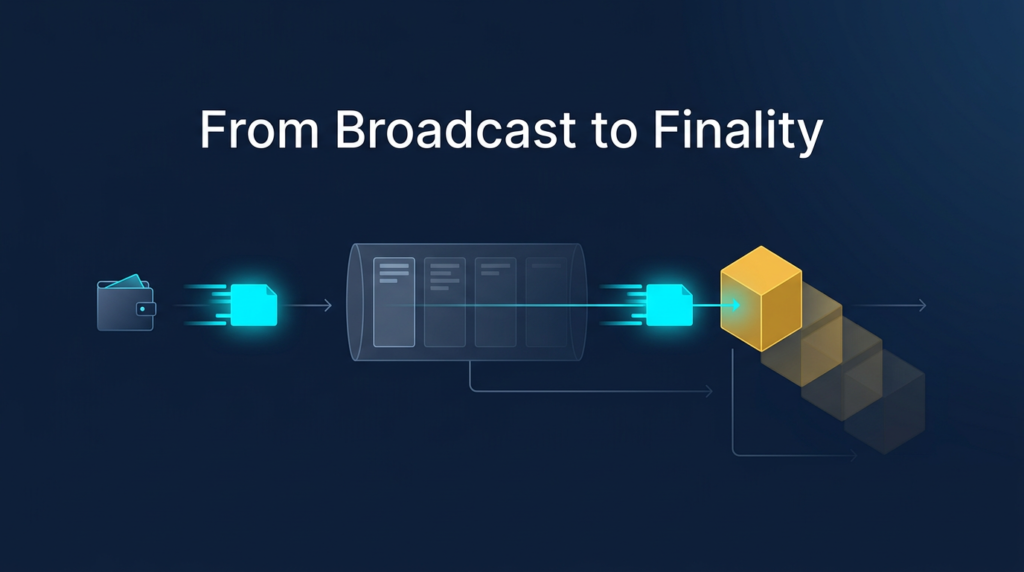
Transaction confirmation in crypto is the process that turns a signed, broadcast payment into a permanent blockchain record. This matters because a transaction that has been broadcast is not yet settled. It sits in a temporary queue, competing for block space, and will not become part of the ledger until a block producer selects it. This article covers the full confirmation lifecycle: from the moment a wallet broadcasts a transaction to the point where enough blocks have accumulated to make reversal economically impractical.
This content is for educational purposes only and should not be considered financial or investment advice.
Broadcast is permission to wait; confirmation requires block producer selection.
Key Takeaways
- A transaction is not confirmed until a block producer includes it in a valid block accepted by the network.
- Confirmation requires competing on fee rate against other pending transactions in the mempool.
- One confirmation means block inclusion; additional confirmations increase settlement assurance by raising the cost of reversal.
- Bitcoin uses probabilistic finality that strengthens with each block. Ethereum achieves deterministic finality after two epochs.
- Stuck transactions result from insufficient fees or network congestion, not random failure.
Transaction Broadcast and Node Validation
When a wallet creates and signs a transaction, the next step is broadcasting it to the peer-to-peer network. The wallet connects to one or more nodes and submits the raw transaction data. Each receiving node performs its own validation before accepting the transaction. On a blockchain network, no central server decides what gets through. Every node independently enforces the same protocol rules, and only transactions that pass all checks enter the local pending pool.
Validation checks differ by chain. On Bitcoin, nodes verify the digital signature, confirm that each referenced input is an unspent transaction output, and ensure the total output value does not exceed the total input minus the implied fee. On Ethereum, nodes verify the signature, check the account nonce for correct sequencing, and confirm the sender has enough balance to cover the gas cost. A transaction that fails any check is rejected immediately and never enters the mempool. For the cryptographic proof behind this step, see What Is Transaction Signing in Crypto.
Once validated, the node stores the transaction in its mempool and relays it to connected peers. Those peers repeat the same validation before accepting and forwarding further. Propagation across the network takes seconds under normal conditions, but it is not instantaneous. A transaction visible on one block explorer may not yet appear on another. This is normal network behavior during propagation, not a sign of failure.
The critical distinction is that broadcast success proves structural validity, not confirmation. A transaction accepted into the mempool has cleared the rules check, but it still must compete for limited block space. Users who see “transaction broadcast successfully” in their wallet should understand that this confirms the transaction entered the queue. It does not mean the transaction reached the blockchain.
Mempool Staging and Fee-Rate Competition
After propagation, the transaction waits in the mempool: the temporary staging area where valid unconfirmed transactions sit until a block producer includes them. The mempool is not a single global queue. Each node maintains its own local version, shaped by its memory limits, relay policies, and the transactions it has received. Two nodes can have slightly different pending sets at any given moment, which is why block explorers sometimes disagree on mempool size or transaction visibility.
Inside the mempool, transactions compete on fee rate. On Bitcoin, fee rate is measured in satoshis per virtual byte (sat/vB). A transaction paying 50 sat/vB will be prioritized over one paying 10 sat/vB regardless of which arrived first. On Ethereum, the EIP-1559 fee model adds a base fee that adjusts with demand and a priority tip that incentivizes validators. The practical result is the same: block space is finite, and transactions offering more compensation per unit of space get selected first.
This competition explains why two transactions sent at the same time can confirm hours apart. The higher-fee transaction enters the next block while the lower-fee one waits for demand to drop. During high-traffic periods, the minimum fee for fast confirmation rises sharply. During quiet periods, even minimal-fee transactions clear quickly. For a detailed look at how this queue operates under pressure, see Bitcoin Mempool Explained.
Transactions do not stay in the mempool indefinitely. Most nodes drop unconfirmed transactions after a timeout period, typically 14 days on Bitcoin Core nodes. A dropped transaction is not lost permanently; the wallet can rebroadcast it or create a replacement with a higher fee. The mempool is designed as a temporary buffer, not a permanent waiting room. Understanding this timeout behavior prevents users from mistaking a dropped transaction for a stolen one.
Block Inclusion and Transaction Confirmation Mechanics
Transaction confirmation in crypto occurs when a block producer selects a transaction from the pending pool and includes it in a newly created block. On proof-of-work chains, the block producer is a miner who has found a valid hash that meets the current difficulty target. On proof-of-stake chains, the block producer is a validator selected through stake-weighted randomness. In both cases, the block containing the transaction is proposed to the network, verified by other nodes, and appended to the chain tip.
This moment is the first confirmation. The block producer has committed economic resources, either energy expenditure or staked capital, to vouch for the block’s validity. Other nodes verify the block independently and build on top of it if it passes all checks. The transaction is now part of the blockchain’s recorded history, but one confirmation alone does not make it irreversible. Settlement assurance grows as subsequent blocks accumulate on top.
The confirmation mechanic is fundamentally an economic commitment rather than a timestamp. In proof-of-work, the miner spent electricity and hardware cycles to produce the block. In proof-of-stake, the validator risked slashing penalties if the block turns out to be dishonest. Both mechanisms make it expensive to produce invalid blocks, which is what gives confirmations their settlement weight. Without that economic penalty structure, a confirmation would be a label without security backing.
Confirmation is also where double-spending is resolved. Before confirmation, a sender could theoretically broadcast two conflicting transactions that spend the same funds. The mempool may contain both briefly, but only one can be included in a block. The block producer resolves the conflict by choosing one, and the competing transaction becomes invalid once that block is accepted. This conflict resolution is the fundamental problem that block-level confirmation solves.
Block production is not continuous. Bitcoin targets one block roughly every ten minutes. Ethereum produces a block every twelve seconds. During the interval between blocks, new transactions accumulate in the mempool, and block producers assemble the next candidate from the highest-paying pending transactions. The pace of block production directly controls how quickly transactions can confirm, which is why Bitcoin confirmations take longer per block than Ethereum confirmations.
Confirmation Depth and Settlement Assurance
Each additional block built on top of a confirmed transaction increases the cost of reversing it. This accumulation is called confirmation depth. One confirmation means the transaction is in the most recent block. Six confirmations on Bitcoin mean five additional blocks have been mined on top. The deeper a transaction is buried, the more computational or economic work an attacker would need to spend to undo it.
Bitcoin’s standard convention for high-value settlements is six confirmations, which takes roughly one hour at ten minutes per block. The logic is probabilistic: after six blocks, the cumulative hash power spent on top of the transaction makes chain reorganization economically impractical. For smaller amounts, many services accept one to three confirmations because the cost of a double-spend attack at that depth already exceeds the value of the transaction being contested.
Ethereum operates on a different finality model after its transition to proof-of-stake. Blocks reach “justified” status after one epoch (roughly 6.4 minutes) and “finalized” status after two epochs (roughly 12.8 minutes). Once a block is finalized, reversing it would require at least one-third of all staked ETH to be slashed. This is deterministic finality rather than probabilistic: the protocol enforces irreversibility through economic penalties, not through accumulated hash work.
Different blockchains define finality differently. Some use probabilistic finality that strengthens with each new block. Others achieve deterministic finality backed by economic penalties after a defined waiting period. The practical result is that confirmation requirements vary by chain, and users transferring assets across multiple networks should understand each chain’s finality model rather than applying one universal confirmation count to all transactions.
The practical takeaway is that confirmation requirements should match the value at risk. A small retail purchase may need only one or two confirmations. A large over-the-counter settlement should wait for deeper finality. Exchanges and payment processors set their own thresholds based on the chain’s security model, the transaction value, and their tolerance for reorganization risk.
When Confirmations Fail or Stall
Transactions stall when the offered fee is too low relative to current network demand. The transaction remains structurally valid but sits unprioritized in the mempool while higher-fee transactions fill available block space. This is the most common reason a payment appears stuck. It is not a protocol failure; it is a market outcome. The fee was insufficient to compete for block inclusion at the time of broadcast.
On Bitcoin, the primary rescue tools are Replace-By-Fee (RBF) and Child Pays For Parent (CPFP). Replace-By-Fee allows the sender to broadcast a new version of the same transaction with a higher fee, replacing the original in the mempool. Child Pays For Parent lets the recipient create a high-fee transaction that spends an unconfirmed output, incentivizing miners to confirm the parent alongside the child. On Ethereum, users submit a new transaction with the same nonce and a higher gas price, which replaces the stuck version in the pending pool.
Transactions also fail before reaching the mempool if they contain invalid signatures, reference already-spent inputs, or violate consensus rules. These are rejected during node validation and never enter the pending pool. The distinction matters: a stuck transaction is valid but underprioritized, while a rejected transaction is structurally broken. Checking the transaction status directly on a block explorer clarifies which scenario applies. For the practical inspection steps, see How to Read a Blockchain Transaction Step by Step.
A less common but important failure mode is chain reorganization. In rare cases, a confirmed transaction can lose its confirmation when the block it was included in gets replaced by a competing chain tip. This is why confirmation depth matters more than a single confirmation. A transaction with one confirmation is still vulnerable to short reorganizations. A transaction with six or more confirmations on Bitcoin is protected by enough accumulated work to make reorganization economically impractical. For the full comparison of how different consensus mechanisms handle this risk, see PoW vs PoS Explained.
Sources
Frequently Asked Questions
How many confirmations does a Bitcoin transaction need?
The standard for high-value settlements is six confirmations, roughly one hour. For smaller transactions, one to three confirmations is common because the cost of a double-spend attack already exceeds the transaction value at that depth. The right number depends on the amount being received and your risk tolerance.
Is one confirmation enough for a transaction to be final?
One confirmation means the transaction is included in a block, but it is not fully settled. A single confirmation is still vulnerable to short chain reorganizations. Most security-conscious services wait for multiple confirmations before treating a payment as irreversible.
Why do different exchanges require different confirmation counts?
Each exchange sets its own threshold based on the blockchain’s security model, the deposit amount, and its tolerance for reorganization risk. A chain with faster block times or deterministic finality may require fewer confirmations than a chain with slower blocks and probabilistic finality.
Can a confirmed transaction be reversed?
Reversing a confirmed transaction requires reorganizing the blockchain past the block that included it. With one confirmation, this is difficult but theoretically possible. With six or more confirmations on Bitcoin, the energy cost of reorganization far exceeds any practical attack incentive.
What should I do if my transaction stays unconfirmed?
Check the fee rate your transaction paid and compare it with current network demand. If the fee is too low, use Replace-By-Fee to rebroadcast with a higher fee. If your wallet does not support Replace-By-Fee, Child Pays For Parent may work if the receiving wallet can spend the unconfirmed output. If neither option is available, the transaction will eventually be dropped from the mempool and can be rebroadcast.