

A non-custodial wallet is a wallet where you control the private keys or recovery material needed to authorize transactions. No exchange, broker, or app operator has to approve movement on your behalf. That is the core idea: the user, not a third party, controls the signing authority.
A simple mental model helps: a custodial account is like asking a platform to release funds for you, while a non-custodial setup is like holding the only key to your own safe. The gain is direct control. The cost is direct responsibility.
This content is for educational purposes only and should not be considered financial or investment advice.
Key Takeaways
- You control the keys: No third party needs to cooperate for you to sign and broadcast a transaction.
- The wallet is user-controlled, not platform-controlled: The trust model changes from account permission to direct signing authority.
- Control brings responsibility: Backups, recovery, device security, and signing discipline become your job.
- Non-custodial does not mean risk-free: It removes custodian dependence but does not remove phishing, malware, approval, or user-error risk.
- It is a custody model, not just a product label: The important question is who can move the assets, not which interface looks nicer.
What Makes a Wallet Non-Custodial
A wallet is non-custodial when the private keys or recovery phrase stay under the user’s control and the wallet can sign transactions directly without asking a platform to release funds. In practical terms, the user holds the credentials that matter most.
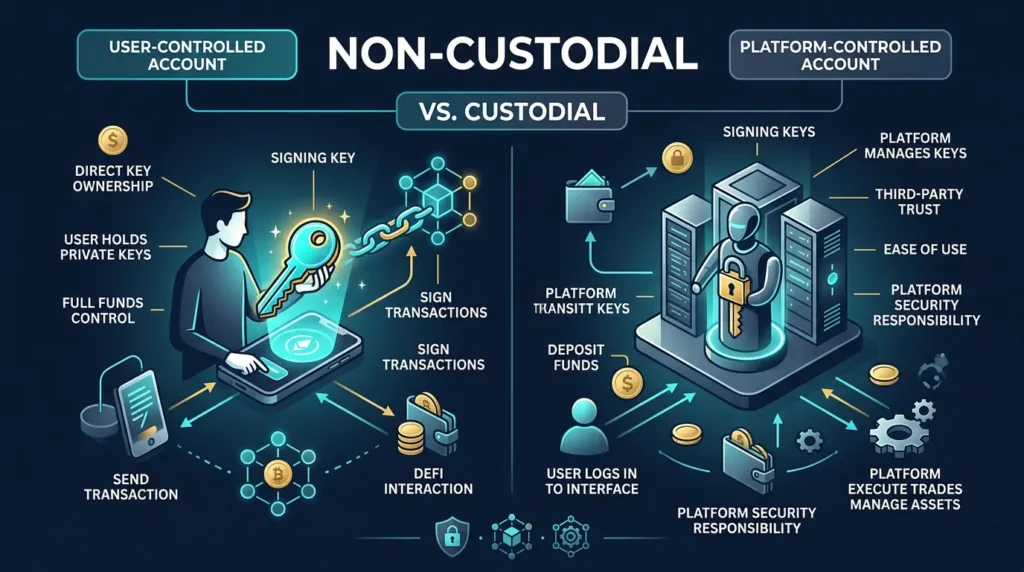
This is why a dashboard balance and a non-custodial wallet are not the same thing. An exchange account may show assets on screen, but if the platform controls withdrawal approval and the underlying keys, the setup is custodial even if it feels like a wallet from the user’s point of view.
How It Works in Practice
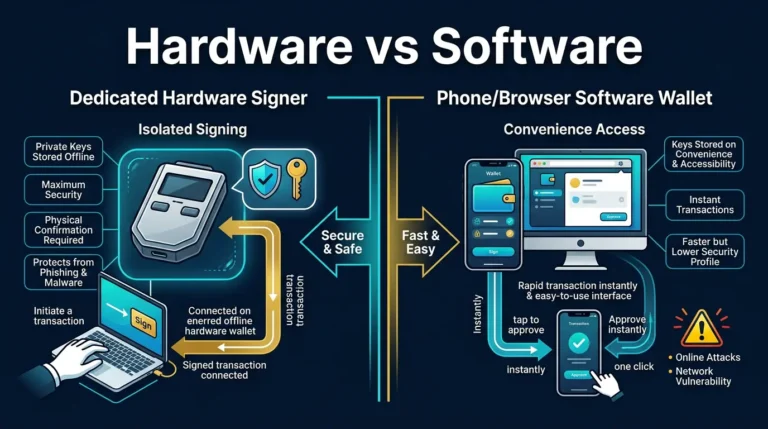
A user-controlled wallet typically generates or imports a seed phrase, derives keys and addresses from it, and uses those keys to sign transactions locally or on a dedicated signing device. When the user approves a transfer, the signature comes from the user’s wallet environment, not from a company’s internal system.
Real-world example: if you use a mobile wallet or hardware wallet that gives you the recovery phrase and lets you restore the wallet independently, you are generally in a non-custodial model. If you log in with email and password and the company can reset access or decide when withdrawals are processed, you are generally not.
How It Differs From a Custodial Wallet
The clearest difference is who has final transaction authority. In a custodial setup, the platform controls the key infrastructure and processes movement for users. In a non-custodial setup, the user signs directly. That changes recovery, failure modes, and what kind of trust the system requires.
Why Key Control Matters So Much
In crypto, the key is not just a login secret. It is the thing that authorizes movement on-chain. That is why key control matters more than brand names, app design, or convenience features. If another party controls the signing path, they also control whether movement can happen, when it can happen, and under what conditions.
Operator insight: beginners often think the important question is “Where do I see the balance?” The deeper question is “Who can actually sign?” Once that clicks, the difference between exchange balances and self-custody becomes much easier to understand.
What You Gain With Direct Control
- Direct transaction authority: You do not need a custodian to approve withdrawals.
- Less platform dependence: Exchange freezes, account policy shifts, or custodian insolvency matter less to funds already under your control.
- Clearer sovereignty: The signing path is yours rather than being mediated by a company account system.
That does not automatically make it easier. It makes it more direct. Whether that is better depends on whether the user can manage the responsibility well.
What You Take On Yourself
- Backup responsibility: If the recovery phrase is lost or exposed, there may be no support desk to fix it for you.
- Signing responsibility: Sending to the wrong address or approving a malicious spender can cause irreversible loss.
- Device and process responsibility: The safety of the wallet depends on how you manage devices, browser habits, and verification steps.
Real-world scenario: a user leaves a strong exchange because they want more control, but stores the seed phrase in cloud notes and signs blindly on risky dapps. The user gained sovereignty on paper, but the new setup may still be weak in practice because the operating discipline never improved.
Common Types of Non-Custodial Wallets
- Mobile wallets: Convenient for smaller balances and active use.
- Browser extension wallets: Common for Web3 interaction but exposed to more signing risk if used carelessly.
- Desktop wallets: Useful in some workflows, though the device environment matters greatly.
- Hardware wallets: Often better suited to higher-value storage because signing can happen on a more isolated device.
What a Non-Custodial Wallet Does Not Guarantee
It does not guarantee perfect safety. It does not protect against every drainer, phishing site, or malware infection. It does not make bad backup habits safe. And it does not eliminate human error. It only changes who controls the keys and who bears the operational burden.
This matters because some users hear “non-custodial” and assume it means “most secure” in every situation. That is too simplistic. The model reduces custodian dependence, but the actual outcome still depends on the quality of the user’s security habits.
Why Beginners Misunderstand the Term
Some beginners assume any wallet app is automatically non-custodial. Others assume a non-custodial setup is always advanced and difficult. Both views are incomplete. The defining feature is not the app category or the user’s experience level. It is whether the user controls the signing credentials and recovery path.
Another common mistake is treating “I have the app installed” as equivalent to “I control the wallet.” If the wallet can be reset entirely by a company account flow, or if the provider controls the real signing path, the custody model may not be what the user thinks it is.
Practical Usage: How to Identify One
- Ask who can sign: If only you can authorize the transaction with your keys or recovery path, it is likely non-custodial.
- Ask who controls recovery: If a company can fully restore access for you without your own recovery material, the setup may be custodial.
- Ask whether withdrawals depend on a platform workflow: If movement requires platform approval, you are probably not in a user-controlled model.
- Ask where the critical secret lives: The seed phrase, private key, or signer should be under your control, not just under your login.
A practical shortcut is this: if you can lose access through your own backup failure, you probably control the wallet. If a company can both restore and restrict movement for you, you probably do not.
Risks and Common Mistakes
- Confusing app access with key control: A user may see balances in an app and assume the wallet is non-custodial even when actual movement still depends on a platform-controlled system.
- Moving to self-custody without backup discipline: Direct control is valuable only if the recovery phrase is stored and tested responsibly.
- Assuming control means safety automatically: A user-controlled wallet still fails if device hygiene, signing review, and phishing resistance are weak.
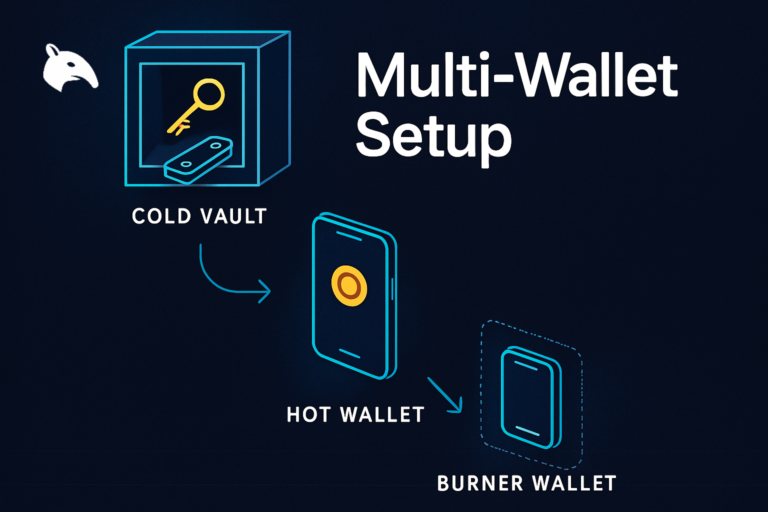
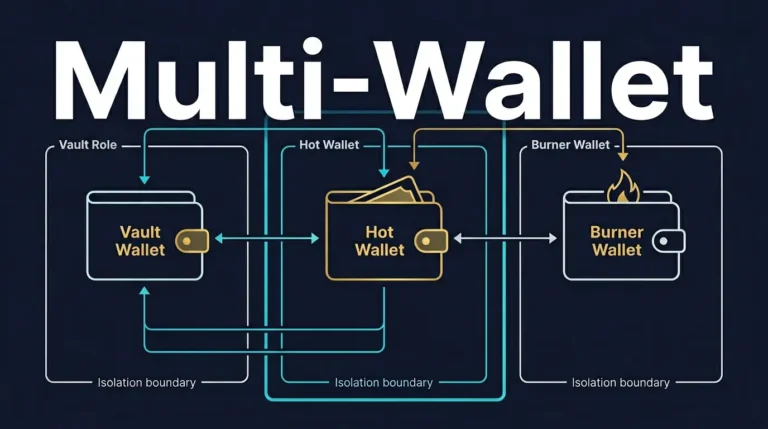
- Using one wallet for every purpose: Non-custodial control does not remove the need for role-based separation between storage, routine use, and risky experiments.
Sources
Frequently Asked Questions
What is a non-custodial wallet?
It is a wallet where the user controls the keys or recovery material needed to authorize transactions directly.
What is the difference between custodial and non-custodial?
Custodial means another party controls the signing path or key infrastructure. Non-custodial means the user controls those critical credentials directly.
Is a hardware wallet non-custodial?
Usually yes, if you control the recovery material and the device signs under your control rather than under a third-party platform account.
Can a non-custodial wallet still be unsafe?
Yes. Poor backups, phishing, malware, malicious approvals, and weak device hygiene can still cause loss even when the wallet is user-controlled.
Why would someone choose a non-custodial wallet?
People choose it for direct control, reduced custodian dependence, and the ability to authorize transactions without asking a platform to release funds.