

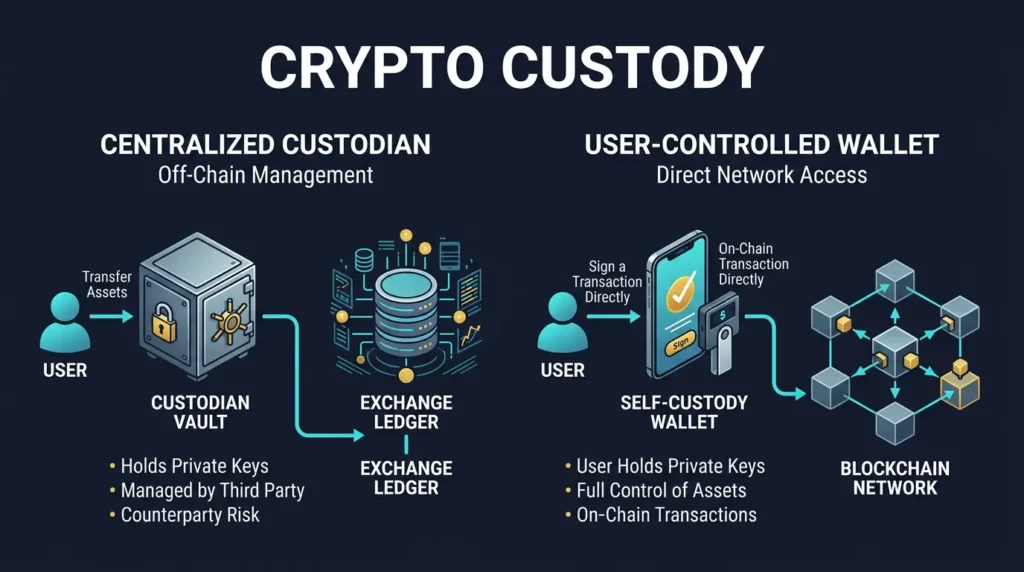
Custody in crypto is the arrangement that determines who controls the private keys needed to authorize transactions and move digital assets on-chain. That is the core idea. If another party holds the keys for you, the assets are under custodial control. If you hold the keys yourself, you are using a non-custodial or self-custody model. In crypto, the issue is ultimately control over signing authority, not just where you view a balance on a screen or who can process a withdrawal for you.
A simple mental model helps: think of this as the difference between holding valuables in your own safe and holding a claim on valuables stored in someone else’s vault. In both cases the value may still be yours economically, but the operational control is different. In crypto, that control difference matters because the party with the keys can approve transactions.
This content is for educational purposes only and should not be considered financial or investment advice.
Key Takeaways
- This topic is really about key control: The main question is who holds the private keys that can authorize transactions.
- Custodial access is not the same as self-custody: An exchange balance may give you account access without giving you direct control of the keys.
- Custodians hold assets on behalf of users: Exchanges and specialized custodians often use internal ledger systems and managed wallet infrastructure.
- Non-custodial storage shifts responsibility to the user: You gain direct control, but you also take on backup, recovery, and signing risk.
- Custody is a control model, not just a wallet label: The same asset can move between custodial and self-custody environments at different times.
What the Term Actually Means
Crypto custody is the control model behind a balance. If you can sign the transaction yourself, you have custody. If a company holds the keys and must approve the movement, the company has custody even if the assets appear in your account.
This concept refers to who controls the credentials required to move assets. In most blockchain systems, that means control over private keys or the signing system tied to those keys. If you can directly approve the transaction yourself, you have custody. If a company, institution, or platform must approve the transaction on your behalf, then the arrangement is custodial.
This is why custody in crypto is more precise than the everyday idea of “where my coins are stored.” The assets exist on a blockchain, but the ability to move them depends on who controls the signing authority. A user interface may show a balance either way. The deeper question is who can actually authorize movement.
Custodial vs Non-Custodial
The easiest way to understand the concept is to compare these two models directly:
| Model | Who controls the keys | What the user controls | Main trade-off |
|---|---|---|---|
| Custodial | An exchange, platform, or institutional custodian | Account access and withdrawal requests | Convenience and recovery support in exchange for less direct control |
| Non-custodial | The user | Direct transaction approval and key management | More control in exchange for more responsibility |
In a custodial setup, you often log in with an email, password, and identity checks. In a non-custodial setup, the wallet itself controls the signing credentials and the user is responsible for protecting recovery information. The balance may look similar on screen, but the underlying trust model is completely different.
Why Exchanges Are Usually Custodial
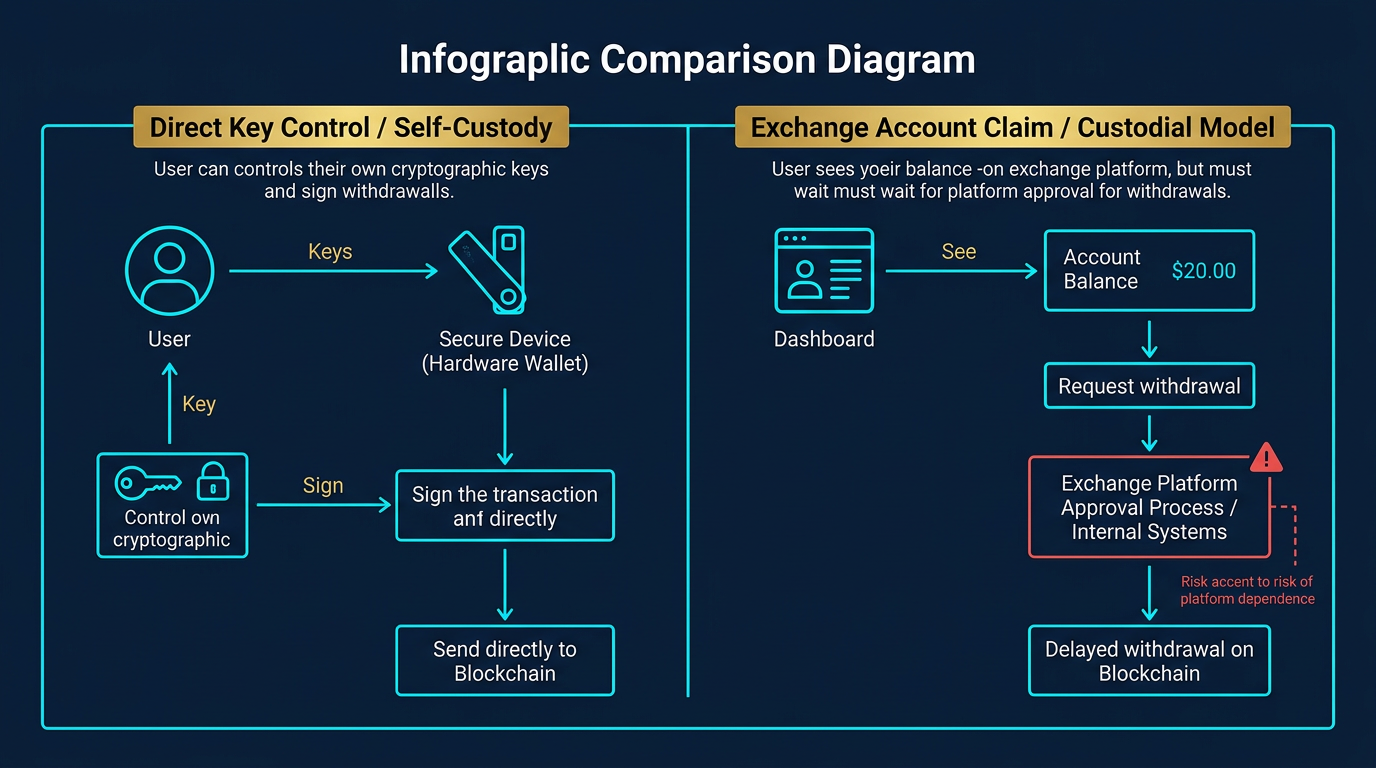
Most centralized exchanges are custodial because the platform holds the wallet infrastructure and the private keys behind it. Your account balance is usually an internal ledger entry showing what the platform owes you, not a wallet whose keys you directly control. That is why exchange access can feel immediate while withdrawal ability still depends on the platform’s systems, policies, and operational status.
This does not mean custodial platforms are automatically bad. They are useful for trading, conversion, and fiat access. It does mean that the user’s relationship to the assets is mediated by the platform. For the adjacent practical angle, see How Much Crypto Should You Keep on an Exchange? and Crypto Exchange Collapse.
What Self-Custody Means
Self-custody means the user controls the keys or recovery material needed to authorize transactions without relying on a third party to release funds. That changes the trust model from “the platform will process my request” to “I can authorize this transaction directly.” It also changes the risk model, because the user must now protect devices, backups, addresses, and signing decisions personally.
Why Key Control Matters So Much
In crypto, keys are not just login credentials. They are the mechanism that authorizes movement on-chain. That is why custody matters more than the app interface or the brand name of the service. Two users may each see “1 BTC” on a screen, but one user may control the signing path directly while the other only controls an account request inside a company system.
Operator insight: many beginners think custody is about storage location, but it is really about who has the power to approve movement. Once that clicks, the difference between exchange balances, hot wallets, and deeper self-custody setups becomes much easier to understand.
How Custody Connects to Compliance and Regulation
Custody matters in regulation because holding assets for users creates legal, operational, and compliance obligations. A platform that custody-holds client assets may face rules around identity checks, internal controls, segregation, reporting, security procedures, and operational oversight. That is one reason “custodian” is not just a casual label. In many contexts it implies a formal service role with governance and control expectations attached.
At a user level, the practical takeaway is simpler: custody changes who you trust, who can block or enable withdrawals, and who carries operational responsibility when something goes wrong.
Common Custody Models
- Centralized exchange account: Usually custodial. The platform holds the key infrastructure and processes withdrawals for users.
- Institutional custodian: Usually custodial. A specialized service manages keys, governance, and asset handling on behalf of clients.
- Software wallet under your control: Usually non-custodial. You control the recovery material and sign transactions yourself.
- Hardware wallet under your control: Usually non-custodial. The user controls the keys while signing happens on a dedicated device.
These examples are useful because they show that custody is not really about whether something is online or offline. It is about who controls the signing authority and the recovery path.
What the Term Does Not Mean
This term does not automatically tell you whether a setup is good or bad, safe or unsafe, or right or wrong for every user. It is a classification of control. A custodial setup may be appropriate for trading access or institutional operations. A non-custodial setup may be appropriate for users who are ready to manage recovery and signing risk directly. The point is to clarify the trust model first.
The more practical comparison and trade-off layer belongs in a separate article. This definition page is meant to make the vocabulary clear before those debates begin.
Practical Usage: How to Identify the Custody Model
- Ask who can authorize the transaction: If you must request withdrawal from a platform, the setup is usually custodial.
- Ask who controls recovery: If the service can reset or restore access for you, that often signals custodial account design.
- Ask whether the balance is an internal claim or direct key control: Exchange dashboards usually show claims on platform-managed assets, not direct self-custody.
- Ask where signing happens: Direct wallet confirmation usually points toward non-custodial control.
A practical rule is this: if another party must cooperate for funds to move, you are probably in a custodial model. If you can directly sign the transaction yourself, you are probably in a non-custodial one.
Risks and Common Mistakes
- Confusing account access with asset control: Seeing a balance in an app does not necessarily mean you control the keys behind it.
- Treating “wallet” as one single category: A custodial account, a hot wallet, and a hardware wallet do not offer the same control model.
- Assuming self-custody removes all risk: It removes custodian dependence but introduces backup, recovery, and signing responsibility.
- Ignoring the trust model: Users often compare features before first identifying who actually controls movement of the assets.
Sources
Frequently Asked Questions
What does custody mean in crypto?
It is the arrangement that determines who controls the private keys or signing system needed to move digital assets.
What is the difference between custodial and non-custodial?
Custodial means another party holds the key infrastructure and processes asset movement for you. Non-custodial means you control the keys or recovery material yourself.
Is an exchange account a custodial arrangement?
Yes, in most cases. Centralized exchanges usually hold the keys and maintain internal ledgers for user balances, which makes the arrangement custodial.
Does self-custody mean the same thing as the broader custody concept?
Self-custody is one type of custody arrangement. It refers specifically to the user controlling the keys instead of a third-party custodian.
Why does key control matter in crypto?
Because the party that controls the keys or signing authority controls the ability to authorize transactions and move assets on-chain.