

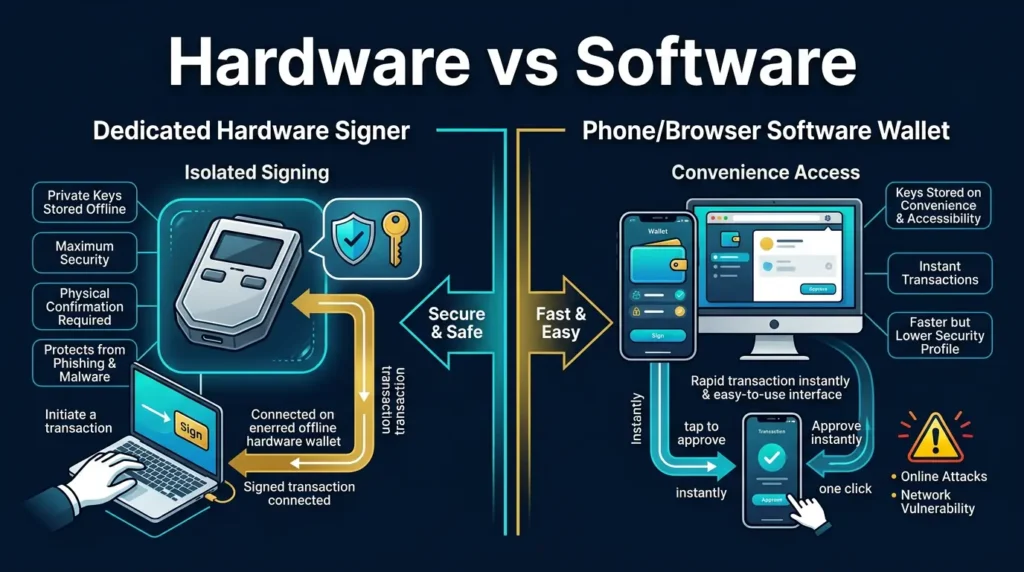
The core difference between a hardware wallet and a software wallet is where the signing keys live and how exposed that signing environment is. A software wallet keeps keys on a general-purpose phone, browser, or computer. A hardware wallet moves signing into a dedicated device built to isolate those keys from everyday internet activity. The decision is not about which one is “good” and which one is “bad.” It is about matching the wallet type to the amount at risk, the frequency of use, and the kind of attacks you actually care about.
A practical mental model helps: a software wallet is the easier daily-use tool, while a hardware wallet is the stronger vault-style signer. The more often funds need to move, the more convenience matters. The more painful compromise would be, the more isolation matters.
This content is for educational purposes only and should not be considered financial or investment advice.
Quick Answer
If the balance is small, active, or experimental, a reputable software wallet is often enough. If the balance is meaningful, long-term, or important enough that one device compromise would be painful, a hardware wallet is usually the better default. Many users should not choose one or the other for everything. They should use both for different roles.
Key Takeaways
- Hardware wallets isolate signing better: They reduce direct key exposure to malware and browser risk on everyday devices.
- Software wallets win on convenience: They are faster for routine transfers, active Web3 use, and smaller working balances.
- The right choice depends on the job: Long-term savings and daily activity usually should not share the same wallet model.
- Neither option is risk-free: Hardware wallets do not fix careless signing, and software wallets are not automatically reckless if the balance is sized appropriately.
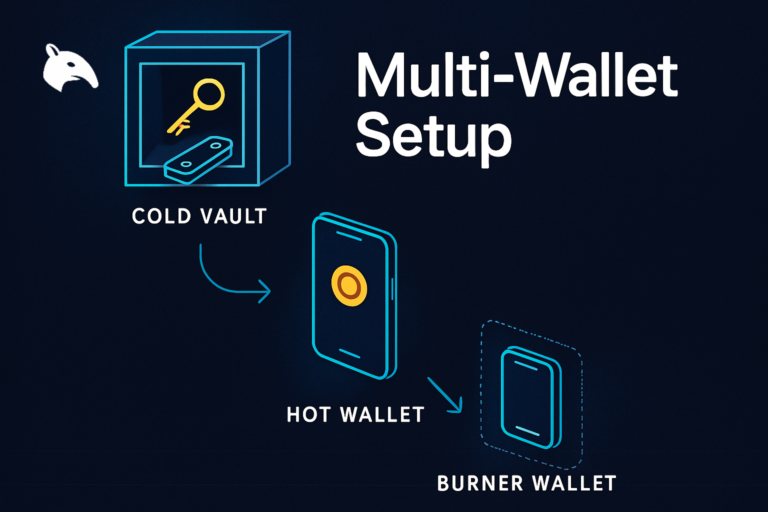
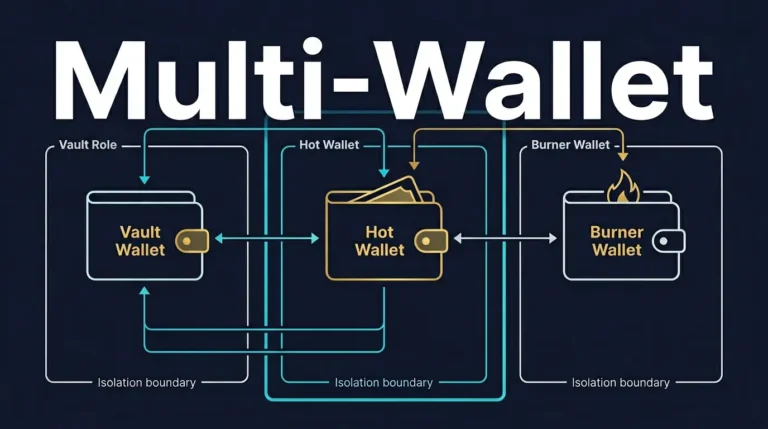
- Many users need both: A strong setup often uses a hardware wallet for reserve storage and a software wallet for operational use.
The Core Security Difference
The main difference is where the private keys and the final signing step live. In a software wallet, both exist inside a device that also handles browsing, messages, extensions, downloads, and many other internet-connected activities. In a hardware wallet, the signing process happens on a more dedicated device designed to reduce exposure to that wider environment.
This matters because most real-world wallet loss does not come from blockchain failure. It comes from the host environment: phishing, malware, browser compromise, sloppy backups, or bad signing decisions. The wallet type changes how much of that environment can touch the signing path directly.
Software Wallets: Where They Win
A software wallet usually wins on speed and convenience. It is easier to install, easier to use for regular sending and receiving, and often better suited to daily interaction with DeFi, NFTs, and on-chain tools. For smaller balances and active workflows, that convenience can be the right trade-off.
Real-world example: a user who needs a wallet for routine transfers, testing dapps, or holding only a modest working balance often benefits more from a reputable software wallet than from adding hardware friction too early. The problem starts when the balance grows but the wallet model does not change with it.
Software Wallets: Where They Break Down
Software wallets live inside more exposed environments, so they inherit more of the device’s attack surface. Malware, unsafe extensions, fake wallet prompts, clipboard hijacking, browser compromise, and general poor device hygiene all matter more when the keys or approvals live in that same environment.
Operator insight: software wallets often become unsafe not because the wallet app itself is weak, but because users quietly upgrade the balance without upgrading the security model around it. A hot wallet that started as a small convenience tool can become an unintended vault through neglect.
Hardware Wallets: Where They Win
A hardware wallet usually wins when key isolation matters more than speed. The strongest benefit is that transaction approval happens on a separate device path instead of relying entirely on the computer or phone that also handles daily internet use. That narrower trust boundary is why many users move meaningful long-term holdings into hardware-backed storage.
The clean local definition page is What Is a Hardware Wallet?. This article stays focused on the comparison and decision layer.
Hardware Wallets: Where They Break Down
Hardware wallets are not magic shields. They do not prevent every phishing attack, every bad approval, or every weak backup habit. If the recovery phrase is exposed, the device itself may not matter much anymore. If the user approves the wrong transaction without careful review, the stronger signing device still cannot fully save the decision.
Real-world scenario: a user buys a hardware wallet for safety but stores the seed phrase digitally, rushes through setup, and signs without checking the device screen closely. The user has improved the tool but not the process. That is why hardware wallets are strongest when the surrounding routine is also disciplined.
Hot Wallet vs Cold Wallet Is Related, But Not Identical
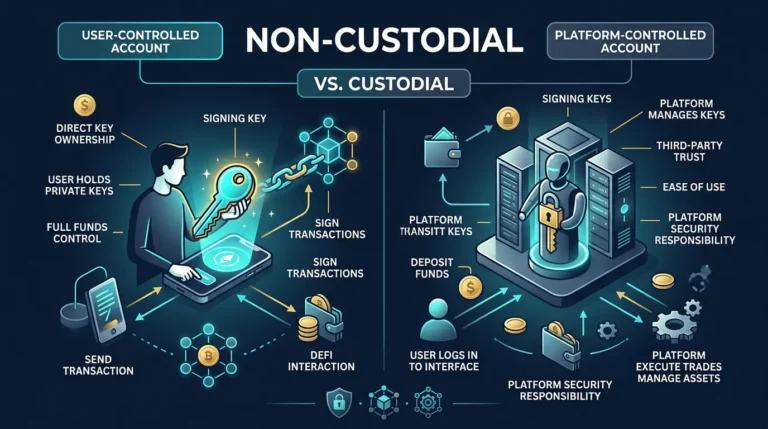
People often mix up “hardware vs software” with “hot vs cold.” They overlap, but they are not exactly the same question. Many software wallets are hot wallets because they live on internet-connected devices. Many hardware wallets are used in colder storage workflows. But the cleaner comparison here is about where the signing secret lives and how exposed that signer is during normal use.
That is why this article is distinct from a generic hot-vs-cold explainer. The practical decision here is which signer fits which balance and workflow.
Which One Fits Which Job?
- Small daily-use balance: Usually fits a software wallet better.
- Active Web3 experimentation: Usually fits a smaller software wallet or burner wallet better.
- Meaningful long-term holdings: Usually fit a hardware wallet better.
- Hybrid setup: Often means hardware for reserves and software for active use.
If you are still deciding wallet roles more broadly, the best local next step is How to Choose a Crypto Wallet. If you want the storage framework for where different balances belong, use How to Store Crypto Safely.
When a Hardware Wallet Is Worth It
A hardware wallet becomes worth the friction when the balance is large enough, the holding period is long enough, or the downside of one host-device compromise is serious enough that more isolated signing is justified. It is not about achieving theoretical perfection. It is about deciding that direct key isolation now matters more than daily convenience.
If that moment has already arrived for you, the most relevant product-level follow-up is Best Crypto Hardware Wallet, because the next question becomes which device and setup model fit your needs.
When Software Is Enough
Software is enough when the balance is intentionally limited, the role is active, and the user accepts that convenience is the main priority for that bucket. A small mobile wallet, browser wallet, or desktop wallet can be perfectly rational if it is treated like a working balance rather than like a vault.
Real-world example: a user keeping only a modest amount for spending or for a specific dapp workflow may not gain much from moving that exact balance into a hardware wallet. The key is that the balance must stay modest and the role must remain operational rather than quietly becoming long-term storage.
Practical Usage: A Simple Default Rule
- Use software for speed: Smaller balances, regular transfers, and active workflows fit here.
- Use hardware for isolation: Larger balances and long-term storage fit here.
- Promote funds when their job changes: A balance that no longer needs daily access should be reconsidered, not left in the same wallet by inertia.
- Keep the hybrid model in mind: Many users do best with both, not one universal winner.
- Match the wallet to the failure you most want to avoid: Host-device compromise, platform risk, and backup failure are different problems.
A practical shortcut is this: software wallets are usually for money in motion, while hardware wallets are usually for money at rest.
Risks and Common Mistakes
- Keeping too much in the convenient wallet: A software wallet that began as a small operational balance can quietly become a high-value target if funds are never moved out after the job changes.
- Assuming hardware fixes every mistake: A stronger device does not erase phishing, bad approvals, weak seed storage, or rushed transaction review.
- Choosing by ideology instead of use case: Some users force hardware for everything or software for everything when the safer answer is often a role-based combination of both.
- Ignoring setup quality: A poorly sourced or poorly configured hardware wallet, or a messy high-risk software-wallet environment, can both undermine the intended security model.
Sources
Frequently Asked Questions
Is a hardware wallet safer than a software wallet?
Usually yes for larger or longer-term balances, because it gives the signing keys a more isolated environment. But the safer choice still depends on how the wallet is set up and used.
When is a software wallet enough?
A software wallet is often enough for smaller balances, routine transfers, and active on-chain use, as long as the balance remains intentionally limited.
Do I need both a hardware and software wallet?
Many users benefit from both. A common setup uses software for daily activity and hardware for long-term or higher-value storage.
Does a hardware wallet stop phishing?
No. It can improve key isolation, but it does not stop phishing, bad approvals, or careless transaction review if the user still authorizes the wrong action.
What is the biggest mistake in this comparison?
The biggest mistake is using convenience as a permanent excuse to keep serious long-term value in a wallet model that was only meant for active spending or experimentation.