

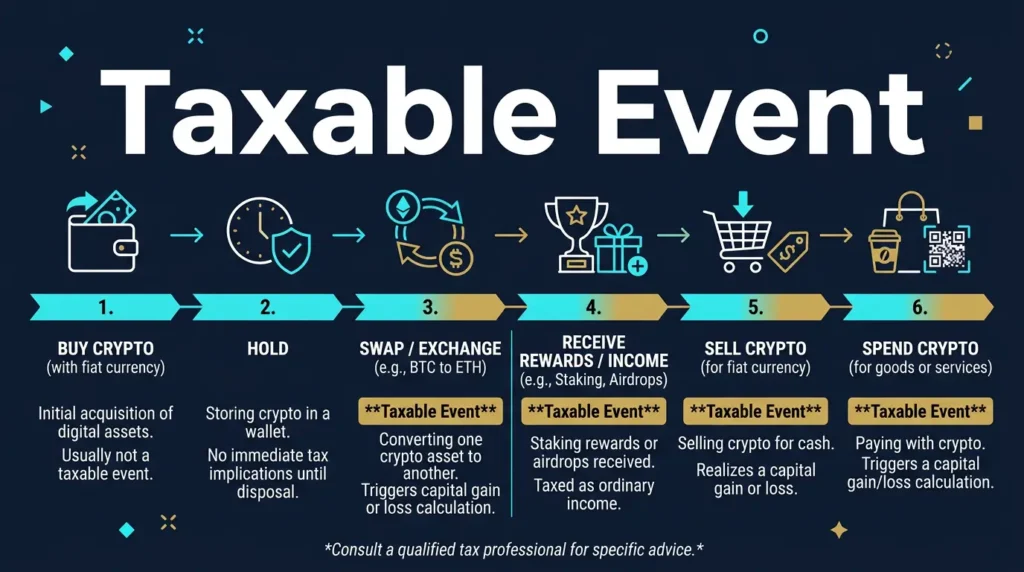
A crypto taxable event is an action that can trigger tax reporting because it creates a recognized gain, loss, or income event under the tax rules of a given jurisdiction. In practice, the most common triggers are selling crypto for fiat, swapping one cryptoasset for another, spending crypto, or receiving certain types of crypto income. The exact treatment depends on where you file taxes, but the core idea is simple: once you dispose of an asset or receive taxable income from it, the tax system may treat that as reportable.
For a closely related follow-up, see Wallet Address Reuse Risks: What It Exposes On-Chain.
If you want the foundational definition behind this concept, read Liquidity Pool Risks Explained: What LPs Need to Watch.
A useful mental model is to think of taxable events as “tax moments.” Buying and holding an asset usually does not create one by itself. Converting, spending, gifting, or earning value often does. The practical challenge is that crypto creates many more of these moments than users expect, especially once they move beyond simple buying and holding.
This content is for educational purposes only and should not be considered financial or investment advice.
Key Takeaways
- Taxable events usually happen when value is disposed of or received: Selling, swapping, spending, or earning crypto often creates a reporting obligation.
- Buying and holding are often not taxable by themselves: The tax event usually comes later when you dispose of or receive value.
- Crypto-to-crypto swaps are commonly taxable: Many users wrongly assume only fiat sales count.
- Transfers between your own wallets are often not taxable: But poor records can still create accounting problems later.
- DeFi, staking, and rewards can complicate the picture: Income treatment and cost-basis tracking often become harder once on-chain activity expands.
What Usually Counts as a Taxable Event
Across many common tax jurisdictions, the most widely recognized taxable events are straightforward disposals or receipts of value. While the terminology and calculation rules differ, these actions are often where tax reporting starts:
- Selling crypto for fiat: If you bought BTC at one price and later sold it for cash at a higher or lower price, the gain or loss is commonly reportable.
- Swapping one cryptoasset for another: Exchanging ETH for SOL or BTC for USDC is often treated as a disposal of the asset you gave up.
- Spending crypto on goods or services: Paying with crypto can be treated like disposing of property at its market value on the day of spending.
- Receiving staking rewards, airdrops, or other income-like distributions: These may be treated as taxable income when received, depending on the rules involved.
- Some gifts, DeFi transactions, or lending arrangements: These can become taxable when beneficial ownership changes or when income is recognized.
One operator insight is that crypto users often focus only on “selling for dollars” and miss that many tax authorities treat crypto as property-like value. If that is the model, then exchanging, spending, or disposing can all matter even when no bank account was involved.
What Is Often Not Taxable by Itself
Some actions are often non-taxable by themselves in common frameworks, although recordkeeping still matters:
- Buying crypto with fiat: The purchase usually establishes cost basis rather than creating a gain or loss immediately.
- Holding crypto: Price changes while you continue holding generally do not create a realized taxable event on their own.
- Transferring assets between your own wallets: Moving BTC from an exchange account to your hardware wallet is often not taxable if ownership stays with you.
The practical problem is that “not taxable” does not mean “not important.” If you do not track these actions carefully, later cost-basis calculations can become messy and the tax event that eventually does happen becomes harder to report accurately.
Why Swapping Crypto Often Surprises People
Many users intuitively think of a crypto-to-crypto swap as staying “inside crypto,” so they assume no tax event occurred. But in many jurisdictions, swapping ETH for SOL is treated as disposing of ETH and acquiring SOL at a new basis. That means the ETH side may create a gain or loss even though you never touched fiat.
A second mental model helps here: the tax system often cares about what you gave up, not only what you converted into. If you gave up one asset and acquired another, that exchange may be enough to trigger reporting.
Why Spending Crypto Can Also Trigger Tax
When you use crypto to buy something, the tax system in many places treats it like you sold the crypto at its market value and then used the proceeds to pay the merchant. That means the difference between your cost basis and the asset’s market value at the time of spending may create a gain or loss.
For a deeper dive into this specific angle, read The CLARITY Act.
Example: if you bought ETH at a lower price and later use it to buy a laptop after the price has risen, the spending action can create the same tax-style reporting consequence as a sale would. Users often miss this because the purchase feels like a payment event, not a disposal event.
How Staking, Rewards, and DeFi Complicate Things
Once users move beyond simple spot transactions, tax complexity tends to rise quickly. Staking rewards, yield-farming receipts, lending income, airdrops, rebases, LP tokens, and cross-chain activity can create multiple reporting questions: was income recognized, was ownership disposed of, what is the new cost basis, and when exactly did the event occur?
One operator insight is that the tax difficulty often comes less from the headline strategy than from the record trail it leaves behind. A user may understand the investment idea but still fail to capture timestamps, fair-market values, fees, and wallet-to-wallet movement needed to reconstruct what happened later.
For the adjacent strategy background, the closest local references are What Is Yield Farming in Crypto and Yield Farming vs Staking.
Why Cost Basis and Records Matter So Much
Most taxable-event calculations depend on knowing what you originally paid, what you later received, when the event happened, and what fees were involved. If those records are incomplete, the tax event itself may be obvious but the calculation becomes unreliable. This is why users who trade across many wallets and chains often struggle even when they know the general rules.
That is also why many crypto users end up using dedicated tracking and reporting tools. The practical money-page follow-up for that workflow is Best Crypto Tax Software 2026. For a direct comparison of the two leading platforms, see CoinLedger vs Koinly 2026.
Common Patterns Across Major Jurisdictions
While rules vary, several broad patterns show up repeatedly in guidance from major tax authorities:
- Sale for cash is usually taxable
- Crypto-to-crypto exchanges are often taxable
- Spending crypto often counts as disposal
- Transfers between your own wallets are often not taxable by themselves
- Rewards and some DeFi receipts may be treated as income when received
The exact labels, reporting thresholds, and calculation methods vary. That is why this article stays at the “common trigger map” level rather than pretending one country’s rules fit every reader exactly.
Practical Usage: How to Judge Whether an Action Might Be Taxable
- Ask whether you disposed of an asset: Selling, swapping, or spending often means yes.
- Ask whether you received value as income: Rewards, distributions, and some airdrops may count here.
- Ask whether ownership really changed: Moving funds between your own wallets is often different from giving them to another party or protocol.
- Ask whether the event creates a new basis record: Many complex DeFi actions do.
- Ask whether you can reconstruct the transaction later: If not, fix the recordkeeping before activity expands further.
A practical frame is to stop asking only “Did I cash out?” and start asking “Did I dispose of value, receive income, or create a new ownership or basis event?” That question is usually much closer to how crypto tax rules are actually triggered.
Risks and Common Mistakes
- Thinking only fiat sales matter: Crypto-to-crypto swaps and spending often trigger reporting too.
- Ignoring wallet transfers in records: Even if not taxable, they still matter for basis tracking and auditability.
- Treating DeFi activity like one simple event: Farming, staking, LP positions, and bridges can create multiple tax-relevant moments.
- Waiting until year-end to reconstruct everything: By then, timestamps, fees, and wallet flows may be much harder to rebuild accurately.
- Assuming all countries treat crypto identically: Common patterns exist, but local rules and personal facts still decide the final answer.
Sources
- IRS: Frequently Asked Questions on Virtual Currency Transactions
- GOV.UK: Check if you need to pay tax when you sell cryptoassets
- ATO: Crypto to crypto exchange or swap
Frequently Asked Questions
What counts as a taxable event for crypto?
It is an action that can trigger tax reporting because it creates a recognized gain, loss, or income event under the rules that apply to you.
Is swapping one coin for another taxable?
In many common tax jurisdictions, yes. A swap is often treated as disposing of one asset and acquiring another at a new basis.
Is moving crypto between my own wallets taxable?
Often not by itself, as long as ownership has not changed. But those transfers still matter for accurate cost-basis and transaction records.
Does spending crypto count as a taxable event?
In many places, yes. Spending crypto can be treated like disposing of it at its market value at the time of payment.
Are staking and DeFi rewards taxable?
They often can be, but the exact treatment varies by jurisdiction and by the type of reward. This is one of the areas where country-specific advice matters most.