

Last Updated on March 20, 2026 by Snout0x
Is Ledger Nano X safe in 2026?
The question hits differently now, after Ledger Recover quietly rewired what “non-custodial” means, and the January 2026 Global-e breach put customer privacy back in the spotlight.
This article is for educational purposes only and does not constitute financial or security advice. Hardware wallet choice depends on your threat model, portfolio size, and operational habits.
For years, the Ledger Nano X was the default hardware wallet — strong brand recognition, a polished mobile app, and support for thousands of assets.
But 2026 changed the calculus.
Ledger Recover introduced firmware-level seed export capability. The Global-e breach proved Ledger’s commerce infrastructure is not immune to attack. And hardware wallet standards have evolved.
The question is no longer “Does it work?”
It’s: does it still match your threat model?
If you are new to hardware wallets, start with Best Crypto Wallets for Beginners (2026) to understand the broader landscape first.
5 Key Takeaways
- Ledger Recover confirms firmware-level seed export is technically possible, even if optional.
- The January 2026 Global-e breach exposed customer order data — not private keys.
- The Nano X’s 128×64 OLED screen is functional but dated for complex DeFi signing.
- Bluetooth is cryptographically secure but still increases operational exposure.
- Best suited for active traders — less ideal for maximum-sovereignty cold storage.
1. Ledger Recover: Does It Change the Security Model?
Ledger Recover is an optional subscription service that:
- Encrypts your seed phrase
- Splits it into three encrypted shards
- Distributes them to custodians (Ledger, Coincover, EscrowTech)
- Requires 2-of-3 shards plus identity verification to restore access
You can read Ledger’s official explanation here:
https://www.ledger.com/ledger-recover
Why This Matters
- The firmware now contains seed export capability.
- Recovery introduces identity linkage to a third-party custodian network.
- The security model shifts from pure cryptographic isolation to conditional trust.
This is not a hidden backdoor. It is a design decision.
But design decisions affect threat models — and anyone evaluating the Nano X in 2026 needs to weigh that deliberately.
If you’re new to cold storage principles, read:
👉 Hot vs Cold Wallets: What Crypto Cold Storage Actually Means
2. Hardware in 2026: Is Nano X Showing Its Age?
The Nano X hardware still works reliably — but its design reflects an earlier generation of hardware wallets.
Screen Limitations
- 128×64 monochrome OLED
- Two-button navigation
- Scroll-based transaction verification
For simple Bitcoin storage this is completely fine. For complex DeFi contract interactions, however, scrolling through long transaction data increases friction and the chance of user mistakes.
Compared to newer devices like the Trezor Safe 7, which features a color touchscreen, verification on the Nano X requires more steps.
If you want a full comparison:
👉 Ledger Nano X vs Trezor Safe 7 (2026)
3. Bluetooth Security: Risk or Overblown Fear?
Technically, Bluetooth on the Nano X is well contained:
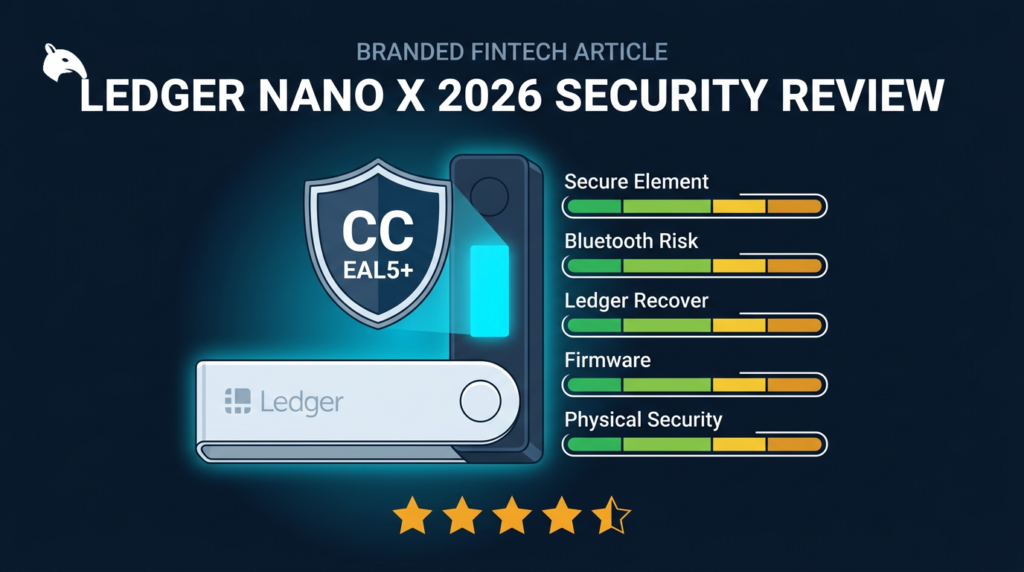
- Private keys never leave the Secure Element (CC EAL5+)
- Encrypted communication channel
- Physical confirmation required for every transaction
From a cryptographic standpoint Bluetooth does not expose your seed phrase. However wireless connectivity widens the operational attack surface.
Operational mistakes — not cryptography — are where most hardware wallet compromises happen.
Best practices:
- Disable Bluetooth when not in use
- Use USB at home
- Avoid pairing devices in public environments
For broader mobile wallet risks see:
👉 Mobile Wallet Security Risks (2026)
4. Global-e Data Breach: Privacy vs Wallet Security
In January 2026 Global-e — Ledger’s merchant-of-record partner — confirmed unauthorized access to customer order records.
Ledger published an official security notice explaining the incident.
Data exposed included
- Full names
- Email addresses
- Shipping addresses
- Order details
Data NOT exposed
- Private keys
- Recovery phrases
- PIN codes
This was a commerce database breach — not a cryptographic compromise.
However it increases phishing risk. Attackers now know who owns hardware wallets.
To avoid supply chain attacks, always purchase hardware wallets directly from the manufacturer.
👉 Buy Ledger Nano X from Official Store
Ledger Nano X vs Alternatives (2026)
Two common alternatives are:
- Trezor Safe 7 – touchscreen, open-source design
- SafePal S1 – air-gapped QR transaction signing
Read the full breakdowns:
Final Verdict: Is Ledger Nano X Safe in 2026?
From a technical standpoint — yes. Private keys remain isolated inside the Secure Element and the device has not suffered a cryptographic compromise.
However Ledger Recover introduces a trust-based recovery model that some users prefer to avoid.
For users prioritizing convenience and multi-chain support, the Nano X remains a solid hardware wallet.
For users prioritizing maximum sovereignty and transparency, alternatives like Trezor may better match their threat model.
If you’re completely new to hardware wallets start here:
👉 Crypto Starter Guide 2026